The staff of the St. Thomas Libraries has again compiled their annual list of summer reads. From suspense to young adult to biographies you are sure to find something on this year’s list for your summer enjoyment. We also have an archive of over ten years worth of lists if you’d like to revisit past recommendations.
Indigenous American Music Selections
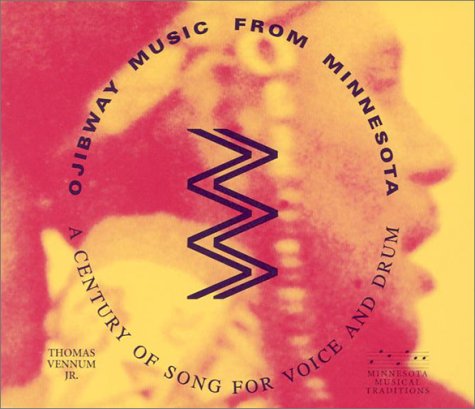
Experience Ojibway Music from Minnesota, a recording featuring tracks dating back to 1899. Ethnomusicologist Thomas Vennum, Jr presents a rich variety of voice and drum music that shows the diversity of traditional Ojibway music.
Ojibway Music from Minnesota. call# M 1669 .O45 1997 CD

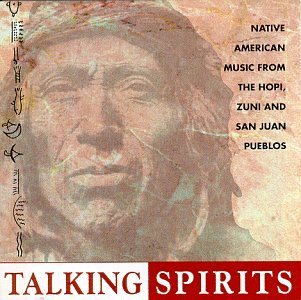
Talking Spirits brings us the social dance music from the Hopi, Zuni, Laguna, and San Joan Pueblo tribes. These 14 tracks capture the spirit of the Southwest, featuring The Garcia Brothers, Chester Mahooty, and Roger Mase.
Talking to Spirits. call# M 1669 .T34 1992 CD

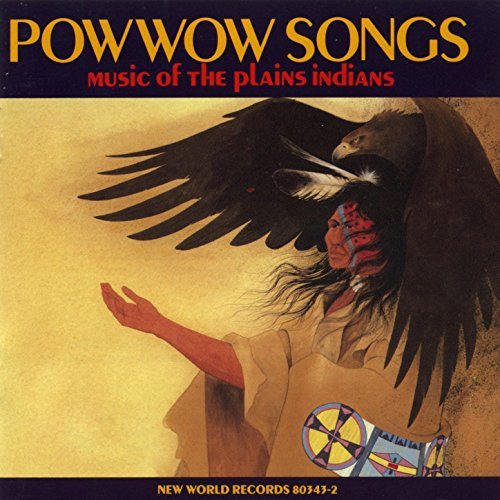
If you’re looking for more music from the plains check out Pow Wow: Music of the Plains Indians. This excellent recording offers ceremonial and social drum music from Oklahoma tribes Pawnee, Ponca, Quapaw, and Kiowa.
Pow Wow: Music of the Plains Indians. call# M 1669 .P69 1986

The Music and Media Collections on the first floor of the O’Shaughnessy-Frey Library houses hundreds of music CDs in addition to our extensive DVD collection. Everyone is welcome to stop by and check out some fantastic titles!
By Sarah Pavey

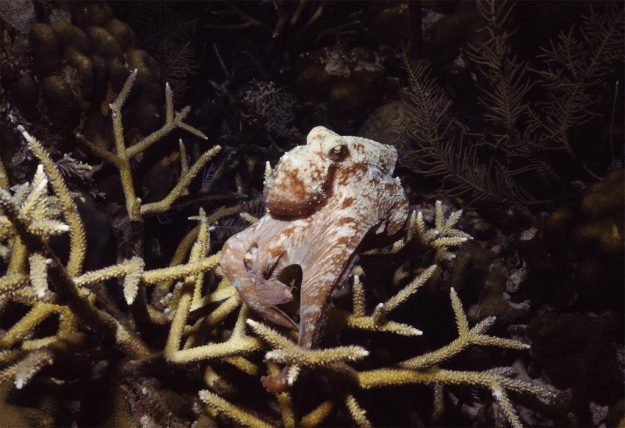
If you’re looking for an underwater adventure The National Film Board of Canada is a great place to start. Bernard Devlin’s 1965 short documentary Octopus Hunt follows a zoological expedition to capture an octopus specimen for the Vancouver aquarium. Or, dive into a feature-length documentary like St. Lawrence: Stairway to the Sea and watch famed French oceanographer Jacques Cousteau explore the Great Lakes.
https://www.nfb.ca/film/octopus_hunt/
https://www.nfb.ca/film/st_lawrence_stairway_to_the_sea/
Additionally, our DVD collection boasts some stunningly filmed documentaries about life under the sea. BBC Earth’s Great Barrier Reef doesn’t just capture the beauty of this natural environment but examines how it functions and the delicate balance that keeps this incredible ecosystem alive. For a wider look at the ocean, Visions of the Sea features Al Giddings’ remarkable underwater photography and an innovative soundtrack as you learn more about the world beneath us.
Great Barrier Reef: QE566 .G7 G7 2013 DVD
Visions of the Sea: QH91 .V57 2009 DVD
By Sarah Pavey
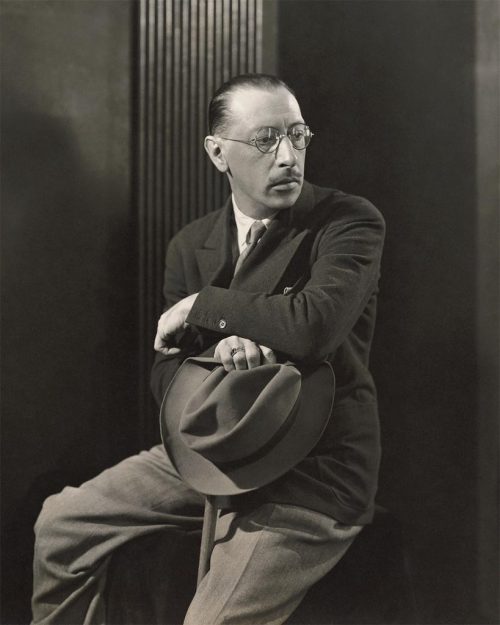
Le Sacre Du Printemps (The Rite of Spring) by Igor Stravinsky

Celebrate the warm weather with Igor Stravinsky’s exciting and innovative 1913 ballet The Rite of Spring! During springtime rituals, a maiden is chosen to dance as a sacrifice to the new season. Although a short ballet, only 40 minutes, this work of theater is packed with energy and spirit. The performance challenged the forms of classical ballet to such an extent riots broke out in the theater the evening it premiered. Our copy features exquisitely replicated costumes and set designs from Nicholas Roerich’s original designs and performed by the Mariinsky Orchestra and Ballet.
Call # M1520 .S9 Z5 2009 DVD
We encourage you to visit the Music and Media collections this summer and explore our vast music selection. In additional to our classical and operatic CDs and DVDs, we also have titles about music history, bluegrass, rock, jazz, and many more!
By Sarah Pavey
Do you have books, media, or other materials you’ve borrowed through St. Thomas Libraries and still need to return before leaving for the summer? Maybe you need to renew an item, check to see when they are due, or forgot what exactly you currently have checked out!
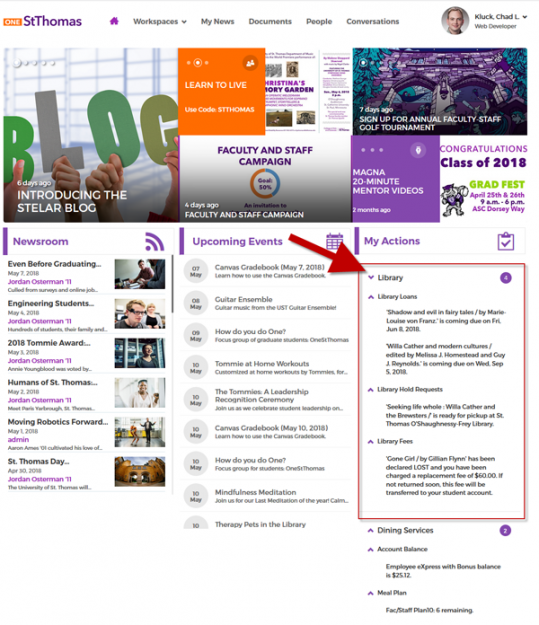
You may have noticed a new section in One St. Thomas under “My Actions” for the library. These Library actions allow you to quickly check your St. Thomas library account for your loans, materials ready for pick-up, or fees. If you don’t see anything listed for Library that’s fine, you just don’t have any actionable items.
If you are not renewing, please return all library materials including materials borrowed from other CLIC Libraries to your St. Thomas library before you leave campus for the summer to avoid your account from being billed. Please note, if you visited another CLIC library to check out a book you will need to log into your library account directly to see the item. If you are not sure, contact Emmanuel Takgbajouah at eotakgbajoua@stthomas.edu or 651-962-5403.
If you have any fees due please stop in at the Circulation Desk at your main St. Thomas library and work to resolve the issue.

Quickly check your library account in One St. Thomas
Many have said that just being in a library, surrounded by the walls of books within, invigorates the academic spirit and makes one feel smarter. It is also said that power naps have the potential to unleash creative thoughts. Therefore, it is no wonder why a student would want to put his or her face in a book and allow knowledge to seep in while journeying though such an imaginative state of sleep.
Studying can be exhausting but quick naps can be invigorating to the mind and spirit as well as breeding grounds for thought, ideas and, “Aha!” moments. Even Thomas Edison, who detested sleep calling it a waste of time, would take power naps in his lab, library, or even outside.
So what is the history of napping in libraries? I dunno, there is probably a study on that somewhere, maybe. If I were to venture a guess and make up a theory, I’d say it most likely goes back millennia. If I were to put some minimal effort into this essay by doing a Google search on “napping in libraries” it will reveal it is perhaps a widespread craze. With a little more effort by digging into our university photo archives online I at least know library napping is nothing new and is probably a bigger tradition than kissing under the Arches.
I’m sorry to disappoint if you thought this was going to be an intellectual and informative post citing research studies, psychology, and Greek literature, but at least I brought along some visuals—and they’re in authentic black and white which gives them a sense of credibility.
From 1955 we see a student napping in the old library located in what is now the basement of Aquinas Hall.
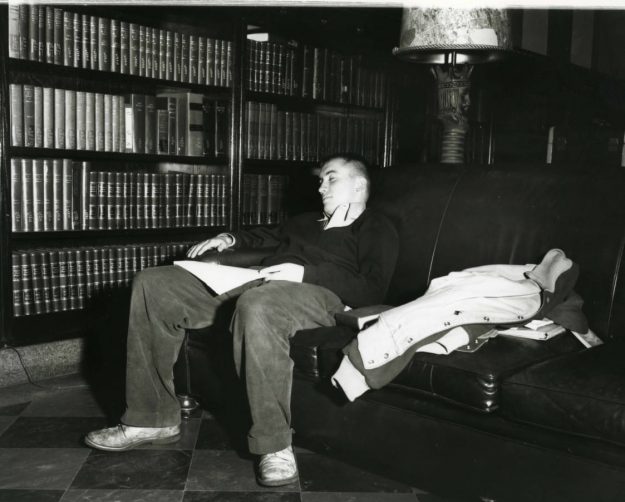
Note the open book. It was probably not an intended nap, but with the leather couch, warm clothes, lamp, and stack of books beside him, the library was just the perfect, cozy spot to catch a few Z’s.
Today, students set timers on their cell phones to make sure they don’t oversleep for exams. Back in the day, as evidenced in this photograph from 1962, students had to bring their own alarm clocks to the library and, since we don’t loan out pillows to patrons, his own pillow as well.
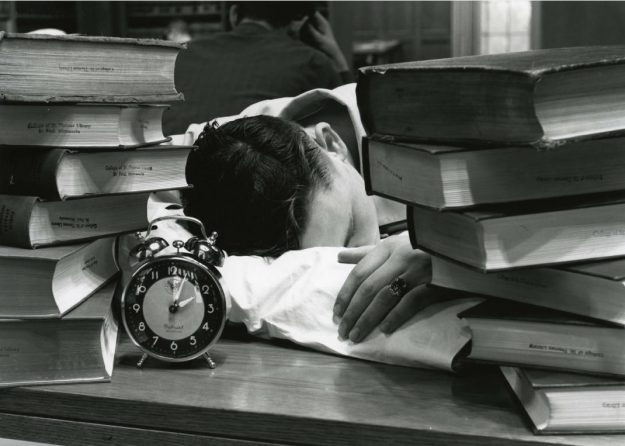
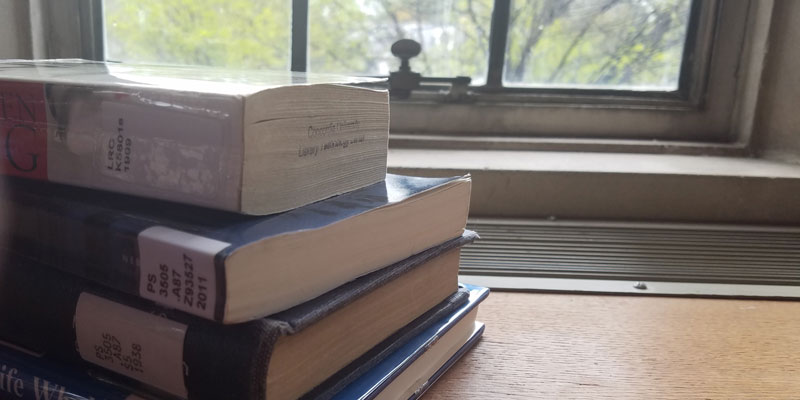
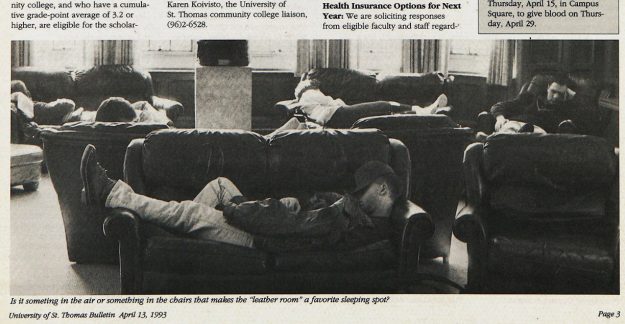
Word of caution: we do not recommend stacking books this high so close in proximity to your head. It appears the stack on the right could cause injury if it were to topple. Note that this is in the O’Shaughnessy Room (aka Leather Room) of the O’Shaughnessy-Frey Library, an ever-popular place to rest as evidenced in the archival photo from a 1993 St. Thomas Bulletin newspaper.
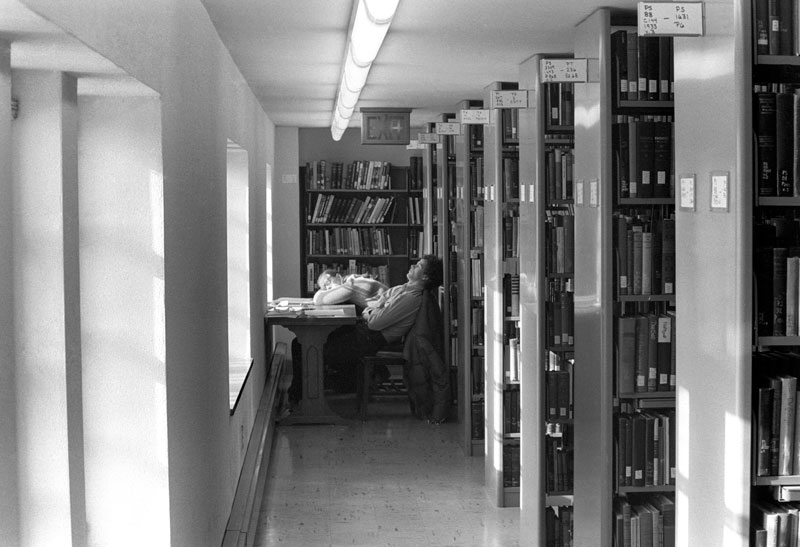
You don’t always have to nap alone in darkness, you can do it as a pair or in teams by a window.
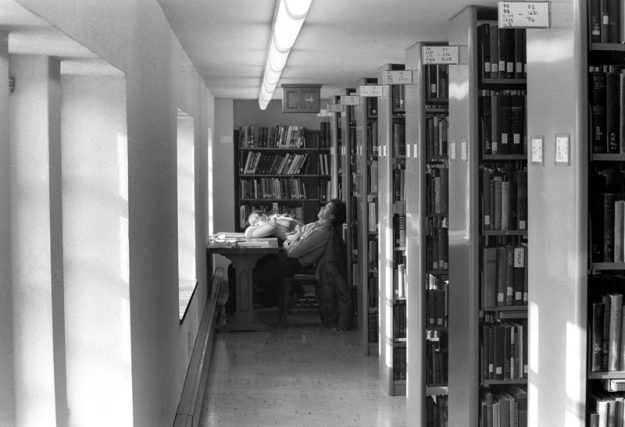
While it is always good practice to give your body enough hours of sleep each night, a quick power nap in the library can be just what you need to get through finals. Just don’t oversleep for your exam.
What is your #whythelib reason? Let us know by posting #whythelib to Instagram, Twitter, or Facebook.
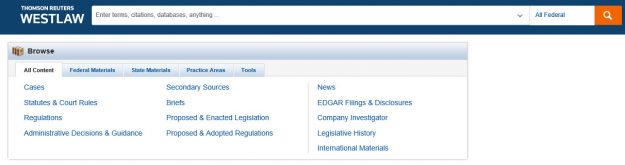
UST libraries will cancel Nexis Uni, and replace it with Westlaw Campus Research

The University of St. Thomas Libraries subscribe to databases and electronic materials based on curricular needs and faculty requests. We are continually watching for products that address these needs with relevant, easy-to-access content. One long-standing need is legal information for students who are not in law school. For example, students studying business or social work may require primary and secondary legal information on a variety of topics in their disciplines. Lexis Nexis, now known as Nexis Uni, has long been our database for that type of legal information, as well as providing national and international news sources and public company information. However, this database has never been easy to search or navigate, so we have been looking for another database that can provide the same information. We have finally found one, Westlaw Campus Research.
Westlaw is a reputable database, and a staple in law libraries across the country. The Westlaw Campus Research is designed for academic research across the disciplines. Along with legal materials, it also contains thousands of full-text news sources, and information about public companies. The decision to cancel Nexis Uni and replace it with Westlaw was made after careful consideration and a trial of the database during which librarians gathered feedback from students and faculty. The response to Westlaw was positive, especially around the interface and ease of searching. We understand that this is a big change and are committed to working with you to make that transition as easy as possible. Our subscription to Nexis Uni will end on July 1, 2018. Access to Westlaw Campus Research is expected to begin by June 2018, so you will have some time when both are available. And for current local and international news sources updated daily, the UST libraries subscribe to Access World News and ProQuest Global Newsstream. Both databases provide access to thousands of news sources that can be searched by topic, Access World News can also be searched by region. If there is anything that your subject librarian can do in order to assist you in using these databases, or to understand the materials in Westlaw, please let us know.
May 1 noonartsound: Vietnam
Please plan to attend the May 1 noonartsound in the O’Shaughnessy-Frey Library, Tuesday, May 1, 2018 at noon. All are welcome and, of course, refreshments will be provided.
Andy Scheiber and Bernie Brady are this month’s featured noonartsound presenters, sharing their perspectives on the music and art of the Vienam era, featuring street art, protest music, and photojournalism.
Dr. Scheiber will sing a few Vietnam-related songs — mostly “protest” songs from people like Pete Seeger, Country Joe McDonald, and Tom Paxton. He may add some reminiscences of his own. (He was subject to the military draft, and was within weeks of being called when they suspended military conscription in the early 1970’s.)
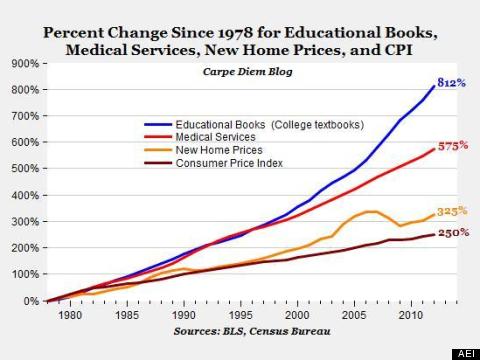
Textbook prices have been increasing at a greater rate than the Consumer Price Index for the last three decades, but the rate of increase has itself taken a dramatic upturn in the new century as shown in this graph based on Bureau of Labor Statistics and U.S. Census data:

This dramatic increase is leading to students deciding not to purchase course materials, which negatively impacts student learning. According to the U.S. Public Interest Research Group (PIRG) study, Fixing the Broken Textbook Market:
- The average student spends $1,200 on textbooks per year.
- 65% of students said that they had decided against buying a textbook/coursepack because it was too expensive.
- 82% of students felt they would do significantly better in a course if the textbook/coursepack was available free online and buying a hard copy was optional.
The future doesn’t have to be bleak. There are a couple of options to reduce or even potentially eliminate course costs for students for a course:
- Open Educational Resources (OER) – There are a wide variety of freely available textbooks and other open courseware that can be customized, repurposed, or used as-is for a course. The library suggests places to find these on the Textbook Alternatives Research Guide.
- Resource Lists Canvas Add-on – Since January, the University Libraries and STELAR have worked together to offer a Canvas add-on that allows instructors to create, manage, and deliver lists of course materials in Canvas. This system can be utilized to make course materials more affordable because the Resource Lists system filters the readings through existing library holdings which have already be licensed or purchased by the library. Learn more about Resource Lists, see the how-to documentation, or contact Greg Argo at gargo@stthomas.edu if you’re interested in using it for an upcoming course.
“Birth of a Family” in National Film Board of Canada

The current National Film Board of Canada subjects featured include World War II, hockey, vignettes, cultural diversity, land claims and rights, and endangered species. These are just some examples of the many forms of media and subject matter found on the NFB website, with topics relevant globally.
Three sisters and a brother, adopted as infants into separate families across North America, meet together for the first time in this deeply moving documentary by director Tasha Hubbard.
Removed from their young mother’s care as part of Canada’s infamous “Sixties Scoop”, Betty Ann, Esther, Rosalie and Ben were four of the 20,000 Indigenous children taken from their families between 1955 and 1985, to be either adopted into white families or to live in foster care. As the four siblings piece together their shared history, their connection deepens, bringing laughter with it, and their family begins to take shape.
Why I Loved It: This feel-good film pulls at your heartstrings in all the right ways. A group of siblings who had been separated for over 50 years had the opportunity to reconnect and begin to build their family. One moment that was particularly touching was when all four siblings gathered around a portrait of their mother who passed away, but in the words of Betty Ann, “she’s here with us, and she’s just so happy,” or their laughter as they tried to fit everyone into a selfie. This film draws you into the siblings’ lives and reunion, making me reflect on my family relationships with increased gratitude.
By Sophia Wolf