Database Highlights & Trials – St. Thomas Libraries Blog - Page 17
Browsing Category

Database Highlights & Trials

Database Highlights & Trials

Core Curriculum – Faith and the Catholic Tradition

You are required to take 3 classes in faith and the Catholic tradition. We got loads of dictionaries and encyclopedias on every religious faith.  Using these dictionaries and encyclopedias is a good way to get a basic understanding of concepts that might not be familiar to you.

  • World Religions Online
    World Religions Online is an easy to use, inclusive guide to the world’s major religions and spiritual traditions. Includes core essays and information on the beliefs, practices, and history of major religions, topic centers, and videos.
  • Encyclopedia of Religion
    Recently updated version of the classic resource for in-depth background on all topics in religion and religions, strong in East, West, and World religions. Authoritative articles by outstanding scholars.
  • New Catholic Encyclopedia
    Partially revised second edition of one of the best of all encyclopedias
  • Routledge Religion Online
    Religion subject collection of thirty background reference books published by Routledge Taylor & Francis Group. A wide range of topics is represented, including world religions, ethics, early Christianity, the papacy, the Reformation, etc.
  • Oxford Biblical Studies Online
    Oxford Biblical Studies Online provides a comprehensive resource for the study of the Bible and biblical history. It contains six essential OUP Bible texts, including the latest edition of the New Oxford Annotated Bible, as well as deuterocanonical collections, Concordances, and the Oxford Bible Commentary. Search across multiple versions of the Bible, and compare different texts and commentaries in an innovative side-by-side view
  • Encyclopedia Judaica
    Updated edition of a classic, the best source for background information on Judaism and Jewish topics
  • Oxford Islamic Studies Online
    Oxford Islamic Studies Online offers a multi-layered reference experience designed to provide a first stop for anyone needing information on Islam. Limited to 3 simultaneous users.

If you don’t find it here, be sure to check out all the theology databases we have.  Or see if there’s a course guide for your class.



Database Highlights & Trials

Core Curriculum – Historical Studies

Everyone who graduates from UST is required to take a history class.  At least one.  And it’s a very good thing because, as the saying goes,  those who don’t know history are destined to repeat it. There are many history classes that fulfill the history requirement and in that same vein, the library has many history resources.  I’ll try to restrain myself, but it’s a field of study that interests me.

History dictionaries and encyclopedias are a great way to get a sense of the who, what, why, where.

  • Blackwell Reference Online – History  an online library of background works. The collection is especially rich on topics related to the history of the United States and the United Kingdom.
  • Oxford Reference Online – History  an online collection of background resources on a wide variety of historical topics.  Some entries are brief, others are extensive.
  • African American Studies Center contains articles on all aspects of the African-American experience along with images, primary sources, time lines, maps, tables, and reference resources.

If you prefer watching history,  these video packages cover world and American history, primary sources (news reels, news clips, etc.) and secondary sources (documentaries).  You can find Ken Burns’ Civil War here, or WWII newsreels or the Complete History of US Wars.

We have many specialized resources, encyclopedias only of China or Africa or an entire encyclopedia devoted to American immigration.   A great way to find dictionary or encyclopedia articles on a history topic is to do a Summon search and limit it to CONTENT TYPE/REFERENCE.  This searches the contents of the online dictionaries and encyclopedias we have.  You can be as broad or as general as you would be in a Google search.   Remember to click MORE under CONTENT TYPE to get to REFERENCE.  To see a list of recommended resources, check out the History databases.  Or find a guide created just for your class under Research Guides.


Database Highlights & Trials

Core Curriculum – Natural Science and Mathematical and Quantitative Reasoning

Let’s say you barely made it through high school biology and now you’re faced with college biology.  Well, have no fear!  We got sources that’ll explain science things for non-science majors.

These sources cover ALL sciences and will most likely be useful for any of he natural science or mathematical or quantitative reasoning classes you may have:

But for specific classes I offer…

BIOL 101 General Biology

BIOL 102 Conservation Biology (also good for GEOL 1xx classes)

BIOL 106 Women, Medicine & Biology

CHEM 100, 101, 111, 112, 115

  • Lange’s Handbook of Chemistry Lange’s Handbook of Chemistry includes data for each compound including name, structural formula, formula weight, density, refractive index, melting point, boiling point, flash point, dielectric constant, dipole moment, solubility in water and relevant organic solvents, thermal conductivity and electrical conductivity.
  • SciFinder SciFinder provides easy access to information in Chemical Abstracts Services resources: journal citations and abstracts, substance data, chemical reactions, regulatory data, chemical suppliers, and biomedical literature. Sign up for an individual account.

Now I realize there are probably many, many other classes that fulfill the natural science, math and quantitative reasoning requirement. I’ve missed more than a couple of them I am sure. If you are in a class that meets the core requirement and don’t see anything here that would help you, see if you can find related resources on our SCIENCE pages.  If those don’t work, check out the research guides in the various disciplines.


Database Highlights & Trials

Core Curriculum – Moral and Philosophical Reasoning

The next core curriculum on the list is moral and philosophical reasoning.  You do not need to be a  Socrates or Nietzsche  to fulfill this requirement.  You only need to be taking PHIL 115 Philosophy of the Human Person and check out some of the resources below.  The course is described as:

An examination of fundamental conceptions of the human person in ancient, medieval and modern philosophy. Possible topics include: the existence and immortality of the human soul, free will and determinism, the immateriality of the intellect, the relationship between mind and body, and the relevance of different conceptions of the human person for ethics and religion. Attention is given to relevant issues of human diversity. The development of logical and critical thinking receives special attention.

The Gale Virtual Reference Library has a really good, basic Encyclopedia of Philosophy that gives just enough information without making your head swim.  As always, if you’re looking for more info, go to a complete list of philosophy resources. Or check out a research guide.

Database Highlights & Trials, Uncategorized

Core Curriculum – Literature & Writing

Everyone here who gets a bachelor’s degree has to first get through the core curriculum.  Think of it as spinach.  Remember how as a child you hated spinach but your mom said you had to eat it cuz it’s good for you?  And now as an adult you willingly eat spinach.  Well, when you’re sitting through that class that you had to take cuz it fulfills your core curriculum requirement, just remember that it’s good for you.  And that down the road you’ll appreciate it.  UST is just like your mom.  It wants what’s best for you – and in this case, it’s taking a few courses that will make you a well-rounded, educated individual.  Trust me, it’s good for you.

That said, I’m going to offer up a few blog posts devoted to helping you through those core classes.  I know not everyone forced to take biology is interested in it (trust me, I remember linguistics.  No. Interest. Whatsoever).   So for the next few posts I’ll give some short-cuts to resources in each of the core curriculum requirement starting with Literature & Writing.

For most of your literature needs, you can use Literature Resource Center.  It offers

  • overviews of works (in case you’re not sure what you just read or prefer spoilers before you start)
  • topic overviews (which are themes across several works – i.e. racism in literature, motherhood in 19th century literature)
  • literary criticism (which are articles written by other people about a work that will lend ideas or weight to your paper)
  • author biographies

Blackwell Literature is a collection of hundreds of encyclopedias, both broad and specific, about all things literature: fiction, poetry, literary criticism, theater, theory,short stories, novels, it goes on and on.  This is for background info – gives you idea of what to expect on a topic.

If it’s just articles you want – and you didn’t find them in Literature Resource Center, use MLA.

We have many, many more resources used for all English and writing classes.  Or check out the research guides.

Business & Economics, Database Highlights & Trials

Renaming Frenzy

Hello Business Researchers!

Welcome to Fall Semester 2012! As we all gear up for a great semester, are you looking for a database you’ve used before, but can’t find it?

Have no fear; you’re not going crazy! Our vendors just had a bit of a renaming frenzy this summer. Here are the changes:

You can find these, along with all of our wonderful business databases, in both our A-Z List of Databases and our list of Databases by Subject.

————————————————————-

Recognize these faces?  We UST Business Librarians have been busy all summer making sure we’re all set to provide you the best service we can this fall.

We hope to use this blog to help share news and information that will be of interest to you.

Do you have any questions you’d like answered? An idea for a blog post?  Anything fun to say about how awesome the UST librarians are?  For any of those – and more! – please feel free to contact any business librarian or consult the faculty resource guide on the UST Libraries website.


Database Highlights & Trials

Welcome students

Whether you are a new or returning student I want to give a hearty welcome – we’re glad you’re here (makes things livelier. The summers get a little too quiet for my taste).  In this little corner of the blog you will hopefully find helpful information about the libraries’ electronic resources.  You’ll also find out about outages, technical difficulties and system downtime.

I’m gonna start this year out by highlighting Summon, which is a Google-like search of many library resources – not just ereources, but print as well.  Summon finds stuff we own –

  • books
  • ebooks
  • journals and newspapers
  • journal and newspaper articles
  • encyclopedias and dictionaries
  • country economic forecasts
  • movies and music
  • industry reports

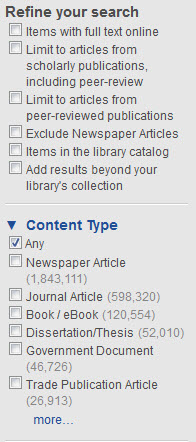
The best way to use Summon is to do a search and then limit the results.  You can limit to –

  • full-text only
  • peer-reviewed or scholarly articles
  • reference (which means content in encyclopedias and dictionaries)
  • books/ebooks (combine books/ebooks with full-text only to get only ebooks)
  • reports (that’s where you find industry, company and economic reports)
  • videos
  • audio recording
  • dissertation

-and many, many other limits.

Give it a spin. And remember, if you don’t find what you’re looking for, ASK US!  We’re here to help.

Database Highlights & Trials

SERVICE INTERRUPTION – Full Text PDFs from ERIC Currently Unavailable

We have received notice from the ERIC (Educational Resources Information Center) database producer that full text through ERIC is unavailable until further notice. Users will get a page saying the PDF files are currently unavailable. The producer has indicated that they will keep us informed as they work through the problems. In the meantime, feel free to contact us to find alternatives that will meet your research needs.

Database Highlights & Trials

Money money money moneeeeeeeey

We have heard a lot this past year about money and the Eurocrisis and Greece and Germany and, and, and.. .  But do many of us really understand what’s going on there?  What it’s all about?   Luckily, we can read the concise and clearly-written Greek Crisis in Perspective: Origins, effects and ways-out  fresh from the New Palgrave’s Dictionary of Economics.  Not surprisingly, this thing has been brewing since 1980, when Greece joined the European Union.  Take a look at the charts and graphs in this article.  Number 7 is particularly confusing.  Hopefully someone over in Greece will read the section on “ways out” and climb out of this situation.

On a more exciting note, the most popular article in New Palgrave’s is the Economic Impact of the Olympic Games.  I often wonder why countries compete to host the games – what with all the logistical and security headaches and the enormous costs.  You know what else I wonder about?  What was Old Palgrave’s like?