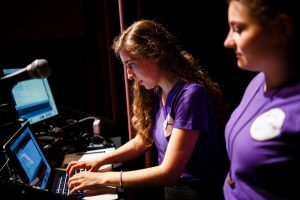
This February, the STELAR Technology Showcases featured Winter Olympics viewing sessions in virtual reality (VR), and we were excited by the number of faculty who made time to visit STELAR and try it out. Since we are also in the midst of our Blackboard to Canvas conversion, this has led to a mental game…if the migration to Canvas was an Olympic sport, which one would it be? For some faculty, we thought Curling. It’s strategic, deliberate, planful and detail-oriented, with slow and steady work that leads to the desired outcome. For other faculty, Figure Skating – these faculty are creating beautiful Canvas courses that have a central theme with a beginning, middle, and end, and are entirely charming. Then we have the ski jumpers… those who see the move to Canvas as a great leap into the unknown (and we have a few skiers still in the air as of April). One thing we know for sure: the closer we get to summer, the closer we all get to bobsled, as we approach the hard deadline for shutting down Blackboard this June.
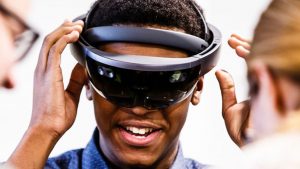
Dan Hoisington, Eric Tornoe, and the whole STELAR team did a great job of putting the VR viewing sessions together, and they turned out to be useful and instructive for two reasons. First, we had some great conversations about practical applications for VR technology this year, not in some far-off future. The question we want to ask about VR this semester is, “What does it mean to be somewhere?” Or put another way, “What is presence?” In the STELAR online teaching certificate program, students learn about the three elements of presence in the Community of Inquiry Model of teaching: Teaching Presence, Cognitive Presence, and Social Presence, with the central point being that high-quality online courses are designed to address each of these elements. Virtual Reality gives us an entirely new tool – and possibly an entirely new set of expectations – for what ‘presence’ can mean in the context of teaching and learning.
Ideas we discussed with faculty members included:
- Education students using VR to experience their own students’ living conditions as a way to increase empathy;
- Geology students using VR to travel up and down rock strata;
- Business students using VR to practice employee coaching and initiating difficult conversations at work; and
- Psychology students using VR to explore new ways to conduct exposure therapy.
Second, the VR experience was instructive thanks to NBC, which of course was responsible for creating all these VR experiences that we shared. One thing that struck us was that NBC had an opportunity to bring essentially unlimited resources and decades of professional video expertise to bear, in order to create unrivaled, amazing VR experiences. But instead they kind of botched it. In STELAR we are guessing that those decades of professional experience were as much a hindrance as a help because of the way they shot the VR. (And it’s not just us. See, for example, MIT’s review of Winter Olympics programming.)
In broadcast video you have establishing shots, medium shots, close-ups, and cutaways. And in many instances this is how NBC shot the VR experiences, presumably using their years of video production as a guide. However, the best VR, we think, is about having an immersive experience and so changing shots and adding cutaways becomes disorienting to the viewer, as they try to re-discover their location in virtual space. In short, it ruins the illusion of presence. It seems to us that NBC did not take a step back to think about what is best about VR and how they could leverage that to create truly unique and effective experiences.
This is a great example of how a new technology can require us leave behind our experiences and expectations. It also demonstrates in a real way something we say a lot down here in STELAR – that the smart use of technology isn’t about learning the tech itself, but rather about understanding what you’re trying to accomplish and then using the technology the way it is best suited to reach those ends. We saw it here on NBC’s virtual reality, and it’s equally true for teaching online or in an active learning classroom.
Learning to use Canvas is one thing – you can learn all the right clicks to upload a PowerPoint slide deck or a video of yourself lecturing, but without stepping back to ask yourself what kind of experience you want your students to have, you might inadvertently wind up with some NBC VR. This can lead to the disappointing online course experiences that many of us have had over the years, when instructors merely update the technology without updating old ways of working and thinking.
We have an opportunity here at St. Thomas to become a leader in the effective use of VR in our courses, and STELAR is ready to partner with you to accomplish that goal. As we move through the VR learning curve together, we’ll discover what works and what doesn’t, and we’ll find new ways to bring this increased sense of presence to your classes and your students. Experimenting with this technology is an important step towards St. Thomas becoming the digitally-enabled university that students have increasingly come to expect. It will help us to continue to deliver high-quality educational experiences that help define our future.
This post was written by Brett Coup, the AVP for Academic Technology for the St. Thomas E-Learning and Research (STELAR) Center at the University of St. Thomas in St. Paul, Minn. To learn more about this topic, please visit our website at www.stthomas.edu/stelar or email us at stelar@stthomas.edu.