St. Thomas Libraries Blog - News, Events and Musings from the UST Libraries - Page 64
Database Highlights & Trials

Core Curriculum – Faith and the Catholic Tradition

You are required to take 3 classes in faith and the Catholic tradition. We got loads of dictionaries and encyclopedias on every religious faith.  Using these dictionaries and encyclopedias is a good way to get a basic understanding of concepts that might not be familiar to you.

  • World Religions Online
    World Religions Online is an easy to use, inclusive guide to the world’s major religions and spiritual traditions. Includes core essays and information on the beliefs, practices, and history of major religions, topic centers, and videos.
  • Encyclopedia of Religion
    Recently updated version of the classic resource for in-depth background on all topics in religion and religions, strong in East, West, and World religions. Authoritative articles by outstanding scholars.
  • New Catholic Encyclopedia
    Partially revised second edition of one of the best of all encyclopedias
  • Routledge Religion Online
    Religion subject collection of thirty background reference books published by Routledge Taylor & Francis Group. A wide range of topics is represented, including world religions, ethics, early Christianity, the papacy, the Reformation, etc.
  • Oxford Biblical Studies Online
    Oxford Biblical Studies Online provides a comprehensive resource for the study of the Bible and biblical history. It contains six essential OUP Bible texts, including the latest edition of the New Oxford Annotated Bible, as well as deuterocanonical collections, Concordances, and the Oxford Bible Commentary. Search across multiple versions of the Bible, and compare different texts and commentaries in an innovative side-by-side view
  • Encyclopedia Judaica
    Updated edition of a classic, the best source for background information on Judaism and Jewish topics
  • Oxford Islamic Studies Online
    Oxford Islamic Studies Online offers a multi-layered reference experience designed to provide a first stop for anyone needing information on Islam. Limited to 3 simultaneous users.

If you don’t find it here, be sure to check out all the theology databases we have.  Or see if there’s a course guide for your class.


Libraries, News & Events, O'Shaughnessy-Frey Library

O’Shaughnessy-Frey Library Celebrates Voter Registration Day September 25 and Encourages Voter Engagement

The O’Shaughnessy-Frey Library has resources to help you make informed choices in the voting booth this fall.  The library will provide the opportunity to register to vote, and information you can use to research the candidates and amendments that will be on your ballot.  And for a limited time, Coffee Bené will be offering patriotic drinks and muffins in the library.  

We invite you to check the schedule below and take advantage these opportunities.  We look forward to seeing you! 

Tuesday, 9/25
National Voter Registration Day,
10:00 AM – 2:00 PM & 6:00 – 8:00 PM
@ the O’Shaughnessy-Frey Library

Saturday, 10/13
Homecoming Pre-game table, 10:30 AM – 1:30 PM
@ John P. Monahan Plaza

Tuesday, 10/16
Mobile Library, 11:00 AM – 1:00 PM
@ Anderson Student Center

Database Highlights & Trials

Core Curriculum – Historical Studies

Everyone who graduates from UST is required to take a history class.  At least one.  And it’s a very good thing because, as the saying goes,  those who don’t know history are destined to repeat it. There are many history classes that fulfill the history requirement and in that same vein, the library has many history resources.  I’ll try to restrain myself, but it’s a field of study that interests me.

History dictionaries and encyclopedias are a great way to get a sense of the who, what, why, where.

  • Blackwell Reference Online – History  an online library of background works. The collection is especially rich on topics related to the history of the United States and the United Kingdom.
  • Oxford Reference Online – History  an online collection of background resources on a wide variety of historical topics.  Some entries are brief, others are extensive.
  • African American Studies Center contains articles on all aspects of the African-American experience along with images, primary sources, time lines, maps, tables, and reference resources.

If you prefer watching history,  these video packages cover world and American history, primary sources (news reels, news clips, etc.) and secondary sources (documentaries).  You can find Ken Burns’ Civil War here, or WWII newsreels or the Complete History of US Wars.

We have many specialized resources, encyclopedias only of China or Africa or an entire encyclopedia devoted to American immigration.   A great way to find dictionary or encyclopedia articles on a history topic is to do a Summon search and limit it to CONTENT TYPE/REFERENCE.  This searches the contents of the online dictionaries and encyclopedias we have.  You can be as broad or as general as you would be in a Google search.   Remember to click MORE under CONTENT TYPE to get to REFERENCE.  To see a list of recommended resources, check out the History databases.  Or find a guide created just for your class under Research Guides.


News & Events

Take a Virtual History Tour of the UST Campus

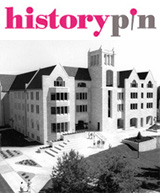
History PinThe construction of the new Anderson Student Center & the Anderson Athletic and Recreation Complex transformed the look of the St. Thomas campus in Saint Paul.  But have you ever wondered what the campus looked like in the past?  Well – wonder no more!  Take a virtual historic walking tour of the Saint Paul campus created by the University of St. Thomas Archives.  Some the buildings and locations you may recognize, while others have faded into memory.  Visit Lake Mennith, stop over at “Tom Town” and make your way down to the Grotto near the Saint Paul Seminary.   You will not look at campus the same way again!

Database Highlights & Trials

Core Curriculum – Natural Science and Mathematical and Quantitative Reasoning

Let’s say you barely made it through high school biology and now you’re faced with college biology.  Well, have no fear!  We got sources that’ll explain science things for non-science majors.

These sources cover ALL sciences and will most likely be useful for any of he natural science or mathematical or quantitative reasoning classes you may have:

But for specific classes I offer…

BIOL 101 General Biology

BIOL 102 Conservation Biology (also good for GEOL 1xx classes)

BIOL 106 Women, Medicine & Biology

CHEM 100, 101, 111, 112, 115

  • Lange’s Handbook of Chemistry Lange’s Handbook of Chemistry includes data for each compound including name, structural formula, formula weight, density, refractive index, melting point, boiling point, flash point, dielectric constant, dipole moment, solubility in water and relevant organic solvents, thermal conductivity and electrical conductivity.
  • SciFinder SciFinder provides easy access to information in Chemical Abstracts Services resources: journal citations and abstracts, substance data, chemical reactions, regulatory data, chemical suppliers, and biomedical literature. Sign up for an individual account.

Now I realize there are probably many, many other classes that fulfill the natural science, math and quantitative reasoning requirement. I’ve missed more than a couple of them I am sure. If you are in a class that meets the core requirement and don’t see anything here that would help you, see if you can find related resources on our SCIENCE pages.  If those don’t work, check out the research guides in the various disciplines.


News & Events

Celebrate the Birth of Our Government


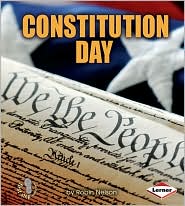
September 17 is Constitution Day! (It’s also known as Citizenship Day.) On this day in 1787, the US Constitution was ratified in Philadelphia, PA. The Constitution is the highest law in the US. It’s the framework for our government, outlining the powers and duties of the legislative, executive and judicial branches. It has been amended 27 times. The first ten amendments are known as the Bill of Rights. But here are some facts you may not know…


Constitutional Fun Facts:
• The original document was handwritten by Jacob Shallus for $30 ($728 today).
• The original is on display at the National Archives and Records Administration in Washington, DC., behind protective glass framed with titanium and filled. To preserve the document, the cases contain argon gas and are kept at 67° F with 40% humidity.
• The US Constitution is the oldest Constitution written in any major government in the world.
• The US Constitution is the shortest Constitution written in any major government in the world – it’s only 4,400 words!
• The US Constitution contains a few spelling errors – one being “Pensylvania” written above the signatures.

Libraries, News & Events, O'Shaughnessy-Frey Library, Uncategorized

Telos Project Noon lecture series begins Sept 13: Hear Dr. John Boyle, Theology Professor

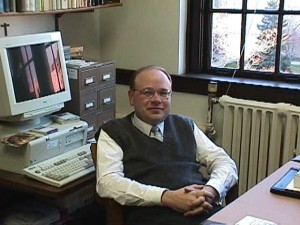
Theology Professor, Dr. John Boyle

This Thursday, September 13, marks the first in a semester-long series of open discussions between St. Thomas faculty and students. This inaugural meeting features Dr. John Boyle of the theology department. Sharing with students the importance of his area of expertise, Dr. Boyle will also give his perspective on why a liberal arts education is important.

The Telos Project is an effort to bring a renewed focus on a crucial aspect of the University of St. Thomas’ commitment to the pursuit of truth: the integration of knowledge across disciplines. It is the purpose of The Telos Project to re-introduce to the St. Thomas community the dialogue and discussion that is essential for any intellectual community.

Meetings are scheduled to take place on Thursdays, from Noon to 1pm, in the O’Shaughnessy-Frey Library. Each week a professor from a different department will give a brief but provocative presentation on (a) what his/her discipline is, (b) what attracts him/her to it, and (c) why the larger UST community should care. The meetings will take place in the O’Shaughnessy Room, (Leather Room/Rm 108) and will follow this format:

•12:00 – 12:15: Introduction by professor to his/her discipline and area of expertise.
•12:15 – 1:00: Discussion and conversation among/between students and faculty.
All students, staff, and faculty are invited to participate in discussion this Thursday, September 13 at Noon.

Database Highlights & Trials

Core Curriculum – Moral and Philosophical Reasoning

The next core curriculum on the list is moral and philosophical reasoning.  You do not need to be a  Socrates or Nietzsche  to fulfill this requirement.  You only need to be taking PHIL 115 Philosophy of the Human Person and check out some of the resources below.  The course is described as:

An examination of fundamental conceptions of the human person in ancient, medieval and modern philosophy. Possible topics include: the existence and immortality of the human soul, free will and determinism, the immateriality of the intellect, the relationship between mind and body, and the relevance of different conceptions of the human person for ethics and religion. Attention is given to relevant issues of human diversity. The development of logical and critical thinking receives special attention.

The Gale Virtual Reference Library has a really good, basic Encyclopedia of Philosophy that gives just enough information without making your head swim.  As always, if you’re looking for more info, go to a complete list of philosophy resources. Or check out a research guide.

Database Highlights & Trials, Uncategorized

Core Curriculum – Literature & Writing

Everyone here who gets a bachelor’s degree has to first get through the core curriculum.  Think of it as spinach.  Remember how as a child you hated spinach but your mom said you had to eat it cuz it’s good for you?  And now as an adult you willingly eat spinach.  Well, when you’re sitting through that class that you had to take cuz it fulfills your core curriculum requirement, just remember that it’s good for you.  And that down the road you’ll appreciate it.  UST is just like your mom.  It wants what’s best for you – and in this case, it’s taking a few courses that will make you a well-rounded, educated individual.  Trust me, it’s good for you.

That said, I’m going to offer up a few blog posts devoted to helping you through those core classes.  I know not everyone forced to take biology is interested in it (trust me, I remember linguistics.  No. Interest. Whatsoever).   So for the next few posts I’ll give some short-cuts to resources in each of the core curriculum requirement starting with Literature & Writing.

For most of your literature needs, you can use Literature Resource Center.  It offers

  • overviews of works (in case you’re not sure what you just read or prefer spoilers before you start)
  • topic overviews (which are themes across several works – i.e. racism in literature, motherhood in 19th century literature)
  • literary criticism (which are articles written by other people about a work that will lend ideas or weight to your paper)
  • author biographies

Blackwell Literature is a collection of hundreds of encyclopedias, both broad and specific, about all things literature: fiction, poetry, literary criticism, theater, theory,short stories, novels, it goes on and on.  This is for background info – gives you idea of what to expect on a topic.

If it’s just articles you want – and you didn’t find them in Literature Resource Center, use MLA.

We have many, many more resources used for all English and writing classes.  Or check out the research guides.

Political Science, Uncategorized

Facts on File World News Digest

I’ll admit it, I’m a geek. I love data and Facts on File World News Digest provides me with mounds of data. By the time you read this, the 2012 London Olympics will be in the history books – or in the World News Digest chronological timeline which gives you such data as the number of visitors – from 380,000 in 1896 (not too shabby) to 6.5 million in Beijing.  I could calculate the increase but you can tell it was a big increase.  It also tells you how many countries participated – from 14 at the Athens olympics in 1896 to 204 in Beijing. The feminist in me wanted to see what percentage of the athletes were women. The change is astounding. In 1896, the first modern olympiad, there were only 241 athletes – none of them were women. In 2008 there were 10,946 athletes and 42% were women.  For the US, title 9 changed everything for women’s sports. I wonder if that has spurred other countries to change their funding mechanisms too so that they can be competitive with the U.S. women.

But this is a scintilla of the information available. There is a searchable encyclopedia and almanc and then in depth articles and information on elections. The curriculum tools will help you choose a subject for a paper and then provide timelines to use to follow your topic. The research topics go from Abortion to Supreme Court nominations. 

There are country profiles, too. And the information goes back to the 1940’s. 

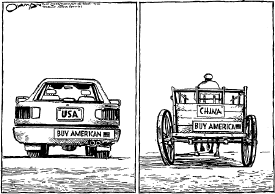
 And includes editorial  cartoons like this one. But not only the cartoon, oh no. It includes discussion questions on the cartoon. Try it out. Worth your time. From Universal