News & Events – St. Thomas Libraries Blog
Browsing Category

News & Events

Business & Economics, Data Services, Database Highlights & Trials, News & Events, Political Science

Trial for add-ons to SimplyAnalytics database through the month of December


Fans of thematic maps, demographic information, and detailed datasets already know that SimplyAnalytics is an essential tool for building reports and supporting many types of research projects. The UST Libraries are currently testing two new add-ons that will make SimplyAnalytics even more powerful and versatile.


Dave Leip’s Election Atlas is one of the most trusted sources for U.S. election data. This add-on allows users to easily combine national, state, and county election results with the many datasets already available in SimplyAnalytics. Whether you’re studying historical voting patterns, or simply trying to understand the political landscape, this new product adds depth and context to your research.


The SimplyAnalytics API provides a new way to access SimplyAnalytics curated datasets directly. With it, you can integrate reliable demographic, spending, health, and behavioral data into your own:
• Applications
• Dashboards
• Data pipelines
• Modeling projects
These tools expand how SimplyAnalytics can be used for teaching, research, and project development. The trials will go on until January 3rd, 2026.


For more information on either of these products, feedback and instructions for setting up an API key, please contact Andrea Koeppe.

Libraries, News & Events, O'Shaughnessy-Frey Library, Special Collections and Archives

Merry Christmas from the University of St. Thomas Libraries

Among the many treasures in the University of St. Thomas Libraries’ Rare Books collection are volumes sure to spark your Christmas spirit. Throughout our shelves you’ll find charming works that reflect the season’s traditions, celebrations, and stories. Featured below are a few examples from the collection that center on the Nativity story:

Frankincense and Myrrh
Susan L. Mitchell and Jack B. Yeats, Cuala Press, Churchtown, Ireland, 1912

Susan Mitchell, a notable Irish nationalist, poet, and essayist of the early 20th century, authored this small pamphlet of poems, Frankincense and Myrrh. As a close friend of the Yeats family in Sligo, she collaborated with Elizabeth Yeats of the Cuala Press and the renowned artist Jack B. Yeats to bring this publication to life.

The Irish Christmas
Published by Candle Press, Dublin, 1917
Woodcut from a drawing by Sadb Trinnseach; poem by Joseph Campbell

One of the earliest publications from Colm Ó Lochlainn’s renowned Three Candles Press, The Irish Christmas is a poignant reflection of Irish identity and independence. The pamphlet features poems in both English and Irish by writers connected to the nationalist cause. Illustrator Saodhbh Trinnseach, known for her dedication to the Irish language and culture, contributed the woodcuts in the piece.


Gloria in Profundis
G. K. Chesterton and Eric Gill, Faber & Gwyer Ltd., London, 1927

Part of the Ariel Poems series, this small yet profound pamphlet, Gloria in Profundis, features a single poem by G. K. Chesterton, one of England’s most celebrated Catholic authors. The accompanying wood engravings of the Nativity scene were designed by Eric Gill.   Gill, who had been deeply influenced by Chesterton’s writings on Distributism, established the Ditchling community—a Catholic artists’ commune dedicated to craftsmanship and simplicity.

Christmas Wayfarers [and Other Poems].
O’Byrne, Cathal. Dublin: At the Sign of the Three Candles, 1932.

Published in 1932, Christmas Wayfarers was authored by the Belfast-based singer, poet and writer Cathal O’Byrne.  Published in Dublin by the Colm O’Lachlan’s Three Candles Press, the volume is illustrated with a series of unattributed woodcuts.

News & Events

Library Workshop: AI-Powered Scholarly Research Using Consensus

On Thursday, November 13th at 12pm, the St. Thomas Libraries will host a one-hour Zoom session (register here) to help attendees learn about an AI-powered research tool called Consensus. The libraries are trialing Consensus for the 2025-26 academic year and want to help interested users learn how it and the class of research tools it represents differ from both traditional library tools and more web-augmented research tools like Perplexity or ChatGPT. Learn how it deploys LLM natural language searching to surface research from a corpus of 200M+ academic papers, and how it can help both students and faculty with quick-and-dirty literature reviews and syntheses of scholarship on a wide variety of topics.

Session led by librarians Scott Kaihoi and Karen Brunner.

Registration available here

News & Events

October 20–26 is Open Access Week

Open Access logo
Image by MikeAMorrison used under a Creative Commons Attribution-Share Alike 4.0 International license.


Open Access Week: October 20–26

Each year, Open Access Week celebrates the potential benefits of transitioning research to Open Access (OA). This year’s theme, Who Owns Our Knowledge? emphasizes the importance of prioritizing publishing models that benefit the scholarly community and the public rather than those that benefit commercial interests.

Here are a couple of quick resources to get you thinking about OA:

  • Thought-Provoking Article: We encourage faculty to read an article from the Chronicle of Higher Education titled “Making Your Research Free May Cost You” (use this link to access the Chronicle through UST’s subscription to it if the direct article link is not working). The article discusses the NIH’s new policy requiring all federally funded research to be made publicly available as soon as it is published, and how in response, many publishers are forcing authors to pay large open-access fees—effectively shifting costs onto researchers. Some journals, especially those owned by major for-profit publishers like Springer Nature and Elsevier, have eliminated free “green” routes (e.g., a one-year embargo before public release) and now only offer open access via high article processing charges. Scholars who have uncertainty in their funding–especially in an era when policies governing federal grants and other research funding are rapidly changing–are concerned that steep publication fees will limit who can afford to publish in top-tier journals.
  • Library Guide on Open Access: The UST Libraries have created a guide that offers information and resources about the library’s ongoing commitment to Open Access and its role in supporting OA initiatives.

Hopefully these resources contribute to an ongoing discussion of OA on our own campus and support UST’s collective efforts to promote accessible, community-driven scholarly publishing.

News & Events

October Research Database Trial (concluded)

China Academic Journal

The University of Saint Thomas Libraries has trial access to CNKI China Academic Journals (All Series) until November 14, 2025. The trial gives students, faculty, and staff an opportunity to explore and provide feedback to help determine whether the libraries should invest in this resource in the future.

China Academic Journals (CAJ, 中国期刊全文数据库) is the largest and most continuously updated Chinese journal database in the world, containing over 60 million full-text articles and growing. Offered via the China National Knowledge Infrastructure (CNKI, 中国知网) platform, CAJ covers 99.9% of all academic journals published in mainland China, with comprehensive access to an impressive range of content in all disciplines, with over 10,000 journals categorized among 10 series, 168 subjects, and over 3,000 sub-subjects. 

We value your input! Please send any comments or questions to Kate Burke.  

Database Highlights & Trials, News & Events

New User Interface for EBSCO Databases

EBSCOhost logo

EBSCO has rolled out a modern, user-friendly new interface design for databases on the EBSCOhost research platform, including Academic Search Ultimate, Business Source Premier, CINAHL, and Education Source!

What’s new?

  • Durable, shareable URLs
  • Enhanced accessibility features, including text-to-speech
  • Improved search and filtering, including a new natural language search option
  • Personalized dashboard for saved searches, articles, and projects
  • Responsive, mobile-friendly layout that works well on various devices

Visit EBSCO’s Quick Start Guide to learn more, or ask a librarian if you have any questions!

News & Events

Spring 2025 Book Cart Name Winner!

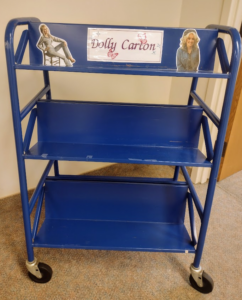
The University of St. Thomas Libraries invited students, staff, faculty, alumni and the public to help us name our little blue library book cart! From March 31st until April 7th,  you submitted your pun-ny ideas. We definitely saw a theme of name suggestions based on famous figures and also a smattering of funky alliterations. The winner is:  

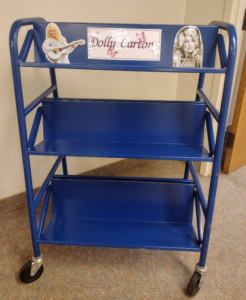
Dolly Carton!  

a small blue book cart with 2 photos of Dolly Parton

Here are the top 5 book cart names that followed our winner: 

  1. Young Shelvin’ (as in Young Sheldon)  
  1. René De Cart (as in René Descartes)  
  1. The Novel Navigator  
  1. The Literary Limo  
  1. Jean-Luc Bookcart (as in Jean-Luc Godard)   

Thank you to all who voted! Follow @ustlibraries on instagram for updates! Please contact Conrad Woxland (conrad.woxland@stthomas.edu) with questions, feedback or comments. 

Database Highlights & Trials, News & Events

Generative AI Tools for Research

Generative AI Tools in Library Databases

The St. Thomas Libraries are trialing several databases in February, including two with AI-driven search interfaces: Scopus AI and Web of Science Research Assistant. The Libraries are excited about the potential for these tools to help researchers save time and uncover hard-to-find content. As we look at the broad range of AI-based tools that advertise similar functionality, we are closely evaluating their capabilities and differences.

What makes these library tools different from freely available tools?

The tools the library is trialing combine natural language AI search with high-quality, subscriber-only content. Both Scopus and Web of Science index over 20,000 journals, offering rich metadata that enhances summaries, relevancy rankings, and connections to related research. Additionally, as tools connected to our subscriptions, full-text access is often just a click away.

Free tools generate results based on either general web searches (Perplexity, ChatGPT Web Search, etc.), the Semantic Scholar corpus of academic documents (Semantic Scholar, Elicit, Consensus), or a mix of web content and publisher metadata they maintain themselves (Scite). These tools often do quite well at surfacing and summarizing relevant scholarship, particularly in fields with a lot of open access content, but results can vary widely depending on the specific subfield being researched.  Some disciplines are well-covered and return excellent results, while others have gaps where important publishers or journals are missing.  Free tools may also include predatory journals and student scholarship in the results they return.

So…is the library saying I shouldn’t use the free ones?

Not at all! We’re actively testing them alongside subscription-based tools to understand their strengths and limitations. Right now, it’s a “both/and” situation rather than “either/or”—free tools can help surface insights missed by traditional searches, but the tools we are trialing fill in many gaps left by the free tools, particularly when doing deep, comprehensive research.

We want your feedback!

We would love to hear from anyone who is interested in using AI tools to help them with research and has time to try out either Scopus AI or the Web of Science Research Assistant.  If you have tried them, please take five minutes to fill out our feedback form.  Faculty input is crucial when we evaluate new tools like this.

News & Events

February Research Database Trials (Concluded)

Please note, the February Trials have concluded.

This February, the University of St. Thomas Libraries are trialing five research databases. These resources will be available for the entire month, giving students, faculty, and staff an opportunity to explore and provide feedback to help determine whether the libraries should invest in these resources in the future.

We value your input! Please send any comments or questions to the librarian listed with each resource by February 28th.

APA PsycTests (via ProQuest)

Access APA PsycTests
APA PsycTests allows you to instantly find and download instruments for research and teaching, making it easy to access tests and measures designed for use with social and behavior science research. Each record provides a summary of the construct, and also provides information on reliability, validity, and factor analysis.

Dive into the wide range of test types including test batteries, questionnaires, rating scales, surveys, and much more.

Please contact Merrie Davidson with any questions or feedback.

Financial Times

Access Financial Times: you will need to set-up an account using your St. Thomas email

FT.com is the fully digital version of The Financial Times, a leading international newspaper that provides in-depth analysis of global markets, industries, and economic trends. Beyond business, it also covers politics, technology, climate change, social issues, and lifestyle trends, making it a valuable resource across multiple disciplines. The digital platform allows users to quickly search for topics using keywords or browse entire issues with ease.

Please contact Andrea Koeppe with any questions or feedback.

ProQuest One Academic

Access ProQuest One Academic (copy/paste link into browser):
https://login.ezproxy.stthomas.edu/login?URL=https://www.proquest.com/pq1academic

ProQuest One Academic is an all-in-one research database that provides access to scholarly journals, dissertations, newspapers, ebooks, primary sources, and streaming videos across multiple disciplines—all from a single platform.  It includes four core multi-disciplinary products – ProQuest Central, Academic Complete, Academic Video Online and ProQuest Dissertations & Theses Global.

With over 40 databasesProQuest Central includes content across all major subject areas, including business, health and medical (including nursing), social sciences, arts and humanities, education, science, engineering and religion.
ProQuest One Academic information page

Please contact Andrea Koeppe with any questions or feedback.

Scopus and Web of Science

Scopus and Web of Science are two of the most widely used multidisciplinary citation databases for academic research. Both databases are essential for literature reviews, tracking research trends, and assessing scholarly impact through citation analysis. They are competing products from two different providers.  St. Thomas currently subscribes to Scopus.

Since both Scopus and Web of Science have recently added AI features to their products, the Libraries are trialing both products to solicit feedback on their functionality and to determine future needs.

Scopus AI

Access Scopus AI
Scopus AI is a powerful, AI-driven add-on feature to the Scopus database. It is designed to enhance the research process by leveraging the extensive Scopus database of peer-reviewed literature, patents, and conference proceedings. Developed to assist researchers, students, and professionals, Scopus AI simplifies the often-daunting task of sifting through massive amounts of scholarly information.

Key features of Scopus AI include:

  • Smart Search Assistance: Scopus AI refines search queries, helping users locate relevant articles, papers, or datasets with precision.
  • Trend Analysis: It identifies emerging trends in research fields, providing insights into current and future directions.
  • Content Summarization: Scopus AI generates concise summaries of articles, saving time and making it easier to extract key findings.
  • Collaboration Insights: The tool highlights key contributors, institutions, and partnerships in specific research areas.

Scopus AI FAQs page

Please contact Karen Brunner with any questions or feedback.

Web of Science, with AI Research Assistant

Access Web of Science
The Web of Science Research Assistant is a responsibly developed, generative AI-powered tool designed to enhance research and help discover fresh insights faster. The Research Assistant runs alongside researchers as they work, keeping up with research needs as they develop. Intelligent discovery helps the researcher effortlessly interpret and explore the literature. Task-based guidance and contextual prompts light up potential paths forward and enable researchers to complete complex research tasks faster.

Key features include:

  • Delivery of carefully curated data from editorially selected sources, with guided walk-throughs and relevant, context-specific prompts
  • Optimization for academic research use cases
  • Adherence to licensing agreements, usage rights, and evolving global regulations
  • Inclusion of concise overviews and commentaries, as well as dynamic visualizations such as trend graphs, topic maps, and co-citation networks

More information about the Research Assistant

Our trial also includes the Journal Highly Cited Data package, a separate analytics solution that is the combination of Journal Citation Reports and Essential Science Indicators. This has connections to Web of Science Core Collection to provide visibility to journal metrics (like Impact Factor) and article metrics (like Hot or Highly Cited Papers).
Access Journal Citation Reports
Access Essential Science Indicators

Clarivate Trial Terms and Conditions

Please contact Meg Manahan with any questions or feedback.

News & Events

Meet your new AI-powered Research Assistant!

Screenshot of LibrarySearch Research Assistant user interface with the call to action: "Ask research questions, explore new topics, discover credible sources."

The Libraries are excited to introduce a new AI-driven way to explore scholarly sources using LibrarySearch. Research Assistant allows you to ask research questions in your own words, rather than relying on traditional keyword searching.

The tool constructs an advanced search across over 5 billion records in a unified database of vetted, reliable academic materials, then returns citations for five relevant sources and provides a brief overview of these sources based on their abstracts. Additionally, it offers suggestions for related research questions. You can also view the complete search results generated by Research Assistant in LibrarySearch.

Research Assistant enables you to discover content beyond St. Thomas collections. Items not immediately available locally can be requested through our interlibrary loan service.

As with any experimental tool, there are limitations. Research Assistant is not able to retrieve sources from local collections, like physical books owned by St. Thomas. It also excludes news content and material from certain providers, including JSTOR and Elsevier.

To make the most of Research Assistant, try asking detailed, specific questions about academic topics, like the ones displayed on the starting screen.

We hope you find this new tool helpful! We welcome you to share your feedback through a brief survey.