St. Thomas Libraries Blog - News, Events and Musings from the UST Libraries - Page 68
Database Highlights & Trials

TRIAL – Classical Music in Video

There is open/free trial access to the new streaming video collection Classical Music in Video (Alexander Street Press) for the entire month of April.  Click on Classical Music in Video, then click the Go To Product box in the right column.  If that doesn’t work, try this:  Access the collection here.

Classical Music in Video currently includes 600 videos, totaling more than 300 hours of performance and teaching, and will grow to more than 1,500 performances and 1,000 hours of viewing. All forms and periods of classical music are covered, including performances by leading orchestras, plus chamber music, oratorio, and solo performances.  Also included is the masterclass series from the Masterclass Media Foundation.  Other content includes performances, interviews, and documentaries from music DVD producer EuroArts.

The Library is considering the purchase of this new streaming video database, so your feedback is most welcome.  Please contact Cathy Lutz (x2-5459; crlutz@stthomas.edu) with your comments on this product by the end of April.  You may also want to compare the content with that in Opera in Video and the Music and Dance films in Films on Demand.  Trial ends May 12, 2012.

Database Highlights & Trials, News & Events

Hunger Games

ARTstor, a great image resource, has joined in the Hunger Games frenzy.  Their blog post of art images from major museum collections helps illustrate the Hunger Games.

Yeah, I know the movie also helps illustrate it, but theirs is really a great blog post.

I just flew through the Hunger Games and Catching Fire books this past weekend.  Good reads.  The books reminded me of Spartacus (the violent TV show, not the tame Kirk Douglas movie) and Where the Lilies Bloom.  It’s got the gladiator thing happening with the games themselves and Katniss collects wild foods for her family just like Mary Call Luther does in Where the Lilies Bloom.

Where ARTstor illustrates the Hunger Games, Films on Demand animates it (again, I know the movie is out and animates it just fine, but bear with me).  So if you’re interested in blood sports, take a look at these movies from our streaming collections:

Blood Sacrifice

On the day of the ceremonies, Balinese villagers stage bloody cock fights. Each bird has razor-sharp blades attached to the feet. This brutal blood sport has sacred significance. Some demons desire a sacrifice of blood.

In Search of History: The Bloody History of Human Sacrifice

Human sacrifice was once considered the greatest offering that could be made to the gods. This program seeks to understand why ritualized killing was acceptable in certain ancient cultures.

The Real Olympics

The ancient Greeks tolerate a level of violence in sport that is, by modern standards, horrifying. Their Games are a world of combat that has few limits or restraints. Athletes wear their scars with pride, and many games end in death.

Act I: Thirst for Blood

In Eastern Europe 300 years ago vampire is first encountered; professionals record these accounts. A report from Serbia in 1732, states that 17 villagers die from vampire attacks. They trace them back to Arnold Paole.  (I threw this one in for the TwiHards.)

Database Highlights & Trials

SERVICE INTERRUPTION – Proquest to RefWorks

Currently Proquest is not exporting to RefWorks.  Ok, ok, ok.  Don’t anyone panic.  There is a work-around.

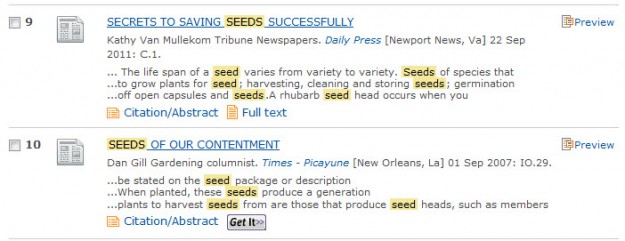
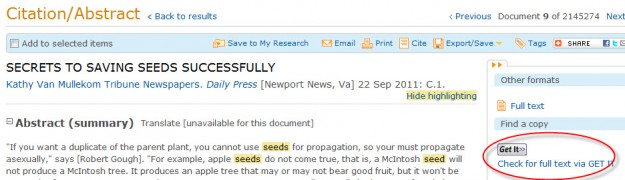
Go ahead and search whatever it is you need in any Proquest product and use RefWorks through the GET IT button.  Now, when you get results in Proquest,  you may or may not see the GET IT button.

Don’t despair.  Do not despair.  The GET IT button is always an option in Proquest, even if there’s full-text.  All you have to do is click Citation/Abstract and GET IT will be an option:

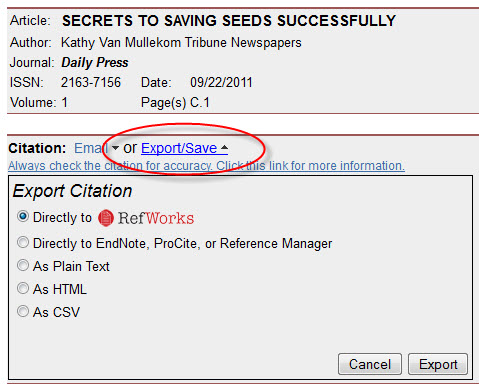
Once on the GET IT window, simply click RefWorks.

PS – If you click the GET IT button and you immediately get full-text and not the GET IT window, simply go to “Full-text not found?  Get additional resources” and the GET IT window appears. It’s at the top of the page after you click GET IT.

Uncategorized

TRIAL – Springer Images

Trial of Springer Images.

This product includes access to more than 3 million photos, graphs, histograms and tables from science, technology and medicine in 18 subject collections most from books. One of the cool features  is that once having chosen an image, chart or graph or photo you are then in the book from whence it came. You then will be guided to other images and text about the image you have chosen. If this is purchased, the images can be used legally in presentations, Blackboard and classroom work for educational purposes only.

If you find SpringerImages valuable, please let

Trial ends 4/30/12.  Send comments to Eric or Linda know.

PS – if you wanna be creeped out, look up sand flea.  <shudder>


Political Science

CQ Researcher and Archives

Looking for original, comprehensive reporting and analysis on issues in the news? Look no further –well, of course, you should look further than just one resource, but this is a great place to start. There is content back to 1923 and as recent as last week BUT not in every topic. Birth control’s most recent entry is 2005 and high speed train’s is 2011. The CQ Researcher provides in-depth, unbiased coverage of  lots of topics across many disciplines: health, education, economy, etc.

Reports, researched and written by journalists, are substantive, but not too long: they do not fall into the TLDR category (oh yes, we’re on to you!) at about 12,000-words. Each report follows a consistent format with overview and background, chronology and an assessment of the current state of affairs. Pro and con statements will help you look at the positions offered from ‘both sides,’ although most issues have more than two sides and some have only one side. Maybe after reading the content YOU can think of the third or ninth side. There may be maps and charts depending on topic.

Ways to navigate include browsing by topic; using tracker to see when the most recent content on your topic was updated oryou can go directly to the pros and cons section.

Libraries, News & Events, O'Shaughnessy-Frey Library

Electronic books in the academic library – a complicated and dynamic phenomenon

Dan Gjelten      Linda Hulbert
By Dan Gjelten and Linda Hulbert

It is hard to avoid news of the growth of the electronic book – between announcements of the latest technologies in e-book readers, we learned recently that Amazon is now selling more e-books than print. (July 2010 more e-books than hardcopy and as of May 2011 more ebooks than paperbacks.)  The percentage of U.S. adults with e-book readers nearly doubled between mid-December and early January, 2012. 

E-books are also making a splash in academic libraries. Nearly all academic libraries now include e-books in their collection and the number of titles is growing rapidly:

  • 95 percent of academic libraries offer e-books
  • From 2009 to 2010 the average number of e-books per library went up 93 percent
  • Most reading of e-books happens on personal computers (72 percent)
  • The preferred format is PDF
  • Reference and scholarly monographs are the primary types of books offered in academic libraries
  • 56 percent of academic libraries report an increase in the use of their e-books
  • Nationwide academic libraries expect to spend nearly 20 percent of their materials budget for e-books. (At this time, the UST Libraries spend about 5 percent of our material budget for e-books.)

While e-books are clearly a rapidly growing phenomenon, they are also very complicated. Comparing digital books to digital music is only partially correct – digital music was primarily a new form of distribution, while digital books can be a fundamental change in the basic reading process. A further complication is the problematic interactions between reader technologies, reading software from numerous providers and the varieties of content contained in books, from text to audio and video.

UST Libraries are quickly developing electronic book collections. This short white paper is intended to shed some light on the complex world of e-books.

What is an e-book? 

Broadly defined, e-books are books delivered electronically, either to a reader (Kindle, Nook, iPad, etc.) or to your computer. UST libraries have purchased more than 100,000 titles in a variety of formats, including:

  • Titles for the libraries’ Kindles
  • Major Reference Works (MRW) now in digital form that used to be in print and housed in the reference areas
  • Titles from a number of vendors: ebrary, EBSCO books and others:
    • These books may be purchased one at a time and are accessed through the library catalog and read on a computer.
    • As selectors identify the titles they want, they must decide whether it will be for one user at a time or for multiple users to read at the same time.  
  • The entire collection of Early American Imprints (17th- and 18th-century primary sources).

The University of St. Thomas libraries own eight Kindles that are available for checkout. We are constantly adding new titles to these devices and the list of what is available can be found here. If you want the library to add something to one of its Kindles, fill out the request form. We bought our first five readers in August 2009 and added three more in August 2010. Since then, they have been checked out nearly 300 times.

Major Reference Works include titles from Gale Virtual Reference, Oxford Reference Online and Blackwell Reference Online. These titles are also in the catalog and many are searchable via our Summon search engine.

The libraries own nearly 115,000 e-books in addition to our Kindle titles, and the collection is growing; however, the use of e-books in the academic library is hindered by publishers who are still working on a pricing model for these titles.

Restricting the use of the book to one user at a time is an option – but in the 21st century that doesn’t make sense. From a technological standpoint, an e-book can easily be used by more than one person at a time – but the publishers then require the library to purchase a multiple-user license for the title, raising the cost substantially. CLIC, our eight-member library consortium, has negotiated an e-book purchasing license that will allow an individual library to buy a title and have it be useable by students and faculty from other schools. We believe this is the best model. As member libraries purchase more e-book content, we want to be able to share these electronic collections with our consortium partners. Since UST borrows more than 20,000 books each year from the other CLIC libraries, if publishers won’t allow us to share them, all of us in CLIC will be affected.

We also have negotiated the right to download some of our ebooks to user’s preferred portable readers. EBSCO e-books are available that way – we are still working with other vendors to obtain the same rights and functionality.

The libraries do not purchase adopted textbooks in any format, and e-texts are no exception; however, we are providing some alternatives via this Library Guide.

Electronic book collections

Beyond the UST Libraries, there is an even larger collection of electronic books – a phenomenal (and rapidly growing) wealth of content available from Project Gutenberg, Google books, and the Hathi Trust.

Project Gutenberg has 36,000 books available for downloading to personal devices. Since they are all in the public domain, there are no copyright restrictions on their use.

Google books is a cooperative initiative by several large academic research libraries, and Google is dedicated to making available full-text and fully searchable online editions of millions of scholarly books.

Hathi Trust is an international partnership of academic and research institutions dedicated to ensuring the preservation and accessibility of the vast record of human knowledge. While the Hathi Trust includes some of the content of Google Books, it also includes other items not chosen for the Google books project; most importantly, Hathi has made the entire content of items still under copyright fully downloadable by their partners. (UST is not a Hathi partner.)

Using Google Books and Hathi Trust search engines allows anyone to do keyword research in the contents of millions of books. While it won’t be possible to download all of those books, many of which are still protected by copyright, retrieving the printed book from the UST libraries or from somewhere else via interlibrary loan is an alternative once it is discovered.

A recent conference paper (“Ebooks, the new normal,” Library Journal, 2011) reported that there are several barriers to the use of e-books in academic libraries:

  • Users who are unaware of the availability of e-books and who find them hard to discover
  • Users who prefer print
  • Users who don’t like to read large parts of books online
  • Rights management issues, which make printing and downloading impossible or cumbersome
  • Titles that are not available for download or use on preferred devices
  • Lack of training either given or taken
  • Limited access to reading devices
  • User resistance to new technologies

While some of these barriers probably exist at UST, library staff will continue to monitor developments in the world of electronic books as we work to allocate our budget on the type of content our users want, at the time they want it and in the format they prefer.

If you want to recommend the purchase of any item in any format, this is where you can do it.
Uncategorized

Ebook Article in The Bulletin Today

Dan Gjelten and I write about the state of the ebook today in the University of St. Thomas’  The Bulletin Today. Read it really soon, by tomorrow it will be out of date. UST will have purchased more ebook content from more publishers and vendors; more publishers will have allowed users to download their books to their preferred device; more companies will have created devices; fewer people will resist the temptation of using an ebook; more people will seek out an ebook to use their snazzy new device (see above comment). In order to help everyone understand the complexities by vendor, ‘we’ve’ created (and by we, I mean Carolyn)  a LibGuide. Further, we have a LibGuide on textbook alternatives, most of which are ebooks, but NOT owned by the UST libraries. Much like the beginning of the journal migration from print to online we are witnessing a huge change in publishing and libraries. I sometimes think of the change from the tablet to the scroll and the scroll to the book. How everything had to be different to manage these new forms of communication and technology. Imagine having shelves that held those stone tables and along comes a scroll – and that scroll can be any height. Anyway, I digress. But you get my drift. It would be really exciting if we could just sit back and watch this evolve, but, alas, we have to make it all happen and happen seamlessly.

Database Highlights & Trials

RefWorks Classic says, “Farewell forever”; RefWorks 2.0 says, “Oh, were you still here?”

Attention all you old schoolers out there: RefWorks Classic has at last bid its final adieu! After months of hanging around as an optional click back into familiarity, POOF! It has gone off to sunnier climes.

Have no fear! RefWorks 2.0, which has been the default since last summer, is still there to gather, organize, store, and share all types of your reference information and is just waiting to instantly generate your citations and bibliographies.  Watch the video below to discover where all your favorite features have gone off to, and don’t be shy about discovering the new ones. Can I just say, “drag and  drop?” Yes, please!

http://www.youtube.com/watch?v=YulwLOzvQ6k&feature=related

Now to all of you who I can hear… “Say what now? Ref….Woooorks?”  If you have no idea what I’m talking about, it is your lucky day! Your information gathering will never be the same again. RefWorks is an online research management, writing, and collaboration tool that will allow you to easily save your citations as you do your research, which will allow you to not only find them again, but will format them for you to instantly generate your citations and bibliographies.

RefWorks has its own channel on YouTube and is a great way to get started.  Also, UST libraries has a very helpful guide (in the process of being updated for the new interface), and RefWorks offers its own guide. And of course, our super duper librarian friends are never too far away!


Uncategorized

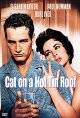
Cat on a Hot Tin Roof

The Guthrie production of Tennessee Williams’ play, Cat on a hot tin roof, is terrific.  The reviewers said that if you saw the movie, you have not seen the play, and they were right.

The libraries own copies of both the book and the movie, but you don’t even need to do your homework before you go. The libraries also have ample scholarly literature on the book and movie.  The actors were absolutely pitch perfect. Extremely demanding roles:Big Daddy, Big Mama, Maggie, and Mae are stand outs. Mae had a relatively small role, but she played it brilliantly. Every turn of her hand, expression or cross of her ankles, reeked of, well, a conniving, ruthless and yet, still likeable person. They were all likeable, and I was surprised. The play is set in its original time and place: 1955 the American South. I love the Guthrie and they did a masterful job with this play.


Charles J. Keffer Library, News & Events

Welcome to Keffer 2.0!

As many of you have noticed, on Monday, February 6th, Keffer Library moved up the stairs into our new space!

The last few weeks have been ones of excitement and transition as we unpack boxes and find new homes for the many people and things that make Keffer tick.

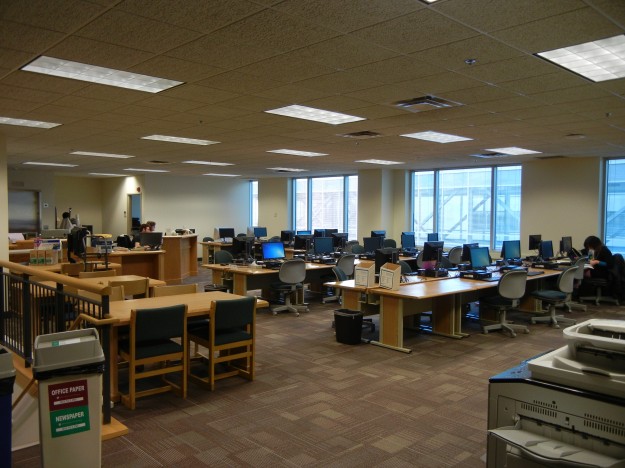
The new library space now contains:

  • Curriculum and Children’s book collections (moved back already thanks to the dedication of some of our amazing student workers)
  • over 30 public computers, including two Mac stations and four computers with specialty software.
  • two study rooms, each able to be reserved with an online reservation system
  • a one-point service desk – staffed by a librarian and both technology and circulation assistants
  • sunlit reading lounge


Look for the following additional changes in the next few weeks and months:

  • wall shelving for the reference collection
  • a lower-level quiet study area
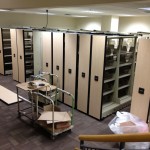
  • the return of the rest of the collection from its temporary housing at the Law Library.  It will be housed on compact shelving on the lower level (currently being installed).

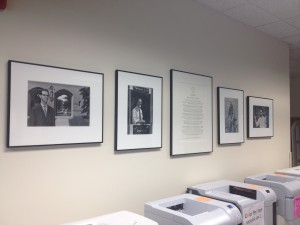
We’re happy to say that it’s starting to feel like home!  Our beloved Charles Keffer dedication display has been hung back on the walls, and things are starting to feel settled.  Thanks again for all of your patience as we continue to transition into our new space.