In this article New Yorker staff writer and surgeon Atul Gawande visits McAllen, TX after learning that Medicare costs in this town are the highest in the country second only to Miami, which has much higher labor and living costs. He speaks with a number of MDs and hospital administrators in town to find that
a) No one here realizes that Medicare costs here are so exorbitantly high
b) Simple overutilization is the most likely reason and
c) Higher healthcare spending does not result in better health.
Links
–Compare some of Gawande’s numbers at the Dartmouth Atlas of Health Care.
–Read some of the news media’s take on Gawande’s article in Factiva. Simply type gawande and mcallen in the search box to see at least six great related articles.
–Gawande’s website
Browsing Category
Subjects/Topics
An annual list of the best federal, state, and international government documents, compiled by a committee of the American Libraries Association, and posted online @ Library Journal. The list is always good, and contains many titles of interest for business research.
When I first heard about Wolfram Alpha I wondered if it would be the next generation engine that would give Google a run for its money. But looking at now I believe that it does not exactly do what a ‘regular’ search engine like Google does. Wolfram Alpha (the name just rolls naturally off your tongue, doesn’t it?) provides calculations based on data that the user enters – i.e. socioeconomic data by state, weather patterns, probability and even simple mathematics equations.
I have not seen a whole lot of stories about its launch this week, but then again I don’t believe it is not the type of engine that people would normally go to for daily use. For an informed overview of this product and a slightly gloomy prediction for its success I recommend this article from the Silicon Alley Insider.
This is a story I plan to follow because if there is one thing I like more then business stories, it is business stories that relate to the music industry and how new models are being studied to revive this faltering industry. According to The Register a new report about P2P networks will be released tomorrow which will recommend amongst other things that copyright holders recognize P2P networks as a broadcast medium, one which can be tapped with more reasonable fees for music downloading.
The other ‘whoa’ moment for me in this article was the mention of a study that debunks the Long Tail business model as overly optimistic and does not necessarily pan out as predicted by Chris Anderson in 2004. I don’t know if I am quite ready to give up on that fairy tale yet, but the articles are wonderful food for thought.
P2P study: Music crackdown is bad for business via The Register
Recent releases from the Census Bureau:
–Security and Commodity Exchange Revenue Nearly $9 Billion in 2007: Securities and commodities exchanges employed 8,852 people with nearly $1.4 billion in annual payroll and more than $8.9 billion in revenue in 2007, according to new data released by the U.S. Census Bureau as part of the 2007 Economic Census Industry Series
–Residential Vancancies and Homeownership: National vacancy rates in the first quarter 2009 were 10.1 (+ 0.4) percent for rental housing and 2.7 (+ 0.1) percent for homeowner housing, the Department of Commerce’s Census Bureau announced
–Census Bureau Releases Data Showing Relationship Between Education and Earnings: workers with a bachelor’s degree earned about $26,000 more on average than workers with a high school diploma, according to new figures that outline 2008 educational trends and achievement levels. Educational Attainment in the United States: 2008 is a series of tables containing data by characteristics such as age, sex, race, Hispanic origin, marital status, occupation, industry, nativity, citizenship status and period of entry. The tabulations also include historical data on mean earnings by educational attainment, sex, race and Hispanic origin.
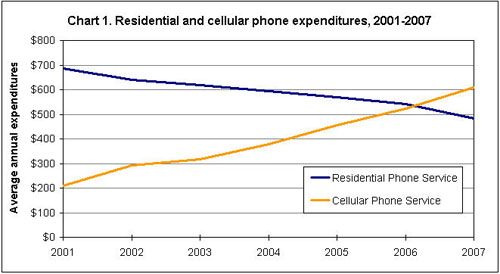
According to a release from the Bureau of Labor Statistics Consumer Expenditure Survey, spending on cell service was $608 per consumer, while spending on residential service had dropped to $482. The BLS’s annual survey is one of the most comprehensive and useful sources available on consumer spending, with data stratified by income, geography, educational attainment, etc.
Even though everyone is all ‘a-twitter’ about Twitter, this graph shows that it’s early growth does not come close to the early growth of other semi-comparable companies like Facebook, Youtube and Google. But fear not for Twitter because so much of its traffic is generated by mobile phones usage which in the long run may mean more business as mobile technology becomes more ubiquitous.
For more on Twitter with some extra sarcasm check out the Colbert Report interview with Biz Stone, one of the founders of Twitter.
Even though everyone is all ‘a-twitter’ about Twitter, this graph shows that it’s early growth does not come close to the early growth of other semi-comparable companies like Facebook, Youtube and Google. But fear not for Twitter because so much of its traffic is generated by mobile phones usage which in the long run may mean more business as mobile technology becomes more ubiquitous.
For more on Twitter with some extra sarcasm check out the Colbert Report interview with Biz Stone, one of the founders of Twitter.