Places & Spaces: Mapping Science is a cool set of physical exhibits featuring infographics and maps that are also browseable online. From the website: “Places & Spaces: Mapping Science is meant to inspire cross-disciplinary discussion on how to best track and communicate human activity and scientific progress on a global scale. It has two components: the physical part supports the close inspection of high quality reproductions of maps for display at conferences and education centers; the online counterpart provides links to a selected series of maps and their makers along with detailed explanations of how these maps work. The exhibit is a 10-year effort. Each year, 10 new maps are added resulting in 100 maps total in 2014.”
See the exhibits/maps organized around their annual themes (listed below) or browse them all.
The exhibit is a 10-year effort. Each year, 10 new maps are added resulting in 100 maps total in 2014.
1st Iteration (2005): The Power of Maps
2nd Iteration (2006): The Power of Reference Systems
3rd Iteration (2007): The Power of Forecasts
4th Iteration (2008): Science Maps for Economic Decision Makers
5th Iteration (2009): Science Maps for Science Policy Makers
6th Iteration (2010): Science Maps for Scholars
7th Iteration (2011): Science Maps as Visual Interfaces to Digital Libraries
8th Iteration (2012): Science Maps for Kids
9th Iteration (2013): Science Maps for Daily Science Forecasts
10th Iteration (2014): Telling Lies with Science Maps
Listen to a podcast about the project or see a short YouTube video clip :
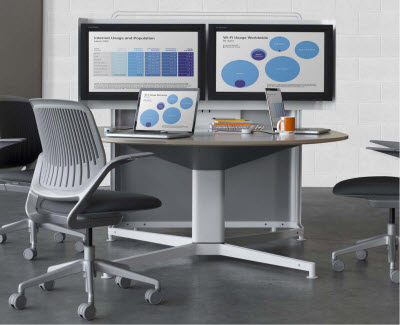 Our latest effort in this area is to provide a new kind of workspace for the UST community. We’ve undertaken a trial installation of the “media:scape” product from Steelcase. media:scape is a combination of furniture and technology that allows easy sharing of information in a small group. Room 110 in the O’Shaughnessy-Frey Library is now (and for the next month) equipped to accommodate at least four users with laptops that can be linked to a large flat screen monitor. Users can easily plug in their computers and view what is on their monitor on the large screen. It is very easy to go from computer to computer, making the sharing of ideas very convenient.
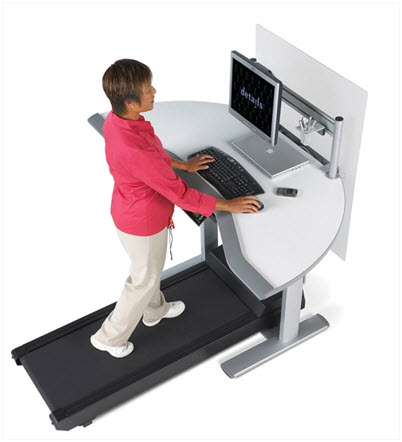 In addition, we’ve installed a “Walkstation” in the OSF Library. The Walkstation allows users to walk as they work – on a slow moving (2 mph) treadmill that allows the use of a computer at the same time. There is research (most notably from the Mayo Clinic) that suggests that movement improves brain function, ease of learning and reduces anxiety and depression in addition to providing the physical benefits associated with physical activity. Since scholarly work can be highly sedentary, we are curious to know whether providing this option in the library would be welcome as well as beneficial, both intellectually and physically. The Walkstation will be in the library for the next few weeks and we invite anyone to give it a try.