Celebrate Banned Books Week with Streaming Films
Banned Books Week is an annual celebration of the freedom to read and a reminder of the ongoing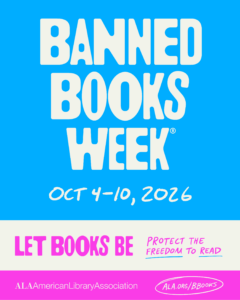 challenges to intellectual freedom, free expression, and access to information. Each year, libraries, readers, educators, and communities come together to spotlight books that have been challenged or removed from schools and libraries—and to affirm the importance of making diverse voices and ideas available to all.
In recognition of Banned Books Week, the University Library invites you to explore a selection of streaming films that examine censorship, book banning, free speech, and the power of stories. From documentaries about today’s battles over school and library collections to feature films adapted from frequently challenged books, these titles offer powerful ways to reflect on why the freedom to read—and to think freely—matters.
To explore more titles for Banned Books Week, search the Music & Media Collections for films on book banning, censorship, and free expression.
Documentaries on Libraries, Book Bans, and Intellectual Freedom
- The Librarians (2025) – This documentary follows librarians across the U.S. as they defend access to books and information amid escalating challenges to library collections and intellectual freedom.
- Banned Together: The Fight Against Censorship (2025) – Following students and adult allies fighting to restore 97 books removed from school libraries, this documentary examines the current wave of book bans and curriculum censorship in the U.S.
- Banned Books, Censorship & the Future of Reading (2025) – This documentary explores why books are being banned, who is organizing against them, and what these challenges mean for the future of reading and free expression.
- The Forbidden University (2025) – Set in Iran, this documentary reveals how members of the Bahá’í religious minority risk persecution to pursue higher education through an underground university system.
- Writers and Censorship (2005) – This documentary examines the impact of literary censorship through challenged and banned books while featuring authors Salman Rushdie and Taslima Nasrin, who share their personal experiences with censorship, persecution, and defending freedom of expression.
- Floyd Abrams: Speaking Freely (2023) – This documentary profiles First Amendment attorney Floyd Abrams and the landmark cases that shaped modern debates over free speech in the United States.
Feature Films on Censorship and Free Speech
- Trumbo (2015) – Set during Hollywood’s anti-communist blacklist era, this film follows screenwriter Dalton Trumbo as he fights to keep writing in the face of censorship and political persecution.
- Howl (2010) – This hybrid drama recounts Allen Ginsberg’s poem Howl and the obscenity trial that became a landmark battle over literary free expression.
- Good Night, and Good Luck (2005) – Centered on journalist Edward R. Murrow’s confrontation with Senator Joseph McCarthy, this film captures a climate of fear, censorship, and political intimidation in 1950s America.
- V for Vendetta (2005) – In a totalitarian future, a masked revolutionary challenges a regime that controls speech, media, and public memory.
- Equilibrium (DVD) (2003) – Imagining a society where books, art, music, and emotion are outlawed, this dystopian film explores the cost of conformity enforced in the name of order.
- The Post (2017) – Dramatizes The Washington Post’s 1971 decision to publish the Pentagon Papers, the classified government study of the Vietnam War that the Nixon administration sought to suppress; the resulting Supreme Court case, New York Times Co. v. United States, became a landmark victory for press freedom against government censorship and prior restraint.
Feature Films Adapted from Banned Books
- The Hate U Give (2018) – Adapted from Angie Thomas’s YA novel about police brutality and systemic racism; one of the most challenged and banned books of the past decade.
- 12 Years a Slave (2013) – Solomon Northup’s 1853 slave narrative was banned in Southern states before the Civil War and has faced contemporary curriculum challenges related to depictions of racial violence.
- Love, Simon (2018) – Adapted from Becky Albertalli’s novel Simon vs. the Homo Sapiens Agenda; frequently challenged in school libraries over LGBTQ+ themes.
- The Shining (1980) – Based on Stephen King’s frequently challenged novel, The Shining explores isolation, madness, and violence as a family’s stay at a remote hotel descends into terror.
- The Book Thief (2013) – Set in Nazi Germany, The Book Thief follows a young girl who finds comfort and courage in stolen books during a time of censorship, propaganda, and book burning.
- Fahrenheit 451 (1967) – In a dystopian future where books are outlawed and burned, Fahrenheit 451 follows one fireman’s awakening to the power of reading and independent thought.
- To Kill A Mockingbird (1962) – Adapted from Harper Lee’s frequently challenged novel, To Kill a Mockingbird portrays racial injustice, moral courage, and childhood innocence in the American South.
- The Fault in Our Stars (2014) – Based on John Green’s challenged YA novel, The Fault in Our Stars tells the story of two teens with cancer who find love, humor, and meaning amid grief and uncertainty.
- The Godfather (1972) – Adapted from Mario Puzo’s controversial bestseller, The Godfather examines family loyalty, power, and violence within the world of organized crime.
- Fight Club (1999) – Chuck Palahniuk’s novel has been banned in state prison systems (including Texas) and challenged in libraries for extreme violence, nihilism, and anti-consumerist extremism.
- The Call of the Wild (2020) – Adapted from Jack London; burned by the Nazis in 1933 and banned in Yugoslavia and Italy for its perceived radical social undertones.
- Gone Girl (2014) – Gillian Flynn’s novel has faced removal challenges in public and high school libraries over graphic language and violent/sexual scenes.

No Comments