If you have books that you used to love but no longer wish to keep, please consider donating them to the UST Libraries Library Week Book Sale! We are accepting donations of books that would make a fun book sale, which will take place Monday – Friday, April 11 – 15 in the O’Shaughnessy Room of the O’Shaughnessy-Frey Library Center. Please drop off your books at the O’Shaughnessy-Frey circulation desk anytime between now and Thursday, April 7. Book sale shoppers are especially excited when they find treasures from your donations of novels, mysteries, classical works of literature, poetry, fiction, non-fiction, biographies and history, cookbooks, children’s books, travel, art, music. If you have any questions please call Julie at 962-5014.
Monthly Archives
February 2011
Database Update from Linda Hulbert, Associate Director for Collection Management and Services
“Roper’s IPoll bites the dust!
“The libraries purchased IPoll from Roper two years ago. It’s unique in what it has, although ponderous as a search tool.
“Unfortunately, its use had been dismal AND decreasing AND its price went up. It has gone from $1,700 to $2,300. While there does not seem to be anything like it, the combination of poor use and increase in price is hard to support. The increase in cost would take it to $36 per search and $104 per session. That wins as the most expensive database per use that we have. It was high at $1,700 but at $2,300 – it’s too hard to justify.
“Therefore, we will be cancelling the title and it will disappear on the 14th of March, 2011. Please send your comments and concerns to Linda Hulbert 2-5016 or lahulbert@stthomas.edu.”
All are cordially invited to hear Dr. Anne Klejment, UST history professor, speak on Dorothy Day. This Noon Conversation: Dorothy Day and Social Justice will be held on Thursday, February 24 at Noon until 1pm in the O’Shaughnessy Room of the O’Shaughnessy-Frey Library. You are welcome to bring your bag lunch if you wish; beverages and a light dessert will be provided.
Dr. Klejment earned a Ph.D. in history at the State University of New York at Binghamton and has taught at UST since 1983. Her research and publication has focused on Catholics and nonviolence, the early liturgical movement, and Catholic publishing in the mid twentieth century.
Please plan to join us — meet Dr. Anne Klejment – and Dorothy Day. Questions or in need of parking information? Please call Julie Kimlinger at 651-962-5014.
What drew you to study Dorothy Day so intently?
I had heard about Dorothy Day from my mom, whose high school classmate was one of the founders of the Rochester (New York) Catholic Worker. Her classmate’s son was also a draft resister during the Vietnam War. I was writing about Catholic protest against the Vietnam War and about nonviolent movements—focusing on Martin Luther King and the Berrigans—when I realized that I couldn’t understand Dan and Phil without understanding Dorothy Day. So I started reading…and the rest is history!
How long have you been researching her?
I’ve been reading about her since the mid seventies and I started serious research in the early 80s, when on the strength of a published bibliography on the Berrigans, I got a contract to compile a Dorothy Day/Catholic Worker bibliography and index. That was published in 1986 with my mom as co author. Since then I’ve co-edited another book about Catholic Worker pacifism and have written several articles on Dorothy Day.
Any favorite things about her that you have discovered?
Her love letters are phenomenal. They confirmed what I had suspected: that although she gave up Forster Batterham, the father of her child, because he would not marry her in either a civil or religious ceremony, that they chastely loved each other until their deaths! What a struggle she had trying to convince him to marry her on the one and trying to leave him on the other because she knew how stubborn he was. A very powerful story.
Her life in 1917 as a young radical and protester against WWI and the actions of her radical friends against the war.
The complex and loving relationship of Day and her daughter Tamar.
Her emphasis on continuing conversion throughout your spiritual life!
What were your favorite resources to use in researching her life?
I love Bob Ellsberg’s books, which are compilations of her writings—By Little and By Little is a sampler of her published writings. All the Way to Heaven contains her letters to Forster. I particularly love her journals, The Duty of Delight, because it provides such an authentic view of her daily life and the challenges that she had to meet as the head of the Catholic Worker movement.
The events of the past few months in northern Africa have been remarkable, world-changing, revolutionary. A lot of the news outlets try to give background info on events and circumstances that have led to the great upheavals, but if you prefer a more systematic approach to the how we got here, here are a few library resources that can help.
New Encyclopedia of Africa – if you need to understand modern Africa, this is going to give you long articles on Egypt, Tunisia and Sudan.
Europa World – lengthy country background info, plus a bit of a timeline of what’s going on in the region. Sadly, the calendar of political events in the Middle East and North Africa ends in September 2010. Wow – how much has changed in these past few months!
Columbia Gazetteer of the World – chooses Egypt as its Place in the News and features a concise article.
My old standby the Encyclopedia Britannica has an up-to-date article on Hosni Mubarak. In fact, they’ve got it updated through what he’s doing today.
Encyclopedia of Violence, Peace, & Conflict – hats off to the demonstrators in Egypt that have kept this a mostly non-violent protest.
Routledge handbook of religion and politics – includes an article on Islamism in contemporary Egypt.
What’s great about a number of these resources is that they keep linking to more and related info.
News & Events, O'Shaughnessy-Frey Library
Student posters honor Black History Month in O’Shaughnessy-Frey Library
The O’Shaughnessy-Frey Library will display Black History Month posters starting Monday, Feb. 14.
The posters were prepared by students in Dr. Anne Klejment’s HIST 116, African American History: Global Perspective classes. The posters represent student work from several semesters and will be displayed through the end of the month on a rotating basis on the library’s first floor.
Please be sure to stop by and take time to visit this poster exhibit throughout the month of February.
Taken from Bulletin Today, February 10, 2011:
 Earlier this month, UST Libraries released a beta version of its mobile Web app. It is believed to be the first of its kind on campus, and UST Libraries invites feedback and ideas for new features, which links to a survey that can be taken after trying the site on your mobile.
Get quick access to library hours, locations, maps and phone numbers – all easily linked so you can, among other uses:
- Call directly from your mobile device
- IM and SMS text for research help
- Use mobile versions of UST Libraries’ Summon search engine and Research Guides
- Check for open computers in UST library computer labs
The app was built using the JQTouch framework, which allows a Web page to appear and act like a native iPhone app while functioning equally or nearly as well in all WebKit-enabled browsers – including Android phones, recent versions of the Blackberry, and Symbian-based phones.
View St. Thomas’ mobile site here or visit the UST Libraries home page on your mobile device. If the phone is supported, you will be redirected to the mobile site automatically without needing to download or install anything.
Also, add the Libraries’ mobile page to your home screen to view the custom icon, startup screen and full-screen mode.
In the February 8 issue of Bulletin Today, Dan Gjelten, Director, UST Libraries writes:
“I consider coffee to be a religious discipline of sorts: it begins my day, like prayer does for some; is a sacrament at every familial function, friendly gathering, and every celebratory or solemn occasion. If I venture out for a walk in a strange city, the quest for it directs me along my way. I offer it to every soul who enters my house, and likewise I would never refuse its offer without due cause, any more than I would refuse someone’s handshake. It’s not so much a substance, I mean, as a way of life … a true habit of my being.”
~Musician Joe Henry
* * *
The UST Libraries and Coffee Bené invite you to celebrate with us the first year of our partnership in O’Shaughnessy-Frey Library. On Feb. 10, 2010, Coffee Bené sold its first cup of coffee in its new location in the OSF Library. Since that day, the shop has sold 14,772 brewed coffees, 5,631 lattes, 8,417 mochas, 4,158 muffins and 2,000 cookies. (And we are pretty sure that the library director is responsible for the purchase of only two or three thousand of the brewed coffees and a few hundred cookies!)
The impact of the coffee shop on the use of the library has been that we’ve had the busiest months in the history of the library at St. Thomas. The impact on student and faculty happiness is immeasurable, except by the many smiles we see every day in the vicinity of Coffee Bené! Perhaps we are all smarter because of the great freshly ground, freshly brewed coffee that is available in the library!
Come celebrate coffee beginning at 11 a.m. Thursday, Feb. 10.
Look for Ericka and Kellie at the greeting table – they’ll be giving away reusable cup sleeves to the first 100 guests, free cookies, coffee coupons, and a chance to win one of five ceramic mugs especially designed for the first birthday party. “Tommie” and “Coffee Cup” mascots will be on hand to greet students as they study on the various floors between 1 and 2 p.m.
Plan to hear the Show’d Up Band at noon in the O’Shaughnessy Room – featuring a very special guest artist! Refreshments, too, of course.
Thank you for your patronage during this last year and our best to you as you begin this new semester.

This article was posted at 12:01 a.m. Tuesday, Feb. 8, 2011 and is filed under University News.
The last big change in the libraries over J-term was the way we deliver databases to you. We have always had an alphabetical list of resources and a subject list, in addition to having databases on all of the Research Guides. But we’ve redesigned and improved the alpha and subject pages with plenty of student input.
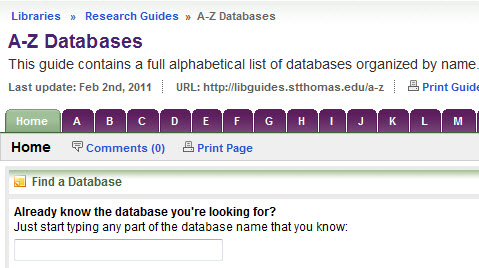
The new alpha page offers not only the alphabet in big purple tabs across the top, but it also now features a way to look up a database if you know the name.
 Obviously, the subject page has databases arranged by subject. If you’re doing work for, say, biology, just click the biology link and get recommended resources and really clear instructions on what to use when.
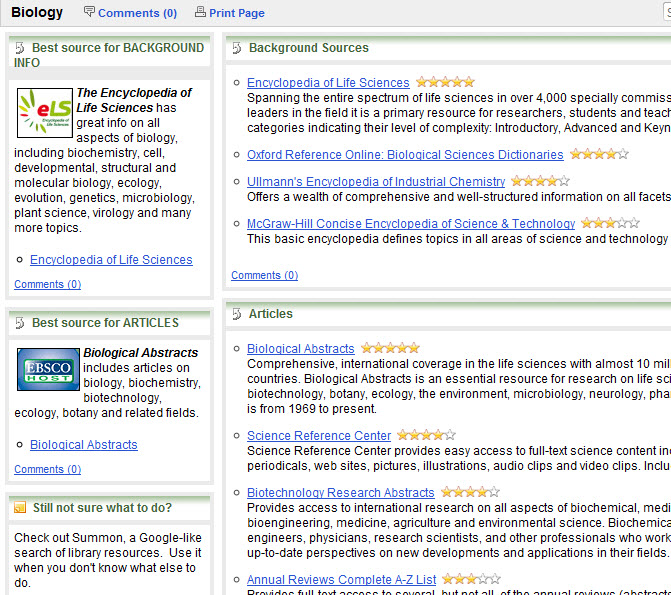
For every subject we give you a list of databases that give background information (think Wikipedia-type of info but from library databases, not from the free web). Of those, we pick one that is especially good for that topic and it’s featured on the left. Same goes for finding articles. We give you a list and recommend the best place to find articles on that topic (featured in the left column). For every page there is a way to contact the librarian who is a specialist in that particular field and links to his/her Research Guides. And as an added bonus, there is usually section of specialized resources in that given field. For example, on the English page we have a special section on criticism and where to find it. You get the idea.
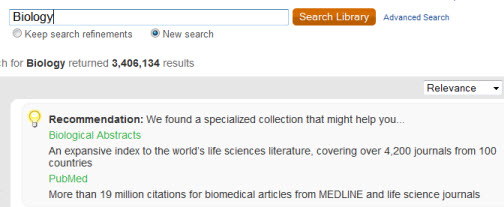
Another way to discover which databases we have is through Summon. I’ve spent a lot of time talking about Summon in this blog, but it recently added a new feature where you can type in the name of the database and it’ll recommend it to you (i.e. PsycINFO). If you don’t know the name but know you want a database in biology, just type biology and it’ll recommend databases:
Finally, you can search any database name in the library search and we’ll whisk you right over to the resource you’re looking for – no choosing, no clicking. Just type in the title and go. The library search is on the very bottom of the library homepage.
Even with all these avenues to find stuff, always remember if you get stuck don’t hesitate to ask us. We’re here for you. We buy this stuff for you. We ask you the best ways to present it. And we’re thrilled to be able to help you with your research.
The Libraries does not carry hard copy tax forms for you to fill out (some public libraries provide these, you can check with your local public library).
We do have a page linking to federal and state tax forms online for your convenience.
Note that we cannot assist you in filling out or filing tax forms, nor can we provide tax advice.
Well, technically PsycINFO itself is not new but the look of it is. Over J-Term we changed PsycINFO platforms from this
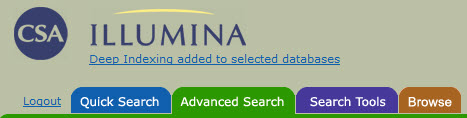 to this

You’ll find the new version of PsycINFO includes all the same content, it’s just got a different look. So if you’re looking up articles on any topic in psychology [like phobias, specifically the fear of clowns or the fear of mimes (technically not found in PsycINFO – hey, there’s an original dissertation topic for those of you who are still looking)] and you’ve used PsycINFO before, you’ll note the changes. If you have any questions or comments on the new interface, send ’em to Merrie Davidson. She’ll help you out.