
By: Jerry Organ, Bakken Professor of Law and Co-Director of the Holloran Center for Ethical Leadership in the Professions, University of St. Thomas School of Law
This blog posting updates my blog postings over the last several years regarding what we know about the transfer market, for example 2024 and 2023. With the ABA’s posting of the 2025 Standard 509 Reports, we now have more than a decade of detailed transfer data from which to glean insights about the transfer market among law schools, which has been in decline for most of the last decade. This posting also includes a section on transfer “feeder schools” and some reflections on whether and how law schools might be providing opportunities for professional identity formation for their transfer students. In addition, it speaks briefly to how changes in federal lending might impact the transfer market this summer.
Numbers of Transfers and Percentage of Transfers Decline to the Lowest Levels in the Last Decade
As shown in Table 1 below, the number of transfer students received by law schools in 2025 decreased nearly 10% from 1194 to 1085, the smallest number of transfers in the last decade as well as the smallest percentage of transfer in the last decade, at 2.7%. Notably, these numbers/percentages are essentially half of where the transfer market was in 2014. Aside from slight bumps in 2017, 2020, and 2024, there has been a continuous gradual decline in transfers over the last several years – from nearly 2200 to less than 1100 and from 5.5% of first-years to 2.7%.
TABLE 1 – Number of Transfers and Percentage of Transfers from 2014-2025
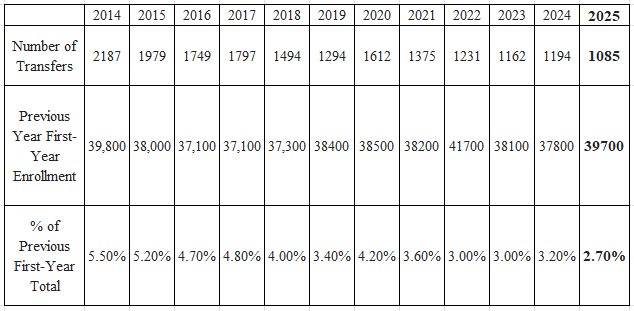
Figure 2 shows this in graph form:
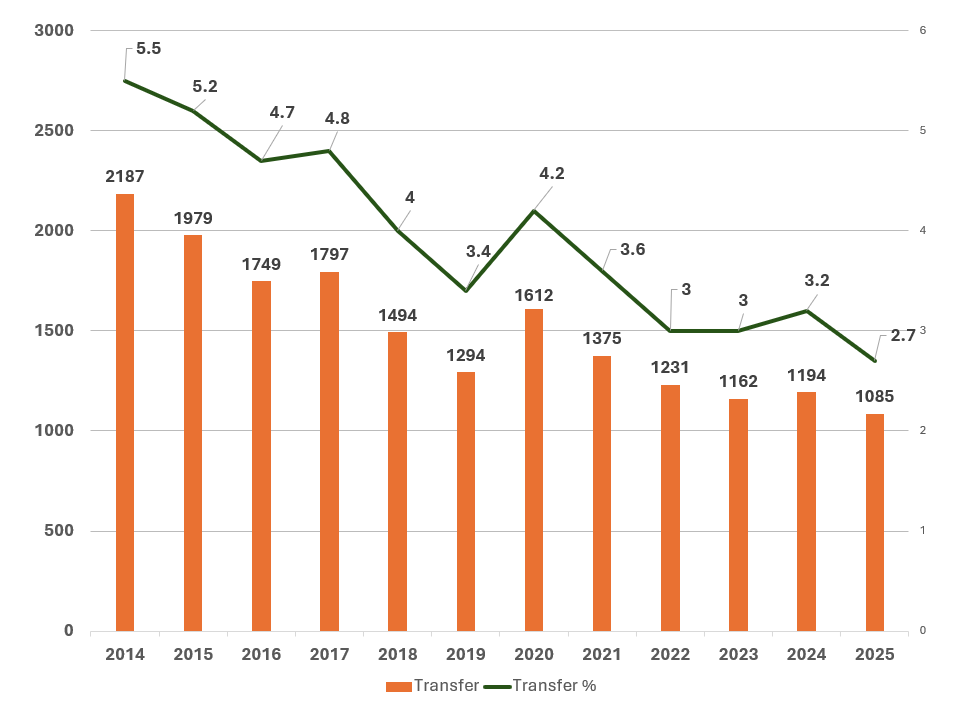
As noted in my previous blogs, I believe the consistent decline in transfers is directly related to the increase in scholarship assistance over the last decade, including the elimination of conditional scholarships at dozens of law schools, which has made the financial calculus associated with transferring much less attractive. (The ABA defines a “conditional scholarship” as any scholarship “the retention of which is dependent upon the student maintaining a minimum grade point average or class standing” other than good standing. The number of law schools with conditional scholarship dropped from roughly 140 in 2011 to fewer than 70 as of 2023.) If a student were going to be paying full tuition at a given law school either because they did not receive a scholarship or lost a conditional scholarship and could transfer to a much higher ranked law school in the region for only marginal additional cost (and perhaps without having to move), transferring might make sense. But if a student has to forego scholarship assistance and absorb significantly more financial cost to transfer, then staying at the student’s initial law school makes more sense.
In addition, with the dramatic improvement in employment outcomes across law schools generally, with 81% of May 2024 graduates landing full-time, long-term bar passage required positions, the likelihood of having significantly better employment prospects at a school to which one might transfer also seems less compelling.
Finally, with the change in federal direct lending under the Trump Administration, there may be another financial factor that functions to discourage transfers this coming summer. Under the federal lending rules presently being promulgated, the legacy provision for first-year law students who first borrowed prior to July 1, 2026, which allows them to remain under the prior direct lending regime rules will be lost if students transfer to another law school this summer or transfer or change programs at any time during their course work. For some subset of potential transfer students that shift might provide a sufficient financial disincentive to keep them from transferring. (I am grateful to Monica Konate at AccessLex Institute for this insight.)
SOME LAW SCHOOLS CONTINUE TO DOMINATE THE TRANSFER MARKET
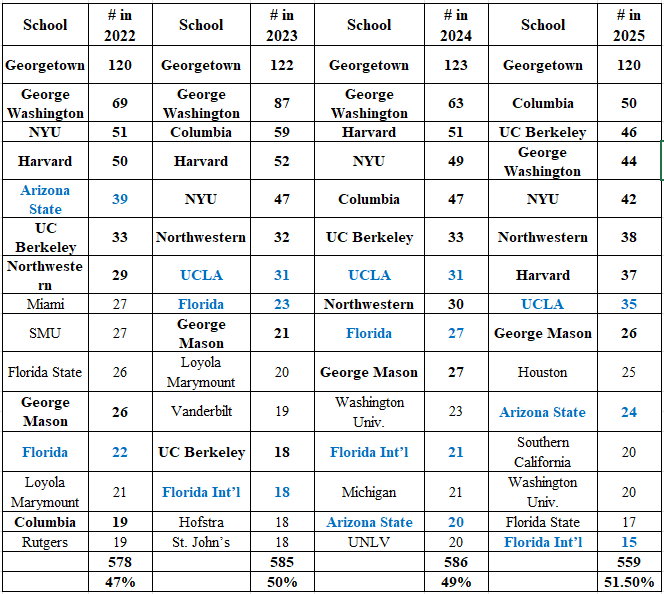
Table 2 below lists the top 15 law schools participating in the transfer market in descending order in Summer 2022 (fall 2021 entering class), Summer 2023 (fall 2022 entering class), Summer 2024 (fall 2023 entering class), and Summer 2025 (fall 2024 entering class)
(Note that in Table 2, Table 4, and Table 5 the “repeat players” are bolded – those schools in the top 15 for all four years are in black, those schools in the top 15 for three of the four years are in blue.) Eight of the top 15 for 2025 have been on the list for taking in the largest number of transfers all four years: Columbia, George Mason, Georgetown, George Washington, Harvard, NYU, Northwestern, and UC Berkeley. Four others have been on the list for three of the four years: Arizona State, Florida, Florida International, and UCLA. Table 2 also shows that for 2025, the concentration of transfers in the top 15 law schools for transfers exceeded 50%, the highest percentage over the last four years.
TABLE 2 – Largest Law Schools by Number of Transfers from 2022-2025
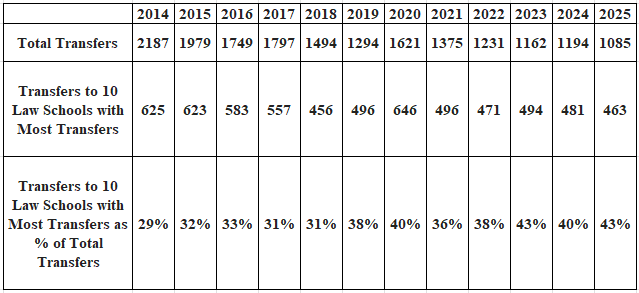
As shown in Table 3 below, if we focus just on the top ten law schools for transfers in, the total number of transfers is 463 – 43% of all transfers – the highest percentage in the last decade.
TABLE 3 – Totals for Top Ten Law Schools for Transfers In as a Percentage of All Transfers for 2014-2025
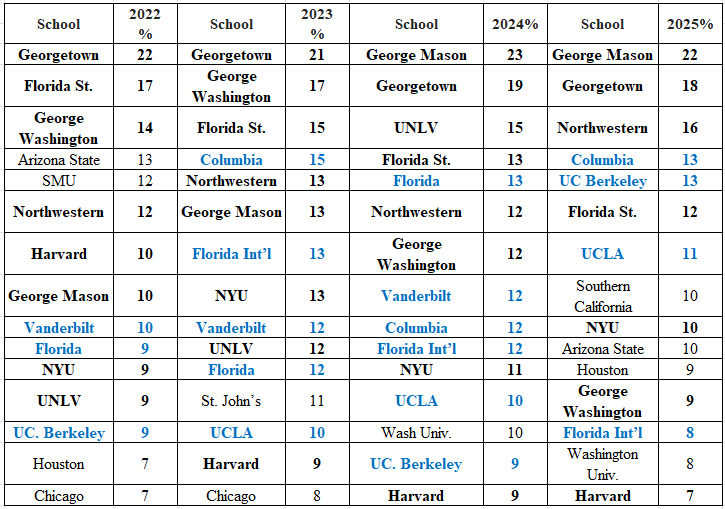
In terms of law schools with the highest percentage of transfers in as a percentage of their previous year’s first-year class, as shown below in Table 4, seven law schools have been on the list each of the last four years – Florida State, George Mason, Georgetown, George Washington, Harvard, NYU, and Northwestern. Six law schools have been on the list three times in the last four years – Columbia, Florida, Florida Int’l, UC Berkeley, UCLA, and Vanderbilt. The number of law schools welcoming transfers representing 20% or more of their first-year class has fallen from nine in 2013 (not shown), to only one in 2022, 2023, 2024, and 2025.
TABLE 4 – Largest Law Schools by Transfers as a Percentage of Previous First-Year Class – 2022-2025
It is also worth noting that in addition to having some regular “players” in the transfer market, there are a large number of law schools that are not meaningful participants in the transfer market. On average over the three years from 2023-2025, over half of ABA-accredited law schools (103) had two or fewer transfers in, while over 20% (42) had no transfers at all.
TRANSFER FEEDER SCHOOLS
There also are some law schools that appear consistently in the list of top feeder schools for transfers as shown below in Table 5. These fifteen schools have been responsible for roughly 25-30% of transfer students in each of the last four years.
TABLE 5 – Largest Law Schools by Transfers Out for 2022-2025
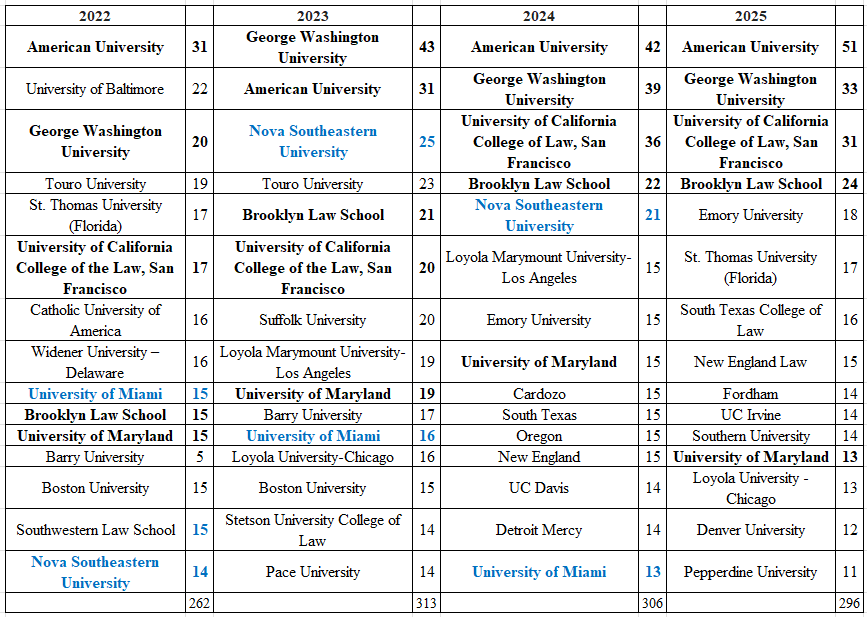
Five law schools have been on the list of top transfer out law schools in each of the last four years – American University, Brooklyn Law School, George Washington University, University of California College of the Law, San Francisco, and the University of Maryland. There are two additional law schools on the list in three of the last four years: Nova Southeastern and University of Miami.
Notably, one of these schools – George Washington University – shows up on both the transfer out in Table 5 and the transfer in list above in Table 2. They are losing students to higher-ranked law schools and then back-filling with their own transfers from lower-ranked schools.
NATIONAL AND REGIONAL MARKETS –
Starting in December 2014, the ABA Section of Legal Education and Admissions to the Bar began collecting and requiring law schools with 12 or more transfers in to report not only the number of students who have transferred in, but also the law schools from which they came (indicating the number from each law school). In addition, the law schools with 12 or more transfers in had to report the 75%, 50% and 25% first-year law school GPAs of the students who transferred in. This allows one to look at where students are coming from and are going to, as well as the first-year GPA profile of students transferring in to different law schools.
Table 6 below focuses on the eight law schools in Table 2 that have been among the top 15 in terms of number of transfers in for each of the last four years, presented in descending U.S. News & World Report (U.S. News) rank. Table 6 indicates the extent to which these seven law schools were attracting transfers from the geographic region in which they are located and highlights that the transfer market, to some extent, is a set of regional sub-markets.
TABLE 6 – Percentage of Transfers from Within Geographic Region 2023-2024-2025 and Top Feeder School for 2025 at Each of the Eight Law Schools among the Top 15 for Transfers In for 2023, 2024, and 2025
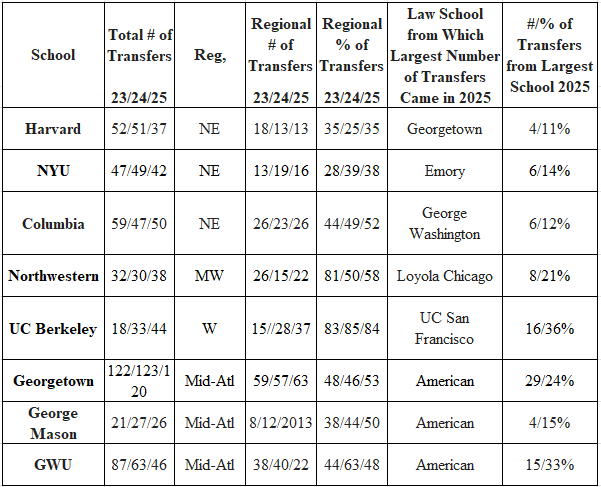
Six of the eight law schools had at least 48% of their transfers from the region in which they were located in 2025, with UC Berkeley having at least 83% of their transfers from the geographic region within which the law school is located for the last three years. On the other hand, Harvard is the only law school to have 35% or fewer transfers from its own region all three years, while NYU is the only other law school to have less than half of its transfers from its own region all three years.
When one looks at the transfer out schools in Table 5 in comparison with the transfer in schools in Table 2, one can see some of the regional realities. In the Mid-Atlantic, American and George Washington, were the primary transfer feeder schools for Georgetown in 2025, with George Washington and George Mason receiving a number of transfers from American as well. In California, the University of California College of Law San Francisco, is the major transfer feeder school for the University of California Berkeley, whileUC Irvine, Loyola Marymount and Pepperdine were the primary feeder schools for University of California Los Angeles in 2025. George Washington in the Mid-Atlantic region, Fordham in the Northeast, and Loyola Marymount and UC Davis are the unique players in their respective regions as they tend to lose a significant number of transfers and also accept a significant number of transfers
Table 6 also identifies the law school that provided the largest number of transfers to each listed law school in 2025, as well as the percentage of transfers that came from that school. Four of the eight law schools had a significant percentage (more than 20%) of their 2025 transfers in from one feeder school – UC Berkeley with 36% from UC San Francisco, George Washington and Georgetown, with 33% and 24% of their transfers coming from American; and Northwestern with 21% of its transfers from Loyola Chicago.
Notably, six of the eight law schools that have been the most consistent players in the transfer market over the last four years are on the East Coast (Columbia, George Mason, Georgetown, George Washington, Harvard and NYU), while one is in the Midwest (Northwestern) and one is in California (UC Berkeley).
VARIED QUALITY OF THE TRANSFER POOL
Table 7 below shows the tiers of law schools from which these eight largest law schools in the transfer market for each of the last four years received their transfer students. Six of the eight law schools that consistently have high numbers of transfers in are ranked in the top 15 in U.S. News, while the other two are ranked 31 (George Mason and George Washington).
TABLE 7 – Percentage of Transfers from Different Tiers of School(s) for 2023, 2024, and 2025 at the Eight Law Schools Among the Top 15 for Transfers in 2023, 2024, and 2025
(Bolded data indicates the modal percentage response for each law school.)
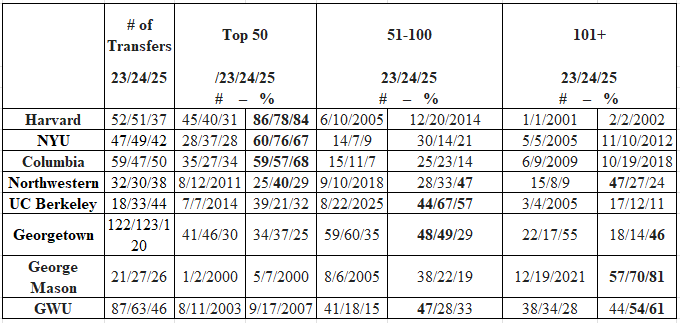
Three of the eight law schools – Harvard (no lower than 78%), NYU (no lower than 60%) and Columbia (no lower than 57%) – have consistently had large percentages of their transfers from law schools ranked between 1 and 50 in the U.S. News rankings. By contrast, in 2024 and in 2025, two of these eight law schools had more than 50% of their transfers from law schools ranked 101 or lower (George Mason (70% and 81%, respectively) and George Washington (54% and 61%, respectively)).
TABLE 8 – First-Year Law School 75th/50th/25th GPA of Transfers in 2023, 2024, 2025 at the Eight Law School among the Top 15 for Transfers in 2023, 2024, 2025
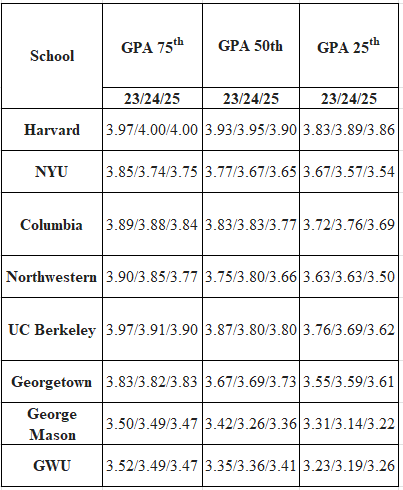
Table 8 above highlights the reported GPAs of transfers in for these eight law schools. In looking at Table 8, one quickly sees that of the five law schools ranked in the U.S. News top 15, only one – Harvard – has a 50th GPA for transfers that is consistently 3.9 or above, and a 25th GPA that is consistently 3.83 and above. Harvard also is accepting most of its transfers from top 50 law schools, making it clear that it is accepting transfers in who could have been admitted to Harvard in the first instance.
The other four top 15 law schools – NYU, Columbia, Northwestern, and UC Berkeley — are a step below in terms of the credentials of their transfers, with 50th GPAs between3.87 and 3.65, across the three years and with 25th GPAs between 3.76 and 3.50 across the three years. In 2025, over 65% of UC Berkeley’s, Northwestern’s, and Georgetown’s transfers were from law schools ranked 51 or lower. For these three law schools, with a majority of their transfers coming from law schools ranked outside the top 50, many of these transfer students may not have had the credentials to be admitted as first-year students at these law schools.
Once you drop out of the top 15, the other two law schools – George Washington and George Mason – each has had a 50th GPA well below that of the other law schools on the list and 25th GPAs that drop to 3.26 or lower with one exception. With 80% or more of these transfers coming from law schools ranked 51 or lower, these law schools clearly are welcoming a number of transfer students whose entering credentials almost certainly were sufficiently distinct from each of those law schools’ entering class credentials such that the transfer students they are admitting would not have been admitted as first-year students in the prior year.
STILL MANY UNKNOWNS
As I have noted for the last few years, these more detailed transfer data from the ABA should be very helpful to prospective law students and pre-law advisors, and to current law students who are considering transferring. These data give them a better idea of what transfer opportunities might be available depending upon where they are planning to go to law school (or are presently enrolled as a first-year student).
Even with these more granular data now available, however, there still are a significant number of unknowns relating to transfer students, particularly regarding gender and ethnicity of transfer students and performance of transfer students at their new law school (both academically and in terms of bar passage and employment).
With the increased emphasis on professional identity formation reflected in ABA Standard 303(b)(3) and (c), there may be questions about how law schools are addressing professional identity formation for transfer students, particularly at those law schools that have added a first-year course/program focused on professional development or professional identity formation.
Are these law schools requiring transfers to take these courses with their incoming first-year students? Are there specific professional development or professional identity formation courses structured for transfer students at those law schools with a significant cohort of transfer students (10-15 or more)? Are there better ways to address the professional identity formation of transfer students that would help them integrate into the law school community where they are transferring? These are questions for which additional research would be warranted.
Please feel free to contact me at jmorgan@stthomas.edu should you have any comments or questions.

Jerome Organ is the Bakken Professor of Law and Co-Director of the Holloran Center for Ethical Leadership in the Professions at the University of St. Thomas School of Law