by Jerry Organ, Bakken Professor of Law and Holloran Center Co-Director
I am writing to follow up on my employment outcomes blog for the class of 2024 with an analysis of the employment outcomes for the class of 2025. The ABA will be releasing data on employment outcomes for 2025 graduates of all ABA-accredited law schools in the coming days. I went and gathered the data from those ABA-accredited law schools that have posted their employment outcomes on their website – comprising 185 of the 191 law schools outside of Puerto Rico. (Data were not available for Belmont, Emory, North Carolina Central, Northern Illinois, Ohio Northern and Texas Southern as of April 21.)
- Increase in Percentage of Graduates in Full-Time, Long-Term Bar Passage Required Positions Despite Decrease in Number of Graduates in Such Positions
Across these 185 ABA-accredited law schools outside of Puerto Rico, the number of graduates between 2024 and 2025 decreased by 2,266, from 37,662 to 34,928, but the number of graduates in full-time, long-term bar passage required jobs decreased by only 1,716 – from 30,934 to 29,218!
As a result, these 185 law schools once again saw the percentage of graduates in full-time, long-term bar passage required positions increase from 82.1% to 83.7% — the highest rate since records have been maintained.
- First Decline in Several Years in the Number of Graduates in Full-Time, Long-Term Bar Passage Required Positions
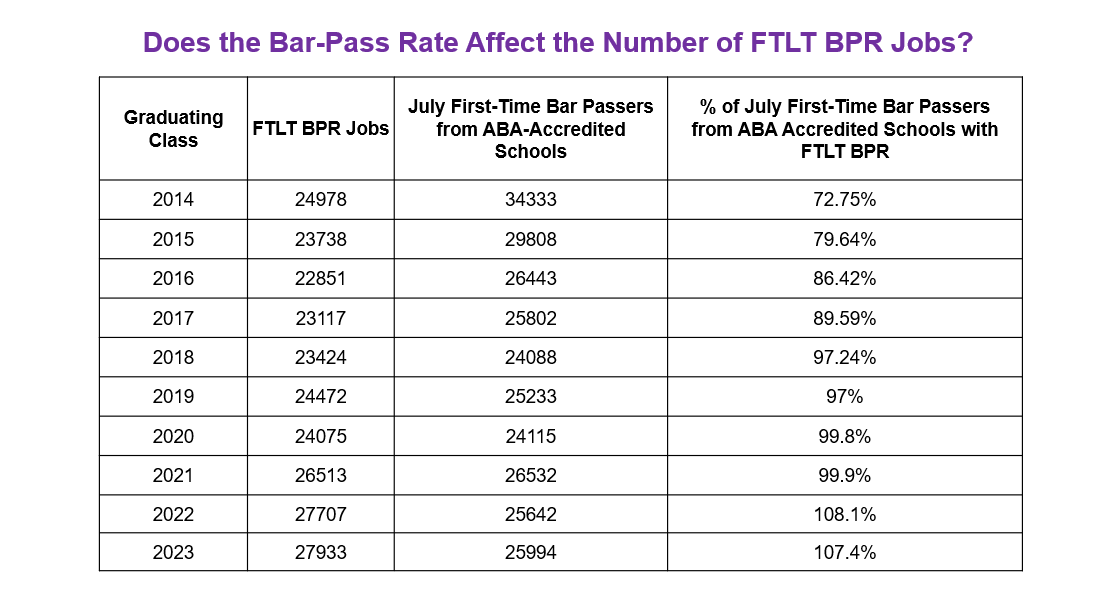
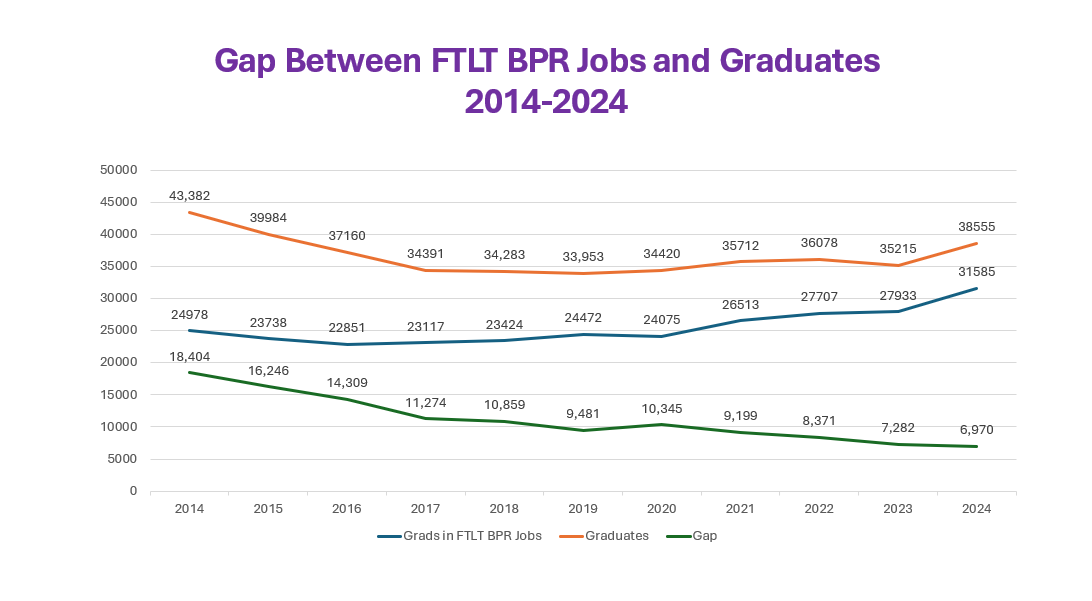
For the graduating class in 2014, nearly 25,000 graduates found full-time, long-term bar passage required jobs. For the next several years, from 2015-2020, the number of graduates in full-time, long-term bar passage required jobs fluctuated between a low of roughly 22,800 and a high of 24,500.
Since 2021, the number of graduates in full-time, long-term bar passage required positions has been on the rise – 26,500 in full-time, long-term bar passage positions for 2021 graduates, 27,700 for 2022 graduates, 27,900 for 2023 graduates and roughly 31,500 for 2024 graduates, the highest number ever, surpassing the previous high of roughly 30,500 for the graduating class in 2007, just prior to the great recession. While the class of 2025 reflects the first year-over-year decline in several years in the number of graduates in full-time, long-term bar passage required positions, this is not surprising given that there was a significant decline (roughly 6%) in the number of graduates between 2024 and 2025.
- Vast Majority of Law Schools and States Saw Increases in the Percentage of Graduates in Full-Time, Long-Term Bar Passage Required Positions
Across the 185 schools for which information is available, 120 saw an increase in the percentage of graduates in full-time, long-term bar passage required positions, while 4 were flat and 61 saw a decrease. This means nearly two-thirds of law schools saw an increase in the percentage of graduates in full-time, long term bar passage required positions in the class of 2025.
For the class of 2023, 60 law schools had 85% or more of their graduates in full-time, long-term bar passage required position. That number grew to 76 for the class of 2024, and to 85 for the class of 2025.
For the class of 2023, 20 law schools had 90% or more of the graduates in full-time, long-term bar passage required positions. That number increased to 28 for the class of 2024 and to 37 for the class of 2025.
When one looks at this on a state-by-state basis, one sees strong results as well. There were 37 states that saw an increase in the percentage of graduates in full-time, long-term bar passage required positions between the class of 2024 and the class of 2025, with one flat and 12 that saw a decrease. Seventeen states – one-third – had more than 85% of the graduates of law schools in each of those states in full-time, long-term bar passage required positions, up from eleven for the class of 2024.
- Possible Explanations
What might explain this growing appetite for law grads in full-time, long-term bar passage required positions?
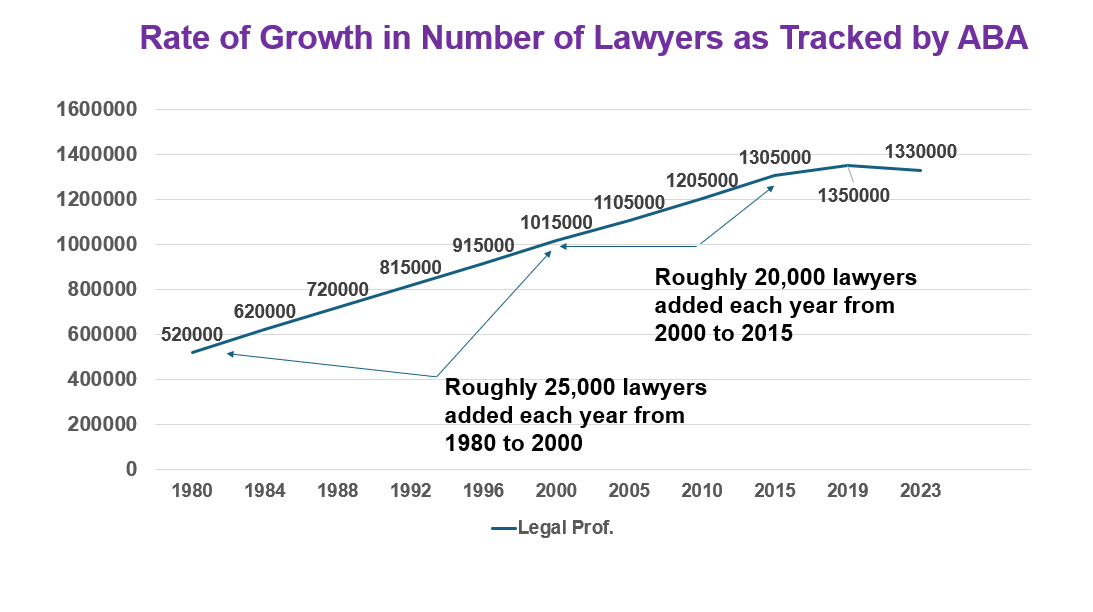
I think the most likely explanation is demographic. The attorneys that started the significant, sustained growth in the legal profession in the late 1970s and early 1980s are finally starting to retire or pass away in significant enough numbers to counterbalance new entrants into the legal profession, with new entrants also at a smaller number than a decade ago given the right-sizing of law school enrollment in response to the great recession.
It appears that the number of lawyers exiting the marketplace has increased sufficiently over the last decade that more full-time, long-term bar passage required positions were available to 2024 law school graduates than ever before with the demand remaining robust for 2025 law school graduates given the increased percentage of graduates in full-time, long-term bar passage required positions.
While we may have reached a point where the market for lawyers has “matured” and reached a “new normal” in terms of having a number of annual exits from the legal profession that more closely equals the number of new entrants each year, after the class of 2026, the classes of 2027 and 2028 will see increases in the number of graduates (based on increased first-year enrollment in fall 2024 and fall 2025) that may not be matched by the available jobs in the legal services market particularly given the potential impact of artificial intelligence.
It is possible that the class of 2024 will be the high-water mark for the number of graduates in full-time, long-term bar passage required positions while the class of 2025 will represent the high-water mark in terms of the percentage of graduates in full-time, long-term bar passage required positions.

Jerome Organ is the Bakken Professor of Law and Co-Director of the Holloran Center for Ethical Leadership in the Professions at the University of St. Thomas School of Law