hami3258 – Holloran Center Professional Identity Implementation Blog - Page 14
All Posts By

hami3258

Aric Short

Crowdsourcing Implementation Plans, Tools, and Techniques for Standard 303(b)(3)

By: Aric Short, Professor of Law and Director of the Professionalism & Leadership Program, Texas A&M University School of Law

As law schools welcome students back to campus this fall, a revised accreditation standard goes into force. Under the new Standard 303(b)(3), each law school “shall provide substantial opportunities to students for the development of a professional identity.” As explained in Interpretation 303-5, “[p]rofessional identity focuses on what it means to be a lawyer and the special obligations lawyers have to their clients and society.” Exploration of this topic should include the “values, guiding principles, and well-being practices considered foundational to successful legal practice.” Importantly, the ABA recognizes that professional identity formation is a process that takes time, experience, and reflection. As a result, students “should have frequent opportunities for such development each year of law school and in a variety of courses and co-curricular and professional development activities” (emphasis provided).

The ABA has taken a sequenced approach to implementation of this new professional identity formation requirement. In the fall of 2022, all law schools are expected to have initial plans in place to implement Standard 303. By the fall of 2023, schools are required to begin implementing their plans.

Figuring out exactly how to comply with this new ABA standard can be challenging. Embedded in that challenge are various procedural and structural questions. What process will your school use to evaluate existing professional identity formation efforts? Who will be in charge of ensuring compliance? Which law school stakeholders will be involved in that process? Will professional identity formation be introduced during Orientation? If so, how and by whom? Will 1L students take a course on professional identity formation or be required to attend a series of workshops? Or will similar themes be introduced in classes across the 1L curriculum? Similarly, how will each school continue to expose students to professional identity formation themes throughout the remainder of their law school experience—including in experiential courses and in interactions with offices supporting career services and academic support? Beyond these and other mechanical issues, there exist significant questions about content. What exactly does professional identity formation mean to your institution? What are the core themes you want to emphasize and reinforce with your students? And how will those themes be staggered and built upon so that students develop a deeper sense of their own professional identities as they move through law school?

To assist law schools as they work through these and other issues related to Standard 303(b)(3) implementation, the Holloran Center is announcing two new crowdsourced and collaborative resources. You and your school are invited to contribute to these resources and to learn new ideas and approaches to professional identity formation from colleagues across the country. While these resources are related, they have different purposes:

Resource #1: A repository of law school implementation plans for Standard 303(b)(3). This database, in Google Sheets, is intended to capture law schools’ evolving plans to implement Standard 303(b)(3). Each school is requested to share a narrative describing its Standard 303(b)(3) plan, as well as whether that plan is currently in draft or approved form. Schools are encouraged to provide a full description of their plans to help share creative and effective ways to implement this new Standard. This Google Sheet also asks for contact information for the person at each school responsible for Standard 303(b)(3) implementation, as well as anyone else on your staff or faculty who will be taking the lead in any specific professional identity formation efforts (for example, related to academic support, career services, clinics, externships, legal writing, doctrinal courses, etc.). Each school is also encouraged to provide links to any related web-based materials and to submit any other supporting documents through this Dropbox. While anyone with the link to this Google Sheet can review the submitted plans and contact information details, this document should be completed by the person at each school responsible for compliance with Standard 303(b)(3).

Resource #2: A clearinghouse of specific ideas, techniques, strategies, and tools related to professional identity formation. We know that many of you are already doing impactful work in this area, regardless of your title and the capacity in which you engage with students. This database, also in Google Sheets, provides a means to share those great efforts and learn new ideas from other law school faculty and staff across the country. Anyone who is engaged in professional identity formation efforts—big or small—is encouraged to share their ideas, as well as their contact information. This database is organized broadly in tabs across the bottom by the general area of student engagement, including academic support, career services, clinical / experiential classes, doctrinal classes, lawyering skills classes, student organizations, and professional formation courses. Within each tab, contributors are asked to indicate the primary professional identity focus of the exercise, program, or reflection and to include additional information, including the primary contact person for that contribution. We hope this format makes it easy for you to search for techniques and strategies that might be useful for you. In addition to providing a description of the professional identity work you are doing, you are encouraged to submit to this Dropbox any supporting documents that might be helpful for others, including syllabi, course plans, teaching notes, assessment tools, and grading rubrics.

A note on scope: As described above, these two new crowdsourced resources are focused primarily on Standard 303(b)(3), which relates to professional identity formation. The ABA has also implemented a new Standard 303(c), which requires law schools to “provide education to law students on bias, cross-cultural competency, and racism (1) at the start of the program of legal education; and (2) at least once before graduation.” Most of us working in this general space understand that bias, cross-cultural competency, and racism are foundational topics within professional identity formation. As a result, you and your school should feel free to share in the databases above specific implementation plans and strategies related to Standard 303(c). However, our primary focus is Standard 303(b)(3). We also encourage you to visit Buffalo School of Law’s Website on ABA Standard 303(c) for more specific information about efforts across the country to implement Standard 303(c).

We wish you and your law schools the best of luck as you create institutional plans and design specific techniques for implementation. Hopefully the two databases announced above will help you come up with impactful and effective ways to engage in this important work. We encourage you to share your ideas, to borrow from others, and to connect with other faculty and staff exploring professional identity formation.

Aric Short, Professor of Law and Director of the Professionalism & Leadership Program, Texas A&M University School of Law


Angela Schultz

Can Participation in Pro Bono Service Increase Student Well-Being? I’ve Seen It Happen

By Angela F. Schultz, Assistant Dean for Public Service, Marquette Law School

I have been at Marquette Law School for eleven years. Over the years, I have witnessed students become more willing and able to identify and discuss mental health challenges they have faced in their own lives—challenges the students themselves have described as stress, anxiety, depression, and sometimes as trauma. I remember one recent student who lost both parents during their first year of law school. Another student took a leave of absence and was hospitalized for severe anxiety. If you work with law students, you also know some of the challenges facing students’ well-being.

I can think of three recent conversations where students identified their involvement in pro bono service as being among the factors that ultimately aided them on a path towards wellness. These three students’ experiences are not unique. Each year, we evaluate student experience in pro bono clinics. Comments from a recent survey included: “This work reminds me why I came to law school in the first place.” “I was afraid of working one-on-one with a client because I didn’t realize I already had skills that could be helpful.” “I feel connected to the people served in the clinic. These are my people.”

Before I go on, let me acknowledge that pro bono service can come with a dose of fatigue, vicarious trauma, and feeling overwhelmed by the poverty, despair, and inequity in our legal system and in our world. But right now, in this brief blog post, I’m focusing on how serving others can contribute to one’s well-being.

According to Self-Determination Theory (SDT), all human beings require regular experiences of autonomy, competence, and relatedness to thrive and maximize their positive motivation. See Sheldon, Kennon M. and Krieger, Lawrence S., Understanding the Negative Effects of Legal Education on Law Students: A Longitudinal Test and Extension of Self-Determination Theory (July 2006). Pro bono service opportunities regularly offer all three.

Autonomy: Pro bono service often involves a student making a choice to engage in something of interest to them; to do something they want to do or something they believe in; and the ability to take initiative and be self-directed. At many law schools (though not all), pro bono is a voluntary activity. Students choose whether to get involved in pro bono service and how much service to do. Students often choose what kind of service to perform and may enjoy increased autonomy as they develop skills.

Competence: Pro bono clinics tend to be places where volunteers all get a chance to feel good at what they do, or at least the opportunity to make progress towards becoming good at what they are learning to do. Pro bono clinics are an avenue where students can gain skills. Looking again at the pro bono evaluation I send to students each year, students indicated the following skills were practiced frequently during pro bono service work: listening; the ability to see the world from another’s perspective; client interviewing; time management; communicating legal information in an understandable way to a client; creative problem solving; and legal/procedural issue spotting.

Relatedness: Pro bono service often (if not always) offers students opportunity to relate meaningfully with others. In our pro bono clinics (called, not surprisingly, the Marquette Volunteer Legal Clinics), law students are paired with volunteer attorneys to serve a client seeking civil legal aid. The lawyer/student pair gets to chat with each other and develop relationships. The client served by the lawyer/student pair typically brings a whole range of human experiences to the mix, from frustration and despair to hope and gratitude. The trio of lawyer, student, and client often laugh together, shake their heads in disturbance together, and sometimes experience victory together. For example, one team recently negotiated a $500 settlement during their time together with a creditor suing their client (a mother of three earning $16 per hour) when her cash loan of $250 ballooned quickly to $1,500. By the end of their two-hour shift, when victory had been achieved, the client asked me to take a photo of her with the law student and lawyer. Without a doubt, meaningful relatedness had occurred for everyone involved in that session.

Autonomy, competence, and relatedness are the experiences cited by research that lend to students’ feelings of positive motivation and well-being.

I’d like to suggest one more reason that pro bono involvement may lend to feelings of well-being: perspective.

Perspective: Pro bono service connects students to the community outside of law school. Law school takes up an extraordinary amount of time, energy, and money for months (and sometimes years) before the student even has their first day. Students sometimes live, drink, and breathe all things related to LSAT preparation. Then soon after they live, drink, and breathe all things related to the law school application process.  Then the actual law school experience begins which often presents students with the most academically challenging materials they have seen throughout their education. And law school almost always involves a student’s first experience with a mandatory grading curve. Students’ social lives tend to fill quickly with other law students. The overall experience can be insular and leave students questioning their very identity: Who am I now? Who will I be once I graduate from law school?

Pro bono service is a quick and vivid reminder of the vast world outside of all-things-law-school. People seeking pro bono legal services are getting by (sometimes barely) while facing excruciating circumstances. A law students’ LSAT score is not even remotely part of the list of challenges facing a client in the legal clinic preparing to represent themselves in their eviction hearing tomorrow. The C- grade a law student received in civil procedure somehow seems miniscule once they are hearing directly from a survivor of domestic violence seeking a civil protection order.

The student who lost both parents during their first year of law school pointed to their experience in the pro bono clinics as a significant part of their path towards creating a “new normal” for themselves. And the student hospitalized for severe anxiety cited her work with “real people” in the pro bono clinics as part of her own journey towards wellness.

Please contact me at angela.schultz@marquette.edu with comments or questions.

Angela F. Schultz
Assistant Dean for Public Service
Marquette Law School
AALS Section on Pro Bono & Access to Justice, 2022 Chair

Thiadora Pina

California, but not Dreaming: The Story of a Successful Mandatory 1L Professional Identity Course

By Thiadora A. Pina, Clinical Professor & Director of the Externship Program,
Santa Clara University School of Law

At Santa Clara University School of Law (SC Law), our Critical Lawyering Skills Seminar is a mandatory, 1-credit first-year course. The course is designed to develop our 1L’s professional identity, which includes cultural intelligence, values, and law student and lawyer wellness. Since 2018, our course evaluations remain overwhelmingly positive. Moreover, this high level of success is consistently achieved across eighteen small sections and all ten professors who teach this course.

The 1L Critical Lawyering Skills Seminar (CLSS) develops our law students’ professionalism by focusing on the top lawyering competencies students need to succeed and enter practice. Fortunately, we do not have to guess or rely on individual ideas or experiences to understand how law students can best prepare to enter the legal market and thrive as new lawyers. The work has been done for us.

There are multiple studies that clearly tell us which skills, characteristics, and values are important for new and successful lawyers. CLSS uses this data, in conjunction with the principles of positive psychology and andragogy, to ground its pedagogy. CLSS relies on the following studies:

  • Foundations for Practice (IAALS) (2016)
  • Attorneys General/Non-Profit (ROADMAP) (2018)
  • Small and Large Firms (ROADMAP) (2018)
  • Predicting Lawyer Effectiveness (Shultz/Zedeck) (2011)
  • Building a Better Bar (IAALS) (2020)


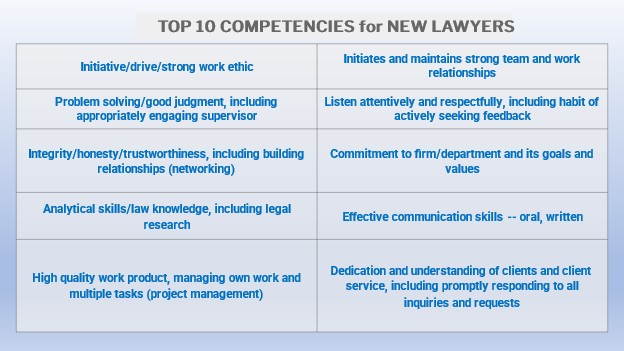
CLSS helps students think strategically about their professional identity and the critical skills they need to practice law successfully by focusing on the top competencies these studies identified as necessary for first-year lawyers. Collectively, the following competencies bubbled to the top:

Because SC Law was an early adopter of this focused pedagogy, the challenge was how to teach and scale this course across the 1L class. Other than Neil Hamilton’s ROADMAP text, no other widely circulated curriculum focused on law student professional identity formation. Nonetheless, SC Law remained committed.

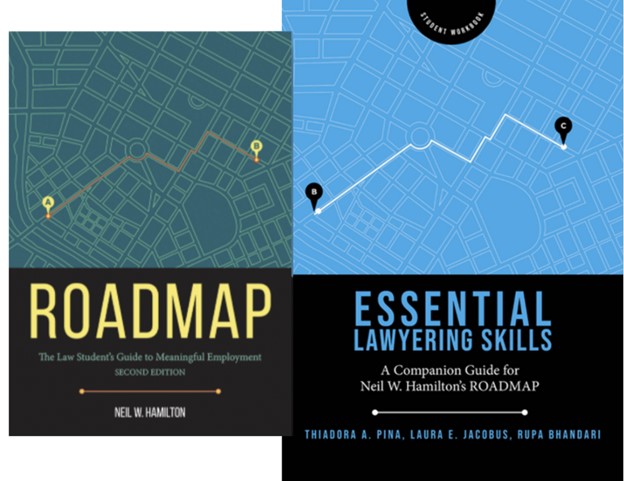
This commitment eventually led to developing and adopting a professional identity curriculum packaged (with ROADMAP) into an interactive Workbook, Essential Lawyering Skills: A Companion Guide to Neil W. Hamilton’s ROADMAP (ELS), published in September 2021 by ABA Publishing.

ELS is data driven and builds upon ROADMAP’s strong foundation by providing activities that personalize each student’s path to professional identity and meaningful employment. ELS enables students to take charge of their own professional development and strengthen the lawyering skills legal employers have identified as necessary for first-year lawyers to succeed.

Because CLSS is a mandatory first-year experiential course, SC Law designed its curriculum for consistency. When ELS is paired with ROADMAP, the ELS Student Workbook and ELS Professor Manual provide a turnkey solution for those instructors and schools focused on law student professional development.

Essential Lawyering Skills: Thiadora A. Pina, Laura E. Jacobus, Rupa Bhandari (ABA Publishing, 2021). Visit the ABA website or https://www.pinbuspd.com/ for more information.

The ELS Workbooks are also adaptable. For example, some schools may not have dedicated professional identity courses, or they may choose to teach large class sections or teach during orientation or school breaks. The ELS Workbooks have a modular design, which can be separated into different parts. Schools and professors may choose any individual module or pair several modules together.

The “traditional” course syllabus for the class only includes SC Law requirements and basic class policy, but the content of the class can be found in the ELS Workbook that each small section of CLSS uses. Attached below are the Table of Contents for the ELS Student Workbook (SW) and the ELS Professor Manual (PM), which provide a substantive preview of the class.

ELS Student Workbook (SW) and the ELS Professor Manual (PM)

You are also welcome to contact Thiadora Pina directly: tpina@scu.edu with questions regarding either the books or the CLSS course. Good luck and have fun implementing the new Standard!


Thiadora A. Pina
Clinical Professor
Director, Externship Program
Faculty Advisor: BLSA + First-Gen Law Student Association
Santa Clara University School of Law
Essential Lawyering Skills (ABA 2021)
email | tpina@scu.edu
Website | https://law.scu.edu/externship/
phone | 408.551.3268

Christopher Corts

Better Conversations? Let’s Talk About It

By Christopher Corts, Professor of Law, Legal Practice, University of Richmond School of Law

Hello, reader! Today I am writing the first of a two-part series that will explore why and how we might facilitate better public conversations, especially when they include controversial topics. In today’s entry, Part I, I will explain why I think new ABA Standards 303(b) and (c) present an opportunity to have some hard but necessary public conversations. I will also share some thoughts on why we should have those conversations, why those conversations can be so difficult, and what we can reasonably expect them to accomplish. (Spoiler alert: not much! Even so, I think they are important for reasons I will explain.)

In a future blog post, Part II, I will give concrete ideas for how to plan and facilitate public conversations in a slower, less reactive, more intentional, inclusive, and meaningful way.

Whenever I facilitate a public conversation, my aim is to try and find a way to facilitate mutual compassion, respect, and trust among participants from the very start. Trust makes broader participation more likely. In my experience, when trust exists, it can also improve the quality of conversation by improving the likelihood that candid, authentic points of view will be voiced—and heard. We should want everyone to leave the conversation thinking something like: “I appreciate the opportunity to finally speak from my heart, and I have appreciated hearing others speak from theirs.” (Why I think this is so important will likely become clearer as you read on.)

Facilitating these kinds of conversations will be especially important as we implement new ABA standard 303(b) & (c). At the risk of understatement: there is nothing close to universal agreement about these standards. Even so, they exist. Now what?

Well…let’s talk about it.

For the unfamiliar: new ABA standard 303(b) mandates that “a law school shall provide substantial opportunities to students for…the development of a professional identity.”  New ABA Standard 303(c) specifies that, as part of its curriculum, “a law school shall provide education to law students on bias, cross-cultural competency, and racism.”[i]

Considered together, these two new standards suggest that, if we are going to effectively teach students how to internalize a professional responsibility for clients and the integrity of the legal system [as we must, under Standard 303(b)], we must help students learn how to detect, address, and overcome the pernicious effects of racism and bias [Standard 303(c)] in our own profession.

“We” cannot credibly pretend to hold a unified, consensus point of view on any of this. And if you disagree with me …I invite you to take issue with me which helps to illustrate the point.

Talking about racism and bias introduces language, concepts, and (different) preferred modes of discourse. Educating students about racism and bias from a distance will not do. We desperately need to assume a curious, searching, self-aware, self-critical approach. And as we do: welcome the many different perspectives on what is worthy of criticism in our community.

This might be unpleasant—but it is not unhealthy. A healthy community must learn to live in conversation with itself through serious conflicts, or it cannot exist as a community. We need to model for our students a way of facilitating conversations designed to do that. Especially because we live and work in a dominant culture that indulges in calling-out more than conversation, values casting-out more than confession, and is more eager to cancel—or complain about cancelling—than showing signs of contrition.

We are a roiling mess, you may have noticed.

The American Bar Association’s “Profile of the Profession,” published annually, can help us start the hard conversations that we need to have. Before we get to any discussion of values, politics, perceptions, policies, aspirations, or goals….we need to understand who “we” are, demographically, and work our way out from there. Historically—and in the year 2022, specifically—where, when, and how well have we included (dare we ask: how well have we welcomed?) people of color, women, sexual minorities, people with disabilities, and other historically-excluded-or-marginalized people into all the corners of our profession?

To be sure, the data paints an encouraging picture of progress. Things are better, yes! And still so horrible. The data also paints a sobering, bleak, and utterly pathetic picture of how we continue to struggle to undo the stubbornly pernicious effects of America’s long history of racism, bias, and exclusion. With a shared understanding of the current demographic data (and recent trends) in view, we can move on to voicing the harder, more contestable, and wildly variable personal perceptions, beliefs, experiences, commitments, political convictions, and values that, collectively, are represented among us.

My own experience participating and facilitating hard conversations began over two decades ago, prior to law school, in a different profession. While pursuing a master’s degree in theology, I began to train and engage in ecumenical and inter-religious dialogues about a range of hotly-contested political, theological, and social issues.  In recent years, in partnership with the Inner Work Center (formerly known as the Chrysalis Institute, located in my hometown of Richmond, Virginia), I have moderated a series of public conversations involving faith leaders who represent six of the world’s religious traditions, on a range of hot topics related to living, dying, sin, grace, justice, and social transformation. And, like all law professors, I have had many opportunities to either participate in or facilitate hard conversations in and out of the classroom with students, faculty, staff, and alums. (Most recently, these kinds of conversations have tended to recur in my work as a co-facilitator of a spiritual well-being program for first-generation 1Ls, called Just Practice; as co-facilitator of a Law, Race, and Power (LRP) Speaker’s Series; and as co-facilitator of a LRP spin-off program, Let’s Talk About It).

All of these experiences have helped me appreciate the value of a form of conversation that is distinct from arguments or debates. The point of these conversations is to speak with courage, hear with compassion, and be heard without being contradicted. And, by doing that, to simply know ourselves and each other better.

The starting point for these conversations is a mutual agreement to forswear any attempt to try and correct or convert dissenters. All speakers are liberated to voice their point of view without being interrupted, corrected, confronted, contradicted, or condescended-to. It is conversation that permits error, tolerates confusion, extends grace to the mistaken or offensive. It is focused on bringing hidden things to light—the deepest hopes, fears, grievances, and frustrations that too often remain hidden beneath the surface in everyday discourse. It is not a conversation that is burdened by usefulness; it is not designed to fix anything, resolve anything, or identify any commonality or unity. It is conversation that is beautiful and pleasing because it invites everyone present to speak and be heard if they wish, on topics of their choosing.
At their best, these kinds of public airings elucidate the sharp contours of conflict and difference. It’s hard work; many of us prefer conflict-avoidance. Speaking with candor and authenticity takes courage, but hearing those things without reacting or making snap-judgments does, too. To speak and hear things that expose deep differences requires a kind of humility and curiosity, a willingness to risk, and a radical tolerance. The goal is to get it all out—to hear “it” all, whatever “it” may be. And then to just let it be, for now.

In my experience, these kinds of conversations can be hard in two senses. First, they require at least some participants to hear and understand information that is in tension with—or possibly even in direct contradiction to—their perceptions, values, political commitments, religious convictions, or personal experiences. Everyone will likely hear (albeit at different times) stupid, offensive, wrong-headed, poorly-reasoned, outrageous, misguided, flat-wrong things. But this is not a problem; it is the point, really.

And so, hard as it may be…to engage in this conversation requires everyone to buy-in to the premise that it might be difficult to join in this conversation. Public displays of emotion are possible, maybe even likely. And that is ok. And everyone, of course, must be free to exit themselves from the conversation if they wish, whenever they wish.

These kinds of conversations are also “hard” in a second sense—in the way that they can tax the patience and goodwill of everyone participating in them. These kinds of conversation take a lot of time, intention, planning, and discipline. Bluntly: hard conversations do not seem to accomplish much. This can be especially irritating for lawyers, who tend to suffer from acute time deprivation. Most of us have been taught to value efficiency, crave productivity, and adopt a bias toward action. We are valued for our issue-spotting and problem-solving capabilities. It is hard to have a conversation that is not a means to some clear, desirable end.

For me? They can be difficult. But I have learned to appreciate how these conversations give a clearer field of perception, a sharper and more nuanced view of just how diverse, different, disunified, and riddled with conflict, division, and disagreement we really are. And I experience a strange satisfaction when, after the conversation, I can continue to dialogue and converse casually with the participants knowing more about just how radically different we are, in some ways—while enjoying the mystery of how we are able to co-exist with genuine kindness, respect, and civility, just the same.

On that hopeful and buzz-killing note, I will conclude this Part I. Next time, in Part II of this series, I will share concrete suggestions for how you might plan and execute public conversations about difficult topics in a way that is most likely to include the most people and elicit the most candid, forthright, and sincere comments possible—especially the ones that are voiced in criticism or dissent.

Until then…if you have any questions, concerns, or comments you would like to share, please email me! I would love to hear from you. You can reach me at ccorts@richmond.edu.

Christopher Corts, Contributor

[i] For a helpful introduction to these standards, see Neil W. Hamilton and Louis D. Bilionis, “Revised ABA Standards 303(b) and (c) and the Formation of a Lawyer’s Professional Identity, Part 1: Understanding the New Requirements,” PDQ in NALP Bulletin+ (May 2022).

Janet Stearns

Postcard from Miami

By Janet Stearns, Dean of Students, University of Miami School of Law
August 24, 2022

We have just concluded our orientation week at the University of Miami School of Law. I thought that I would share some lessons learned from this year’s program as we all work to set the right tone on well-being and mindfulness.

This year, day 2 of orientation included rotating programs for all of our incoming JD students:
–Mindfulness & Well-Being
–Academic Integrity & Professional Identity
–Inclusion, Belonging & Professional Identity
–Panels of upper-level students sharing advice and insights with the 1L’s.

While we included some aspects of all of these themes in past years, the focus on ABA Standard 303 guided us to sharpen our message in some important ways.

The Mindfulness & Well-Being program was the culmination of a powerful collaboration throughout this summer between my colleagues Jack Townsend, a Miami Law graduate who joined our team one year ago as an Assistant Director of Student Life, Scott Rogers, Director of our Mindfulness in Law Program, and Marcia Narine Weldon, Director of our Transactional Skills Program, and a consultant on legal coaching particularly in the area of growth mindset and  lawyer well-being.

We framed our presentation to address and respond to three concerns common to many 1Ls.


First, the feeling of overwhelm.

During this section, I spoke of the importance of managing time to balance school obligations and goals with self-care and other personal priorities.  Drawing on the work of Steven Covey, in his book First Things First, I used a jar to demonstrate the importance of identifying our life’s big priorities (i.e., the “big rocks”) and find strategies for ensuring that all of the big rocks can fit into the jar. One goal is to identify the big goals during these next three years of law school. Another is to manage time so that we don’t waste it all on “little rocks” so that we can’t get to our “big rocks.” As you can see the jar also includes a tea bag (because we can never be too busy for a cup of tea with a friend.)  All members of the panel reflected on our own valuable self-care practices and how we managed time to support these practices as well as our other life goals.

Next, concerns about fear.

To this, Marcia drew on a range of practices to manage fear, from breathing exercises, movement exercises, and tapping.  She reflected on her own recent travels (to Machu Picchu) and her consulting with law firms and major corporations around professional coaching. She spoke also about the power of growth mindset to tame fears, enhance our brains and emotions, and develop confidence. All members of the panel reflected on tools that we used to address fears in law school and beyond.

Third, self-doubt in law school, including imposter syndrome. This provided the foundation for Scott to discuss and demonstrate the power of mindfulness practices in law school.  Scott shares a powerful image from his book Mindfulness for Law Students that depicts the “Roller Coaster of E-Motion.” Scott spoke to the ways that mindfulness can train our mind to have awareness of the patterns that sabotage our “freeway of flow” where we can best focus on law school and our other pursuits. This section then led into a mindfulness exercise for all.

In between each of these three sections, Jack invited each student to reflect and write on a designed card; students had five minutes to journal. The goals were both to provide opportunity for self-reflection and also to document each student’s emotions and insights from the session. At the conclusion of the program, each student was asked to put the card in a sealed envelope with his/her/their name on the cover.

Our intention is to return the cards to the students in November near the end of the semester and before finals. We hope that this will provide a reminder of their own thoughts on tackling overwhelm, fear, and self-doubt as they gear up for the end of the semester “push.”

Measuring the efficacy of our interventions is a challenge for me, and one that I am striving to address in the upcoming year. Anecdotally, I will note that I attended a reception for one of our affinity groups four days after this program. Several students came up to me to tell me that they had been pondering their “big rocks.” Students have also approached me to obtain information on where I am practicing yoga (one of the self-care activities I spoke about) and how they could join. Each and every one of these encounters suggests positive steps as we build our community of well-being and model our own approaches to integrating wellness with our professional identities.

I welcome comments and opportunities to learn from others as to how you are addressing these important topics in Orientation 2022.


You may contact me at jstearns@law.miami.edu.

Dawn Figueiras

One Law School’s Faculty-Approved Implementation Plan for Complying with the ABA’s Revised Standards 303(b) and 303(c)

The American Bar Association (ABA) requires that all law schools develop a plan in the fall of 2022 regarding how schools will implement in the fall of 2023 the revised ABA standards 303(b) and 303(c) that cover professional identity formation and bias, cross-cultural competency, and racism. Appalachian School of Law (ASL) tasked its Curriculum Committee to draft a proposed plan for compliance with the revised standards. The Committee, chaired by Professor Dawn Figueiras, included the Honorable Larry G. Elder, Professor Jeremy Hurley, Associate Dean of Students Shelly James, Dean of Experiential Learning Lucy McGee, Professor Ken Russell, Chief Academic Officer Laura Wilson, and President & Dean Keith Faulkner. The committee spent the summer discussing what ASL already does in these spaces and how ASL would utilize those efforts, along with new ones, to create a proposed plan for the faculty to review. Professor Figueiras participated in webinars sponsored by AALS, SUNY-University at Buffalo School of Law, and others, and gratefully utilized the resources links compiled and hosted on the Buffalo School of Law website. On August 8-9, 2022, at ASL’s Faculty Retreat, the Committee presented its plan to the faculty and engaged in productive discussions to revise the plan. Although the ABA did not set a date for completion of the plan, the full Faculty unanimously adopted the Implementation Plan below on August 16, 2022.

The following is the IMPLEMENTATION PLAN FOR REVISED ABA STANDARD 303’s REQUIREMENTS approved by the ASL faculty.

ADOPTED ASL Implementation Plan for Revised Standard 303 2022-08-16 (003)

A.  Revised 303(b)(3)—“provide substantial opportunities to students for . . . the development of a professional identity.”

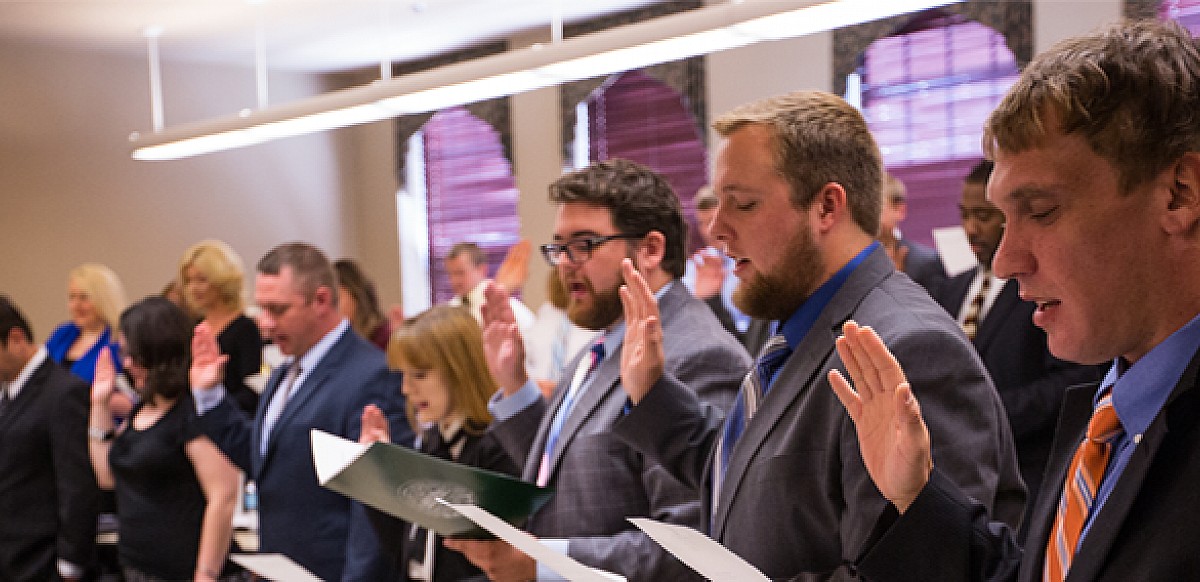
  1. Orientation: Administration of the “Professionalism Oath” by a Virginia Supreme Court Justice or Court of Appeals Judge. The Professionalism Oath is modeled after the oath given to new members of the Virginia State Bar about their professional duties and responsibilities; students take the Oath after being sworn and sign the Oath as well.

    Students take the Professionalism Oath at ASL

  2. During Orientation/early during 1L year: Organize a visit to a Court, preferably a federal court; give students opportunities for reflection on their experience.
  3.  Fall Semester, 1L year: Revise “Introduction to Community Service” course to incorporate at least three lectures/sessions about concepts of professionalism and professional identity formation. Rename course: “Building a Professional Identity.
    a. Possible examples of topics may include: What kind of lawyer do I want to be? What character/personality strengths do I possess and what does that mean for my career choices? How do I conduct myself in a professional manner? How do I incorporate community service and pro bono service into my career?
  4. Spring Semester, 1L year: Lecture series for 1Ls (3 events) involving professionalism and/or professional identity formation. This would be incorporated as part of the Dean’s new “Professionalism, Leadership, and Transition to Practice” (“PLT”) program.
  5. Summer after 1L year: Students participate in an Externship placement and keep a journal documenting their experiences and self-reflections.
  6. 2L year: The PLT program will incorporate four formal sessions on leadership; at least one session will discuss and encourage leadership within the legal profession.
  7. Annually: Professionalism Dinner event (part of PLT program). Select a bar leader to receive a Professionalism Award from ASL. Invite attorneys and judges to attend, with professors, to engage in discussion with students regarding professionalism/ethical issues.

B.  New 303(c)—“provide education to law students on bias, cross-cultural competency, and racism … at the start of the program … and at least once again before graduation.” “For students engaged in law clinics or field placements, the second educational occasion will take place before, concurrently with, or as part of their enrollment in clinical or field placement courses.”

  1. Orientation: Lecture/session by ASL Diversity Mentor Virginia Supreme Court Justice Cleo Powell. (Fulfills the requirement for one educational experience at the start of the J.D. program)
  2. Spring Semester, 1L year: Incorporate into the required “Introduction to Externships” course at least one mandatory session on bias, cross-cultural competency, and/or racism. (Fulfills the requirement for a second educational experience prior to/concurrently with externships and other field placements.)
  3. Spring Semester, 2L year: Incorporate into the required “Professional Responsibility” course at least one mandatory session on bias, cross-cultural competency, and/or racism.
  4. 3L year: The Professionalism, Leadership, and Transition to Practice (“PLT”) program will include six sessions on Transition to Practice; at least one session will incorporate discussion of issues involving bias/cross-cultural competency/racism that arise in legal practice.
  5. Curriculum-wide: Encourage all faculty to incorporate discussions of racism/cross-cultural competency/bias into their courses, wherever the regular course of study offers such an opportunity. The subject matter should be documented in the Course Description and in the Course’s Syllabus by the professor.
  6. Elective Courses: Offer electives with a significant component addressing bias, cross-cultural competency, and/or racism. Elective courses will outline in their Course Descriptions/Syllabi how bias, cross-cultural competency, and/or racism are addressed in the course. Currently, ASL offers “History of Race and the Law” (co-taught by the Hon. Larry Elder and adjunct Professor and ASL Diversity Mentor Chris Young) as a general elective in both Fall and Spring semesters, and “Poverty, Health, and the Law” (taught by Dean of Experiential Learning

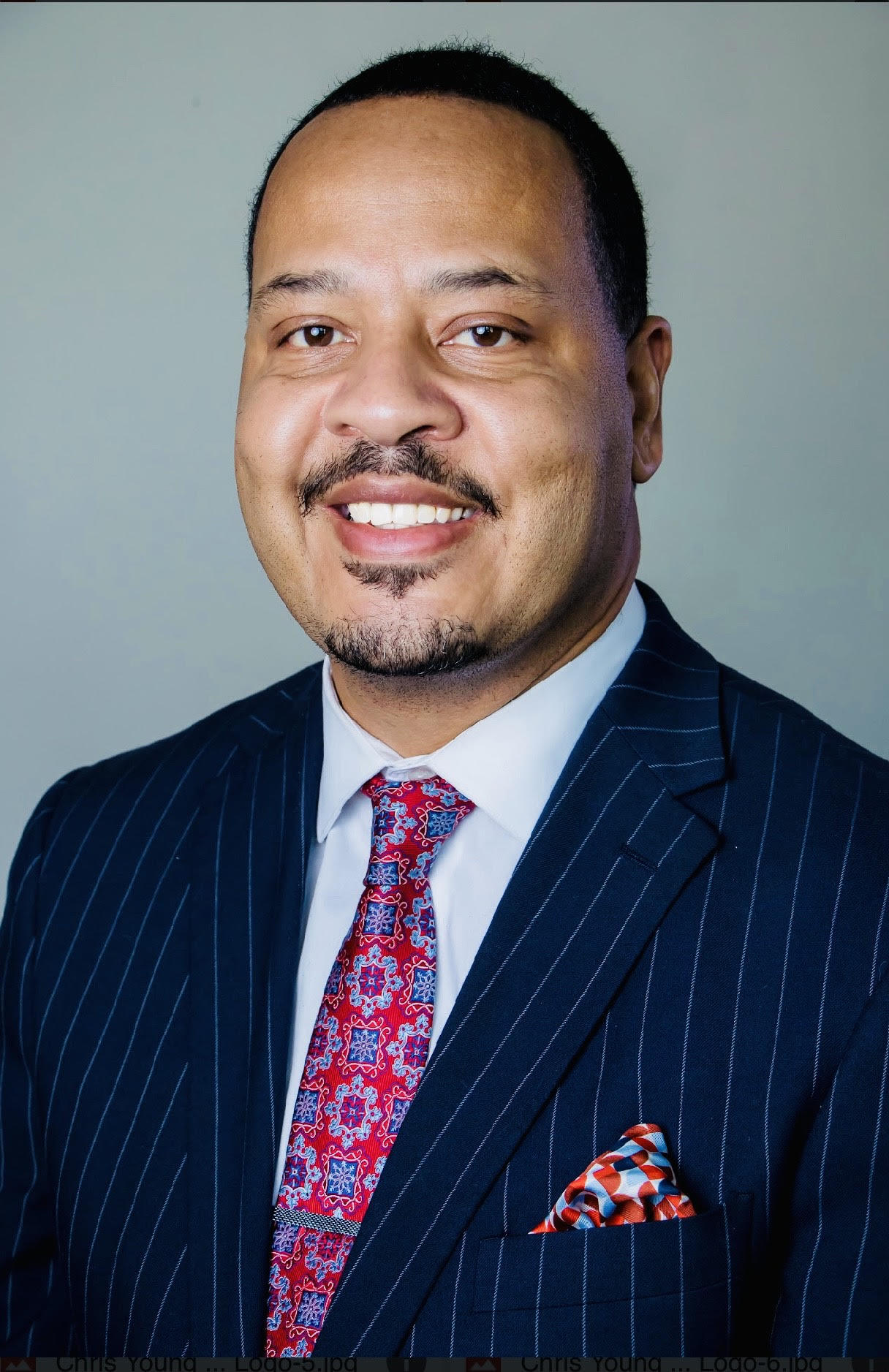
    Professor Chris Young

    Lucy McGee as a general elective in Fall and Spring semesters as well as summer sessions. This course is a pre-requisite for student participation in ASL’s Medical-Legal Partnership Clinic. The Clinic is a joint project of Ballad Health Systems, ASL, and Virginia Tech’s Pamplin College of Business.


Should you have any questions or if you would like to discuss the plan, then please contact Professor Dawn Figueiras at dfigueiras@asl.edu.

Guest Contributor Professor Dawn Figueiras