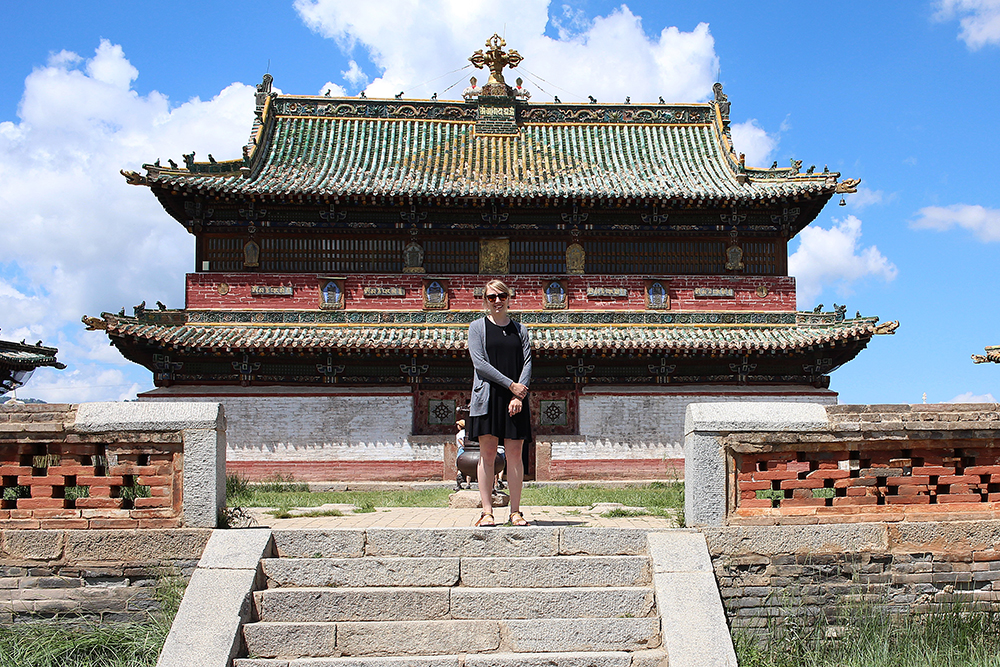
Erdene Zuu Monastery in Kharkhorin, Övörkhangai Province, Mongolia. Erdene Zuu is likely the oldest extant Monastery in Mongolia.
Sam Wisneski is a graduate student in the Master of Arts in Art History program. Sam was awarded a Department of Art History travel grant to participate in a Buddhist Art field seminar in Mongolia this summer and to conduct research on contemporary art in Ulaanbaatar.
In July 2018, I had the opportunity to travel to Mongolia to study Buddhist art and architecture and contemporary art. As a recipient of a Department of Art History travel grant, I spent a month traveling in both rural Mongolia and in the capital, Ulaanbaatar. My goal for this trip was to learn more about the historical development of art and Buddhism in Mongolia, in order to better understand modern and contemporary Mongolian art.
This was not my first time visiting Mongolia. I had been there for an extended stay in 2016 where my exposure was limited to mostly rural life, but it proved to be an absolutely invaluable and formative experience. Since returning to my graduate studies in 2017, I felt strongly that I wanted to visit Mongolia again, but to examine it with the eyes of an art historian.
During spring semester 2018, I enrolled in Dr. Elizabeth Kindall’s Buddhist Art class, where it first occurred to me to examine Buddhist imagery in contemporary Mongolian art. It was one of those few serendipitous moments in which my interests in Buddhist art and contemporary art intersected in an exciting way. A few weeks into the semester, I got the chance to seriously entertain the idea of traveling to Mongolia again when I came upon a summer Buddhist art field seminar led by art historian Dr. Uranchimeg “Orna” Tsultem.
Buddhist Art Field Seminar
For ten days, I traveled alongside Professor Uranchimeg with another pupil, a trip organizer, and our expert driver, mostly via the rutted dirt paths (a.k.a roads) in rural Mongolia. For a lot of the time, we were off-roading in a mini-van and occasionally found ourselves in some peculiar situations. At one point, we literally drove through a river.
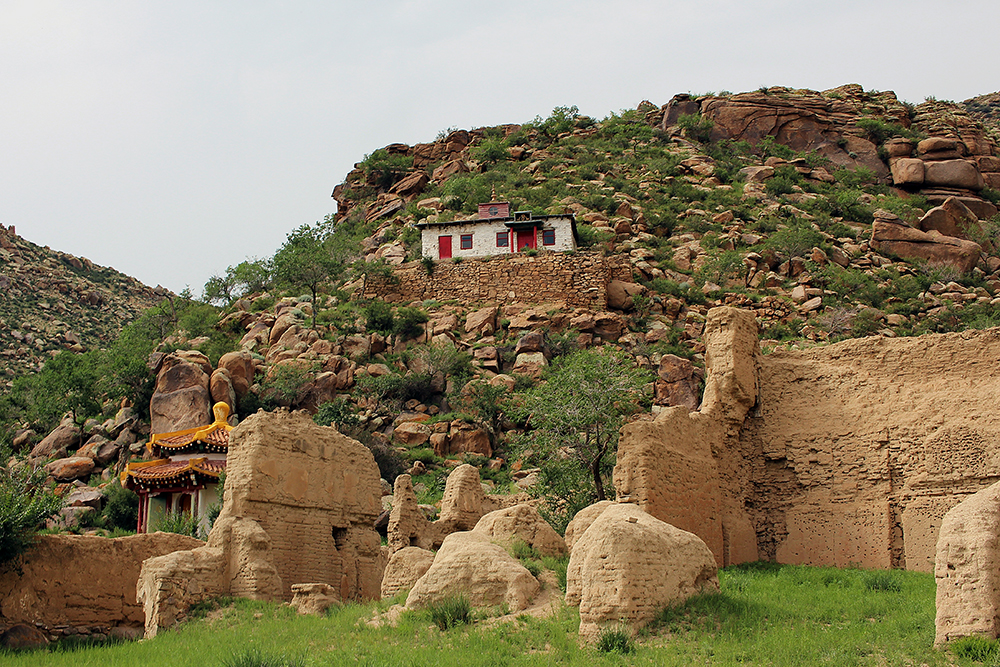
Övgön Monastery, Khögnö Khan Mountain
We had an ambitious itinerary with travel planned across several provinces. Unfortunately, we did not make it to all of the sites on our itinerary due to an outbreak of hoof-in-mouth disease that had stricken livestock in one of the provinces we planned to visit.
With our altered itinerary, we split our time between two central provinces and the capital, Ulaanbaatar, where we visited many of Mongolia’s most significant temples, monasteries, and museum collections. We, of course, had to visit the famous ancient Mongol capital of Karakorum (Kharkhorin), home to (likely) the oldest monastery in Mongolia, Erdene Zuu. We also visited Övgön Monastery, with its charming clusters of small colorful temples, and the mountain retreat meditation caves and temples of Tövkhön Monastery, my favorite site on the itinerary.
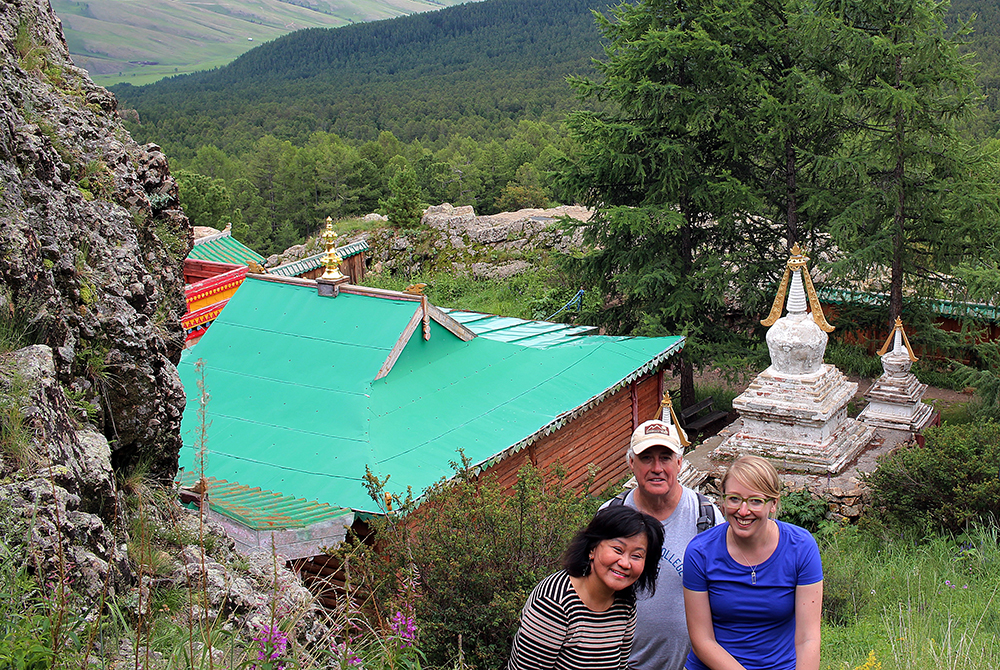
Tövkhön Monastery is situated in the mountains and has spectacular vistas.Visitors must drive to the base of the mountain and hike or travel by horseback to reach the monastery. I am pictured here with Professor Uranchimeg and fellow traveler, Jack.
In Ulaanbaatar, we visited major Buddhist sites including the Gandantegchinlen Monastery, the Daishchoilin Monastery, the Bogd Khan Winter Palace Museum, and the Choijin Lama Museum. The latter two sites house impressive museum collections and several temples. We also visited the Zanabazar Museum of Fine Arts, which houses important Buddhist works, many of which were executed by the museum’s namesake, Zanabazar. Zanabazar was the sixteenth Jebtsundamba Khutuktu and the first Bogd Gegeen of Mongolia, effectively the spiritual head of Mongolia. He was also a polymath and artistic visionary and is credited with ushering in a golden age of art in Mongolia.
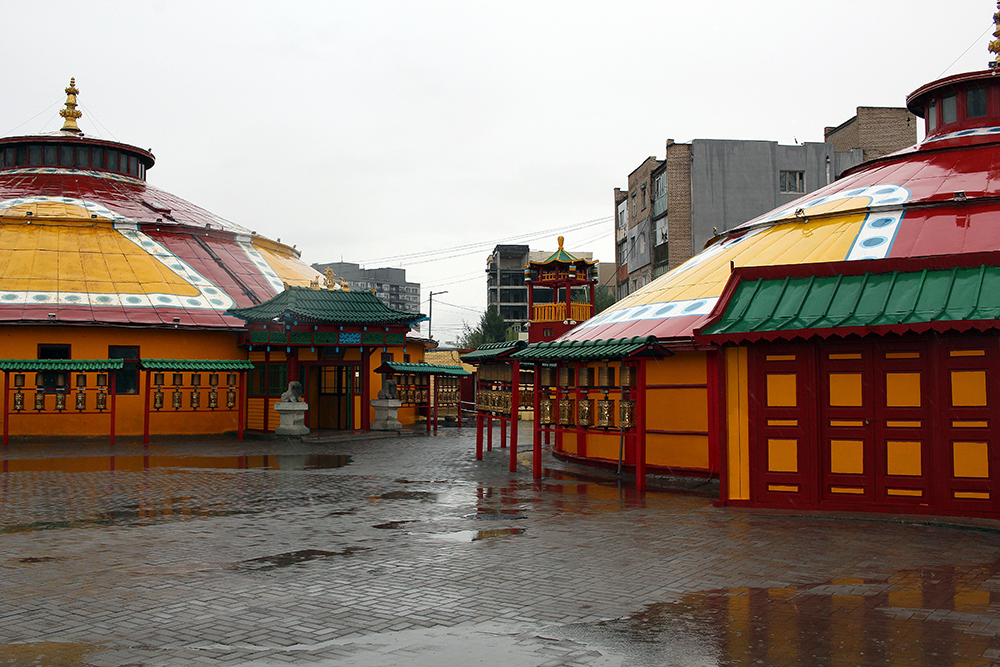
Daishchoilin Monastery has temples built in the shape of a Mongolian ger (yurt).
Having dedicated the entire seminar to Buddhist art and architecture, it is shocking to consider that the sites we visited are only a tiny fraction of the temples and monasteries that once dotted the Mongolian landscape. It is estimated that more than 1,000 monasteries and temples were destroyed during the communist period (1924-1992). Only a handful of monasteries survived, two of which we visited. Since 1990, some monasteries have been rebuilt, and many Mongolians practice Buddhism once again, though its revival has not been without difficulty. Limited financial support and a young monastic community are just two of the challenges Buddhism faces in Mongolia.
Contemporary Art in Mongolia
After ten days of the field seminar, I still had nearly three weeks left to explore Mongolia’s contemporary art scene. I planned to keep a loose schedule for those three weeks, with the hope that I could arrange some studio visits with artists, while fitting in gallery and museum visits as well. With the gracious facilitation and help of Professor Uranchimeg, I got in touch with several artists, many of whom are trained in the style of Mongol zurag (literally, ‘Mongolian pictures’). Mongol zurag is characterized by fine brushwork, vivid colors, narrative composition, and a flat perspective. I have long had an affinity for South Asian miniature painting and Tibetan thangka, so I was immediately drawn to the shared formal qualities of Mongol zurag.
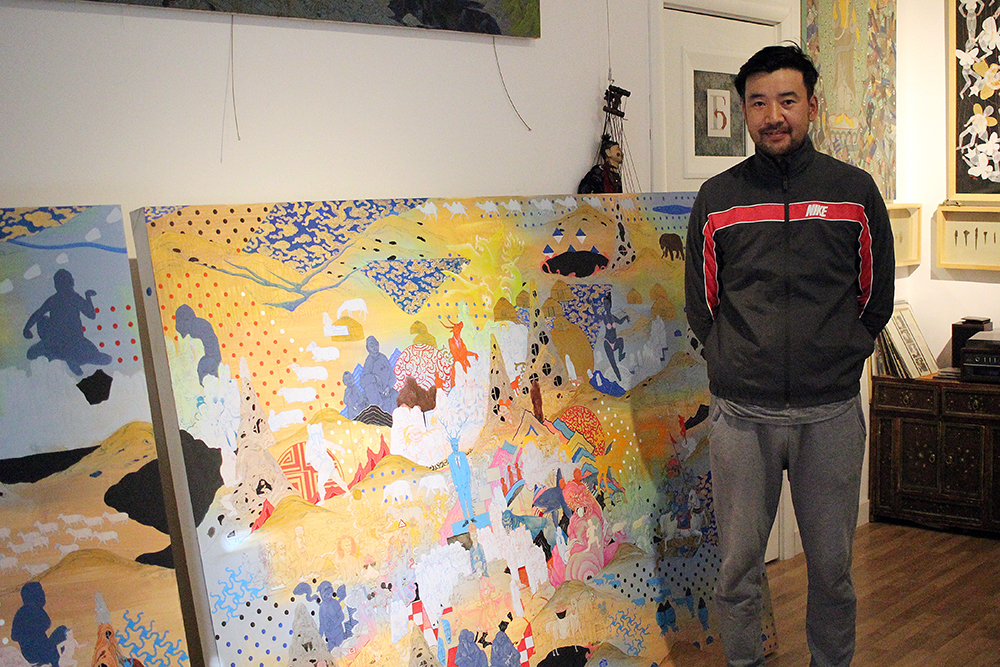
Mongol zurag artist Baatarzorig poses in front of his recent work, MGL. MGL was recently exhibited in “Five Heads (Tavan Tolgoi)—Art, Anthropology and Mongol Futurism” in London.
I was eager to meet any artists willing to speak with me, but I was especially excited to meet two in particular: Nomin Bold and Baatarzorig Batjargal, two Mongol zurag artists who also happen to be married. I had followed both artists on Facebook and elsewhere online, hoping to someday see their work in person. I found their work vibrant, complex and rich with social commentary.
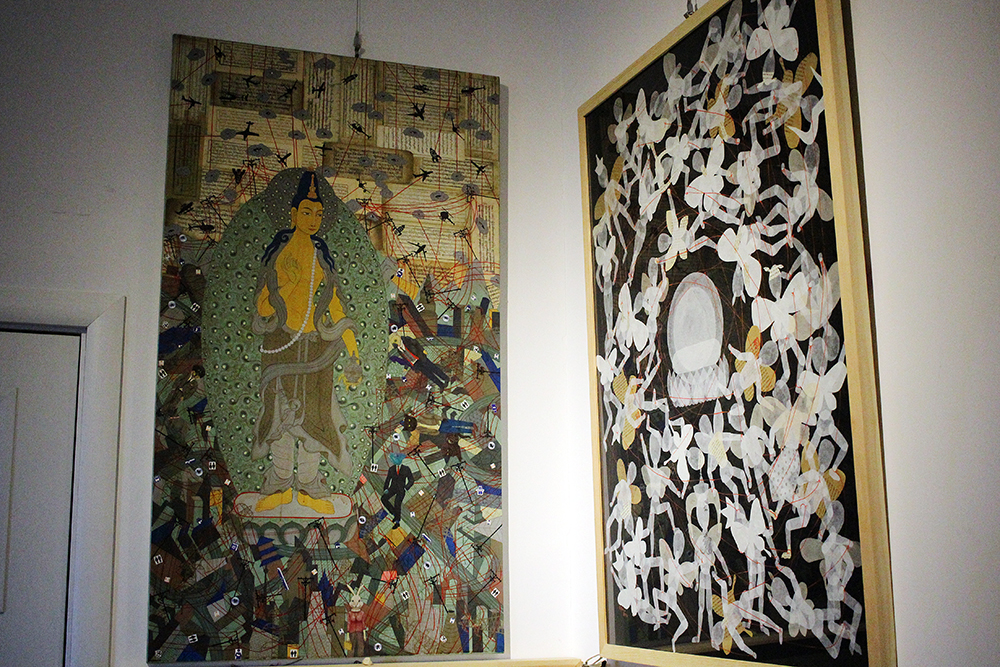
Works by Mongol zurag artist Nomin Bold in the artists’ joint studio.
Truthfully, my eagerness stemmed partly from the fact that the Minneapolis Institute of Art very recently acquired one of Baatarzorig’s paintings, Smoke (2017). The sheer luck of the timing of my research, my travels, and this exciting acquisition was unreal, especially given the fact that there are so few works of contemporary Mongolian art in American museums. With news of the acquisition, I felt obligated to meet Baatarzorig, to better understand Smoke, and to share what I learned with others. (I had the pleasure of doing exactly that at the Midwest Conference on Asian Affairs held October 19-20.)
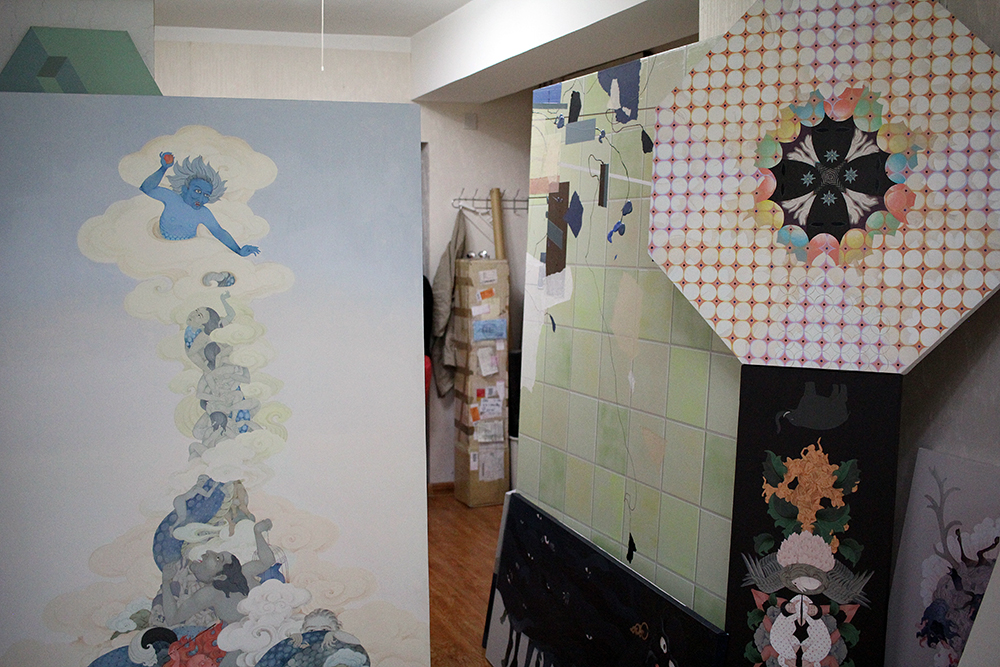
Works by Mongol zurag artist Uuriintuya, which were recently included in a solo exhibition at Art Space 976 in Ulaanbaatar in September 2018.
I was quietly ecstatic and slightly nervous about the opportunity to meet Baatarzorig and Nomin, along with several of their Mongol Zurag peers, including Uuriintuya and Baasanjav. The hospitality and openness of each artist was humbling, and the experience reaffirmed my interest in contemporary art in Mongolia as each artist described their work and practice to me.
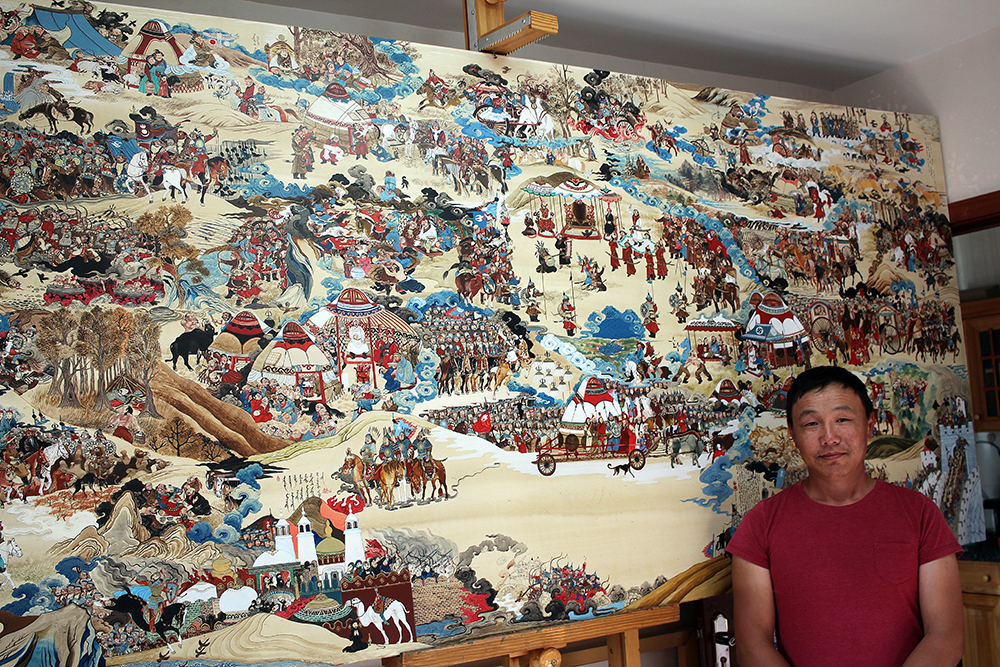
Mongol Zurag artist Baasanjav poses in front of a work in progress. This narrative painting contains scenes of Mongolian history. He has been working on this piece for three years now, on and off. The opportunity to see this work in person was incredible!
Once more, I left Mongolia with a resolve to return and a deep sense of gratitude for all that I experienced. In addition to my advisor Dr. Kindall and the Department of Art History, I owe a special thanks to Professor Uranchimeg and my Mongolia Quest guide Ayush, and to the gracious artists who opened their studios to me.
 Abby Slawik is currently in her first semester in the Non-Degree Program in Art History. She is enrolled in Imaging the Other: Representation of/in Pre-Columbian and Early Colonial Mexico and Peru.
 Ann Arntson recently completed her first semester in the Museum Studies Certificate program at the University of St. Thomas in fall 2019.