
Sometimes, the smallest, most insignificant things can be transformed into something much greater. This is certainly the case at the Ave Maria Grotto in Cullman, Alabama, where a Benedictine monk’s hobby of creating items out of concrete and found materials turned into a world-famous tourist attraction. This summer, I was fortunate to receive a St. Thomas Graduate Art History Department travel grant to spend a week at St. Bernard’s Abbey researching the Grotto. I had three goals:
- Experience and explore the site
- Conduct interviews with those familiar with the grotto
- Research in the St. Bernard Abbey Archives for vital primary source information
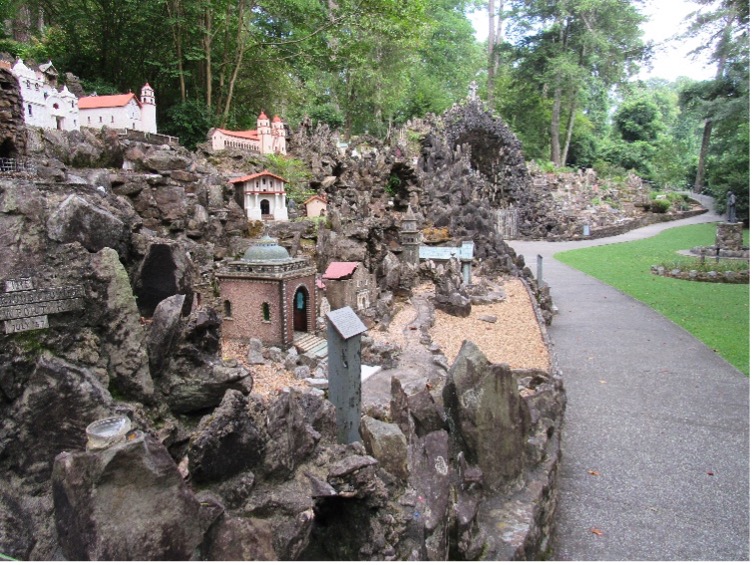
View of the grotto park walking down the main path
The Ave Maria Grotto is a landscaped, four-acre park spanning two city blocks. It contains 125 miniatures of buildings and religious sites from around the world as well as fantasy scenes, monuments, memorials, and sculptural works. Brother Joseph Zoettl, a German immigrant, created these over forty years (1915-1958) using concrete and found objects such as marble, glass, stone, tile, seashells, and costume jewelry. He even used empty beauty cream jars to create a tower in one miniature, and a bird cage and toilet tank floats as the domes on his version of St. Peter’s Basilica. He only saw six of the buildings in person; the rest were from images, postcards, or his imagination.
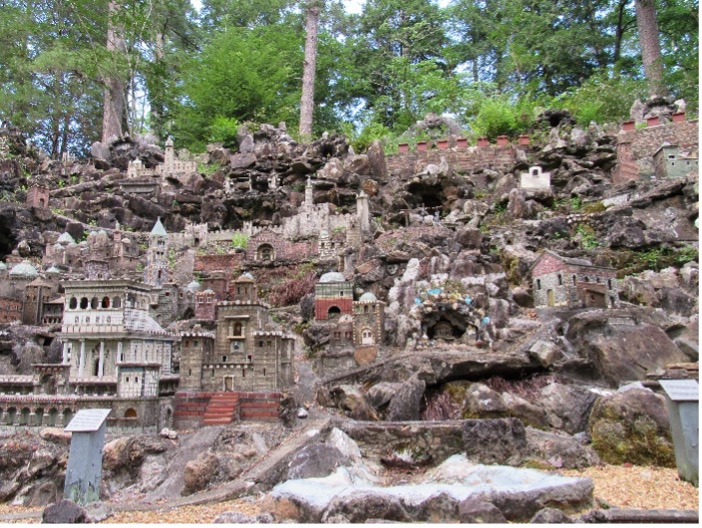
Scenes from the Holy Land group of miniatures

Close-up details of miniature Fortress of Antonia

Grotto of St. Joseph, one of many smaller grottos to different saints and holy figures within the park
Born as Michael Zoettl in Landshut, Bavaria in 1878, he immigrated to Alabama at fourteen to become a student at the newly founded St. Bernard College. When an accident left him hunchbacked and unable to become a priest, he instead professed vows as a lay brother in 1897 (historically, lay brothers were responsible for manual labor rather than ecclesial duties). In 1911, Brother Joseph was assigned to run the monastery power plant, a demanding job with long hours spent shoveling coal. Here, he developed his hobby of creating miniatures to pass the time. First, he made over 5,000 small concrete grottos for Marian statues sold in the Abbey gift shop.

Photo of Brother Joseph Zoettl in his workshop; digital scan of original in St. Bernard Abbey Archives. (Special thanks to Mary Hovator, St. Bernard Abbey Archivist, for her help in archival research. All archival documents are shared with permission.)
In 1915, he began constructing “Little Jerusalem,” miniature versions of biblical landmarks from the city. Originally placed around a small Marian grotto behind the monks’ recreation house, they eventually became so popular with tourists that they disrupted the monks’ prayer. In 1932, a solution was found when the abbot approved the creation of a large Marian grotto on the site of the monastery’s rock quarry. “Little Jerusalem” was moved there and Brother Joseph added new miniatures until his retirement in 1958. The namesake grotto is a massive, 27-foot-tall manmade cavern rising out of the hillside. It was built to Brother Joseph’s specifications and he decorated the interior, even creating manmade stalactites out of chicken wire and concrete. In 1934, the altar was consecrated and the park opened to the public. A significant example of a 20th-century Southern folk-art environment, the Ave Maria Grotto is on the National Register of Historic Places and the Alabama Register of Landmarks and Heritage. It is still open to the public as a tourist attraction complete with a visitor center and gift shop.

The Ave Maria Grotto, after which the entire park is named. It contains statues of Our Lady of Prompt Succor, St. Benedict of Nursia, and St. Scholastica. The altar, which Brother Joseph decorated with crushed glass and stone, was consecrated in 1934.
Being on-site provided firsthand accounts and primary source information not available through secondhand research. I walked the same grounds Brother Joseph walked, saw the power plant where he worked, and was even invited into the private Grotto workshop, which contains a collection of his original materials.

The St. Bernard Abbey Power House, later turned into a dormitory for monks

Brother Joseph’s miniature version of the Power House, located in the grotto park
I made discoveries that I would not have made if I had not been onsite. While walking a wooded path, I found a decaying structure I thought was a well or monument. I later mentioned it during an interview with a monk. He told me there had been a college seminary at that location.
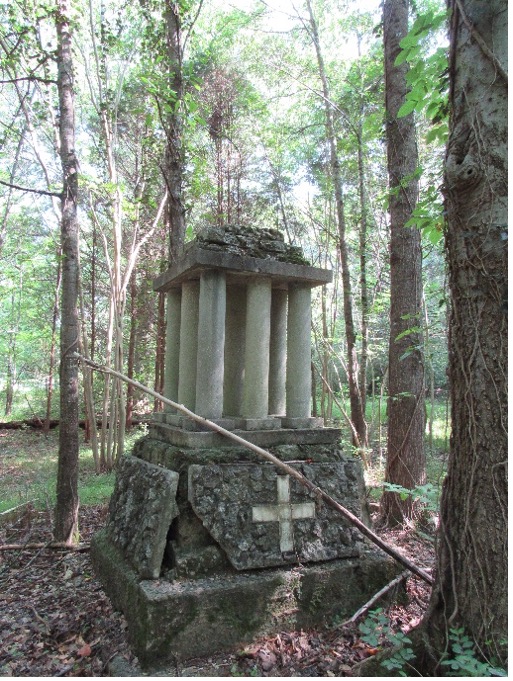
The monument in the woods
Then, browsing books in the monastery archives, I came across a photo of the seminary grounds. To my amazement, it included this structure in its prime! It was not a well, but a pedestal for a statue of St. Benedict of Nursia. With the archivist’s help, we found a very similar-looking statue on the monastery grounds and theorized that the statue itself was moved.

Photograph of archival document: “St. Benedict, Seminary Recreation Grounds.” From a booklet entitled “Abbot Boniface’s Jubilee February 26, 1947” in the St. Bernard Abbey Archives. The monument from the woods can be seen in the background.

Photograph of a page from a photo album in the St. Bernard Abbey Archives labelled “Grotto 2” showing close-up images of the statue and stand in April 1961. Handwritten on the page are the words “St. Benedict of Nursia, Father of Western Monasticism.”
While I am unsure if this particular discovery will be included in my qualifying paper, it demonstrates a practical application of the research process I was taught, forming a research question and combining various pieces of evidence from interviews, observations, and archival records to make claims and support (or disprove) theories. My overall classroom education and professors’ advice prepared me to conduct this research well: look closely, immerse yourself in space, see where the research leads you.

Statue of St. Benedict of Nursia on the monastery grounds, suspected to be the same statue from the archival photos.
Due to its massive size and number of works, the grotto is constantly revealing new details. Someone could walk through for days and still not notice everything, reiterating the sheer scale and creative complexity of Brother Joseph’s creations. I noticed something new every time I walked through and every encounter I had during the trip revealed a new perspective. My second time walking through the park, I met two conservationists working on preservation of the miniatures. They provided a wealth of information about Brother Joseph’s original techniques, ongoing preservation efforts, and the challenges of maintaining an outdoor built art environment.

Active conservation work happening on the Hanging Gardens of Babylon miniature
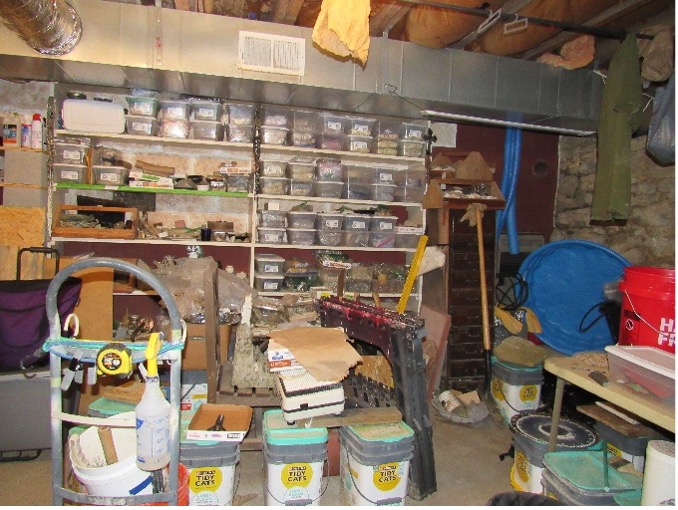
: Inside of the Grotto workshop with shelves of Brother Joseph’s original materials
The Grotto park serves a multiplicity of roles as complex and multifaceted as the miniatures it contains: it is a roadside tourist attraction, pilgrimage place, cultural heritage site, prayer garden, a folk art environment, and more. This shapes how viewers relate to and interpret it. It was important to be on site to listen to different people and hear their perspectives to begin understanding the Grotto’s full meaning and overall significance.
The travel grant enabled me to move beyond the pages of a book or a classroom, and to use the skills I have learned to make discoveries that will shape the direction of my qualifying paper. I am grateful to the Art History Department for their support and am excited to continue this research on the creative genius and art of a monk who dedicated his life to humbly living out the Benedictine motto of “Ora et labora” (pray and work) through his creations.

Michelle exploring the Ave Maria Grotto; Brother Joseph’s “Bethlehem” enclosure in the background