Research – Holloran Center Professional Identity Implementation Blog - Page 6
Browsing Tag

Research

Sarah Beznoska

Professional Identity Formation and First-Generation Law Students

By: Sarah Dylag Beznoska, Assistant Dean for Student and Career Services,
Cleveland-Marshall College of Law, Cleveland State University

It comes as no surprise to those of us who work with law students on first destinations and career paths that when the National Association for Law Placement (NALP) studied national employment statistics for the graduating class of 2020, it found that whether or not you are a first-generation law student impacts your career outcomes in the law.

NALP reported: “Overall, Class of 2020 continuing-generation JD students (graduates who have at least one parent or guardian with a JD degree) and continuing-generation college students (graduates who have at least one parent or guardian with a bachelor’s degree or higher, but whose parents/guardians all lack a JD degree) had a higher employment rate and were more likely to be employed in a bar passage required/anticipated job than their first-generation college student peers.”

The Law Student Survey of Student Engagement (LSSSE) also consistently highlights important disparities related to first-generation law students. From LSSSE, we know that first-generation law students bear more law school debt and face significant stressors related to debt. We know that “the amount of time that first-generation law students [spend] with peers and faculty outside of class [is] significantly less than non-first-generation law students.” LSSSE data has shown that first-generation students also participate in co-curricular opportunities at a lower rate that non-first-generation students, spend more time studying, and spend more time working to support themselves.

This data should be important to everyone in the legal industry, especially as we talk about diversifying our workplaces and our leadership. It is particularly important to me as someone who works in career services at an urban law school that serves a significant population of first-generation college and law students. To provide the best student and career services to our students, we are continually assessing our work through the viewpoint of first-generation students and making adjustments to provide better support.

This assessment can be done for professional identity formation (PIF) too. Understanding and accounting for the unique experiences noted above is critical to developing any comprehensive PIF plan. On the positive side of things, schools can leverage PIF to build belonging for first-generation students. At the same time, being mindful about the time constraints sometimes faced by first-generation students might inform the methods a school chooses for offering PIF opportunities.

First-Generation Students and Law School Culture: Professional Identity to Build Belonging

Belonging matters to law student success, and most especially to first-generation law students. The unique culture of law school and the legal industry can be a challenging adjustment even when someone has lawyers in their family. Without knowing any lawyers or having people already in their network to ask for help, first-generation law students can feel like outsiders from day one. (For some insights on the first-gen experience see: https://abaforlawstudents.com/2021/08/25/first-generation-law-student-challenges/ and https://abaforlawstudents.com/2020/01/01/how-to-thrive-as-a-first-generation-law-student/).

For this reason, I have sometimes been skeptical of the premise of professional identity formation that focuses on students moving from an “outsider” in the profession to an “insider” in the profession. As someone who was a first-generation law student myself (although I was not the first in my family to attend college), I know very personally that not having lawyers in my family or lawyers in my network impacted my law school experience in a negative way. From day one of law school, I internalized deeply that I did not belong and, although my law school trained me well on the doctrinal skills, I never once came to a place there where I felt like an “insider.”

It is because of this personal experience, however, and because of the commitment I have to making sure that first-generation students at the law school where I work never feel this same way, that – as much as I can be skeptical about the terminology of PIF – I think PIF can be leveraged to build more belonging. There are a variety of ways a school might use PIF to increase belonging. For example:

  • Self-Assessment and Industry-Focused Panels: having students complete self-assessment exercises allows them to identify strengths and values that they bring with them to the profession. Taking it a step further, once schools provide an opportunity for students to identify their strengths and values, schools can offer diverse panels of attorneys to demonstrate the varying skillsets that can make someone successful. Providing students with opportunities to know their own strengths and then to see those things in successful practitioners can help them to feel like there is a place in the law for them and who they are matters.
  • Mentoring: providing thoughtful mentoring opportunities allows students to feel less alone in their journey through law school. Schools can engage alumni, peers, faculty, and staff in formal and informal mentoring programs with students, giving them a broad set of people to whom they can turn for support. Consider, also, having faculty, staff, or alumni identify themselves to students as first-generation students, so that your first-generation cohort has examples of first-generation success stories.
  • Student Organizations: schools can support student leaders to create a robust community of student engagement and a space where students can connect with each other and feel less alone. Connecting student organizations to a school’s alumni network can be helpful and assisting student organizations with career-related programs can give students more opportunities to understand the variety of paths in the law.

These three things have worked for us as a starting point to increase belonging at Cleveland-Marshall College of Law. We start at day one when we dedicate a portion of our Orientation to professional identity. This Orientation program covers the essential eligibility requirements for the practice of law in Ohio and the 26 Lawyering Effectiveness Factors. More importantly, it includes diverse panel speakers who reflect on what these things mean in their practice, along with when and where they developed these skills.

We also require incoming law students to complete the Law Fit assessment, and we use those assessments with them in their meetings with career advisors. In addition, together with my team in Student and Career Services, we have built a one-on-one alumni mentor program and a one-on-one peer mentor program for every first-year student who enrolls with us. Later this Fall, we will offer a Storytelling event to our student body, in partnership with our First-Generation Law Student Association, focusing on things like times when we and they have felt imposter syndrome and why one’s personal story matters.

First-Generation Students and Time: Creating Meaningful Space for Students to Reflect

One of the foundational concepts behind PIF is reflective thinking and opportunities for reflective exercises to help students understand their values, the values of the profession, and the competencies required to be a successful lawyer. Reflection, in turn, requires time and space that are carved out to allow specifically for it. Time is a valuable resource for all students, but especially for first-generation law students. Therefore, PIF plans must be mindful of these time constraints.

There are a lot of reasons why first-generation students might not have time for PIF. For example, if they are working significant hours outside of the law school in legal or especially in non-legal jobs to support themselves, if they face family or personal expectations or obligations (especially from family members or personal connections who are unfamiliar with the legal industry), if they are trying to plan the logistics of taking two months off (unpaid and without benefits) after graduation to study for the bar exam, or if they are de-railed by a financial, health, or other crisis without social capital or resources to support them. In the optional space of Student and Career Services, when we support students with challenges like these, there is sometimes precious little time or energy available to ask students to reflect on how a chosen work or academic experience contributes to their professional identity.

Worse, when I see my first-generation students struggling with time, I worry that PIF will feel to them like optional engagement that is only possible for those law students who are supported by deep family resources or who are not struggling with other life priorities. I also worry whether they will trust me if I ask them to add to their already overflowing plates the additional work required by PIF. Notably, I believe these students are frequently already very self-directed learners, but they are people with clear and important demands on their time that often do not leave room for any optional piece of the law school curriculum.

For this reason – to bring all students along in PIF – schools must be creative about how and when to include PIF in the law school experience, and be respectful of the time constraints students might face, depending on their circumstances.

  • Bring PIF to Students: one option, of course, is to build into the existing curriculum opportunities for reflection and discussions about professional identity. But, if that won’t work for your school/classroom, schools might consider inviting the career services team to stop by before or after classes to provide handouts or resources that are aligned with related career paths. Schools can emphasize the importance of related programming that is happening outside of the classroom and encourage students to make strategic decisions about which to attend. Schools can include in other required spaces – Orientation, graduation-required courses, student leader trainings – information about building lawyering skills. Schools can encourage students to work with academic advisors, staff, or alumni to create a plan that works for them, and schools can help those advisors, staff, and alumni to have the PIF information they need to be impactful.
  • Create a PIF-focused Course: changing the curriculum to include a new course is another option, and one that may or may not be a fit for a school. For better or worse, however, we know that in a world impacted by COVID, general student engagement in optional parts of the law school experience is significantly decreased. Add to that the time constraints we know our first-generation students face and we simply cannot wait for students to come to us. As I’ve learned from my colleagues in the undergraduate space, we are responsible for finding ways to go to them. One way to go to them is to create a credit-bearing course that will reward students for doing PIF work while creating a meaningful space for first-generation and other time-strapped students to include the work among their other priorities.

At Cleveland-Marshall College of Law, Students and Career Services has seen some movement with bringing PIF to students. For example, my department no longer expects that attendance will be robust at optional career related programs. Instead, we collaborate with student organizations on panel presentations and visit their student organization meetings to connect. We bring handouts and resources to student-run events, instead of requiring them to come to us for the information. We try to model the behavior we are seeking from students by showing up to the programs and panels that they have organized rather than simply demanding they show up at ours. We also leverage our alumni and peer mentor programs to provide resources to students. It is clear to us that peer-to-peer advising among students is at an all-time high, and rather than discourage or limit this connection, we provide information and resources to support it.

Perhaps most importantly, we try to ask students for input on what kinds of activities will help them most when it comes to lawyering skills. Without exception, they prefer activities that require engagement from them, opportunities to become involved in the community through pro bono work, and learning experiences where they connect with others. As a result, we are adjusting our traditional Student and Career Services programming to offer more of these kinds of experiences, and fewer lectures/presentations, while also incorporating reflective coaching questions into our everyday conversations with students.

Conclusion

Supporting first-generation law students to succeed is a critical component of increasing diversity in the legal industry. When PIF is offered thoughtfully and in a way that is mindful of time as a resource, it can be a place where schools can provide that support, not just through efforts focused on belonging, but also efforts focused on financial wellness, building support networks, introductions to professional norms, and academic planning.

If you have any questions or comments about this post, then please feel free to contact me at s.beznoska@csuohio.edu.

Sarah Dylag Beznoska is the Assistant Dean for Student and Career Services at Cleveland-Marshall College of Law at Cleveland State University.

Christopher Corts

Better Conversations? Let’s Talk About It. (Part 2)

By: Christopher Corts, Professor of Law, Legal Practice, University of Richmond School of Law

Hello, again, readers! Today I am writing the second of a two-part series devoted to the art of facilitating better conversations about controversial topics. When we convene these kinds of conversations, we need to be especially attentive to the possibility that some number of listeners are likely to hear perceptions, opinions, beliefs, and values that are in tension with, and sometimes oppositional to, their own—and that some speakers will need to feel comfortable uttering those kinds of polarizing comments, too.

Last month, in Part I, I explained why I think new ABA Standards 303(b) and (c) present an important opportunity for law schools to have some hard but necessary public conversations about racism, bias, and inter-cultural competency. I suggested that, if we are going to effectively teach students how to internalize a professional responsibility for clients and the integrity of the legal system [as we must, under Standard 303(b)], we will necessarily need to help students learn how to detect, address, and overcome the pernicious effects of racism and bias [Standard 303(c)] in our own profession. And: in our own institutions, which collectively help to constitute the state of “the profession” that we are all obligated to critically assess, strengthen, and reform.

All of this means that we will need to facilitate a different kind of conversation within our communities—one that does not involve debating, arguing, or problem-solving. We need conversations that can help to clear the air, establish the state of things as they are (and not as we hope or wish them to be), and give public voice to important, deeply held viewpoints that some stakeholders might be reluctant to share, especially if they perceive those viewpoints to be at odds with official messaging or apparently-prevailing sentiments within the group.

When I facilitate these kinds of hard conversations, I have four primary, process-oriented goals in view (which, astute readers will notice, could also be read as value statements):

  • give every person an opportunity to speak about a given subject (or: to decline to speak on that subject);
  • elicit candid and forthright comments about things that are most meaningful to the speaker, especially the kinds of statements about deeply-held personal perceptions, opinions, values, and convictions that are at odds with official messaging or prevailing opinions in a group (which may not ordinarily be heard in public, community-wide conversations that are efficiently managed to meet the aims of organizers running an agenda that they set);
  • strive—with curiosity, compassion, and non-attachment to any particular outcome—to discover the full, true range of views that constitute the community as it just-is;
  • create opportunities to be together as a community through periods of shared silence (rather than defaulting to treating silence as something to be feared, avoided, or filled with noise).

All of this takes a lot of time to do well. Without giving adequate time, we cannot hope to let everyone speak, cannot build trust within the group, cannot elicit comments about the deepest and most meaningful things, cannot fully hear and appreciate the true state of things, especially when the true state of things includes profound, meaningful disagreements.

Today, in Part II, I want to give some concrete suggestions for how to plan, stage, and facilitate these kinds of public conversations to achieve the goals outlined above. We need rules and norms to keep everyone invested in the same process. And to do that we need tools and techniques to help us make these conversations slower, less reactive, more intentional, more inclusive, and personally-meaningful to each individual present.

Birthed in my own experiences with inter-faith and ecumenical dialogues while completing my seminary education prior to law school, the suggestions that follow have been refined and further developed during my past decade in legal education and service to the broader community that goes with it. These suggestions reflect communication principles and practical techniques that will be familiar to anyone who has ever experienced non-violent communication, mindful communication…or a Quaker meeting.

Whenever I approach these kinds of difficult conversations, my aim is to try and find a way to facilitate mutual compassion, respect, and trust among participants. Trust makes broader participation more likely, and it makes deeper participation more likely, too. In my experience, when trust exists, it can improve the quality of conversation by improving the likelihood that candid, authentic, contrarian points of view will be voiced—and heard.

Here are a few ideas for how you might facilitate these conversations in a more inclusive and meaningful way. In addition to increasing the likelihood of quality participation from the greatest number of participants (as speakers and listeners), the rules in this list are designed to improve access to the conversation by (a) reducing the costs of speaking for socially-anxious and marginalized participants, while also (b) reducing the possibility that socially-confident participants will be able to grandstand or dominate the discourse.

  1. Consult with experts. The suggestions I am offering are process-oriented. But, especially when it comes to matters of racism, bias, and inter-cultural difference, in the interest of pursuing institutional-level policy reforms—as we must—we all benefit from expert help. There can be no substitute for the wisdom and guidance of experts who have dedicated their professional lives to helping institutions address and fix the wide range of complex problems caused by bias, racism, and a lack of inter-cultural fluency in our organizations.And, at the individual level, we can all benefit from consulting books written by experts. I recommend Rhonda Magee (a lawyer and law professor) and Ruth King (founder of the Mindful of Race Institute, LLC). Both are well-published and write in an accessible way that is especially helpful for deftly navigating the intersection of mindful communication and race in a way that invites maximum participation and deep, compassionate engagement.
  2. Facilitate small group conversations. Public conversations that elicit maximum participation and candor are not possible in mass groups. The smaller the group, the more questions that can be asked and the more topics that can be covered in the same amount of time.How small do the groups need to be? In my experience, six to eight is optimal (for reasons that I hope will become more obvious as you keep reading). Ten to twelve is doable. More than twelve will severely undercut your ability to realistically include all speakers and invite them to contribute with depth and authenticity. This takes many facilitators for many groups, potentially, but one organizing facilitator can come up with the question prompts and guidelines for all of the groups to use and then just leave it to a number of volunteer facilitators to implement at the small-group level. If they can read and follow directions, then they can facilitate.
  3. Seat each small group in a circle. Staging matters. When you facilitate a hard conversation, you have the ability to stage it in a way that can make participation easier—or more burdensome. By creating a circle for conversation, you can help speakers speak and listeners hear.This is not just about achieving a certain form; it is more than just staging and optics. It is also a show of values. And it enhances superior functioning in the group. Sitting in a circle eliminates hierarchies that exist when a podium, stage, microphone, or another arrangement that confers a superior position to one person (the speaker, usually) distinct from all others. In a circle, everyone is seated side-by-side. There is no privileged place for the facilitator, no privileged place for any speaker. There is no person drawing focus in the center of the circle, and no person is (literally or figuratively) outside of the circle. Everyone can see everyone else as an equal within the same circle of concern.
  4. Create rules that make candid participation possible for the most people. To achieve maximum participation, we need to create conditions that make it more likely that everyone, wherever they sit, will feel comfortable offering statements of deeply-held conviction, personal experience, and subjective perception. Some people may be more inclined to do this than others by nature, culture, or socialization, but we want to make it easier for everyone to feel safe bringing hidden things to light—especially sincere statements of personal perception, value, opinion, or belief.Setting rules for equitable, inclusive discourse from the outset of your conversation can help. I will reserve a future blog post to explore the fine art of crafting a beautiful reflection question. But for now, the basic idea is that you want to create questions that are open-ended enough to elicit feedback that is most meaningful to each speaker, but targeted enough to elicit the kinds of hidden opinions and contrarian points of view that you, as facilitator, have designed this conversation to expose.At a minimum, you need rules about speaking and listening that can (1) establish confidentiality, (2) prevent interruption and cross-talk, (3) prevent a small number of participants from dominating the discourse, (4) prevent certain other participants from hiding or refraining from speaking (when they would be willing to do so, given the chance), (5) create a clear order of conversation that each participant can follow, (6) encourage speakers to speak freely and respectfully, (7) encourage listeners to hear charitably, and (8) invite everyone to strive for respectful, compassionate conversation that you can collectively (as a group) define for one another.[In my next blog post, I will give more detail about specific rules you can institute to make the achievement of these goals more likely. These rules are good rules for all kinds of public conversations you might convene in the ordinary day-to-day life of teaching or leading organizations. But they are especially helpful for achieving the goals of hard conversations as we have defined them in this series.]
  5. From start to finish—in your heart, and in your public expressions—keep seeking and valuing contrarian statements of difference and disagreement. This one might be counter-intuitive. There is a strong bias that pervades professional contexts in favor of being positive, constructive, and helpful. But if we are to successfully convene and facilitate a public conversation where the broadest number of people speak and hear the rawest, truest, most polarizing, controversial, and divisive opinions, we need to expect, accept, and normalize expressions of disagreement. Even better? We need to welcome We cannot bring divisions to light and begin a process of growth, healing, repair, and restoration unless we do. Dissent is by its nature disruptive; expressions of it always slow down the ability of the majority to get stuff done, and it always threatens to impede the ability of the majority to get everything they want. In a public conversation, we need to take special care to successfully welcome (and keep welcoming) dissenting viewpoints.As facilitator, by (a) helping to establish shared rules, norms, and values at the outset of the conversation and then (b) posing open-ended questions prompts that are designed to elicit frank feedback on targeted topics, you have tremendous power to help set the social-cultural conditions that are necessary for individuals to speak, hear, and hold disagreement about the things that matter most.It is possible—perhaps likely—that you will be trying to normalize dissent within the context of a community that, in the day-to-day order of things, does not always do a great job of seeking, hearing, and holding dissent? Whatever intended by officials in a community, or by the prevailing majority on a given issue, in practice, the expression of dissent can be impliedly vilified as an enemy of progress. Dissent upsets people. It slows things down. It frustrates decision-making. It destabilizes things. It hurts feelings. And, if we are not extra careful, dissenters can feel as if they are being vilified as enemies of progress…unless we figure out how to sincerely welcome and bless them in our circle of discourse.I think this concern for dissenters is especially important as “well-being” rhetoric becomes increasingly mainstream in law schools (and other legal environments). There are dissenters, laggards, and resisters to that movement, and—for a variety of very important reasons—they might not wish to perform mental health, positivity, or happiness in public spaces. As we try to create a “culture of well-being”, we may unwittingly coerce some into performing positivity in public spaces. These dynamics are at play whenever we try to have a hard conversation across deeply-held differences within a community of common concern.

So: what is the solution? Well, against the noble-seeming bias toward positivity and agreement, we can lead by example.

  • Use your power as facilitator to model the courageous, vulnerable behavior you seek to elicit. You do not need to pretend to be neutral. You can do more than strive to be positive/affirming; or, to put it another way: you can use your positivity and affirmation to welcome, endorse, and affirm dissent. Actively look for opportunities to express your own statements of dissent, difference, disagreement, criticism, objection, or resistance. Don’t be afraid to express negativity, skepticism, or pessimism about something. And, when you do, do it without apology. You can thus model the important truth: those kinds of statements are not a problem, and bringing them to light is one of the most important reasons for having this kind of conversation.
  • After someone expresses a criticism or a contrarian view, sincerely thank them for the comment. With curiosity, ask a follow-up question that doesn’t challenge their view (or a premise upon which it is based); instead, use your follow-up question to give the speaker an opportunity to further develop and voice that same line of thinking. With sincerity, ask questions designed to help yourself and other listeners try to better understand that dissenting point of view with more precision and detail.
  • As facilitator, take care to monitor and enforce the rules of conversation established by the group in unbiased ways. Those rules are in place to ensure that all speakers have the opportunity to express dissenting opinions in the clear, without being countered, corrected, interrupted, debated, disputed, or otherwise managed or controlled. You might be tempted to suspend the rules in order to “handle” or “manage” a certain kind of rogue message that threatens harm to institutional goals. Resist the urge to shut-down dangerous, disruptive comments (which can be distinguished from other kinds of harmful, violent comments that are directed towards individual persons; those kinds of comments can fairly be rebuffed without running afoul of your goal to encourage good faith dissent, criticism, disagreement, etc. in a non-personal, non-violent way).
  • As facilitator, you also have power to create question prompts that are designed to elicit criticism, dissent, or disagreement in indirect, less burdensome ways for your listeners and speakers.For example: you could invite speakers to imagine themselves as having absolute power to take action and fix something in the community—and then ask them to describe the change they would make, and why. Like this:If you had absolute, unilateral, god-like power to take action and change one thing about the way this law school handles [insert controversial topic that you hope to learn about]—what would it be? Why is making that change so important to you? How do you imagine the law school community would be better after you made that change? What would it look like?Notice: by identifying the thing that most needs to change, you are likely to find out about something that angers/frustrates/demoralizes the speaker, something the speaker wants to change. And you are able to discover the speaker’s preferred solution to the problem, including their reason for the solution. And you will help everyone catch a glimpse of the way the reformed world would look like, from the speaker’s perspective, once that thing the speaker wants to change gets fixed.In my experience, this question can elicit some surprising, thoughtful, deeply-felt responses. This kind of question can be applied to many different topics, and refined so that it is posed in a broad or narrow way.There are many other ways to directly or indirectly ask questions that can get people talking about things that, if not actively sought-out, would just remain hidden. Have courage! Get creative. See if you can find an easier way for someone to bring something they might ordinarily keep hidden to light.
  1. End with silence. When I facilitate, I like to close a hard conversation by leading everyone in a minute or two of silence. It creates a sense of ritual. It creates an ending. It gives space for everyone’s brain to transition away from the rigor of dialogue to whatever comes next. It also reinforces the value of slowness, which has permeated every aspect of the conversation circle.Sometimes, I make the silence symbolic. For example: I might tell everyone that we are going to observe the silence as a way of bringing our collective attention to the reality that, for all that has been shared today, there remains a number of true and meaningful things that have yet to be articulated. Silence helps us hold those mysteries in our collective consciousness.Or: I might invite everyone to sit together for two minutes in silence to show that, despite all of the differences expressed today, the silence we share is still big enough to hold us together in unity—despite whatever differences or disagreements we voiced and heard.Or: I might say that we will observe the silence by filling it with thoughts of gratitude for contributions made—by showing up, by speaking, by hearing, by caring.Or: I might say that we are observing the silence as a way of respecting the mystery of human existence. Like the ties that bind a community, the silence between us is fragile. And, like silence, the gift of community can be easily, thoughtlessly broken if we do not take care, give our attention to it, and hold it in our concern.Or: I might say nothing. I just invite people to sit silently together for a minute (or two). And leave it to each individual to figure out how to live in their minds during that period.

We need to normalize silence as an important part of public conversations. Silence gives time to think, breathe, reflect, pray, seethe, ruminate, calm yourself, meditate, daydream, whatever. If we let it? It can speak to us. It can draw us into an experience of transcendence or mystery. It can be symbolic of the unknown, unspeakable, yet-undiscovered truths that help to define a community as surely as voiced commitments or grievances do. Silence is not something to fear, avoid, manage, or fill with noise. It is a blessing—part of what just-is—and it ought to be welcomed, with purpose, into our conversations. No shame or apology necessary.

So there you have it: six simple tips for facilitating public conversations that are explicitly designed to bring deeply personal, possibly-controversial opinions to light. Whenever I am privileged to facilitate conversations like these, my deepest hope is that every attendee will be able to head for the exit thinking something like: “I appreciate that I finally had the opportunity to speak from my heart. And I appreciate the opportunity to hear others speak from theirs.” I also hope they will be able to leave the circle saying something like, “Well, no one can accuse that of being an echo chamber!”

All of this might be exhausting, but it is nowhere near exhaustive of all that might yet be done. If you have any ideas, thoughts, concerns, or wisdom that you would like to share on the topic of facilitating hard conversations, please do not hesitate to email me at ccorts@richmond.edu. I would love to hear from you!

Christopher Corts, Contributor

Curtis Osceola, Janet Stearns

Celebrating October 10, 2022: Mental Health Day, Indigenous People’s Day, and Professional Identity

By: Janet Stearns, Dean of Students, University of Miami School of Law
Chair, ABA COLAP Law School Committee

World Mental Health Day

October 10 has been declared as World Mental Health Day by the World Health OrganizationThe objective is to “raise awareness of mental health issues around the world and to mobilize efforts in support of mental health.” Just last week, the CDC announced that the suicide rates in the United States increased four percent from 2020 to 2021, showing that the demand for resources and education remains great.

For many years, the ABA Law Student Division and the ABA Commission on Lawyer Assistance Programs have partnered to bring Mental Health Day to our law students nationwide. While initially organized in March, the groups now celebrate October 10 as Law Student Mental Health Awareness. The ABA will partner to feature national programming to bring attention to law student mental health and reduce stigma so that resources are accessed. Many law schools will use Mental Health Day as a linchpin for law school wellness days or wellness weeks. Often, lawyer assistance programs around the country also use this opportunity to visit area law schools or do outreach through social media. I expect that many of the readers of this article are already on the path to organizing programming for the upcoming Mental Health Day. However, an excellent review of the range of opportunities is covered by Jordana Alter Confino in her 2019 article Where Are We on the Path to Law Student Well-Being?: Report on the COLAP Law School Assistance Committee Law School Wellness Survey.

The 2022 Mental Health Day is just around the corner. This year, at the request of the ABA Law Student Division leadership, we have recruited a group of thought leaders on well-being (among them bar leaders, law faculty, COLAP members, and law students) to record short videos sharing messages on well-being. An intensive social media campaign will continue over the next two weeks. In addition, on Friday, October 14, a number of law students, representing diverse initiatives around mental health, well-being, and mindfulness, will convene to discuss a number of topics in law schools and advocate for change. (Please contact the author for additional information if you have students who should be added to this invitation.) We anticipate that many law schools will be hosting their own programming, and encourage all to share your activities using #LawStudentWellBeing.
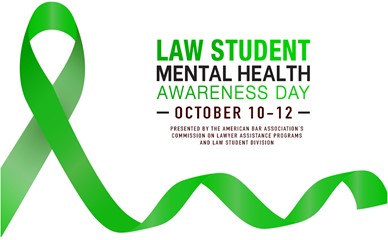
While this initiative predates the recent revisions to the ABA Standards, this is an opportunity to underscore that the ABA COLAP and Law Student Division advocated jointly for the inclusion of well-being in the Standards for many years. This year, now that ALL law schools must make resources available around well-being under Section 508, we expect that 2022 Mental Health Day will truly be a national event.

Indigenous People’s Day

Monday, October 10 coincides with the holiday now known as Indigenous People’s Day. Some history on this holiday: in 1934, President Franklin Delano Roosevelt first designated October 12 as Columbus Day, commemorating the day when presumably a crew member of the ship lead by Columbus “sighted land.”  Since 1971, this was recognized as a federal holiday, and then moved “officially” to the second Monday in October.

South Dakota was the first state to recognize Indigenous People’s Day in 1990, and since then a number of states have followed. While it is not yet a federal holiday, a movement is growing. In 2021, President Biden was the first U.S. President to issue a proclamation in recognition of Indigenous People’s Day.

On Indigenous Peoples’ Day, our Nation celebrates the invaluable contributions and resilience of Indigenous peoples, recognizes their inherent sovereignty, and commits to honoring the Federal Government’s trust and treaty obligations to Tribal Nations….On Indigenous Peoples’ Day, we honor America’s first inhabitants and the Tribal Nations that continue to thrive today.

Early in the planning for this year’s Mental Health Day, the organizers recognized that the coinciding of the two holidays provided a great opportunity for reflection and awareness. For one, we recognized that some law schools may be closed on Monday, October 10 and that we needed to be flexible with programming that would extend over the entire week. Further, in recruiting thought leaders for this year’s videos, we actively sought voices that would help us highlight the significance of the two overlapping dates. We invite you to pay particular attention to the contributions of Professor Rhonda Magee (University of San Francisco), and Siena Kalina, 3L at Colorado/ Boulder and President of the National Native American Law Students Association.  We are grateful for their contributions.

The Intersection of Mental Health Day and Indigenous People’s Day: Lessons for  Professional Identity Education

The significant changes in the ABA Standards in 2022 have created many opportunities in legal education.  Among these is the opportunity to create new dialogue between the advocates for law student well-being and supporters of education addressing bias, cross-cultural competency, and racism. These two issues are closely intertwined on many levels, and we have a unique opportunity in the upcoming weeks to reflect and message on this.

In 2020, Mental Health Day featured the path-breaking work of Rhonda Magee and her book The Inner Work of Racial Justice: Healing Ourselves and Transforming Our Communities Through Mindfulness. The recording of her presentation is still available on the ABA website. Professor Magee’s powerful work speaks to the role of mindfulness in our own lives and as an integral part of racial justice work.

In recent years, I have also become more attuned to the need for programming that speak directly to some of our students who may feel marginalized in our law schools. I wrote about this in the AALS Student Services Section Newsletter last year, exploring the integration of well-being and anti-racism programming.

As I have been pondering for myself the upcoming holidays, let me suggest a few very concrete but important steps towards well-being for our Native American Law Students:

  • Miami University and other institutions are using land acknowledgements to reframe our understanding of property and show respect for local indigenous peoples. My institution now has such a land acknowledgement on its Consider special messaging that should be shared for Indigenous People’s Day.
  • Read about the National Native American Law Students Association and whether your law school does or should have representation.
  • Reach out to graduates who may be able to teach and share wisdom…with us and with our students. I made such a call last week to a wonderful former student, Curtis Osceola, who now works as Chief of Staff to the Miccosukee Indian Tribe here in
    South Florida. I have asked him to write a short message to be shared with Miami Law next week in recognition of Indigenous People’s Day. You can read his powerful message, which appears at the end of this post.

    Janet Stearns is Dean of Students at the University of Miami School of Law and Chair of the ABA COLAP Law School Committee.

  • Recognize that all of the Mental Health and Well-Being challenges that we are highlighting are playing out in significant ways in the Indigenous community, and often with far fewer resources to support.

The author welcomes hearing from colleagues across the country as we all explore approaches to our commemoration of the dual holidays that will take place October 10, 2022. You can reach me at jstearns@law.miami.edu.

Curtis Osceola’s Reflection Re: Indigenous People’s Day

Columbus Day. I remember when I was a child sitting in an elementary school classroom and being told of the exploits of Columbus. How he traveled the world, explored the Caribbean, discovered America…

I raised my hand, “Miss, Columbus didn’t discover America, my people were here.” The teacher was taken aback. I doubt anyone had ever challenged the lesson plan, “Yes he did, Curtis. Columbus discovered America.” She replied. “No, he didn’t, he was lost and my people were here first.” I was sent to the office for insubordination. I felt humiliated, guilty, and stupid. How could I have been so wrong? Is my entire existence wrong? What can I do to be “right?”

Many Natives have expressed the same defiance to colonial history, but now that defiance has become a movement. The movement to change Columbus Day to Indigenous People’s Day was born out of the rejection of the lie that is the “Discovery” story of Columbus. But why such a strong rejection? America is great after all. We have the blessings of freedom and democracy. We are protected by laws and those who enforce those laws. We have courts and modern notions of substantive and procedural due process. So why fight the history?

Because the lie hurts. Not like a cut with a knife or a bullet through the flesh. It hurts the mind. Take, for instance, a Native child today. How many Natives before them endured racism, oppression, violence? What effect did those experiences have on the mental health of their predecessors? On their brain chemistry? What is the net effect of that experience through their progeny? The generational trauma of war, removal, and extermination have evolved into contemporary mental health issues like schizophrenia, bipolar disorder, depression, and suicide. These are exacerbated by the social ills of poverty, unemployment, disenfranchisement, domestic violence, and constant bereavement.

Take the experience described earlier: Imagine if a young family member told their teacher about the history of their family member told their teacher about the history of their family, of their heritage. Imagine if the teacher said to that child that they were mistaken, that the history they learned from their family, your ancestors, was wrong. Imagine that child being punished for their expression of truth. And think for a moment—if that single incident was foundational for the formation of my personality and identity, then what further effect does the cumulative trauma mentioned earlier have on the mind?

This is a small window into the intersectionality between what is now Indigenous Peoples’ Day and World Mental Health Day. It is serendipitous that this year they both fall on October 10, 2022. Native Americans now celebrate the second Monday of October as one that is representative of their heritage, legacy, and identity. It seems that the healing has begun. Indigenous People have been subjugated and oppressed since the dawn of the New World. You can help make positive change for Indigenous people. It may not be easy, but it’s worth trying.

Curtis Osceola is an alum of Miami School of Law and now works as Chief of Staff to the Miccosukee Indian Tribe in South Florida.

So how can you make a difference? Make it personal. Become aware of the Indigenous people in your community. Ask them about their land, their history, their experiences. Empathize (or even sympathize) with them. We are the real legacy of the land—subject to the original sins of the American experiment. Remember that the experience of Indigenous people is not just a social experience, but a psychological one as well. Be a friend, be an advocate, be insubordinate avant-garde.


Jabeen Adawi

Clinical Pedagogy: Paving the Way for Professional Identity Formation

By: Jabeen Adawi, Clinical Assistant Professor of Law, Director of the Family Law Clinic, University of Pittsburgh School of Law

In response to the American Bar Association (ABA) revised accreditation standard 303(b) requiring schools to provide “substantial opportunities to the students for… (3) the development of a professional identity,” law schools around the country began to remedy a perceived gap in legal education: the formal and intentional development of a cohesive professional identity. Unlike other client-serving professions—such as medicine or social work—law schools are often critiqued as not doing enough to explicitly support the development of a cohesive professional identity for lawyers. Legal education seemed to rely heavily on the existence of the model rules of conduct and one class in legal ethics to ensure that new lawyers understood their fiduciary responsibilities as lawyers. However, all along clinical pedagogy has been equipping clinical programs to move students through identity formation. Below, I’ll explain how at the University of Pittsburgh School of Law, the clinical faculty drew from well-developed tools and teaching approaches to synthesize a clinic-wide foundational orientation for clinic students that directly responds to standard 303(b).

The ABA standard states that professional identity is developed through an “intentional exploration of values, guiding principles, and well-being practices considered foundational to successful legal practice.” In analyzing the new standard, three distinct elements have emerged:

  • Internalizing a deep responsibility and care orientation to others, especially the client,
  • Developing ownership of continuous professional development towards excellence at the major competencies that clients, employers, and the legal system need, and
  • Well-being practices.

The goal of our foundational orientation is to equip students with common skills and perspectives they will refine during their clinical experiences. Since this is our first pre-semester orientation, we are beginning with a half-day program of three sessions followed by a lunch and a small swearing-in ceremony. The skills we focus on meet the three elements of professional identity formation but are not exclusively the only ways we support student growth in our program.

Internalizing Deep Responsibility to Others

The first element promotes the fiduciary responsibilities of lawyers to their clients and society at large. It centers on developing and nurturing a mindset prioritizing a client’s interests above a lawyer’s self-interest. It also orients a law student to the profession’s commitment to pro bono services and developing a justice system that provides equal access and eliminates bias, discrimination, and racism.

To address the first element, our orientation begins with a session on “Understanding Your Responsibility Towards Clients and Society.” Clinic allows students to navigate the demands of real-life legal practice in a setting where clients are facing numerous odds in exercising their legal rights in the current system. However, I find that students need to be grounded in lived experiences of their clients first. For many of my clinical colleagues and me, a poverty simulation is one way to further perspective taking. This simulation will be followed up with discussion questions where students are reflecting upon the choices they were required to make, what circumstances influenced those choices, and what they may have done differently with a changed piece of their identity or additional resource.

The second step in orienting the students towards care of others requires a thoughtful discussion about one’s fiduciary responsibility as counsel. This can begin with a reflective exercise about a student’s own life where they look for experiences being in the care of another or taking care of someone else. These may be life experiences of seeking medical care, customer service, babysitting, caring for a sick relative, being a parent, or a prior career. Reflecting on their own life, a discussion can follow about lawyer’s specific responsibilities and how they relate to the fiduciary responsibility we take on for clients. This discussion will be grounded in the Pennsylvania Rules of Professional Conduct, specifically the preamble. This exercise should set the tone for their identity as lawyers who are in service of others.

I would be remiss if I didn’t acknowledge that a one-time conversation is not sufficient to develop care orientation. After the perspective-taking exercises are introduced in orientation, students will be equipped to revisit these ideas as they move through their clinic work. Typically, clinic students carry lower caseloads than in practice, so it affords them the ability to connect on a deeper level with a client and gain empathy and understanding for a client’s unique lived experience and their actual needs.  During the year, individual supervision conversations can revisit the orientation discussions and further reinforce their care towards others.

By the end of the year, students are well equipped to engage in conversations critically assessing the legal system, identifying shortcomings, and proposing solutions. For example, many clinics end the year with a seminar dedicated to reflecting upon challenges their clients faced in accessing the courts, coupled with a brainstorming session on potential solutions.[1] This allows students to connect what may be frustrating realizations about “justice” to tangible solutions, thus beginning to develop their capacity to effectuate systemic change.

Developing Major Competencies

The second element includes making students aware of major competencies that clients, employers, and the legal system need. These competencies include client-centered relational skills, problem-solving, and good judgment. The goal is not only to make students aware of these competencies, and their importance, but also to internalize ownership of their own development in these areas.

The second session in our orientation introduces the students to one core competency: client-centered lawyering. Through a thoughtful exercise called “the Rich Aunt” students begin to consider how personal values drive human decision making and students begin to reframe the role of a lawyer from just an advocate to also that of a client-centered counselor.[2] This exercise has students consider a hypothetical scenario where they are lined up to receive a substantial inheritance but have to evaluate if they want to settle for a lower amount or go to trial and potentially obtain more. The students evaluate what factors drove them to their decision, and then reflect on how personal the decision was. This is then connected to choices a client may make and the value in respecting the client’s ability to decide.

After orientation, this client-centered perspective is reinforced during deeper seminars on counseling and interviewing skills. In future years, we intend to broaden the pre-semester orientation to also cover these topics so the foundation to these core competencies is uniformly reinforced across the clinical program. Finally, during the semester or year, students will deepen these skills within a clinical methodology that is structured to engage a student in learning the why behind their choices, reflecting upon their choices, and drawing strategies to implement in their legal practice. This is often done in a non-directive supervision model that is designed to maximize their opportunities for developing into a self-reflective practitioner.[3]  This  supervision model is not often available in traditional internship or externship positions.

Establishing Well-Being Practices

The final element of well-being practices goes beyond teaching self-care practices but instead looks at three core needs of the being: “(1) autonomy (to feel in control of one’s own goals and behavior); (2) competence (to feel one has the needed skills, including physical and mental skills to be successful); and (3) relatedness (to experience a sense of belonging or attachment to other people).”[4] Autonomy requires a student to understand their values, be able to express those values, and hence know where they are in control of their goals and behaviors. Hence, developing one’s sense of self as a person becomes foundational to developing the other necessary identities of a lawyer.

The pre-semester orientation will target this element in a third session focused on “maintaining well-being in a live-client setting.” In this session, we will examine the two elements that make up one’s professional quality of life: compassion satisfaction and compassion fatigue. Then, we will introduce a tool called the “Professional Quality of Life Survey” that allows students to self-evaluate the different aspects that affect their quality of life. The Professional Quality of Life Survey is a free tool developed and refined through years of research on what affects a helper’s ability to continue their work. The Center for Victims of Torture owns the tool and provides it free (along with incredible teaching resources) to help anyone working in a helper-oriented profession.

While the results of the survey may be very private, students will not be required to share the results with anyone but can if they choose. I’ve found that the more ways we can provide students a space to discuss boundaries and personal challenges affecting their lawyering, we can assist them in developing skills to navigate issues that are inevitably going to arise in their lives. In private supervision, if a student chooses to share the results of the survey, together we can examine their trends and explore ways to improve their holistic satisfaction. The reality is that no one ever works in a vacuum: our personal lives and experiences come with us to our jobs and influence our work more than we often realize.

Hopefully, like us at Pitt Law, many other schools can utilize the revised ABA standards to bring attention to the strengths of their clinical programs. If anything, there is a wealth of information in clinical pedagogy—it just needs to be tapped.

If you have any questions or comments in response to this post, then please feel free to email at JZA16@pitt.edu.

Jabeen Adawi is Clinical Professor of Law and Director of the Family Law Clinic at the University of Pittsburgh School of Law.

[1] In “Teaching The Clinic Seminar” text by Deborah Epstein, Jane Aiken, and Wallace Mlyniec (three seminal clinical instructors from the Georgetown University Law Center), Chapter 21, “Exploring Justice” offers one thoughtful example of a framework for discussing justice in a clinical seminar. Another example is in Sue Bryant and Jean Koh Peters’ online repository for clinical law teaching materials “Talking about Race”, where they provide tools for facilitating conversations around racial justice.

[2] Deborah Epstein, Jane Aiken, Wallace Mlyniec, Teaching the Clinic Seminar 56 (2014) (describing the “Rich Aunt” exercise).

[3] See David Chavkin, Clinical Methodology in Clinical Legal Education: A Textbook for Law School Clinical Programs 7 (2002); Serge A. Martinez, Why are We Doing This? Cognitive Science and Nondirective Supervision in Clinical Teaching, 26 Kansas Journal of Law & Public Policy 24 (2016) (discussing the non-directive supervision model).

[4] Neil Hamilton, Louis Bilionis, Revised ABA Standards 303(b) and (c) and the Formation of a Lawyer’s Professional Identity, Part 1: Understanding the New Requirements (May 2022).

Megan Bess

A Simple Professional Identity Formation Assignment Ideal for Externship and/or Clinical Courses

By: Megan Bess, Director of the Externship Program and Assistant Professor of Law,
University of Illinois Chicago School of Law

Reflective assignments will be a key tool for law schools as they implement ABA Standard 303’s call for professional identity formation. For the past few years, our school’s externship program has used a simple assignment and associated rubric to encourage students to reflect on the skills and competencies they will need as attorneys. While this was designed for use in our externship seminars, it can be easily adapted for any course with a goal of having students reflect on the responsibilities of an attorney and associated skills and competencies.

I originally created this assignment to get students thinking about the skills and competencies identified in the Institute for the Advancement of the American Legal System Foundations for Practice Study, as well as those outlined by Neil Hamilton in his study of law firm competency models. I present students with these materials at the outset to give them broader context for what they might seek to observe and develop during their externship experience. This assignment can be easily adapted for reflection on other skills and competencies using different resources, including, for example, the Shultz-Zedeck Lawyering Effectiveness Factors or the newer IAALS study on skills and competencies, Thinking Like a Client. The goal is to get students to think about the non-legal skills and competencies essential for lawyering and to reflect on how those skills resonate with them. With the traditional law school focus on analytical skills and “thinking like a lawyer,” students are often surprised to learn that many general professional skills and competencies are highly valued by legal employers. The research behind each of the resources listed above is critical to bringing credibility to the skills and proving their value to students. This assignment is a series of simple questions which ask students to reflect on those skills and competencies. The prompts in this assignment seek to have students identify and explain:

  • Which skills/competencies resonate with them and why;
  • Their reactions to the skills employers value (those that are both surprising and expected);
  • Examples of others who demonstrate skills/competencies in professional settings;
  • A concrete example showing they have mastered at least one skill/competency; and
  • A skill/competency they need to improve or develop.

As the associated rubric indicates, there are no right or wrong answers to these questions. This can be a little disconcerting for law students, who are often accustomed to questions requiring more definitive responses. The rubric focuses on the quality and depth of the reflection. As we discuss the skills and competencies in our externship classes, I always remind students that when grading these answers, it is easy to distinguish between genuine and honest reflection and those that are simply “going through the motions.”

This type of reflection on lawyering skills and competencies can be especially powerful during an externship or clinical experience. Students form their professional identities by internalizing a profession’s values and responsibility to others—a process which occurs most powerfully when students participate in practice settings and see the values and behaviors of members of the profession.[i] As Tim Floyd and Kendall Kerew observed, it is while participating in this type of experiential learning that students really examine their progress in developing the professional identity of a lawyer.

Please feel free to use any part of this assignment or rubric that is useful to you. Like all my assignments and rubrics, these continue to evolve over time. If you have questions, comments, or ideas for improvement, please reach out to me at mbess@uic.edu.

Megan Bess is the Director of the Externship Program and Assistant Professor of Law at the University of Illinois Chicago School of Law.

Need other ideas for reflective prompts to aid in professional identity formation? Check out Neil Hamilton and Jerry Organ’s article that includes 30 questions designed to aid in professional identity formation.

[i] See Yvonne Steinert, Educational Theory and Strategies to Support Professionalism & Professional Identity Formation, in Teaching Medical Professionalism, Richard Cruess et al., Teaching Medical Professionalism 72 (Richard Cruess et al. eds. (2d ed. 2016)); Ann Colby & William M. Sullivan, Formation of Professionalism and Purpose: Perspectives from the Preparation for the Professions Program, 5 U. St. Thomas L.J. 404, 420-21 (2008).

Louis Bilionis, Neil Hamilton

Latest Article from Bilionis and Hamilton on ABA Revisions of 303(b) and (c) Published by NALP’s Professional Development Quarterly

NALP just published the third and final installment of Louis Bilionis and Neil Hamilton’s three-part series on the Standard 303 revisions. Part 1 and Part 2 appeared in the May and June 2022 editions of NALP’s PDQ, respectively.

The last article in the series, which is titled “Revised ABA Standards 303 (b) and (c) and the Formation of a Lawyer’s Professional Identity, Part 3: Cross-Cultural Competency, Equal Access, and the Elimination of Bias, Discrimination, and Racism,” can be read here.

Eliza Vorenberg, Suzanne Harrington-Steppen

Law School Pro Bono Programs: Opportunities To Reflect On What It Means To Be A Lawyer

By: Suzanne Harrington-Steppen, Associate Director of Pro Bono Programs and Clinical Professor of Law, Roger Williams University School of Law

Eliza Vorenberg, Director of Pro Bono Programs and Community Partnerships and Clinical Professor of Law, Roger Williams University School of Law

Law school pro bono programs, whether mandatory or voluntary, offer rich opportunities for students to develop their professional identities as lawyers. Roger Williams University School of Law (RWU Law) has a mandatory 50-hour Pro Bono Experiential Learning requirement. The requirement falls under our “public service” learning outcome and reflects our commitment to teaching our law students about the legal profession’s responsibility: (1) to improve access to the legal system and the quality of justice; and (2) to provide pro bono legal service in law practice to those who cannot afford legal services.

For many law students, pro bono experiences are their first opportunity to play the role of lawyer and reflect on what they are seeing in the profession and how it feels to be a part of the profession. About 40% of our first-year law students engage in a pro bono experience before they finish their first year. But, as we know, experience alone isn’t enough to help students integrate and reflect on the values and norms of the profession as they relate to public service. Law schools are uniquely situated to help students develop their professional identities by providing critical context for their pro bono service.  Law schools can both teach students how pro bono service is central to the profession and also provide them with space to reflect on and process their pro bono experiences in relation to how they see themselves as future members of the profession.

Setting the Stage: Access to and Quality of Justice

Last year, when introducing our law school’s pro bono requirement and programmatic opportunities to first-year law students, we moved away from the traditional “information session” format to a session focused on educating and encouraging law students to think critically about what it means to be a lawyer and how public service and pro bono fit into their future responsibilities and the profession’s values.

We began our session asking our 1Ls to remember the following critically important questions throughout their law school experience, in and outside of the classroom, and throughout their careers:

Who has access to justice?  Who doesn’t? Why or why not?

What is the quality of justice being administered? How do we evaluate the quality of justice being administered in civil versus criminal contexts?

We intentionally decided to start our session with these questions because the Preamble to the Model Rules of Professional Responsibility makes it clear that all lawyers, not just public interest lawyers or lawyers who are self-motivated to give back, have a special responsibility for ensuring access to, and the quality of, justice.  Before we can teach law students about Rule 6.1 or the goals and contours of our law school’s pro bono requirement students need to be told explicitly what a lawyer’s role in society is beyond advocating for their clients. We teach our law students that grappling with these questions and then doing something to fix deficiencies in the legal system are a lawyer’s duty as a member of this profession, not some lofty dream. We also provide students with an overview of the justice gap, using the Academy for Arts & Sciences video entitled “The Civil Justice Gap”.  We explain that pro bono service, as defined by Rule 6.1, is one way to take ownership of their professional responsibility to improve access to justice and the quality of justice for all but that there are many other ways they should be thinking about their role as lawyers in our society. This subtle shift in how we introduce the topic of pro bono asks law students to critique our justice system—using the access and quality framework—from the beginning of their law school journey, to identify who benefits and who is hurt by our systems of justice, and to be aware of the bias and inequities built into those systems.

Providing a Pause: Space for Reflection

Externship pedagogy, particularly its emphasis on structured reflection, can be very helpful in thinking about how law schools can design and structure their pro bono programs to promote professional identity formation opportunities. Pro bono experiences with reflective components offer meaningful opportunities for students to process and think deeply about what they are seeing, experiencing, and feeling while engaged in pro bono service and to connect it to their personal identities and lived experiences.

At RWU Law, each law student must submit a one-page written reflection in response to specific prompts after they have completed a pro bono experience they plan to use to meet our graduation requirement. In the past, we have provided prompts to students focused on the type of pro bono/public service experience, e.g., a prompt regarding working directly with clients, or for judicial experiences, the student’s observations regarding access to justice in the courts. This year, with the changes to Standard 303 in mind, we revised our pro bono reflection prompts to directly engage law students in a reflection focused on how the law student’s pro bono experience fits into their professional identity development.

In addition to requiring a written reflection, we intentionally funnel our first-year law students into pro bono opportunities that the law school has developed, facilitates, and oversees, e.g., Alternative Spring Break, Street Law, Volunteer Income Tax Assistance (VITA), and an Eviction Help Desk. This allows us to facilitate in-person reflective meetings throughout the experience and provide more structure than simply matching the law student with an external community partner. Many law schools may not have the resources to have faculty or staff facilitating in-person reflective meetings but at a minimum law schools should consider asking for or requiring a written reflection as a way students can intentionally think about their professional development.

Whether voluntary or mandatory, law school pro bono programming is an excellent vehicle for facilitating law students’ professional identity formation consistent with the revisions to ABA Standard 303(b).

Suzanne Harrington-Steppen is the Associate Director of Pro Bono Programs and Clinical Professor of Law at Roger Williams University School of Law.

Eliza Vorenberg is the Director of Pro Bono Programs and Community Partnerships, and is Clinical Professor of Law at Roger Williams University School of Law.

If you have any questions or comments in response to this post, then please feel free to email either or both of us at sharrington-steppen@rwu.edu and evorenberg@rwu.edu.

Daisy Floyd

Professional Identity: What is It?

By: Daisy Hurst Floyd, University Professor of Law and Ethical Formation and former Dean, Mercer University School of Law

I’ve been thinking about the lawyer’s professional identity and legal education’s role in developing that identity for almost two decades.  Through it all, I’ve struggled with two questions. First, what do we really mean when we use the term “professional identity?  Second, how should our work overlap with lawyers’ identities outside of their professional roles?  It seems that we lack a clear, shared definition of professional identity; much of the work on professional identity formation, including my own, has been more about the why and how than the what. In this piece, I offer some thoughts about the what. In two later postings, I will address the why and how.

The two questions above occupied much of my summer as I worked on a forthcoming book about professional identity.  My research led me to develop a model that addresses both what we mean when we talk about professional identity and also its overlap with personal identity. This posting describes that model; I welcome your reaction to it.

In our book, THE PATH FROM STUDENT TO LAWYER: THE FORMATION OF PROFESSIONAL IDENTITY, my colleagues Pat Longan, Tim Floyd, and I used the following definition of professional identity: it is a lawyer’s deep sense of self in role, which allows the lawyer to fulfill the public purposes of the profession and live a life of fulfillment and satisfaction.  This definition places our work within virtue ethics and claims that identity is a matter of character.  It also connects a particular kind of identity with the desired outcomes of ethical action and well-being.

While this definition focuses helpfully on the lawyer in professional role, it lacks full consideration of a person’s deep sense of self outside of that role. After all, a sense of self in role as a lawyer is just one part, albeit a large one, of any lawyer’s overall deep sense of self.  All of us inhabit multiple roles in our lives, and a lawyer’s professional identity exists in that broader context.  We know that when a lawyer’s identity in other roles is not consistent with their professional identity, the resulting dissonance is likely to result in unethical behavior and a lack of well-being.  It is therefore incumbent upon us to help our students situate their evolving professional identities within their overall identities.  To do that, we need to be informed by understandings of identity outside of the particular context of professional identity.

During the twentieth century, social scientists addressed a question that had occupied philosophers for centuries: What does it take to lead a good life in which one is a good person (acts ethically) and flourishes (experiences satisfaction and fulfillment)?  This is really the same question that we are asking about professional identity: what does it take for a lawyer to lead a good life, one in which the lawyer is effective and ethical and also flourishes?

A synthesis of the literature on virtue ethics, identity, and character reveals three components of a sense of self that will support a good life across multiple roles.  These three components can help us understand professional identity.  They are: (1) internalization of certain essential core virtues; (2) cultivation of individual strengths and understanding of individual traits; and (3) a purpose that informs actions and provides meaning.

Core virtues

Virtue ethics posits that a person must internalize certain virtues to be a person of good character.  Aristotle famously developed a list of such virtues, and that list has been debated and revised since by philosophers, theologians, and social scientists.  Christopher Peterson and Martin Seligman, leaders in the field of positive psychology, have identified six essential core virtues, finding “a surprising amount of similarity across cultures and…a historical and cross-cultural convergence” around these virtues. According to them, a person who internalizes these six virtues will be a person of good character and likely to live a life of ethical action and fulfillment.  All six are essential; if any is missing, a person will not be a person of good character.

The six core virtues (which they call “the Big Six”) are:

  • wisdom: the acquisition and use of knowledge;
  • courage: the exercise of will to accomplish goals in the face of opposition, external or internal;
  • humanity: interpersonal strengths that involve tending and befriending others;
  • justice: healthy community life;
  • temperance: protection against excess; and
  • transcendence: forging connections to the larger universe and providing meaning.

Christopher Peterson and Martin Seligman, CHARACTER STRENGTHS AND VIRTUES: A HANDBOOK AND CLASSIFICATION SYSTEM (Oxford Univ. Press 2004).

Individual Strengths and Traits

As essential as the core virtues are, however, they are not the total of a person’s identity.  Each of us is different from every other person and possesses individual traits, which make up the second component of identity.  Some traits are strengths that will support implementation of the core virtues, while other traits may present challenges.  Some traits are inherent and even immutable, such as musical talent, shyness, or athletic ability.  Others are more malleable, such as messiness, a dislike of confrontation, or a tendency to procrastinate.

Peterson and Seligman have identified twenty-four character strengths, each supportive of a particular core virtue.  They include such traits as creativity and open-mindedness (supportive of wisdom): persistence and integrity (courage); love and social intelligence (humanity); humility and self-regulation (temperance); citizenship and leadership (justice); and gratitude and hope (transcendence).  Most people can readily identify between three and seven of these strengths as their own, which Peterson and Seligman label “signature strengths.” A signature strength is one that “a person owns, celebrates, and frequently exercises.”

While no one is likely to possess all twenty-four, they have found that a person who possesses at least one strength within each virtue will be a person of good character.  No one is likely to possess all, but their research indicates that most people possess at least two within each virtue.

Purpose

The third component of a healthy sense of self is purpose. It builds upon the first two, but it is greater than the sum of the parts.  A purpose allows a person to live congruently with the sense of self that has evolved from internalization of the core virtues and the appropriate traits.  Without a purpose, one is unlikely to live an ethical life and find fulfillment, even if they possess the core virtues and essential strengths.

Self-determination theory helps us understand the relationship between purpose and identity through its research on motivation.  A person is intrinsically motivated when their actions are either inherently enjoyable or help fulfill an important goal in their lives.  For example, a person may spend time with friends or exercise because those things are inherently enjoyable.  However, they will spend time cleaning trash from the side of the road, not because it is inherently enjoyable but because it fulfills a purpose of caring for the environment.  In contrast, a person is extrinsically motivated when acting to please someone else, earn a reward, or avoid something unpleasant, such as guilt, anger, or pain.  Everyone experiences both intrinsic and extrinsic motivations, but a person who is primarily motivated by intrinsic motivations is more likely to act ethically and experience fulfillment than one who is motivated primarily by extrinsic motivation.  One who is primarily motivated by extrinsic values is likely to experience angst and distress.

Without a guiding purpose, people are more likely to give into pressure to act inconsistently with their identities because they don’t know themselves well enough to act primarily out of intrinsic motivations.  Likewise, a person who has not taken the time to develop the foundational virtues may have a desire to resist extrinsic motivations but will find it hard to do so because of failure to internalize the virtues that support such action.  For example, without courage, it will be difficult to resist extrinsic motivations even in the face of conflicting intrinsic ones.

Sophie, an entering law student

To illustrate this model of identity, we can imagine Sophie, an entering law student.  Sophie describes herself this way: “I am friendly, opinionated, and stubborn.  I do my best to be kind to others, but sometimes my stubbornness makes it hard to be patient when I disagree with someone or think they are doing something they shouldn’t.  I have a good sense of humor, but sometimes I show that through sarcasm, which can be hurtful when I don’t intend it to be.  I care about others, and I feel good when I do things that make life better for others.  I am quiet and a bit shy; I like to read and be by myself for at least part of every day, even though I also enjoy being with friends and family.  I value honesty and believe that it is important not to compromise my ethical values.  I want to be a friend that others can always rely upon.  I don’t like conflict and prefer that everyone get along.  I am learning to stand up for myself and others when necessary, even when confronting others is uncomfortable, but I want to continue to get better at it because sometimes I let things go that I shouldn’t.  I am curious and like to travel to learn about other cultures, but my shyness sometimes prevents me from taking full advantage of being in new situations.  I believe that we are all connected in some way and engage in spiritual practices that are important to me.  Because I want to improve my community, I was a student government officer and involved in a couple of nonprofit community organizations in college.  I am a good athlete and was really successful in high school and college sports.  I lack musical ability, but I appreciate good music, love to go to concerts, and have an interest in learning about singer-songwriters and their work.  I don’t like animals, and I’ve never wanted a pet.  I’ve always liked to be around children and thought about being an elementary school teacher.  I want to do good work in the world that is useful to others, but I’m not sure what that will be.”

Sophie’s answer tells us a lot about her.  As an introvert, Sophie knows that being in social situations will require that she take some time to be alone to restore her energy; an extrovert will know that too much alone time will be draining and that they need to schedule time for interactions with others.  Sophie recognizes that her personality traits of stubbornness and conflict avoidance may present challenges to being the person she wants to be.  Because Sophie is curious about the world and likes to travel, she will make different decisions about how to spend her time and money than someone who does not enjoy or value traveling.  Because Sophie values spiritual practices, she will schedule time to participate in such practices, just as she spends times in student government or volunteer positions.  She will not spend her time or money on pets.

We also see that Sophie inhabits different roles in her life—she is a friend, family member, leader, student, and volunteer.  Sophie’s sense of self will affect how she handles each of these roles, and it will allow her to live authentically across multiple roles even as her identity might manifest differently across those roles.

Sophie’s response demonstrates the requisites for a good life.  First, she reveals all six of the core virtues: wisdom, courage, justice, transcendence, humanity, and temperance.  Second, we see at least nine of the twenty-four essential strengths: curiosity, persistence, integrity, kindness, fairness, appreciation of excellence, humor, self-regulation, and spirituality.  Sophie is aware of individual traits that sometimes are not strengths.  She dislikes conflict, which might support kindness, but also could prevent honesty or integrity.  Her humor can transgress into hurtful sarcasm, and her stubbornness may impede her ability to listen or empathize.  Finally, Sophie has articulated a purpose for her life. She wants to do good work and be useful to others, even as she is unsure what form that purpose will take.

Sophie, like most of our students, enters law school with a healthy sense of self that will continue to develop over a lifetime. Our collective task is to help her both cultivate a new professional identity and to integrate that identity with the evolving sense of self that informs the other roles in her life.  We want her to internalize the professional virtues, to acquire strengths that support the virtues while being aware of traits that may impede them, and to develop a professional purpose.  Importantly, we want Sophie to develop a professional identity that is consistent with her identity across the other roles in her life, avoiding the dissonance that can otherwise occur.  To paraphrase Atticus Finch, we want Sophie to be “the same person in town and at home.”

If we apply the three part model of identity across roles to professional identity, we can identify three analogous component parts:

Core virtues of the Profession

Much like Peterson and Seligman’s “Big Six” core virtues, Pat Longan has identified six core virtues of the legal profession. They are:

  • competence: commitment to excellence, including legal knowledge, skill, diligence, and judgment;
  • fidelity to the client: fulfillment of the duty of utmost good faith and devotion to the client—a fiduciary disposition;
  • fidelity to the law: faithfulness to the law and its institutions;
  • public-spiritedness: commitment to public service, including ensuring access to justice and appropriate self-regulation of the profession;
  • civility: a commitment to be courteous, cooperative, and honest and not to engage in abusive tactics;
  • practical wisdom: the master virtue, allowing the deployment of the other virtues in particular situations in the right amounts, in the right way, and for the right reasons.

Each of these six virtues is essential to being a good lawyer, and internalizing each will support ethical action and well-being.  Just as with the Big Six core virtues, if any one of these is missing from a lawyer’s identity, that identity will be incomplete. Sophie’s developing professional identity must include exposure to the core virtues of the profession and opportunities to internalize and practice them.

Individual strengths and traits

To live out the six virtues, a lawyer must also develop particular lawyering strengths, and we can turn to numerous sources to discover what strengths are necessary to support a lawyer’s professional identity. cFor example, Educating Tomorrow’s Lawyers’ comprehensive surveys of lawyers identifies over 70 attributes that a lawyer needs upon entry into the profession.  Shultz and Zedeck identified a list of 26 lawyering effectiveness factors, and Hamilton and Bilionis synthesize the literature to develop their three-sided model for professional formation.  Some of the identified strengths include those traditionally taught in law school, including legal research, legal analysis and judgment, and oral and written communication skills.  Others are only now being recognized as essential, such as grit and resilience; teamwork; a growth mindset; commitment to continued excellence; empathy; and listening.

Sophie’s professional identity is fostered as she develops these numerous essential strengths, but she must also be aware of individual traits that might challenge her professional identity.  For example, Sophie can be stubborn and unyielding when she thinks she’s right.  That can be a strength as a lawyer if channeled into resilience or fortitude, but it will interfere with good lawyering if it impedes listening or empathy.  Her tendency to avoid conflict could impede the virtues of fidelity to the client if she is unable to be a sufficient advocate, or impede the virtue of fidelity to the law if she is reluctant to tell her client that something the client wants to do is unethical.  Our support of Sophie’s developing professional identity should include helping her cultivate the strengths that support the six virtues, identify those traits that present challenges, and practice overcoming the challenges.

Purpose

Finally, Sophie’s professional identity will include a purpose for her professional life.  In law school and beyond, she will discern how her role as lawyer can be used consistently with the core personal and professional virtues and her individual strengths and traits.  It may be that Sophie won’t thrive as a litigator even if she has strong advocacy or communication skills because she dislikes conflict and is an introvert.  Nor is she likely to be happy devoting her life to animal rights, despite its importance, as she expresses a dislike for animals.  Sophie may, however, find great satisfaction in working to strengthen education, eliminate child abuse, or reform juvenile law.  Her appreciation of music may allow her to thrive in legal work for artists.

Larry Krieger and Kennon Sheldon have demonstrated the importance of purpose to professional identity.  Their research shows that lawyers with the greatest well-being are primarily motivated by intrinsic values and that the extrinsic values of law school, such as grades, class rank, and law review membership do not correlate with well-being.  Yet, they have also shown that law school rapidly shifts students from intrinsic to extrinsic motivations.  We need to make students aware of the pitfalls that follow from that shift and give them the tools and space to listen for their purpose. Lawrence S. Krieger and Kennon M. Sheldon, What Makes Lawyers Happy?: A Data-Driven Prescription to Redefine Professional Success, 83 Geo. Wash. L. Rev. 554 (2015).

Frederick Buechner’s well known definition of vocation as the place where one’s “deep gladness and the world’s deep hunger meet” is affirmed by empirical research. Sophie could be doing great good in the world, but if what she is doing is not aligned with the core personal and professional virtues and her individual strengths and traits, she is unlikely to thrive and is likely to give in to unethical behavior.  If, however, Sophie’s professional work aligns with her identity—both as a lawyer and across the other roles in her life—she is more likely to lead a life in which she acts ethically, fulfills the public purposes of the profession, and is fulfilled.  That benefits us all.

Conclusion

We all want our students to live lives of ethical action and well-being.  By focusing on the “what” of professional identity, we move closer to that goal.

Daisy Floyd is the University Professor of Law and Ethical Formation, and also the former Dean at Mercer University School of Law.

Neil Hamilton

Introduction to the Definition of Professional Identity and the Formation of a Professional Identity

By: Neil Hamilton, Holloran Professor of Law and Co-Director of the Holloran Center for Ethical Leadership in the Professions, University of St. Thomas School of Law

This short Holloran Center definition of student professional identity and the formation of a professional identity is the result of a process of inquiry, dialogue within the Center and with others nationally, and reflection since the founding of the Center in 2006. Starting in 2006, the Center focused on synthesizing the core values of the profession from the Preamble to the Model Rules, the three ABA reports and the Conference of Chief Justice Reports on Professionalism, legal scholars’ definitions of professionalism, and our study of how exemplary lawyers defined the core values of the profession.

Providentially, the Carnegie Foundation for the Advancement of Teaching published Educating Clergy, the first of its empirically-based studies of higher education for the professions in 2006, followed by Educating Lawyers in 2007, Educating Engineers in 2009, and Educating Nurses and Educating Physicians, in 2010. The Carnegie studies introduced “professional identity” and “professional formation” as central to each new entrant’s development in higher education for all of the professions including legal education.

By 2012, we thought that “professional identity” and “professional formation” were more useful than “professionalism” because: (1) they incorporated the same core values; (2) they were terms applicable across higher education for the professions which both increased their fundamental importance and meant that we could learn from higher education in the other professions; and (3) they avoided the narrow understanding of many practicing lawyers that “professionalism” was principally focused on respect for others.

Since 2012, the Center has been in a continuous process of further inquiry, dialogue, and reflection to create a short definition of professional identity and professional identity formation that emphasizes both the two most foundational core values of the legal profession (off of which all the other needed capacities and skills needed to practice law build), and also the journey for students to internalize and demonstrate the two foundational core values. Notably, the two foundational values are emphasized in every major faith tradition and nearly all of the major secular philosophies.

We have a consensus among the two co-directors, the associate director, and the three Holloran Center Fellows, and we offer this Holloran Center short definition of both professional identity and professional identity formation to inform your dialogue and reflection on the Standard 303 revisions.

What Is a Law Student’s Professional Identity and What Is Professional Identity Formation? — A Short Introduction
Holloran Center – September 2022

Generally speaking, professional identity is “a representation of self, achieved in stages over time, during which the characteristics, values, and norms of the … profession are internalized, resulting in an individual thinking, acting, and feeling like a … [member of the profession].”

For law students and lawyers more specifically, we can synthesize a succinct definition of professional identity from the Preamble to the Model Rules of Professional Conduct, the four major reports on professionalism from the ABA and the Conference of Chief Justices, and Holloran Center research. For law students and lawyers, professional identity is grounded in two foundational norms and values that law students and lawyers must understand, internalize, and demonstrate:

  1. a deep responsibility and commitment to serving clients, the profession, and the rule of law;
  2. a commitment to pro-active continuous professional development toward excellence at all the competencies needed to serve others well in the profession’s work.

“Professional identity formation” is a developmental process beginning in law school and extending over a career that “should involve an intentional exploration of the values, guiding principles, and well-being practices considered foundational to successful legal practice.”

Professional identity formation principally involves a process of socialization. The professional-to-be begins as an outsider to the professional community and its ways, values, and norms. Through experiences over time, inside and outside the classroom and the law school, the individual gradually becomes more and more an insider, “moving from a stance of observer on the outside or periphery of the practice through graduated stages toward becoming a skilled participant at the center of the action.”

The process continues throughout one’s career and features “a series of identity transformations that occur primarily during periods of transition” often marked by anxiety, stress, and risk for the developing professional. This process of socialization is a product of the developing lawyer’s social interactions and activities in environments authentic to the legal profession’s culture and enriched by coaching, mentoring, modeling, reflection, and other supportive strategies.

We hope this definition of professional identity and this description of professional identity formation can serve as a useful entry point for a law school’s faculty and staff interested in discussing and reflecting upon professional identity and professional identity formation in the context of the mission of the law school. 

Please click below to view the definition with its endnotes.

Defining Professional Identity and Professional Identity Formation

Neil Hamilton is the Holloran Professor of Law and Co-Director of the Holloran Center for Ethical Leadership in the Professions at the University of St. Thomas School of Law in Minnesota.


Karen Tokarz

Mandatory 1L Negotiation Class and Upper-Class Dispute Resolution Courses Address Professional Identity, Bias, and Cross-Cultural Competency

By: Karen Tokarz, Charles Nagel Professor of Public Interest Law & Policy, Director of the Negotiation & Dispute Resolution Programs, and Director of the Civil Rights & Mediation Clinic, Washington University School of Law

Washington University Law School is striving to address the revised ABA Standards of 303(b) and 303(c) in multiple ways. The law school utilizes a short course on Negotiation, which we have required for 1Ls for over a decade. It is offered each year in August and January. As set forth in the syllabus, one of the four days focuses on professional identity, bias, and cross-cultural competency. This course offers a unique way of introducing 1L students to these issues via education, experiential learning, negotiation partner feedback, and self-reflection.

In addition, all of our upper-class dispute resolution courses explicitly address professional identity, bias, and cross-cultural competency, especially Cross-Cultural Dispute Resolution, which is offered both semesters.

Below are links to the syllabi of the Negotiation course and Cross-Cultural Dispute Resolution, followed by the text of each syllabi.

1L Negotiation Class Syllabus

Cross-Cultural Dispute Resolution Syllabus

Washington University School of Law Required 1L Negotiation Course (1cr.)
Class Schedule, Objectives, Learning Outcomes, and Assignments
All times are approximate

Course Objectives/Learning Outcomes:

Negotiation is the most commonly used form of legal dispute resolution in the United States and around the world. This required course is designed to introduce students to the basics of negotiation through reading, discussion, simulation exercises, and videos. The course focuses on negotiation theory, negotiation skills, lawyer (agent)/client (principal) dynamics, negotiating in teams, and negotiation ethics.

The ability to participate successfully in legal negotiations rests on a combination of five core skills that students will begin to develop in this course: 1) theoretical understanding; 2) interpersonal and intrapersonal awareness; 3) planning; 4) drafting; and 5) reflection. This course provides students with a set of conceptual frameworks and practice experiences that will enhance understanding and skill level in these areas, from the various perspectives of negotiators, advocates, and clients in negotiations.

This introductory course lays the foundation for learning in upper-level negotiation and dispute resolution courses, as well as doctrinal courses. The course introduces issues of leadership, professional identity, bias, cross-cultural competency and cross-cultural humility. The course also helps prepare students for negotiation and dispute resolution issues soon to be added to the multi-state bar exam.

Course Requirements:

  • Attendance will be taken at the beginning of each class Because this is a short, one-credit class, anyone who is not present for all four days will not earn credit for the class and will be required to retake it at another time.
  • There is no final examination for this course, but there is required reading and four required short Students may discuss the assignments with each other but must draft the assignments individually. Students are urged to use their own words in response to the questions. Students are not required to footnote references to the assigned books, other than an initial reference, unless using direct quotations. Students must submit each of their four papers via Canvas before the beginning of each class and receive a passing mark on each paper to pass the course. Students who fail to submit passing papers before the beginning of each class will not earn credit for the course and will be required to retake it at another time.

In addition to the four required papers, there are other short assignments, including a Negotiation Self-Analysis & Partner Feedback Form following each Students must submit passing papers related to the negotiations by the conclusion of each class to pass the course.

ABA Standard 310:

ABA Standard 310 requires “not less than one hour of classroom or direct faculty instruction and two hours of out-of-class student work per week or the equivalent amount of work over a different amount of time” for each credit hour awarded.” This course is designed to meet this requirement, and each student is expected to spend no less than 42.5 hours of total work per credit hour.

Texts:

Students must read Roger Fisher & William Ury, Getting to Yes: Negotiating Agreement Without Giving In (any edition) before beginning the course. Assigned readings in addition to Getting to Yes will be available on the course Canvas page. Students are strongly encouraged to read the additional readings before beginning the course. Each day’s module on Canvas will include assigned readings and relevant handouts and links.

Tuesday August 23: Negotiation Theories, Strategies, and Styles

Class Schedule:

1:00-2:00         Introduction to the Course and Overview of Day
2:00-2:35         First Negotiation Exercise: The Gallery
2:35-2:45         Share Reflections with Other Side
2:45-2:55         Break
2:55-3:30         Analysis of First Exercise
3:30-4:30         Discussion of Getting to Yes and Theories of Negotiation

Assignment: Please read the entirety of Roger Fisher & William Ury, Getting to Yes: Negotiating Agreement Without Giving In (any edition). Please come to class prepared to discuss the reading and to pose two comments or questions.

To be eligible for credit for the course, students must submit before the beginning of class via Canvas a Pre-Negotiation Course Profile, along with a written memo of minimum four (4) pages, maximum five (5) pages, that addresses the questions below. Please use 12 pt. Times New Roman font, 1.5 spacing. In your memo, please answer the following questions:

  1. What are the downsides of bargaining solely over positions in a negotiation? Why and how could one shift the focus from positions to underlying interests in a negotiation?
  2. Compare distributive bargaining to problem-solving negotiation. Can lawyers change adversarial bargaining to problem-solving in disputes and deals without risking exploitation? What comparative benefits do you think lawyers bring to negotiations?
  3. Identify various kinds of interpersonal and intrapersonal people problems that might occur in a negotiation. Why and how could one separate people from the problem in a negotiation? Why and how could one invent and use options for mutual gain in a negotiation? What are possible obstacles to inventing and using these options?
  4. Why and how could one develop and use objective criteria in a negotiation? Why and how could one develop and use their and the other side’s BATNA?
  5. What is the definition of a successful negotiation?
  6. What do you see as the biggest pro and the biggest con of the approach suggested in Getting to Yes.

Wednesday, August 24: Lawyer (Agent)/Client (Principal) Relationships, Professional Identity, Confidentiality, Negotiation Ethics

Class Schedule:

1:00-2:10         Discussion of Readings and Overview of Day
2:10-2:30         Prepare for Second Negotiation Exercise (with same party)
2:35-2:45         Break
2:45-3:30         Second Negotiation Exercise: Client Interview/Retainer Agreement
3:30-3:40         Share Reflections with Other Side
3:40-4:30         Analysis of Second Exercise

Assignment: Please read the Model Rules of Professional Conduct (focus on the Preamble and Rules 1, 4, and 8); read pp. 95-138 in Art Hinshaw & Jess K. Albert, Doing the Right Thing: An Empirical Study of Attorney Negotiation Ethics; and read Beyond Words (and complete the short listening test at the end of that article).

Please come to class prepared to discuss the readings and to pose two comments or questions. To be eligible for credit for the course, students must submit before the beginning of class via Canvas a completed listening test (located at the end of the Beyond Words article), plus a written memo of minimum three (3) pages, maximum four (4) pages, that addresses the below questions. Please use 12 pt. Times New Roman font, 1.5 spacing. In your memo, please answer the following questions:

  1. What are potential professional and ethical dilemmas for lawyers (agents) when engaged in negotiations on behalf of clients (principals)?
  2. Why do you think lawyers violate rules such as Model Rules 1, 4, or 8?
  3. Can lawyers and/or clients lie in negotiations? What are the risks, rewards?
  4. What is the role of confidentiality in legal negotiations?
  5. What does it mean for a lawyer to listen beyond the words? What does it mean to lawyer “with” your client, rather than “for” your client? What is client-centered lawyering?

Thursday, August 25: Bias, Cultural Competence, Cultural Humility

Class Schedule:

1:00-1:40         Discussion of Readings and Overview of Day
1:40-2:00         Prepare for Third Negotiation Exercise (with partner)
2:00-2:40        Third Negotiation Exercise: Sally Soprano
2:40-2:50        Share Reflections
2:50-3:00        Break
3:00-4:00        Analysis of Third Exercise
4:00-4:30         Joint Planning for Fourth Exercise (with same party)

Assignment: Please read Sue Bryant and Jean Koh Peters, Five Habits for Cross-Cultural Lawyering.

Please come to class prepared to discuss the readings and to pose two comments or questions. To be eligible for credit for the course, students must submit before the beginning of class via Canvas a written memo of minimum two (2) pages, maximum three (3) pages, that addresses the below questions. Please use 12 pt. Times New Roman font, 1.5 spacing. In your memo, please answer the following questions:

  1. In what ways might bias and culture influence lawyering with clients and others, and what potential issues might arise for you in client interactions and negotiations?
  2. What are your biggest insights/take-a-ways as to each of the five habits for cross-cultural lawyering that you might use to help identify your biases and cultural norms, and those of your clients and others, to enhance your communications and negotiations?

Friday, August 26: The Art of Persuasion

Class Schedule:

1:00-1:40         Discussion of Video and Overview of Day
1:40-1:50   Prepare for Fourth Exercise (with partner)
1:50-3:00   Fourth Exercise: Multi-Party Negotiation
3:00-3:10   Share Reflections
3:10-3:20     Break
3:20-4:30    Analysis of Fourth Exercise, Concluding Lecture, Next Steps to Improve as a Negotiator

Assignment: Please watch the first 17 minutes of Mr. Rogers and the Power of Persuasion , http://www.youtube.com/watch?y=_DGdDQrXy5U (link also available on Canvas), and read Carmine Gallo, The Art of Persuasion Hasn’t Changed in 2,000 Years, available at www.carminegallo.com/the-art-of-persuasion-hasnt-changed-in-2000-years/ Please come to class prepared to discuss the video and reading, and to pose two comments or questions as to how the art of persuasion is relevant to negotiations and dispute resolution.

To be eligible for credit for the course, students must submit before the beginning of class via Canvas a written negotiation plan of minimum two (2) pages, maximum three (3) pages. Please use 12 pt. Times New Roman font, 1.5 spacing. In your negotiation plan, please include four columns, one each for you and your partner and one each for the other side and her/his partner. Identify what you understand/guesstimate each side wants (substantive and relationship goals/ positions), why (underlying interests), how (optimal negotiation styles), cultural/ethical issues, options for achieving mutual gains as to substantive and relationship goals, information you want to obtain/retain, aspiration points, resistance points (bottom lines), and BATNAs.

Cross-Cultural Dispute Resolution Fall, 2022
Mondays, 9:00 AM – 10:52 AM Anheuser-Busch Hall, Room

Prof. Juan Del Valle juandelvalle@wustl.edu

SYLLABUS

CREDITS: 3.0

COURSE DESCRIPTION

Disputes and dispute resolution frequently involve cross-cultural conflict. Effective dispute resolution methods involve additional elements than those used in intra-culture adjudicatory and amicable dispute resolution processes. Through a harmonic integration of legal, sociological, psychological, and neurological concepts and findings, this course is designed to equip students with valuable tools that will allow them to choose suitable dispute resolution methods and strategies for resolving cross-cultural controversies, and managing legal conflicts involving individuals from diverse cultures and backgrounds, including but not limited to gender, religion, national origin, and race. The course is designed to enhance negotiation and dispute resolution skills by increasing cultural intelligence (CQ) for legal professionals who will be involved in diverse conflict resolution scenarios, whether as attorneys, negotiators, facilitators, or adjudicators. The course includes assigned readings, drafting, and simulations related to cross-cultural dispute resolution.

ABA STANDARD COMPLIANCE

ABA Standard 310 requires “not less than one hour of classroom or direct faculty instruction and two hours of out-of-class student work per week or the equivalent amount of work over a different amount of time” for each credit hour awarded. This course has been designed to meet this requirement, through the inclusion of mandatory readings, free research and assignments that will be explained during the course and a final essay, expecting each student to spend at least two hours of out-of-class time for each one hour of in-class-time per credit hour.

COURSE OBJECTIVES AND LEARNING OUTCOMES

By the end of the semester, students will be able to effectively:

  • Recognize and utilize techniques to communicate and collaborate with cross-cultural stakeholders about their cases, the law, and policy in negotiations and mediation processes;
  • Recognize and understand the existence of biases and their impact in information-collecting processes;
  • Acknowledge ways to control biases and other informational barriers sourced in the adaptive unconscious;
  • Recognize and understand the impact of context and the distribution of power in negotiations and mediations, including culture, gender, race, national origin, religion;
  • Identify and understand the underlying interests of all of the stakeholders in dispute resolution processes where cultural difference may add challenges to the collection of information;
  • Recognize and understand opportunities for and barriers for stakeholders to create and claim value on a sustainable basis in dispute resolution processes.
  • Recognize and understand the impact of intrapersonal and interpersonal styles, and persuasion techniques in negotiations and mediations involving cross-cultural interactions;
  • Identify and utilize necessary oral and written advocacy skills with and on behalf of stake- holders in negotiations and mediations involving cross-cultural interactions;
  • Enhance communication, relationship development, trust building, and persuasion skills in negotiations and mediations involving cross-cultural interactions;
  • Enhance collaboration skills and maximize effectiveness working as a team member to advance the interests of the stakeholders and the process in negotiations and mediations involving cross-cultural interactions;

ASSESSMENT AND GRADING

Students are expected to prepare for every class. Participation in class discussions and class exercises, including a final project will be highly graded and will be assigned twenty-five percent (25%) of the final grade. A final, anonymous essay of approximately 6 pages will have a seventy five percent (75%) weight on the grade.

READINGS AND EXERCISES

Students must read and prepare for a discussion of the assigned readings prior to each session and come to class prepared to actively participate in class discussions. Students are encouraged to read any additional material they find useful to complement lectures. The instructors may suggest complementary readings during the course.

ATTENDANCE POLICY

This is a participatory course. Its success depends on everyone’s active participation and preparation for the exercises that are assigned. Students are allowed to miss 2 classes without that absence negatively impacting their grade; provided that, (i) I am notified in advance of your expected absence (preferably at the previous class) and (ii) any materials you are required to turn in are delivered to me before the class you will miss. Failure to provide advanced notice of an absence, turn in any assignments prior to class or missing more than two classes (absent extreme circumstances approved by Elizabeth Walsh, Associate Dean for Student Services) will count as an unexcused absence. We can be notified about expected absences in class or by email. Unexcused absences will negatively impact both the class participation and performance portions of your grade.

SIMULATION EXERCISES & CASE STUDIES

We will have 2-4 exercises in the course of the semester.

For the simulations to be successful and allow you to develop your skills, it is important that they are approached as seriously as you would approach a real-life negotiation. It is also important that you maintain your assigned role, try to maximize the outcome of the party you are assigned and fully prepare for each simulation. Most of all, I want you to enjoy every single session of this course.

LAPTOP POLICY

Laptops may be used during class discussions to take notes and used during simulations if you are instructed to do so. At no time may laptops be used to surf the web or communicate about subjects not related to the class. Cell phones shall NOT be used at any time while class is in session to make calls, take in-coming calls, or text, except during class breaks. Use of laptops, cell phones, or other electronic devices during class at prohibited times is extremely distracting and reflects a lack of respect to your classmates and me and will result in a failing participation grade for that class session.

CLASS PARTICIPATION

Your final grade will be a combination of the following:
Weekly Class Attendance, Class Participation, and Final Project (25%)

Weekly Participation:

Your weekly class participation throughout the semester, as demonstrated through preparation and discussion of the assigned reading materials, active engagement in the simulations, and negotiation planning memos will be worth 25% of your grade.

Final Essay:

75% of your grade.

*Required Course Textbooks

Fisher, R., Ury, W. (2011). Getting to Yes: Reaching Agreements Without Giving In. New York, NY: Penguin Books. ISBN-10: 0143118757; ISBN-13: 978-0143118756.

Lewis, R. (2018). When Cultures Collide: Leading Across Cultures. Boston, MA: Hachette Book Group. ISBN-10: 9781473684829; ISBN-13: 978-1473684829.

Randolph, P. (2016). The Psychology of Conflict: Mediating in a Diverse World. Bloomsbury Continuum. ISBN-10: 1472922972; ISBN-13: 978-1472922977.

*Required Additional Readings

Cairns, D. (2005). Mediating International Commercial Disputes: Differences in U.S. and Euro- pean Approaches. Dispute Resolution Journal. Aug-Oct, 2005; 60, 3. Available at http://www.nysba.org/workarea/DownloadAsset.aspx?id=67718

Pair, Lara M. (2002). Cross-Cultural Arbitration: Do the Differences Between Cultures Still In- fluence International Commercial Arbitration despite Harmonization? ILSA Journal of International and Comparative Law. Vol 9, Issue 1, Article 2. Available at https://nsuworks.nova.edu/il- sajournal/vol9/iss1/2/

*Suggested Complementary Readings

Groves, K., Feyerherm, A., Minhua, G. (2015). Examining Cultural Intelligence and Cross-Cul- tural Negotiation Effectiveness. Journal of Management Education, Vol. 39(2) 209-243. Available at www.sagepub.com.

Class Schedule and Assigned Mandatory Readings

Week 1: Basics of Legal Negotiation and Dispute Resolution

Readings: Fisher, R., Ury, W. (2011) Getting to Yes. Chapters I – IV.

Week 2: The Psychology of Conflict in Legal Dispute Resolution: Cross-Cultural Perspectives on Existentialism, Psychological Perceptions in Conflicts, and the Impact of Emotions

Readings: Randolph, P. (2016). The Psychology of Conflict: Mediating in a Diverse World. Bloomsbury Publishing Plc. Chapters 1, 2, 3.

Week 3: The Psychology of Conflict in Legal Dispute Resolution: Cross-Cultural Perspectives on Self-Esteem, Values and Polarities, Interpersonal Relationships, and Psychological Impact of Listening.

Readings: Randolph, P. (2016). The Psychology of Conflict: Mediating in a Diverse World. Bloomsbury Publishing Plc. Chapters 4, 5, 6.

Week 4: The Psychology of Conflict in Legal Dispute Resolution: Cross-Cultural Perspectives on Assumptions and Biases, Amicable Dispute Resolution, Differing Models of Negotiations and Mediations, Empathy, and Neurology of Conflict Resolution.

Readings: Randolph, P. (2016). The Psychology of Conflict: Mediating in a Diverse World. Bloomsbury Publishing Plc. Chapters 7, 8, 9.

Week 5: Overcoming Cross-Cultural Barriers in Legal Dispute Resolution: Language Differences

Readings: Lewis, R. (2018). When Cultures Collide: Leading Across Cultures. Boston, MA: Hachette Book Group, Chapter 1.

Week 6: Overcoming Cross-Cultural Barriers in Legal Dispute Resolution: Cultural Conditioning

Readings: Lewis, R. (2018). When Cultures Collide: Leading Across Cultures. Boston, MA: Hachette Book Group, Chapter 2.

Week 7, October 10: Overcoming Cross-Cultural Barriers in Legal Dispute Resolution: Culture Categorization, Culture Relativism v. Constructivism, and Integration

Readings: Lewis, R. (2018). When Cultures Collide: Leading Across Cultures. Boston, MA: Hachette Book Group, Chapter 3.

In-Class Activity Links: Video: Richard Evanoff. (2016). How can People from Different Cultures get Along with Each Other? TedX on Youtube.com. Link: https://www.youtube.com/watch?v=osZr7DLxs8A

Week 8: Overcoming Cross-Cultural Barriers in Legal Dispute Resolution: Time in Cross-Cultural Negotiations

Readings: Lewis, R. (2018). When Cultures Collide: Leading Across Cultures. Boston, MA: Hachette Book Group, Chapter 4.

Week 9: Overcoming Cross-Cultural Barriers in Legal Dispute Resolution: Power- less Communication, Power of Paraphrasing and Reframing, and Communication Gaps

Readings: Lewis, R. (2018). When Cultures Collide: Leading Across Cultures. Boston, MA: Hachette Book Group, Chapter 5.

Week 10: Overcoming Cross-Cultural Barriers in Legal Dispute Resolution: Motivation and Trust-Building, and the Low-Trust Syndrome

Readings: Lewis, R. (2018). When Cultures Collide: Leading Across Cultures. Boston, MA: Hachette Book Group, Chapter 9.

Week 11: Overcoming Cross-Cultural Barriers in Legal Dispute Resolution: Meeting of the Minds, Relationship-Building, Giving-In as a Strategy to Overcome Low Trust and Ot- her Cross-Cultural Barriers

Readings: Lewis, R. (2018). When Cultures Collide: Leading Across Cultures. Boston, MA: Hachette Book Group, Chapter 10.

In-Class Activity Links: Link: Rathi, A. (2015). This Simple Negotiation Tactic Brought 195 Countries to Consensus. Retrieved from https://qz.com/572623/this-simple-negotiation-tactic- brought-195-countries-to-consensus-in-the-paris-climate-talks/.

Week 12: Gender, Race, National Origin, and Religion in Dispute Resolution

Preparation for class:  Please research on recent studies regarding the influence of race, gender, and religion in dispute resolution processes.  Please be prepared to share your findings in class.

Readings: Pair, Lara M. (2002). Cross-Cultural Arbitration: Do the Differences between Cultures Still Influence International Commercial Arbitration Despite Harmonization? ILSA Journal of International and Comparative Law. Vol 9, Issue 1, Article 2. Cairns, D. (2005).

Week 13: Cross-Cultural Views of Commercial Dispute Resolution
Readings: Mediating International Commercial Disputes: Differences in U.S. and European Approaches. Dispute Resolution Journal. Aug-Oct 2005; 60, 3.

Cross-Cultural Arbitration: Do the Differences between Cultures Still Influence International Commercial Arbitration Despite Harmonization? ILSA Journal of International and Comparative Law. Vol 9, Issue 1, Article 2. Cairns, D. (2005).

Week 14: Giving, transparency, and building trust in Cross-cultural dispute resolution processes.

In-class activity: Final project presentation and discussion.

If you have any questions or comments about the courses, then please feel free to email me at tokarz@wustl.edu.

Karen Tokarz is the Charles Nagel Professor of Public Interest Law & Policy, Director of the Negotiation & Dispute Resolution Programs, and Director of the Civil Rights & Mediation Clinic at Washington University School of Law in St. Louis.