professional formation – Holloran Center Professional Identity Implementation Blog - Page 4
Browsing Tag

professional formation

Celebration
Barbara Glesner FInes, David Grenardo, Felicia Hamilton, Jerome Organ, Kendall Kerew, Louis Bilionis, Neil Hamilton

Welcoming the new year with gratitude: Holloran Center Resolutions for 2024

By: Barbara Glesner Fines, Dean and Rubey M. Hulen Professor of Law, UMKC School of Law

What better time to reflect on professional identity formation than the new year, when so many of us are making resolutions for growth and improvement.  Here are three of our resolutions for the Holloran Center’s continued formation:

  1. We resolve to be grateful.  We are grateful for the leadership of Tom Holloran, whose example of servant leadership inspires us. We are grateful for the work of scholars and teachers in other professions who have given us so many insights and inspiration. We are especially grateful to you, our colleagues engaged in this work of coaching, mentoring, and guiding our students in their transformation from student to lawyer.
  2. We resolve to listen.  This past year, we have learned so much from the questions and critiques posed by our colleagues.  What do we really mean by formation? How is it different from the knowledge and skills transfer we aim to teach and provide? How do we assess development?  How do or should concepts of professionalism and civility fit into professional identity? What about this idea of “identity”?  How does that singular-sounding noun reconcile with our diverse cultures and values as individuals and communities? How do we ensure that the work of formation is shared and equitably by our entire community? Our understanding of our work has evolved with each question and challenge.
  3. We resolve to share. Since 2013, over 400 scholars, teachers, and student services professionals from over 60 law schools have attended a Professional Identity Formation workshop or conference or symposium sponsored by the Holloran Center. We look forward to hosting at least three additional workshops in 2024: a conference for professional responsibility scholars and teachers in April, along with two summer workshops.  We will continue to support others leading in this effort. We are also working to develop our online community: revising our databases of materials and inventories, and growing our blog and listserv.  Let us know how we can help.

Happy New Year!

Neil, Jerry, David, Lou, Barb, Kendall, and Felicia


Studying for an exam
Barbara Glesner FInes

Final Exams and Professional Identity Formation

By: Barbara Glesner Fines, Dean and Rubey M. Hulen Professor of Law, UMKC School of Law

As final exam season nears, we who teach doctrinal classes are turning our efforts toward constructing final exams that will fairly assess our students’ mastery of the learning outcomes we have set for our class. What conclusions might we draw about the final exam experience as an opportunity for students to experience being a lawyer or to reflect on what that identity means?

We might conclude that some traditional final exam approaches are not well suited as intentional formation experiences.  Multiple-choice, standardized questions are unlikely to provide an opportunity to develop one’s conception of the role of attorney.  While these exam question approaches can be helpful for assessing knowledge and, to some degree, analytical skill, they are an experience that is entirely academic.  Traditional essay questions, even when framed as “you are the attorney for…”  or asking students to “advise your client,” are equally unlikely to help students to form a professional identity.  When delivered in the artificial environment of a timed, in-class final exam, students are unlikely to see these essay exams as experiences in which they are acting in an authentic lawyering role.

Nevertheless, traditional exam approaches are not irrelevant to professional formation.  All communicate the need for professionals to prepare diligently, perform well under pressure, and communicate clearly: all part of the professional value of striving for excellence.  However, they also may communicate negative habits and mindsets.

If the final exam is the only opportunity for graded credit that students receive during a semester, students are taught that day-to-day work has little value compared to the ability to deliver on deadline.  Many of our students have intellectual abilities that allowed them to earn high grades during their undergraduate education by simply “cramming” for final exams rather than requiring steady, daily practice. Unfortunately, many attempt and even succeed in that same approach to their work in law school.  It is little wonder, then, that we see the ABA Model Rules of Professional Conduct needing to comment that, “Perhaps no professional shortcoming is more widely resented than procrastination.”[1]  One way, then, to create opportunities for students to internalize a strong commitment to sustained, quality work is to make sure that the final exam is not the only place in which they are given feedback or earn reward.

Probably the most powerful formation aspect of final exams is what comes after they are over: grades.  Grades can impact professional formation in many negative ways.  Law students, already overly reliant on external measures of self-worth, can be pushed even further in that direction.  Students can take grades as indicia of career opportunities and academic expectations.  For those at the bottom of the curve, grades can create a sense of hopelessness that undermines continual improvement.  Students at the top of the statistical grade curve are not unaffected either.  Their top-percentage grades can lead them to feel that they are doing something wrong if they do not enter the large firm tournament.

There is a tension here of course.  The more we use “grades” to motivate student performance, the more we emphasize an external locus of control.  We can find ways to provide frequent feedback and give students credit for regular practice without sending a message that student’s performance is tied to their competitive grade ranking with their peers. For example, regular practice quizzes or exams (i.e., evaluated but ungraded) can give students a way to assess their progress and earn the intrinsic satisfaction of producing a quality product.

As one of the most powerful experiences in law school, final exams could become transformative opportunities for students to reflect on their own attitudes toward professional work and value. For law schools to help make that happen, we must build in more opportunities to communicate with students about the meaning of exams and grades. We could engage students to reflect on the exam experience after it is over, develop the habit of reflection on performance for continual improvement, and right-size the impact of grades on their own self-evaluation. We do not generally structure our academic calendars to incorporate such an experience. That doesn’t mean that such an experience could not be built into our academic programs as part of an overall professional identity formation program.

Do any schools have such a program? Please share your experiences on the Holloran Center PIF listserv or with me at bglesnerfines@umkc.edu.


[1] ABA Model Rule 1.3, Comment 3.

Deadlines
Janet Stearns

Getting it Done, and On Time

By: Janet Stearns, Dean of Students, University of Miami School of Law

Deadlines matter
Regardless of our practice area, job setting or employer, we are called upon to complete projects on deadlines set by clients, courts, and bosses. Our ability to manage competing projects and complete tasks on time is a fundamental professional skill.

In September, Nikki Beach, a renowned Miami Beach day spa, lost the right to remain on the property when their lawyers failed to submit a timely proposal to the city. According to the city attorney:

“…[Y]ou did not submit your proposal in Periscope by the deadline, as required by the RFP, and we cannot accept late submittals. Thank you and have a wonderful weekend.”[1]

Habeas petitions in death penalty cases have also found their way to the U.S. Supreme Court over the issue of missed filing deadlines.[2]

Law School & Deadlines
Deadlines produce anxiety and stress among our students. These situations present us with the opportunity to teach about the importance of deadlines, and the ways that we can respond and plan for them. For example, in the past week, our 1L Legal Communications and Writing Course had a memorandum due Monday night at 8 p.m. Meeting this benchmark demonstrated the ability of our students to work under pressure and complete a task on deadline. Some students completed the assignment well in advance over the weekend, others coming in just under the wire. Yet others were still reaching out after the deadline due to various technical and personal issues, asking for extensions and permission to submit late. Our student affairs team, working hand in hand with the Legal Communications and Writing faculty, needed to collaborate on our policies to determine whether to accept late submissions. We have also reflected hard on the lessons that we are teaching our students in these moments that they are confronting the challenges of meeting professional deadlines. At present, the grading deadlines are enforced, with significant penalties for late submissions.

We have the opportunity to teach about the importance of deadlines in other settings, too. Clinics and externships clearly give students some “real world” perspective on meeting deadlines. We also find that students engage with the University over various registration, financial payment, commencement application, and other administrative deadlines, and we do our best to send consistent messages about these activities. Extracurricular activities including Moot Court and Law Review involve submission deadlines, and we have historically construed these very strictly, along the way teaching lessons to our students about the value and necessity of completing tasks on time.

In some situations, we observe students who consistently face challenges in managing their time and meeting deadlines. We continue to explore options for additional training and coaching on executive functioning skills and time management for these students. In my opinion, barring an extraordinary medical or personal family situation, we should not be accommodating or extending these deadlines. We must not only continue to articulate the essential professional skill of learning to meet these deadlines, which students will confront in the “real world,” but we must also align our teaching and administrative practices with this reality.

Character & Fitness Considerations
The Florida Bar character and fitness questionnaire asks us to certify a number of issues, including the following:

Is the applicant thorough in fulfilling obligations?

Does the applicant meet deadlines?

For many years, our focus has been on conduct issues such as academic integrity and candor. Recently, however, we have found the need to disclose when students have chronic issues with fulfilling obligations and meeting deadlines. This semester, I have sent two letters to the Florida Bar relating to students in which, after multiple efforts at outreach from me and professors, we still saw a significant lack of responsiveness and attention to obligations in clinics, law review, and other law school obligations.

Following a brief survey,[3] we identified the following states that also asked character and fitness questions relating to these issues:

  • Maine Board of Bar Examiners Law School Certification (linked here) asks law schools to certify the following statement:
    • “I certify that I am not aware of and my review of the record has not revealed any incident in which the applicant failed to meet a material obligation.”
  • Mississippi Certificate of Dean of Law School (linked here) asks:
    • “Is the applicant timely and thorough in fulfilling obligations?”
  • Wyoming Bar Dean’s Certificate (linked here) asks:
    • “While engaging in law school activities including, without limitation, clinical courses and student bar association activities, did the applicant breach any professional or fiduciary obligation or any duty or trust?”

I would invite all members of our Professional Identity community to consider how and where we have the opportunity to message and teach the essential professional skills around deadlines and obligations. Please feel free to reach out to me at jstearns@law.miami.edu if you have any questions or comments.

[1] Aaron Liebowitz, City rejects Nikki Beach bid to remain in South Beach due to missed proposal deadline, Miami Herald, September 02, 2023.

[2] https://www.themarshallproject.org/2014/11/16/death-by-deadline-part-two.

[3] I am deeply grateful to Madeline Raine, Assistant Director of Student Life, for her survey of state character and fitness questions. She stands on the front lines of teaching students lessons about professional identity as they relate to the character and fitness process in Florida.


Greg Miarecki

Do These PIF Courses Really Matter?

By: Greg Miarecki, Executive Assistant Dean for Career Planning and Professional Development, Director of the University of Illinois College of Law Leadership Project, University of Illinois College of Law

Each spring semester, I teach our professional identity formation class, known as Fundamentals of Legal Practice.  A good number of our students speak positively about the class.  But each year, there are always a series of comments in the course evaluations along the lines of, “Why do I have to take this?  This is a waste of time.  I’d rather spend more time learning about constitutional law or contracts.”  For years, I was pretty disappointed in this kind of response (even if it was a minority view).  Then, several years into my PIF journey, I was at a Holloran Center retreat and learned that many of you who teach these classes get the same response.  That support allowed me to take these kinds of comments with a grain of salt, continually reminding myself that my 25 years in the legal profession equipped me with skills and insights that brand new law students simply don’t have.

And, over the years, I get some support from unexpected sources.  Last week, I was meeting with a Chicago firm – a senior partner and a junior associate. The junior associate graduated from our law school and took Fundamentals.  At the outset of the meeting, the partner talked about what he wanted in junior lawyers – he needed responsiveness, focus on client service, someone who could build relationships, and be a leader – all things we talk about in Fundamentals.  I chuckled a bit, turned to the junior associate and asked her if she’d ever taken a class focusing on those kinds of things.  She looked at me quizzically for a moment, and then said, “Oh, that nonsense we listened to in 1L year” – clearly referring to our Fundamentals class.

The partner, intrigued, asked me to explain.  I told him about what we taught in the class, and he enthusiastically responded that he loved the idea of the class.  We both looked at the junior associate, who looked a bit confused and then sheepishly admitted, “I actually wish I had paid more attention to some of those sessions.”

Some of our students will “get it” right away.  Some will eventually get it, perhaps years into the future.  And some might never get it.  If you ever need reinforcement and support for your PIF initiatives, just talk to alumni and employers – many of them appreciate what you’re doing!

If you would like to share your PIF successes or commiserate, then please connect with me on LinkedIn or email me at miarecki@illinois.edu.

Barbara Glesner FInes

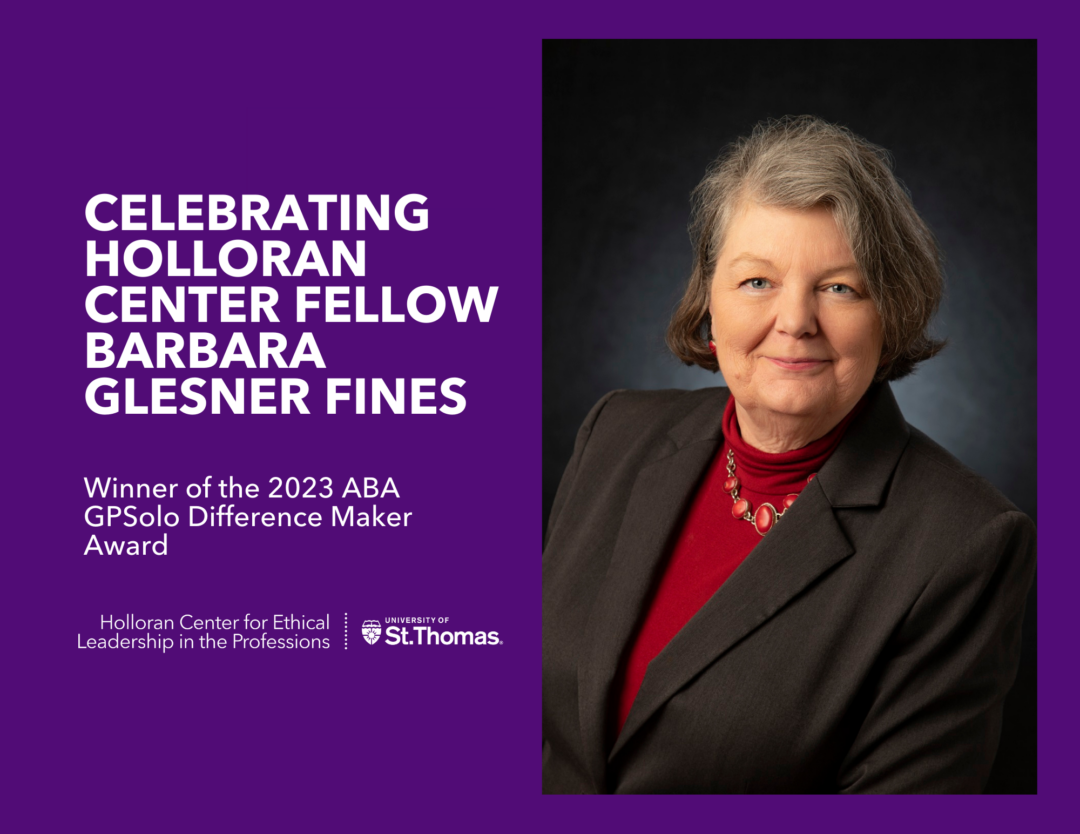
American Bar Association Difference Maker Award Recognizes PIF Program

By Felicia Hamilton, Holloran Center Coordinator

At its annual fall meeting, the ABA Solo, Small Firm and General Practice Division’s (GPSolo) recognized Holloran Center Fellow Barbara Glesner Fines with its Difference Maker Award.   The Award recognized Dean Glesner Fines’ leadership in developing a solo and small firm program at the University of Missouri Kansas City School of Law.  This program is explicitly designed as a professional formation opportunity in which students are guided in envisioning themselves as entrepreneurial lawyers and are required to prepare a business plan and portfolio for their solo or small firm practice.

That program, first developed with Dean Emerita Ellen Suni and Professor Tony Luppino in 2004, serves those students who have a goal of entering solo or small firm practice upon graduation.  More than simply a law practice management course (though that is an important component in building their plan), the course helps students to identify and demonstrate their unique value to the community.  Students articulate the values that will guide their practice.  They learn about the business of law and the professional guideposts.  Their portfolio provides details of financing, equipment, software, staffing, insurance, and more.

To help guide students in preparing their portfolio, the program faculty work closely with members of the bar and professional support service providers to provide expertise, coaching, and mentoring.  The primary course is held during the summer and includes student participation in the Missouri Bar Solo & Small Firm Conference.  At the conference, students meet solo practitioners in their preferred fields of practice and geographic areas.  Students share their portfolios and pitch their business plans to attorneys for critique, attend continuing education sessions, visit with vendors of support services, and meet members of the Missouri Supreme Court and leadership of the Missouri Bar.

Alumni of the program have launched a variety of very successful solo and small firm practices, many of them by starting in the law school’s post-graduate incubator.  These have included solo practices focusing on a highly specialized fields, general practices in rural and underserved communities, innovative nonprofit law firms, practices focusing on innovation or technology, and highly successful solo and small firms across a wide range of practice areas.  Graduates from even a decade ago report that they still revisit and revise their original business plan prepared during law school. These alumni, in turn, guide the next generation of solo and small firm attorneys.

The program is an example of collaboration in building a professional identity formation program to successfully help students in their transition from student to lawyers.  Congratulations to Holloran Fellow Barbara Glesner Fines and her colleagues on making a difference with this program.

To learn more about the solo & small firm program or to share your own experience with similar programs, contact Professor Glesner Fines at glesnerb@umkc.edu.


Barbara Glesner Fines is the Dean and Rubey M. Hulen Professor of Law at the University of Missouri-Kansas City School of Law.

Barbara Glesner Fines is the Dean and Rubey M. Hulen Professor of Law at the University of Missouri-Kansas City School of Law.