Lawyering Skills – Holloran Center Professional Identity Implementation Blog - Page 3
Browsing Tag

Lawyering Skills

Karen Gross

A Case for Getting Proximate

By: Karen Gross, Founder & CEO of Citizen Discourse

“We cannot create justice without getting close to places where injustices prevail….We have to get proximate.” – Bryan Stevenson

Esteemed innocence attorney and justice warrior, Bryan Stevenson, is known for making the case for what he calls, “getting proximate.”  Around the time I first watched him speak, I had the privilege of bearing witness to a transformative restorative circle facilitated for victims of hate, an initiative of the Austin Hate Crimes Taskforce.  This was my first restorative circle and I was amazed by what I witnessed.  In a short period of time, a diverse collection of people connected on a deep level due to the thoughtfulness that went into the curation of the conversation.  And the proximity.

***

Our brains are amazing.  We are literally wired for human connection.  And all it takes is the slightest interaction: a moment of eye contact, the touch of a hand, the sound of a voice.  Humanizing interactions causes the brain’s limbic system to release dopamine and oxytocin.  These neurotransmitters accelerate bonding and trust. 

Research conducted by David DeSteno, a social psychologist at Northeastern University, shows that brief social interactions increase feelings of empathy and compassion.  And a study published in Social Cognitive and Affective Neuroscience in 2017 titled, “The Effect of a Single Session of Intense Emotion on Implicit Empathy in Healthy Participants,” found that simply looking into someone’s eyes for a few seconds increases activity in the prefrontal cortex – the area of the brain associated with empathy. 

In light of this, it seems that getting proximate is an expedient and powerful opportunity for our students to develop their social and emotional skills and even expand their cultural competence.  When students have regular and meaningful interactions with their peers or clients (in clinics or pro bono work) from cultures, geographies, and backgrounds different from their own, they have the chance to develop a deeper understanding, appreciation, and respect for different perspectives. Law school offers an ideal opportunity for students to expand their perspectives by getting proximate with others.  

In my next post, I will discuss the importance of creating psychological safety so these exchanges indeed foster trust and understanding.  

***

Invite to Write

Reflect on a time you recently “got proximate.”  Describe the circumstances, the setting, and the interaction.  How did your perception shift?  What contributed to your shift in perception? 

Let’s connect!  Email me at Karen@citizendiscourse.org.

Karen Gross is the Founder & CEO of Citizen Discourse.

David Grenardo

How Law Students of Faith Can Respond to Imposter Syndrome

By: David A. Grenardo, Professor of Law and Associate Director of the Holloran Center for Ethical Leadership in the Professions, University of St. Thomas School of Law

Imposter syndrome can impede a law student’s (and lawyer’s) ability to develop their professional identity. Several legal scholars acknowledge that an aspect of one’s professional identity includes their spiritual or religious beliefs and/or their faith tradition.[1] The Notre Dame Journal of Law, Ethics & Public Policy recently published How A Person of Faith Can Address Imposter Syndrome in Law School on its Considerations blog. The short article briefly discusses the prevalence of imposter syndrome in law school, and it provides a number of ways that a law student of faith can address imposter syndrome.

Should you have any questions or comments about this post, please email me at gren2380@stthomas.edu.

David Grenardo is a Professor of Law and Associate Director of the Holloran Center for Ethical Leadership in the Professions at the University of St. Thomas School of Law.

[1] See, e.g., Isabelle R. Gunning, Lawyers of All Faiths: Constructing Professional Identity and Finding Common Ground, 39 J. LEGAL PROF. 231, 269 (2015); Neil W. Hamilton et al., Empirical Evidence That Legal Education Can Foster Student Professionalism/Professional Formation to Become an Effective Lawyer, 10 U. St. Thomas L.J. 11, 29 (2012); Robert K. Vischer, Moral Engagement Without the ”Moral Law”: A Post Canons View of Attorneys’ Moral Accountability, 2008 J. Prof. Law. 213, 232 (2008).

Christopher Corts

Know Yourself, Learn Your Audience: Professional Identity Formation and Audience-Awareness in the 1L Legal Writing Classroom

By: Christopher Corts, Professor of Law, Legal Practice, University of Richmond School of Law

Teaching legal writing to 1Ls provides endless opportunities to help students grow their way through the stage-development process of professional identity formation. As students learn how to write in a way that effectively educates and persuades an audience of lawyers and judges, they learn important information about the particular skills, competencies, attitudes, and values they will need to develop if they are to successfully become the kinds of lawyers that employers want and society needs—the kind of lawyers they hope to be, in other words.

For today’s posting, I want to share a PIF-informed exercise I have developed in my Legal Analysis & Writing class. I will try to present it in a way that invites your own tinkering and innovation.

If you share my conviction that education toward professional identity formation (PIF) ought to be integrated into other subjects being taught in the law school curriculum, this exercise can help you experiment with one way that transparently PIF-focused education can help Fall Semester Legal Analysis & Writing students learn more about two of the primary audiences they will be writing documents for during both semesters of a 1L legal writing course: lawyers and judges.

In the opening weeks of a first-year legal analysis and writing course, legal writing professors have a unique opportunity to seamlessly integrate professional identity formation into their legal writing curriculum. As explained below, professional identity formation instruction can help legal writing professors achieve core goals in the legal writing curriculum. By introducing students to core legal writing concepts, language, and skills that students will need to succeed in the short-term (in the writing course), students will learn invaluable information about the kinds of skills, competencies, attitudes, and values that they will need to thrive as professionals in the long-term, in their hopefully-long careers as lawyers who analyze and write to help clients solve legal problems.

In the paragraphs that follow, I will attempt to briefly share what I have learned about how to integrate core analysis and writing objectives with professional identity formation-relevant content early in the 1L legal writing curriculum. To help facilitate your own experimentation, I will share the following:

(1) learning objectives to share with students;

(2) instructional resources that are useful for completing the unit of instruction;

and

(3) an instructional sequence you can use to execute the published objectives.

An appreciation for learning in context[i] is a core feature of any skills-based class. As professors of legal writing, we are lawyers who teach 1Ls early (and often) in their process of professional identity formation. We are uniquely positioned to introduce our students to two threshold questions from the very start of our writing courses. These two questions are familiar features of any professional communication course:

Who is your audience?  

What is your purpose for writing to them?

In the context of the opening weeks of a required 1L writing class, these two critical questions require students to do something nearly impossible for novices to do: imagine what it is like to actually be a lawyer, working in context, with limited (or possibly no) direct observation or experience.

Whatever 1Ls may come to law school knowing about the profession, even when they have practiced law in another country prior to enrolling in an American law school, this fact remains: no 1L has ever yet worked as a lawyer licensed by a jurisdiction in the American legal system.

As instructors, we know that, even as legal interns or summer associates, our students will be expected to complete core lawyering tasks in the same way that veterans of the profession complete them: in the context of a role-based, frequently-adversarial system that is populated by a range of familiar types. Whether our students’ future bosses prove to be some combination of happy, cranky, nurturing, or antagonistic, in the American legal system, all lawyers of every kind must figure out how to thrive in a stressful, unpredictable, ever-changing, perpetually time-deprived, chronically stressed-out, unapologetically-perfectionistic, hyper-achieving culture that defines us as a collective (and as individuals, if we are not intentional and careful). For better or worse.

Several years ago, wanting to give more intentional instruction about the context of lawyering earlier in my legal writing course, I started experimenting with offering a short unit of professional identity formation-style instruction during the first week of the course. I designed it to help legal analysis and writing novices do two foundational things: (1) learn about their audience (lawyers); and (2) learn how to write a simple C-R-A-C.

In the paragraphs that follow, having learned from trial and error, I will share three resources I have developed in order to help you experiment with your own version of this exercise in your legal writing class: (1) learning objectives; (2) instructional resources; and (3) an instructional sequence.

Part 1: Learning Objectives

This exercise uses conventional professional identity formation-related resources in order to achieve five learning objectives that are directly related to success in a legal analysis and writing course. Here is how I articulate the learning objectives for my students.

———————————————————————–

This short unit of instruction is designed to help familiarize you with one of every lawyer’s most frequent audiences: other lawyers. By completing this unit of instruction, you will more fully appreciate the people to whom you will be frequently writing in this course—lawyers and judges. The more you appreciate about them, the more you will understand how you need to learn, grow, and change over the next three years.

Specifically, completing this exercise will help you:

    • identify the features that help to demarcate law as a “profession”;
    • identify some of the issues related to quality, equity, well-being, and the delivery of legal services that all lawyers are professionally obligated to address as part of our duty to maintain the health and integrity of the profession and society’s system of legal justice;
    • identify some of the skills, values, and competencies that data suggests are most relevant to legal practice in America;[ii]
    • assess your own proficiency at the skills and competencies that data suggests are most relevant to legal practice in America; and
    • use your own self-assessment to practice writing a simple argument in the C-R-A-C form that is familiar to all lawyers, and which helps to distinguish legal arguments as belonging to a particular genre or type.

———————————————————————–

Notice: the final learning objective adds an additional layer of legal writing-specific instruction to the exercise. It helps to more seamlessly embed “professional identify formation”-style content and also justify it for especially literal-minded students who are expecting instruction relevant to Legal Analysis and Writing (or whatever your course may be titled).

In my experience, students embrace the purposeful design of the exercise. They have even enjoyed it; rare is the 1L who does not appreciate an opportunity to start a new educational initiative by thinking about herself! And it helps to teach students that professional identity formation can be easily integrated into a first-year legal analysis and writing course. All students can be assured that they will be learning about the skills most relevant to successful work as a professional by learning two of the skills most relevant to success in this course: (a) knowing your audience; and (b) expressing an argument that adheres to a simple IRAC / CRAC form in an audience-sensitive way.

Part 2. Instructional Resources

To achieve the learning objectives identified above, I draw from several resources:

A.  Excerpts from historical, first-person accounts of what it means to “be a lawyer”—especially those written by lawyers from historically-marginalized communities;[iii]

B.  Information about the history of the profession,[iv] professionalism, professional oaths, and other legal writing-specific educational content[v] published by state bar associations[vi];

C.  The “Profile of the Profession” data[vii] that is published annually by the American Bar Association; and

D.  Data about the skills, values, and competencies most relevant to legal practice.[viii]

In endnotes referenced above, I have identified particular texts and resources I have used through the years. But I have tried to describe the four general categories of instruction that I have tried to include. Collectively, these different categories help to capture what it means to be a professional and what it means to be a lawyer, specifically. And what skills, values, and competencies lawyers in America value in themselves and expect of other lawyers, given the particular needs of clients. There are a wealth of resources you can draw from. New resources are being updated and made available all the time. Experimentation is encouraged!

Part 3. The Instructional Sequence

Putting all of this together, the instructional sequence looks something like this:

  1. Preparation for class. Prior to class, I assign foundational homework to prepare students to complete the instructional sequence. The homework is usually some intentionally-curated combination of readings excerpted from suggestions I provided in end notes to Instructional Resources A. and B. in Part 2 above.Because I will be asking the students to write an IRAC / CRAC for the first time, I also assign a brief written introduction to IRAC / CRAC. I use an excerpt from the textbook I have adopted for my course[ix], but many other resources – including short videos published online – are easily accessible and can achieve the same purpose.
  2. In-Class Lecture and Work. During class, I deliver a lecture (with visual illustrations) that briefly introduces students to three topics:
    • (i) the most recent “Profile of the Profession” data published annually by the American Bar Association (as described in letter C. in the list of Instructional Resources provided in Part 2 above);
    • (ii) scholarship and data related to the professional skills, values, and competencies that are most relevant to legal practice (as described in letter D. in the list of Instructional Resources provided in Part 2 above);
    • (iii) the significance IRAC / CRAC in legal analysis and writing.
  3. Homework. After class, I have students complete two exercises, which they finish on their own time as homework following class.
    • First, they should complete a brief self-assessment exercise that asks students to rate and justify their proficiency in the skills and competencies covered in the readings and lecture (#1 & #2 above).
    • Second, when they have created that self-assessment exercise, they should complete an exercise that asks them to use the simple CRAC form to argue that they will make an effective lawyer based upon their ability to articulate a minimally-competent level of proficiency for three of the lawyer-competencies identified in the self-assessment exercise.For example, a simple C-R-A-C-style paragraph could mirror this form (with each student filling out the bracketed information based upon her assessment):

I believe I will make an effective Lawyer.[x] An effective lawyer is someone who can competently perform three or more skills that data suggests lawyers need for effective practice.[xi] Currently, I am at least minimally competent at doing [list 3 skills[xii] from the self-assessment tool that you can currently perform with at least a minimal level of proficiency].[xiii] For example, [here, in a series of short sentences, list each of the justifications you gave for the proficiency rating you assigned yourself for each of the three competencies you identified in the previous sentence.] In all these ways, since I have demonstrated I am at least minimally competent at doing [list again the three competencies selected above], I believe I will make an effective lawyer.[xiv]

    • Third, I collect the self-assessment instruments and the simple C-R-A-C. I do not mark, comment upon, or grade the self-assessment instrument. I do assess and provide detailed feedback – but not a grade – on the simple C-R-A-C paragraph. But when I assess it, I am only commenting on the correct form—whether they effectively wrote each component of the C-R-A-C acronym in that sequence.
    • Fourth, much later in the year, during the final class in Spring, I distribute the self-assessment exercise completed in Fall and ask students to read it, reflect on everything that has happened in the 1L year since the start of the Fall semester (when we completed the exercise), and update it. By asking students to complete the exercise again, they are able to make it current with any new experiences that they might have gained during the 1L year. By using this exercise to effectively book-end the 1L year in my course, I am able to help students appreciate the iterative process of self-reflection that will be key to lifelong learning in the profession. (Lifelong learning is a core lawyering skill!) This approach captures the stage-development process that I understand to be a hallmark of the professional identity formation process.

If you have any questions about how to plan or implement this exercise, or if you would like to share with me your own exercises or experiences doing comparable activities in the context of your course, please email me at ccorts@richmond.edu.

Christopher Corts is Professor of Law and Legal Practice at the University of Richmond School of Law.

[i] “There may be better and worse ways to learn to solve problems, but there appears to be no substitute for context. ” Gary L. Blasi, What Lawyers Know: Lawyering Expertise, Cognitive Science, and the Functions of Theory, 45 J. LEGAL EDUC. 313, 386-87(1995).

[ii] Whereas instruction designed for “professional identity formation” might emphasize education about professional culture as part of a process of indoctrination and enculturation, in the legal writing classroom, context is important for more discipline-specific reasons: because it can help students learn how to identify, research, analyze, and solve legal problems in order to write or verbally communicate coherent solutions for diverse audiences situated within that professional context. “There may be better and worse ways to learn to solve problems, but there appears to be no substitute for context.” Gary L. Blasi, What Lawyers Know: Lawyering Expertise, Cognitive Science, and the Functions of Theory, 45 J. LEGAL EDUC. 313, 386-87(1995).  

[iii] See, e.g., Virginia Drachman, “Women Lawyers and the Origins of Professional Identity in America: The Letters of the Equity Club, 1887 to 1890,” (Ann Arbor, MI: University of Michigan Press, 1993). See also Constance Baker Motley, Equal Justice Under Law, (Farrar, Strauss, and Giroux 1998).

[iv] To give one example: in the past I have used excerpts from Anton Chroust’s two-volume history of the profession, The Rise of the Legal Profession in America (1965). Of course, more contemporary histories are easily available (and probably more easily accessible to readers!) in a shorter form: articles, excerpts from professional responsibility textbooks, etc. My goal is to provide a short excerpt that helps the reader understand what it means to be “a profession” (as opposed to some other career) and what marks “legal professionals” as “professionals” in a sociological sense.

[v] See, e.g., The Supreme Court of Ohio Commission on Professionalism, “Professionalism Do’s and Don’t’s: Legal Writing,” accessible online at https://www.supremecourt.ohio.gov/Publications/AttySvcs/legalWriting.pdf.

[vi] To give one compelling example, the state of Ohio publishes a number of professionalism resources that can introduce law students to the values and ideals of the profession—including some specific to legal writing. See, e.g., “Professional Ideals for Ohio Lawyers and Judges,” accessible online at https://www.uakron.edu/law/docs/proIdeals.pdf. See also The Supreme Court of Ohio Commission on Professionalism, “Professionalism Do’s and Don’t’s: Legal Writing,” accessible online at https://www.supremecourt.ohio.gov/Publications/AttySvcs/legalWriting.pdf.

[vii] The ABA maintains an interactive website that houses all of the data. See http://www.abalegalprofile.com.

[viii] There are an ever-increasing number of resources you could use to help craft this exercise. In the past, I have found the IAALS “Foundations for Practice” webpage to be a sensible place to start. See https://iaals.du.edu/projects/foundations-practice. To read the original report, see Alli Gerkman and Logan Cornett, “Foundations for Practice: The Whole Lawyer and the Character Quotient” (2016), accessible online at https://iaals.du.edu/publications/foundations-practice-whole-lawyer-and-character-quotient.  Allyson Carrel and Cat Moon have innovated an “agile competency model for the modern legal professional” called “Design Your Delta,” accessible online at https://www.designyourdelta.com/about. For a thoughtful, scholarly approach, see also Neil Hamilton, “Empirical Research on the Core Competencies Needed to Practice Law: What Do Clients, Lawyers, New Lawyers, and Legal Employers Tell Us?,” The Bar Examiner 6-16 (September 2014).

[ix] Jill Barton and Rachel Smith, “Handbook for the New Legal Writer,” Aspen Publishing, (2d ed., 2019).

[x] This first sentence is a CONCLUSION.

[xi] This second sentence is a RULE.

[xii] Do not worry about the arbitrariness of this rule selection for now. Later in the course, as we learn more about hierarchies of authority, we will learn how to synthesize binding and persuasive rules that are less arbitrary—and more compelling to our reader—than this crude rule. For now, we just need to pick three competencies so we can create a rule and practice articulating a simple, coherent argument in a recognizable C-R-A-C form our reader will expect.

[xiii] This third sentence provides ANALYSIS of the rule; it applies the three competencies above to your self-assessment. The next sentence provides justification for the way you are here applying the rule; it is part of your ANALYSIS, too, because it helps the reader understand your rationale for concluding that you will make an effective lawyer given the rule (that data suggests the three named competencies are relevant to effective lawyering).

[xiv] This is your final CONCLUSION.

Linda Sugin

Does Law School Have to Suck?

By: Linda Sugin, Professor of Law & Faculty Director for the Office of Professionalism, Fordham Law School

The three-part series published in the National Law Journal, “Does Law School Have to Suck?,” analyzes seven reasons why law students are unhappy.  In the series, I also propose changes that law schools and the legal profession should adopt to transform the student experience by reforming curriculum, assessment, hiring, and financing.  The solutions advocated reflect two major themes – creating inclusive and supportive communities and individuating the development of professional identity for law students.  These reforms would improve learning and help students build a wider range of capabilities necessary for professional success and satisfaction.

Here is a link to the three-part series published in the National Law Journal on March 30, April 4, and April 6, 2023. Feel free to contact me at lsugin@fordham.edu with questions or comments.

Linda Sugin is Professor of Law & Faculty Director for the Office of Professionalism at Fordham Law School in New York.

Greg Miarecki

The Leadership Project

By: Greg Miarecki, Executive Assistant Dean for Career Planning and Professional Development, Director of the University of Illinois College of Law Leadership Project, University of Illinois College of Law

As part of our work on professional identity formation, the University of Illinois College of Law recently launched a Leadership Project that is designed to teach students about core principles of leadership.  For many reasons, our profession is over-represented in leadership ranks.  One only need look at the 45 U.S. Presidents (Grover Cleveland was one man, but two Presidents) for proof – 26 of them were trained as attorneys, two of them (Abraham Lincoln and Barack Obama) from Illinois.

The Leadership Project begins in the 1L year, with three sessions of our Fundamentals of Legal Practice course focused on leadership.  One class offers general principles of leadership, co-taught by our Dean and the CEO of Portillo’s Hot Dogs.  The second class focuses on the importance of diversity, equity, and inclusion when leading teams. The third and final class in the series focuses on leadership in the non-profit realm, recognizing that lawyers will be called to lead everything from condo boards to nations.

We invite 2Ls and 3Ls to continue with Leadership Project activities.  Each year, we offer a series of lectures and classes focused on leadership, as well as two “book talks” – sessions that discuss selected books focused on leadership.  During the past couple of years, we’ve hosted notable guests such as former Illinois Governor Jim Edgar, Carlyle Group co-founder David Rubenstein, and Illinois Supreme Court Justice Lisa Holder White.  And, together, we’ve read and analyzed a variety of books, including, for example, Barack Obama’s A Promised Land and Sam Walker’s The Captain Class.  As part of the event planning process, we regularly reach out to student groups and encourage them to co-host Leadership Project events.  This year, many of our events featured student moderators and discussants.  In fact, each year, our Student Bar Association hosts a panel discussion of student leaders – moderated by students – as part of the Project.

Students who complete the required number of lectures, book talks, and classes are invited to participate in a half-day leadership retreat facilitated by an executive coach.  Upon completing the retreat, students receive the designation of Leadership Scholar, which is added to their transcript.  This month, we’re looking forward to graduating our second cohort of Leadership Scholars, and interest in the Project among our students continues to grow.

We’ve also expanded the Leadership Project beyond the student body, offering continuing legal education in this area to alumni and friends around the world.  If you’re interested in learning more about the Leadership Project, or taking part in some of our events, please connect with me on LinkedIn or e-mail me at miarecki@illinois.edu.

Greg Miarecki is the Executive Assistant Dean for Career Planning and Professional Development and the Director of the University of Illinois College of Law Leadership Project at the University of Illinois College of Law

Patrick Longan

Meeting Students Where They Are

By: Patrick E. Longan
W.A. Bootle Chair in Ethics and Professionalism
Mercer University School of Law

One of the first lessons I learned about teaching professional identity was Neil Hamilton’s oft-repeated observation that we must “meet the students where they are.” This may also be the most important lesson I have learned.

Let me give you an example. At Mercer, a big part of our professional identity course is a series of small group discussions of hypothetical dilemmas the students might face in practice. In one, they are in role as a junior partner in a large firm and discover evidence that a more senior partner, who is a rainmaker and the source of most of their work, may be overbilling their biggest client, a large corporation. The students are asked to come up with a plan for how they are going to proceed and to be ready to convince others in the small group discussions of the wisdom of the chosen course.

This is a classic problem of practical wisdom. There are many values in play, and they are in tension with each other. The junior partner wants to keep a good relationship with the senior partner, for personal and professional reasons. The senior partner has been a mentor, and, without a steady flow of work from the senior partner, the junior partner’s future in the firm is in doubt. At the same time, the junior partner has obligations to protect the firm and the client from the senior partner’s possible wrongdoing. Overlaying those conflicting goals is irreducible uncertainty. Before taking action, the junior partner cannot know for sure whether the senior partner is overbilling or how the firm will react to any questions the junior partner might raise.

The students receive some guidance about how to approach such problems. At a fundamental level, they know that one of the non-negotiable components of a lawyer’s professional identity is fidelity to the client. We teach it as a virtue and articulate it in first-person terms: “I am the kind of lawyer who fulfills my duties of utmost good faith and devotion to my client, and I do not permit my personal interests or the interests of others to interfere with those duties. For this problem, the students also receive more detailed instructions. The problem offers them the options to do nothing, to raise the issue directly with the senior partner, to consult in-house ethics counsel, or to report the partner to the bar.

Because of all the uncertainty, there is no one right answer. Maybe the senior partner is a thief. Maybe he’s a sloppy timekeeper. Or maybe the partner has an arrangement with the client that allows him to bill a certain number of hours each month regardless of how many hours he actually expends. The students have to think through those possibilities and decide what to do.

This is where the lesson “meet the students where they are” comes in. Although there is no single right answer, at least one answer is wrong: the junior partner cannot choose to do nothing. Once a lawyer has substantial reason to believe that their client may have been the victim of overbilling by a partner in the firm, the lawyer must at least inquire further. Fidelity to the client demands action. In the possible overbilling scenario, there are better and worse ways of proceeding, but the lawyer must proceed in some way, even if it is against self-interest.

Every year we learn that many first-year law students cannot bring themselves to accept, even in a law school hypothetical, that they might be required to take personal risks to protect a client from the acts of another. When the students do a written reflection on the exercise, many write, with great candor and self-awareness, that they would not do anything that would put their position at risk, because they feel a primary obligation to protect themselves and their families from the loss of their jobs. Some describe this decision as “minding my own business,” or “staying in my lane,” or – my personal favorite – “not my circus, not my monkeys.” More than a few foresee catastrophic personal consequences if they lose their job. Others justify the decision by pointing out that the client in the hypothetical is a big corporation that would not miss the money.

Students do not respond in these ways because they suffer from character flaws. They are simply at an early stage of their professional identity development. It is our job to “meet them where they are.”

The most important part of doing that is not to be preachy or judgmental about the decision to do nothing in order to protect themselves. We should expect many students to have a self-interested disposition rather than a fiduciary one at this stage. Law students are all high achievers, and being disposed to look out for #1 has helped them succeed. Although we do not shrink from explaining that the decision to do nothing is unacceptable, we do so in a kind and understanding way. For example, we try to help the students see the situation through the client’s eyes. The client has to trust the lawyer and the law firm because the client is unlikely to be able to detect overbilling. The client would surely feel entitled to know if one of the firm’s lawyers was stealing from the client, if for no other reason than to begin the search for a new law firm. The reasons why acting as a fiduciary to a client are non-negotiable begin to emerge from those discussions.

Another aspect of “meeting them where they are” is to address their fears of losing their jobs if they report the senior partner. That is a possible outcome in the scenario. But some students panic because they foresee economic catastrophe.  Some say they fear “not being able to feed my family” or “losing everything I worked so hard for” if they lose their job. These fears are real because that is “where students are.” Many students lead precarious economic lives. Many have no assets or income and live on massive student loans that someday will need to be repaid. Their nervousness about money leads them, in responding to the problem, to cling to the good job they have with lockjaw tenacity, even if the client suffers. But the students do not appreciate that their economic lives as lawyers will be different from their economic lives as students. They do not realize that losing this particular job is unlikely to be quite so catastrophic. There are other firms, other jobs, other clients. There are steps they can take to insulate themselves from possible effects of switching jobs by cultivating their skill, reputation, and client base. At least in this part of the problem, we can speak some comfort to them. Although there is reason to be afraid of losing a job, there is likely no need to be terrified of it. We can start to move them from where they are to a place less filled with economic dread.

A final aspect of “meeting them where they are” in the handling of this problem is to address the suggestion that they owe less of a duty to a big corporate client than to a more sympathetic or impoverished one. The temptation to think that way at an early stage of professional identity development is understandable. Some of our students take a dim view of big business and instinctively feel entitled to condition their conduct as lawyers on the moral worthiness of the client.

If we handle this approach with understanding and patience, we can help the students cultivate a more mature professional identity. Early in the semester, we read a story about a criminal defendant who was executed after he received terrible representation, perhaps in part because his lawyers did not think he deserved it. After all, the client was a “wife-killer.” The students mostly were outraged by that. Many said “everyone deserves the lawyer’s best efforts” or something along those lines. When we play back those sentiments in our discussions about the representation of a large corporation, the students begin to move from where they are to a more sophisticated understanding of the lawyer’s role. If you can’t be 100% of a lawyer for a wife-killer, don’t represent him. If you can’t give your all for a big corporation, do something else. But the students begin to appreciate that selective fulfillment of the lawyer’s duties, depending upon the worthiness of the client, is not an option.

This is a specific example of a general point. Professional identity development is a process. Most law students are at an early stage. If we “meet them where they are” with understanding and kindness, we can help move them to where they need to be. Neil Hamilton taught me that. For this and so much else – thank you, Neil.

Please feel free to contact me at longan_p@law.mercer.edu if you any questions or comments about this post.

Patrick Longan
is the William Augustus Bootle Chair in Ethics and Professionalism in the Practice of Law at Mercer University School of Law and is Director of the Mercer Center for Legal Ethics and Professionalism

Karen Gross

AN INTRODUCTION TO CITIZEN DISCOURSE

By: Karen Gross, Founder & CEO of Citizen Discourse

The group of 2L and 3L students huddled around a long conference table, leaning in so as not to miss a word. These students are enrolled in the Access to Justice Project Management class I co-instruct with Victor Quintanilla at Indiana University Maurer School of Law. The person they are eager to hear from is Calvin, who is a clemency client of mine. He’s been incarcerated at the Greensville Correctional Facility in Jarratt, Virginia since he was 18 years old. Calvin is 38. Right now, Calvin is looking at another forty years of his life locked away.

“Based on your personal experience with the justice system, what advice do you have for law students hoping to contribute to a more just legal system?”

In his slow and deliberate cadence, Calvin responded, “Every person has a story. Take the time to listen.”

**

Unlike breathing, which we do unconsciously, to really listen with the objective to understand the other person requires intention. Otherwise, it’s just hearing. In class, we center the practice of active listening: from mirroring and reflective listening to empathic listening and humble inquiry. We think about scenarios where, as lawyers, these different listening approaches are effective tactics.

Let me back up and introduce myself since I’m new to this space. My name is Karen Gross. I am a practicing attorney, a consultant, a facilitator and instructor, and a social justice advocate. Out of a concern for the state of our democracy and a growing interest in restorative practices, I started an organization whose mission is its name: Citizen Discourse. Citizen Discourse gatherings make space for participants to develop more effective communication, self-awareness, and other valuable human skills. The crux of the Citizen Discourse approach involves a human-centered scaffolding for conversations, coupled with a social contract that defines relationships, sets norms, and builds buy-in. Together, these elements help foster psychological safety which lay the foundation for authentic interactions seeded in trust.

I work with law schools supporting and encouraging law students to think about their professional identities, their values, and the emotional intelligence skills it takes to align actions with values. With the newly revised ABA Standard 303, I hope to share this approach and resources with schools looking for a more holistic strategy for embedding professional identity formation.

 **

Last week I reached out to the student who asked Calvin for his advice to see what she thought of his answer. She responded with:

“I came to law school with aspirations of ‘changing the world,’ and expected law school to teach me how to do that — and I know many colleagues who share that sentiment. Calvin’s advice reminded me that some of the most valuable elements of my practice will be traits that I do not learn in the traditional doctrinal law classrooms. Even if I have all the doctrinal knowledge and ability to ‘think like a lawyer,’ my clients will be looking to talk to a human – not a robot – who can see, appreciate, and value their humanity.

I believe this sentiment captures the essence of what the work of professional identity formation and Citizen Discourse are all about: helping our students both think like a lawyer and act like a human.

Over the next few posts, I will share the theories and thought leaders that inform the Citizen Discourse approach to culture change. I hope this invites an exchange of ideas and a conversation. To that end, Citizen Discourse offers monthly restorative conversations on the first Tuesday of every month for higher education professionals working in this space. Over the course of a one-hour session, we get mindful, discuss trends and challenges, and build rapport. Come join us if you are curious to experience a Citizen Discourse style conversation.

Please email me at Karen@citizendiscourse.org if you have questions or comments, or if you’d like to join an upcoming conversation.

Karen Gross is the Founder & CEO of Citizen Discourse.

Kendall Kerew

A Chat with ChatGPT: The Uniquely Human Aspects of Lawyering

By: Kendall L. Kerew, Associate Clinical Professor of Law and Director of Externships, Georgia State University College of Law; Holloran Center Fellow 

Last month, I had the privilege of participating in the 2023 Wake Forest Law Review Symposium: Leading Change in the Legal Profession.[1] I was part of a panel with Luke Bierman (Elon School of Law) and Maria Savasta-Kennedy (University of North Carolina School of Law) entitled, “Experiential Education and Lawyer Development.” Specifically, the panel “explore[d] the history of experiential education in law schools; the current status of experiential education in American legal education; and the role of experiential education, including clinics, externships, simulations, and more in shaping the professional identity of law students and lawyers.”[2]

Given the focus of the panel, my prepared remarks enumerated four reasons why experiential education should be central to how we teach law students now and in the future: 1) the requirement that law schools incorporate professional identity formation throughout the curriculum because learning while in the role of lawyer, where a student experiences the integration of knowledge, skills, and values, is particularly well-suited to examining one’s emerging professional identity;[3]  2) the requirement that law schools provide education on bias, cross-cultural competency, and racism because, for students in law clinics or field placements, one of the instances must occur before, concurrently with, or part of students’ enrollment in clinical or field placement courses;[4] 3) the development of the NextGen Bar Exam and efforts to ensure alternative pathways to licensure because the path forward is focused much less on rote memorization and more on the application of knowledge and skills;[5] and 4) the greater role artificial intelligence is likely to play in law practice because experiential education teaches lawyering skills that are uniquely human.

In this blog post, I want to focus on the last reason I posited for why experiential education is particularly relevant to the future of legal education: the greater role artificial intelligence is likely to play in law school and law practice. I am sure you have heard the news stories about ChatGPT writing passing answers to the bar exam and law school exams,[6] how ChatGPT can improve student legal writing,[7] how a judge used ChatGPT to write a ruling,[8]  and that ChatGPT may end up making lawyers obsolete.[9] Given all the attention ChatGPT has been getting, I thought it would be interesting to ask ChatGPT the following question and share it as part of my remarks:

What aspects of lawyering cannot be replaced by AI?

This was ChatGPT’s response:

There are several aspects of lawyering that cannot be replaced by AI, including:

Empathy and Emotional Intelligence: Lawyers need to understand their clients’ emotions and needs to provide effective legal advice. AI lacks the ability to comprehend and express emotions, making it difficult for it to replace the empathy and emotional intelligence needed in the legal profession.

Creativity and Critical Thinking: Lawyers often need to come up with creative solutions to complex legal problems. AI, while capable of analyzing vast amounts of data and generating insights, lacks the creativity and critical thinking skills needed to approach legal issues in novel and effective ways.

Advocacy and Persuasion: A significant part of a lawyer’s role involves advocating for their clients’ interests in court or in negotiations. This requires excellent communication skills, the ability to read and respond to non-verbal cues, and the art of persuasion. While AI can analyze and predict the outcome of legal disputes, it cannot advocate for a client in a courtroom.

Ethics and Professionalism: Lawyers are bound by strict ethical and professional standards, which require them to act in the best interests of their clients while upholding the rule of law. AI lacks the moral compass and judgment necessary to make ethical decisions, making it unsuitable for replacing the role of a lawyer.

Client Relationship Management: A lawyer’s success often depends on their ability to build and maintain strong relationships with their clients. AI lacks the ability to build rapport or provide personalized attention to clients, making it difficult to replace the human touch needed in client relationship management.

If you are reading this blog, you probably already knew this and felt secure in the future of our profession. Nonetheless, ChatGPT’s answer encompasses the very things we teach in experiential education and explore through professional identity formation. So for this blog post, I decided to ask ChatGPT a follow-up question:

Why is professional identity formation important to legal education?

This was ChatGPT’s response:

Professional identity formation is essential to legal education because it shapes how law students understand themselves as future lawyers and how they approach their legal careers. A strong professional identity helps students to develop a sense of purpose and a commitment to the values and ethics of the legal profession.

Here are some key reasons why professional identity formation is important to legal education:

Ethical and Professional Conduct: A strong professional identity helps students develop a sense of responsibility towards ethical and professional conduct, which is essential for the effective functioning of the legal system.

Career Satisfaction: By developing a strong professional identity, law students can better understand their strengths and interests, and align them with the legal career path that is most fulfilling to them.

Client Relationships: A strong professional identity can help students develop the skills and mindset needed to build strong relationships with clients based on trust, integrity, and empathy.

Effective Advocacy: Professional identity formation can help law students develop the skills and values needed to be effective advocates for their clients, while still maintaining their own sense of professional ethics.

Overall, professional identity formation is an essential component of legal education, as it helps students develop the knowledge, skills, and values needed to become competent and ethical lawyers.

This response, coupled with ChatGPT’s response to my initial question, reinforced what we already know: professional identity formation is uniquely human and a necessary component of preparing law students to become the lawyers of the future – lawyers who cannot be replaced by artificial intelligence.

Please feel free to reach out to me at kkerew@gsu.edu if you have any questions or comments.

[1] http://www.wakeforestlawreview.com/2023-symposium/.

[2] Id.

[3] See ABA Standards and Rules of Procedure for Approval of Law Schools 2022–2023, Standard 303(b)(3), https://www.americanbar.org/content/dam/aba/administrative/legal_education_and_admissions_to_the_bar/standards/2022-2023/2022-2023-standards-and-rules-of-procedure.pdf; Timothy W. Floyd & Kendall L. Kerew, Marking the Path from Law Student to Lawyer: Using Field Placement Courses to Facilitate the Deliberate Exploration of Professional Identity and Purpose, 68 Mercer L. Rev. 767, 790 (2017).

[4] See ABA Standards and Rules of Procedure for Approval of Law Schools 2022–2023, Standard 303(c), https://www.americanbar.org/content/dam/aba/administrative/legal_education_and_admissions_to_the_bar/standards/2022-2023/2022-2023-standards-and-rules-of-procedure.pdf.

[5] See About the NextGen Bar Exam, https://nextgenbarexam.ncbex.org/ (”Set to debut in July 2026, the NextGen Bar Exam will test on a broad range of foundational lawyering skills, utilizing a focused set of clearly identified fundamental legal concepts and principles needed in today’s practice of law.”).

[6] See Debra Cassesns Weiss, Latest version of ChatGPT aces bar exam with score nearing 90th Percentile, ABA Journal (March 16, 2023), https://www.abajournal.com/web/article/latest-version-of-chatgpt-aces-the-bar-exam-with-score-in-90th-percentile?utm_medium=email&utm_source=salesforce_642881&sc_sid=01075549&utm_campaign=weekly_email&promo=&utm_content=&additional4=&additional5=&sfmc_j=642881&sfmc_s=45062043&sfmc_l=1527&sfmc_jb=18001&sfmc_mid=100027443&sfmc_u=19035492.

[7] See Stephanie Francis Ward, Can ChatGPT help law students to write better? ABA Journal (March 6, 2023), https://www.abajournal.com/web/article/can-chatgpt-help-law-students-learn-to-write-better.

[8] See Columbian judge uses ChatGPT in ruling on child’s medical rights case, CBS News (Feb. 2, 2023), https://www.cbsnews.com/news/colombian-judge-uses-chatgpt-in-ruling-on-childs-medical-rights-case/.

[9] See Jenna Greene, Will ChatGPT make lawyers obsolete (Hint: be afraid), Reuters (Dec. 9, 2022), https://www.reuters.com/legal/transactional/will-chatgpt-make-lawyers-obsolete-hint-be-afraid-2022-12-09/.


Michael Robak

THE “ONE FILE” COORDINATED COACHING INFORMATION SYSTEM: Developing a Robust Advising Management Application

By: Michael Robak, Director of the Schoenecker Law Library, Associate Dean, and Clinical Professor, University of St. Thomas School of Law

The concept behind developing a robust advising management application is to create “One File” of information developed by and about each student from the law school’s whole organization as the student moves through their law school career.

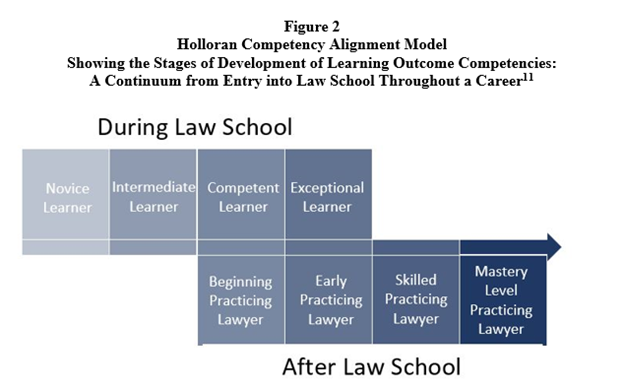
Collecting uniform information in one place, and allowing for appropriate organization-wide access will, we believe, create an advising mechanism that helps each law student move from novice to professional as described in the Holloran Center’s Competency Alignment Model.  (Figure 2 below)

This information system is comprised of three elements:


The first element of this platform, Coordinated Coaching, will be used to capture information for each student from the nine coaching touch points that occur in their journey through law school as identified by Professors and Co-Directors of the Holloran Center Neil Hamilton and Jerry Organ.  The Coordinated Coaching takes place at several points: (1) 1L Fall in a mandatory meeting with the Office of Career and Professional Development (CPD), which is described below in detail; (2) 1L Spring in a mandatory 1L class, Serving Clients Well, where professors, alumni, and local attorneys serve as coaches to the law students who work through Neil Hamilton’s award-winning Roadmap book regarding a student’s journey to finding meaningful employment; and (3) 2L and 3L years in the mandatory Mentor Externship program in which the professors teaching the classroom component of this program continue coaching and guiding the students.  Capturing information from all of these contributors at these different times will allow for those coaching the students to coordinate to better assist student development of learning outcome competencies. Currently this information is captured and stored in multiple systems and trapped in organizational silos.

The second element of this platform is the Academic Communication System (ACS).  We know, anecdotally, there are behavioral “red flags” which constitute potential clues (data points) for those at risk.  The University of St. Thomas School of Law (“School of Law”) currently has nothing in place to serve as a tracking/communication platform for all the department administrators to record and share these interactions—the ACS would serve that function.  The backbone of this element is key information for all students brought in from Banner.  There are eight School of Law departments that would provide information into the system through twenty-three “Reporters” from across those organizations. [1]  The first and most important interactions to capture are the ones with the Director of Academic Achievement and Bar Success as the Director is usually the first stop for students who have some academic success issues or concerns.

The third element of the platform, the Self-Directed Index, allows us to identify the students most at risk for possible problems with first-time bar passage and employment outcomes.  While there is anecdotal evidence suggesting about 20% of students in any given year are at risk, we are seeking to fine tune that identification by developing an instrument to gauge an individual student’s self-directedness.  This self-directed index would pull information primarily from Canvas.  For example, one item of potential concern is class attendance.  With the use of the Canvas attendance tracker, we could gather student information for each semester looking for patterns of activity.  Another example includes tracking when students turn in their assignments?  Are assignments submitted by students early, on time, or late?  This is another variable we would be able to examine.

With these three platform elements in place, the One File system becomes the single source for capturing all the information about the student journey.

The Applications behind One File are Salesforce, Qualtrics, and Canvas.  Salesforce will be customized for this specific project.  Qualtrics will be used to capture the Coordinated Coaching and Academic Communication System information.  The Self-Directed index will primarily rely on Canvas data.

Phase One of the One File system is putting parts of the Coordinated Coaching and Academic Communication System in place by the end of the Spring 2023 semester.  For the Coordinated Coaching element, One File is “starting from scratch” with only the current 1L class; we are investing in the Class of 2025 as our beta group.  We are not seeking to make One File retrospective for Coordinated Coaching.

At launch it will be built to hold the information for that Class’s 1L and 2L years.  We would seek to add the 3L year sometime later in 2023 or early 2024.  We have identified nine coaching touch points through the student’s law school journey for which we wish to track key information, and this first phase will track the first five touch points occurring in the 1L and 2L years.  The last four touch points occur during the 3L year and are similar to the 2L year with the addition of a CPD exit interview and work for bar preparation through the JD Compass program.

Phase one development of the Academic Communication System will be built for our Director of Academic Success to capture the interactions with students.  We anticipate broadening this to include other “Reporters” who can provide additional information to the file.

COORDINATED COACHING – the Beginning Touch Points

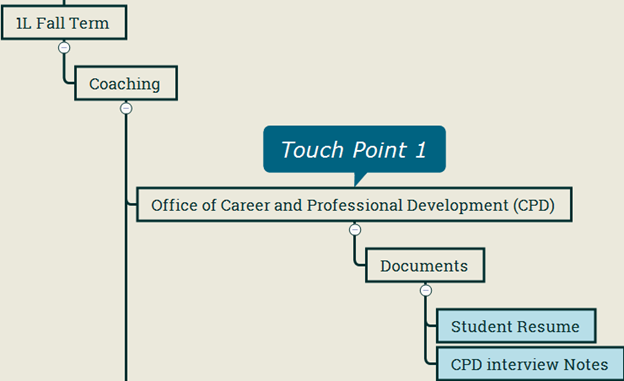
The first Coordinated Coaching touch point occurs during the 1L Fall term.  Each 1L meets with a CPD team member, and this provides the initial (and base line) information about the student.

Coaching Touch Point 1:

Currently, CPD uses Symplicity for storing student resumes, as well as their meeting notes with students.  In addition to the resume, the data we will capture in Salesforce for this touch point are:

CPD Meeting in First Year

  1. Practice Areas of Interest
  2. Geography of Interest
  3. Quick Assessment of Self-Directedness

These questions will be captured using a Qualtrics survey.  The first two questions are answered by the students on their own or as part of the CPD meeting.  The third question would need to be answered by CPD.   We created a drop-down menu for the Practice Areas and Geography to create uniformity and consistency in the data gathered.

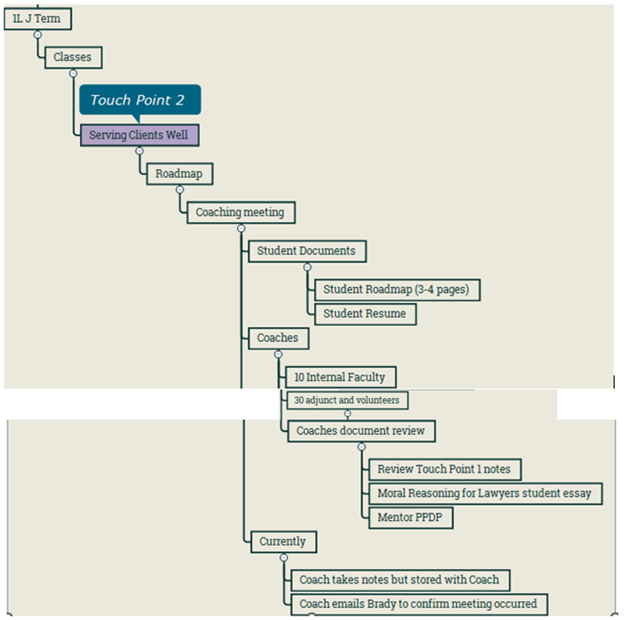
Coaching Touch Point 2: The second touch point, the Roadmap Coaching meeting, occurs early in the spring semester of the 1L year in conjunction with the Serving Clients Well class.

Prior to meeting with their Coach, the students create a student Roadmap and upload it to Canvas.  The coaches have not had a single place to store the information they keep on their Coaching meetings with the students.  In addition, two other documents have been created by the students, an essay written for the Moral Reasoning for Lawyers course and a Personal and Professional Development Plan written for the Mentor program.  These documents, along with the completed student Roadmap template, will be placed in Salesforce and made available for review.

Qualtrics will be used for capturing the following data:

  1. Practice Areas of Interest
  2. Type of employer
  3. Geography of Interest
  4. Students self-identified and peer-affirmed strengths/competencies
  5. Quick Assessment of whether student understands concept of having to communicate a persuasive story of value and has good stories to tell
  6. Quick Assessment of Self-Directedness
  7. Identified goals for summer
  8. Identified interests for registration for next year
  9. Identified possible Mentor Experiences in which student is interested in next year

Again, we will be using drop downs to create uniform data capture.

This is a high-level overview of the One File system.   Also, somewhat unique in the development of the application, we are not building the system all at one time.  As mentioned earlier, we are starting with the School of Law Class of 2025 as the beginning point.  We will be developing the system as that class moves through its law school career and then add the following incoming classes.  In this way we can also learn as we develop the platform and allow for continuous improvement.  We’ll have more to describe as we continue this journey.

If you have questions or comments, please reach out to me at michaelrobak@stthomas.edu.

Michael Robak is the Director of the Schoenecker Law Library, Associate Dean, and Clinical Professor at the University of St. Thomas School of Law.

[1] The Departments and Reporter count are as follows:  Lawyering Skills (5 reporters), Academic Achievement and Bar Success (1 reporter), Mentor Externship (2 reporters), Alumni Engagement and Student Life (1 reporter), Holloran Center (2 reporters), Clinics (3 reporters), Career and Professional Development (3 reporters), Registrar (1 reporter), and Deans (5 reporters).  St. Thomas Law does not currently have a Dean of Students.

Barbara Glesner FInes

A Question to Define Professional Identity Formation

By: Barbara Glesner Fines, Dean and Rubey M. Hulen Professor of Law, UMKC School of Law

During many Holloran Center Workshops since 2017, Jerry Organ (Co-Director of the Holloran Center) has asked participants to begin their exploration of professional identity formation with a simple question:  “When did you first think of yourself as a lawyer?”  Participants reflect on the question individually and then share their reflections.  The question helps to highlight the development process that is identity formation and the key transitional moments in that process.

In a recent faculty workshop at my law school, we used that same exercise but with a slight variation. Participants were asked to think of an identity or a role that they have assumed as adults that is central to their concept of who they are.  For many of us, parenthood is one such role, but we were encouraged to consider professional roles, including the one role we all had in common: “professor” or “teacher.”  We were then asked to think back to one of the first times that we thought of ourselves as being or fitting into that role.

The identities shared varied widely: lawyer, teacher, mentor, public servant, military officer, and parent, among others.  While the identities varied, the descriptions of the transformative moments that caused each of us to more fully assume that identity shared many characteristics.

Nearly all the incidents involved the awareness of significant responsibility for another.   Whether it was the moment that a new parent brought their babies home from the hospital to the moment that a new attorney found strangers in a courthouse lobby asking for help, there was a realization that others were depending on us.

For many, the incidents had a sense of permanence as well—that the shift in our sense of self was not a momentary impression but a moment of transformation.  This sense of movement might have been from outsider to insider, from observer to actor, or from one who follows to one who leads.

These moments often carried significant emotional weight as well.  They were challenging, frightening, exhilarating, or confusing, but never mundane.

The process of reflecting on this question and sharing the reflections helped us to better understand the process of professional identity formation and to think more deeply about how we might guide our students along this path.

First, the exercise emphasized that, for most of us, transformative moments in professional identity formation came from an experience of acting in the role.  That is not to say that formation never occurs in a classroom or in reading or listening, but transformative moments more often involve the emotional content that results from being given real responsibility to another.  This realization led to a discussion of how we could provide or capture more of these high-impact experiences for our students.

Second, the exercise demonstrated the power of reflection as a pedagogy for identity formation.  We saw that the process of reflection and discussion about identity and meaning were just as rigorous and had just as much impact as Socratic dialogue about the meaning of a legal doctrine.  Not only did the exercise require reflection, but for many of us the transformative moments we were describing also included reflection as an integral component.  “I remember thinking…” was a common phrase in the shared reflections.  We discussed how we could more regularly incorporate reflection into our work with our students.

For faculty who are looking for helpful exercises to explore the meaning and practice of professional identity formation, this simple question accompanied by reflection can serve as an invaluable tool.

Please email me at bglesnerfines@umkc.edu if you have any questions or comments.

Barbara Glesner Fines is the Dean and Rubey M. Hulen Professor of Law at the University of Missouri-Kansas City School of Law.