By Felicia Bennett, Holloran Center Coordinator
The 2024-25 academic year marked the first year that the University of St. Thomas School of Law’s Peer Mentor Program operated under Holloran Center leadership. We entered the year with several goals: give 1Ls a peer-based support system during a year that’s often overwhelming; create a platform for consistent messaging about institutional resources to support first-years, provide upper-level students an opportunity for professional development through mentorship; and create a community of professional identity formation (PIF) ambassadors at the law school.
The program, re-christened the Tourek-Marvin Peer Mentor Program in honor of Steve Tourek and Jake Marvin, paired each first-year (1L) student with a dedicated 2L or 3L student who was selected for their empathy, leadership, and commitment to service. This year, we hosted four group sessions for mentor-mentee cohorts, with mentors offering 1Ls the opportunity to meet 1:1 at least twice per semester.
Given that this is an optional program, we saw remarkable engagement during the first year. Attendance at the first, second, and third group sessions was at least 80%, and while attendance declined to 64% at the final session, Peer Mentors reported more frequent and meaningful contact with a smaller group of their assigned mentees throughout the spring semester. Overall, 44% of our 1Ls met 1:1 with their Peer Mentor at least once this year, with some meeting multiple times per semester.
We are encouraged by how the program went this year and we are excited to evolve our methods for structuring content, supporting our Peer Mentors, encouraging engagement, and continuing to develop the narrative around professional identity formation (PIF).
Program Structure
As mentioned above, we hosted four group sessions throughout the year – two in the fall semester and two in the spring. The timing of each session was intended to coincide with an important period of the year: we held a session each prior to first semester midterms and finals, held a “recap and refresh” session at the beginning of spring semester, and anticipated registration for 2L classes with our second spring session. Each session was one hour long, with boxed lunches provided for attendees.
The content of the group sessions was created by Holloran Center Co-Director Jerry Organ and Coordinator Felicia Bennett in consultation with various stakeholders in the law school – academic support, the Career and Professional Development Office, and the Mentor Program, to name a few. Each set of slides covered general law school updates, important deadlines, and relevant conversation prompts. The presentations also included a longer section about a specific important PIF topic: during the first semester, wellness habits and imposter syndrome; during the second semester, intentional time management and self-reflection. Prior to each group session, the Holloran leadership team met with Peer Mentors to prepare them for the conversations they would be having with their groups. These preparatory meetings also served as a time for Peer Mentors to share feedback with us and advice with each other.
In addition to group sessions and preparatory meetings, we hosted two lunches with Steve Tourek, who is not only one of our program namesakes but also a longtime participant in the St. Thomas Mentor Externship program. To ensure we were taking the right approach, we held and surveyed 1Ls about their experience at the beginning of the second semester. In addition, I met with each mentor 1:1 at the end of the year to discuss their experiences.
Building Bridges in the Law School
The Holloran Center team saw meaning and opportunity in the transference of the Peer Mentor program to our supervision. The Center is a nexus for the professional identity formation movement nationally, and directors Jerry Organ, Neil Hamilton, and David Grenardo are deeply involved faculty members and leaders in the St. Thomas Law community. We saw the Peer Mentor program as an opportunity to break down siloes within the law school and to start strengthening the bridges between our Center and other areas of the school. As noted above, we have collaborated with Academic Support, the Career and Professional Development Office, and Mentor Externship, among others, to ensure that the messaging that we give our Peer Mentors to share with their mentees is in line with those departments’ communications and needs. In doing this, we hope to both cultivate goodwill and a mutual willingness to closely support one another, and to begin establishing professional identity formation as the through-line of the St. Thomas Law education.
Peer Mentor Experiences
Peer Mentors found their experiences meaningful: they shared that they grew in their own leadership capacity and learned new things about themselves. Several talked about the challenge of giving advice while still in the midst of their own learning process. Bobbie Schermbeck, a 3L mentor, noted, “Sometimes I had to take a moment to say, ‘I don’t know this—I need to ask someone.’” Others mentioned that they pushed themselves outside of their own comfort zones to be effective mentors. “As Peer Mentors we’re asked to promote different support offices to our mentees,” 3L Arissa Lewis explained. “I didn’t feel comfortable doing that unless I had personally gone to them—so I did.”
Mentors commented that the experience of supporting the professional growth of their mentees was highly rewarding. Maria Garcia-Moya, a 2L mentor, shared about the meaning she found in an experience in which “one student wanted a specific job and wasn’t able to get it, but we were able to pivot and find her an externship with a judge instead.” Similarly, Bobbie enjoyed helping her mentees network – “I introduced [my mentees] to a recent UST grad who’s clerking at the Court of Appeals. She was able to introduce [one of my mentees] to her judge!”
Mentors were also thoughtful about providing encouragement and support around whole-person wellness: “[I was] able to frame the conversation and provide assurance – assure them that their grades are not the only thing that identify how they’re going to be successful in the future!” said Adam Revoir, 3L. “I tried to show them that it’s okay to make mistakes and be vulnerable,” added 3L Grace Pilz.
Beyond personal and professional growth, mentors valued the chance to connect deeply with their mentees and to give back to the community. “My group this semester has become my friends,” Arissa said. “I’m grateful to have been able to have helped my mentees just as others have always helped me,” shared 2L Nazeefa Nezami.
Community Response
Our survey of 1Ls at the beginning of the second semester produced primarily encouraging feedback. Mentees said they appreciated having someone close to their own experience to talk to—especially about studying, exams, and looking for a job. Peer Mentors bridged a gap between formal advising and lived experience. One 1L shared: “My peer mentor provided a lot of helpful information when it came to how to prepare for everyday class or exams.” Many 1Ls also noted that it was useful to learn about their professors’ expectations from a mentor who had been in the same section. In addition, the 1Ls shared that hearing about law school from a student perspective filled a unique niche in their experience.
Some 1Ls commented that the Peer Mentor meetings occasionally happened during busy times when they would have preferred to have an extra hour to study. A few also noted that they would have liked to see more original content, rather than a repetition of some of the information they’d received elsewhere. We are considering this feedback as we build out next year’s program, and we are looking for ways to make the value-add of the Group Sessions clear even during busy times.
We believe that strong engagement levels with the group sessions, plus the fact that nearly half of our 1Ls voluntarily sought out 1:1 support from their mentor at least once, suggest that the student community appreciates and sees the value of this program.
Feedback and Areas for Improvement
Based on conversations we have had with Peer Mentors, as well as feedback received from 1Ls, we are planning several modifications to the program for the 2025-26 academic year, which include the following:
- Shifting to an application-based Peer Mentor selection process;
- Working with Peer Mentors to establish methods to encourage and incentivize 1:1 meetings;
- Changing one of the Group Sessions to a more flexible format to generate more interest and engagement, as well as support the relationship-building element of the program;
- Strengthening support from the Holloran Center, including more regular check-ins, basic mentorship and PIF training, and a stipend for coffee meetings with mentees;
- Making Peer Mentor cohort assignments during the summer and introducing mentors and mentees earlier in the semester at a welcome breakfast; and
- Building in more communication between the mentors with each other and creating resources that allow the mentor cohort to function as a “network” for 1Ls.
Final Thoughts
We’re grateful to Jake Marvin and Steve Tourek for making this program possible—not just through funding, but also through Mr. Tourek’s time and involvement. And we’re grateful to the talented 2L and 3L students who embarked on this new endeavor with us.
As we continue to shape this program, we hope to prioritize relationship-building and the deeper integration of PIF into the experiences of our 1Ls and Peer Mentors. We look forward to growing our contribution to the St. Thomas Law community and learning and evolving alongside our student leaders in the years to come.
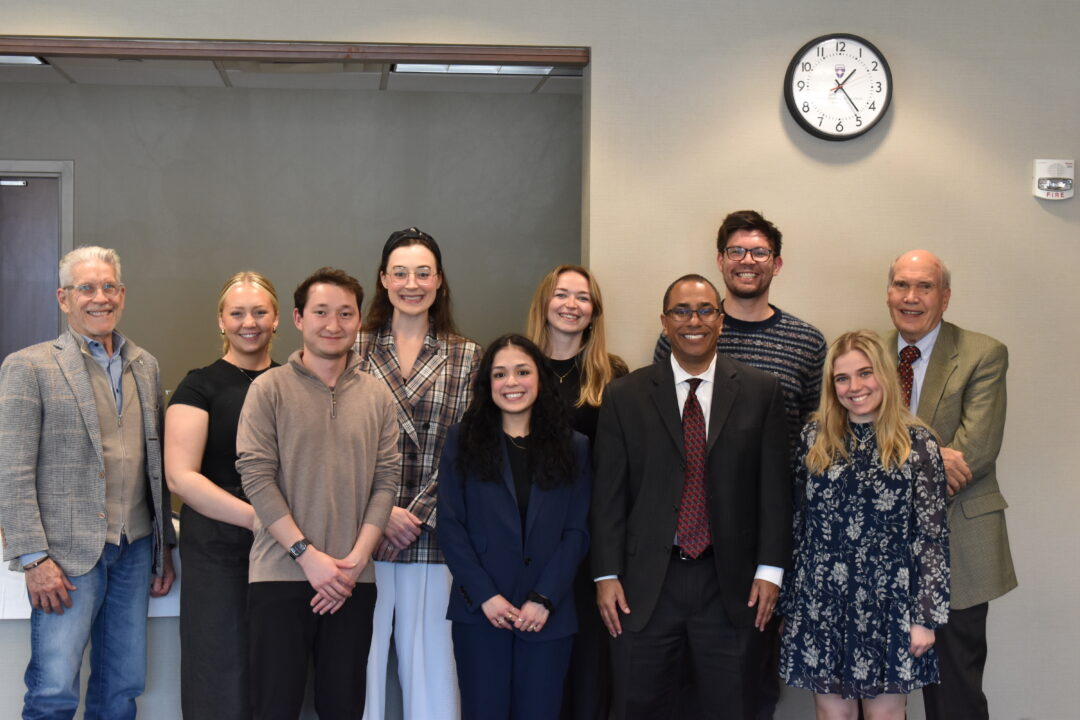
L to R: Steve Tourek, Riley Carlson, Adam Revoir, Grace Pilz, Maria Garcia-Moya, Bobbie Schermbeck, David Grenardo, Evan Hromada, Arissa Lewis, and Neil Hamilton