Lindsay Mayernik – Risk Management and Insurance Blog
All Posts By

Lindsay Mayernik

Networking

Minnesota Insurance Hall of Fame Announces 2026 Inductees; Event Chair Bill Ryan Invites Industry to October Celebration

ST. PAUL, Minn. — The Minnesota Insurance Hall of Fame has announced the distinguished leaders selected for induction into its 2026 class. The honorees will be formally recognized during the annual Minnesota Insurance Hall of Fame Induction Ceremony on October 22, 2026, at the University of St. Thomas in St. Paul.

The Minnesota Insurance Hall of Fame recognizes individuals whose leadership, innovation, and service have made a lasting impact on Minnesota’s risk management and insurance industries. Since its founding in 2024, the Hall of Fame has celebrated professionals who have advanced their organizations, served their communities, and strengthened the broader insurance profession. 

The Center for Risk Management & Insurance at the University of St. Thomas is proud to again serve as the host of the Minnesota Insurance Hall of Fame. The annual induction ceremony brings together industry and community leaders from across the state to the St. Paul Campus for an evening of recognition, connection, and celebration of the individuals who have helped shape Minnesota’s insurance industry. 

The 2026 Minnesota Insurance Hall of Fame inductees are: 

  • John DeSanto, Former AIG Minneapolis Branch Manager 
  • Thomas Devine, President & CEO, Devine Consortium LLC; Regent Emeritus, University of Minnesota & Adjunct Faculty, University of Minnesota Carlson Business School, Insurance Department 
  • Ted Dyste, President & CEO, Dyste Williams; Area President, Gallagher 
  • Patrick D. Francisco, Former President, Patrick D. Francisco and Associates (now NorthView Financial Partners) 
  • Kathleen Gallagher Burton, RPS Excess & Surplus Lines Underwriter/Broker; Minnesota Surplus Lines Board of Directors, Secretary/Treasurer 
  • Stuart C. Henderson, J.D., CPCU, Former CEO and Board Member, Western National Insurance Group 
  • T. Michael Miller, Former CEO and Current Chairman, Global Specialty Lines and Board Director of Intact Financial Corporation  
  • Phillip Richards, Executive Chairman and Founder, North Star Resource Group 

The members of the 2026 induction class represent the very best of Minnesota’s risk management and insurance community whose influence continues to benefit businesses, families, and communities throughout our state,” said Bill Ryan, 2026 Minnesota Insurance Hall of Fame Chair and Vice President, Head of People & Culture and Learning & Development at Allianz Life Insurance Company of North America. We are grateful to partner with the Center for Risk Management & Insurance at the University of St. Thomas, whose leadership helps bring our industry together each year to celebrate these remarkable individuals and inspire the next generation of insurance professionals. 

Registration is now open for the induction ceremony and all are invited to join in honoring the 2026 class. A variety of sponsorship opportunities are also available.  

For information about the event, please visit the Minnesota Insurance Hall of Fame website or contact rmi@stthomas.edu. 


About the Minnesota Insurance Hall of Fame 

The Minnesota Insurance Hall of Fame recognizes individuals who have demonstrated exceptional leadership and made enduring contributions to Minnesota’s insurance and financial services industries. Through its annual induction ceremony and ongoing recognition efforts, the Hall of Fame preserves the industry’s rich history while inspiring and funding for the future generation of leaders. 

About the Center for Risk Management and Insurance 

The Center for Risk Management and Insurance at the University of St. Thomas was founded in 2020 through industry collaboration and funding from the local insurance and risk management community. Aligning the University of St. Thomas mission to advance the common good with the insurance industry’s core purpose, the Center’s RM&I program provides a career pathway through its undergraduate certificate, industry connections and programming, and focused internships and entry level opportunities. 

Networking

Nominations Open for 2026 Minnesota Insurance Hall of Fame

The 2026 Minnesota Insurance Hall of Fame induction ceremony will be held on October 22, 2026 at the University of St. Thomas. Preparations are well underway, and you are invited to submit your nomination for induction now.

To be eligible for consideration, nominees must:

  • Have made significant industry contributions
  • Have exceptional lifetime accomplishments
  • Have a Minnesota connection
  • Serve as role model for others in the industry
  • Exhibit the highest standards of ethical conduct
  • Have contributed to their community

The Minnesota insurance industry has a long, storied history, and we look forward to reviewing your submissions and honoring the next class of Hall of Fame inductees.

Academics

Center for Risk Management and Insurance collaborates with Insurance Federation of Minnesota for Comprehensive Report

Dr. Peter Young, faculty with the Center for Risk Management & Insurance, collaborated with the Insurance Federation of Minnesota to create this report.

State of the Minnesota Insurance Industry Report

The Minnesota insurance industry stands as one of the state’s most important economic and social pillars. It is both a significant source of employment and wages and a central mechanism for managing risk in an increasingly complex environment. This report, prepared by the Insurance Federation of Minnesota in partnership with the University of St. Thomas Center for Risk Management and Insurance, provides a comprehensive assessment of the industry’s current condition, its economic and historical importance, and the challenges that lie ahead.

The industry employs nearly 60,000 Minnesotans across carriers, brokerages, reinsurance companies, and related services. With an average wage of more than $117,000, insurance jobs rank among the highest paid in the state, collectively generating more than $8.1 billion in annual payroll. That payroll alone contributes close to $380 million in state income taxes each year. Beyond payroll and investment, premium tax contributions exceed $750 million annually, further underscoring the industry’s fiscal importance.

Market conditions in 2025 are marked by both stability and strain. Homeowners insurance premiums are projected to rise by an average of 15 percent, placing Minnesota among the five highest states for expected increases. The primary drivers of these increases are extreme weather, hailstorm damage, and the growing costs of claims. Health insurance markets face a similar challenge, with premiums rising between 9 and 20 percent depending on the segment, a reflection of mounting healthcare costs, increased utilization after the pandemic, and the expense of new pharmaceuticals. By contrast, the workers’ compensation system illustrates a more positive trend. A decade of collaboration between employers and insurers has produced safer workplaces, fewer injuries, and more effective claims management, allowing the market to improve its performance without relying on significant premium increases.

Claims data highlight both the scale of the industry’s commitments and the volatility of the risks it faces. In 2024, Minnesota homeowners sustained approximately $2.39 billion in direct insured losses, with wind and hail accounting for nearly $1 billion of that total. Auto insurers continue to manage high loss levels, although recent years have shown some slowing in their growth. Workers’ compensation benefits totaled more than $1.1 billion in 2023, split between medical 4 care and indemnity payments. Collectively, these figures illustrate the central promise of insurance: indemnifying losses and restoring value in the wake of disruption. They also highlight the growing pressures of climate-driven weather events, medical inflation, social inflation, and litigation finance, all of which shape the industry’s future risk environment. The industry operates under a regulatory framework that has evolved for more than a century.

The Minnesota Department of Commerce maintains oversight through licensing, solvency monitoring, consumer protection, and rate approval. Historic laws, such as the Minnesota No-Fault Auto Insurance Act and the implementation of MNsure, continue to influence the market’s structure. At the same time, policy debates over reinsurance, litigation trends, and affordability remain pressing concerns for both regulators and industry leaders.

Looking forward, the Minnesota insurance industry faces a dual reality. On one hand, it provides stability, high-quality employment, significant tax revenues, and billions in investment that fuel the state’s economic growth. On the other hand, it must contend with persistent challenges that threaten affordability, availability, and consumer confidence. Climate change, rising medical and repair costs, new litigation dynamics, and shifting consumer expectations will continue to test the industry’s adaptability.

At the same time, opportunities exist. Industry leaders stress the importance of attracting and developing a new generation of professionals who can harness technological innovation (including artificial intelligence) to strengthen underwriting, claims management, and customer service. Alternative risk financing, which includes self-insurance pools and captive programs, has reshaped the commercial landscape and created new partnerships between traditional insurers and nontraditional risk vehicles. By embracing innovation, building talent pipelines, and maintaining strong collaboration with regulators and policymakers, Minnesota’s insurance industry is well positioned to remain both an economic anchor and a vital risk management resource for the state in the years ahead.

Since its release, the State of the Industry report developed with the University of St. Thomas has become a key advocacy resource for IFM. It has been used in legislative meetings and policy discussions to provide a clear, data-driven view of the insurance industry’s economic impact, workforce, and role in communities across Minnesota. Its credibility and depth have helped elevate conversations with lawmakers and ensure policy debates are grounded in facts rather than anecdotes.

The report has also strengthened broader advocacy and communications efforts. It’s findings have been incorporated into IFM advocacy materials and presentations and it’s data referenced when working with local media to provide context on industry trends and policy issues. This has led to more informed public discussion and a better understanding of the insurance industry’s importance to Minnesota’s economy and consumers.

Networking

Student Club Hosts RMI Career Fair

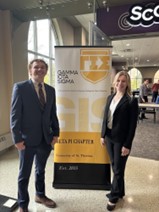
Gamma Iota Sigma (GIS) is a risk management and insurance (RM&I) fraternity at the University of St. Thomas. GIS members have the opportunity to participate in a wide range of events designed to deepen their understanding of the RM&I industry, including information sessions and panel discussions. The club also offers professional development workshops, such as resume reviews and interview preparation events to help students build essential career skills.
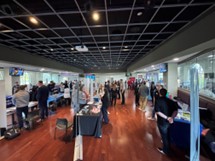
Each year, GIS hosts the RM&I Career Fair, which this year took place on Thursday, November 6, at Scooters in the Anderson Student Center. The event was a major success, drawing 29 RM&I organizations—including Travelers Insurance, Securian Financial Group, and Allianz Life. These companies offered students insight into a broad selection of internship and full-time roles, many of which are located in Minnesota, providing strong opportunities for those interested in staying local.

More than 90 students coming from a range of different majors attended the fair to explore career paths, connect with recruiters, and expand their professional networks. Several students also used the event as a chance to further engage with companies they have previously worked with or plan to work with in the future. Overall, the career fair was a great success and an amazing opportunity for students interested in RM&I.

 

Networking

Travelers Institute launches insurance availability and affordability initiative at University of St. Thomas

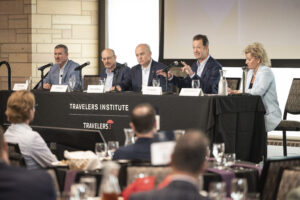
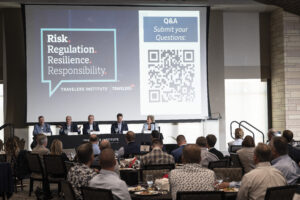
In September, the Travelers Institute, the public policy division of property and casualty insurer Travelers, launched its Risk. Regulation. Resilience. Responsibility. initiative at the University of St. Thomas. The program, hosted by the university’s Center for Risk Management & Insurance and its Gamma Iota Sigma student chapter, brought together students, industry partners, local agents and Travelers leaders to explore how climate change, economic inflation and other trends impact the availability and affordability of insurance in certain markets.

Rob Vischer, President of the University of St. Thomas, and Rick Smith, Regional President at Travelers, opened the program with remarks on the collaborative spirit at the heart of the event. The day continued with a Cyber: Prepare, Prevent, Mitigate, Restore panel hosted by Joan Woodward, President of the Travelers Institute. Carolyn Purwin Ryan, Partner at Mullen Coughlin LLC, provided a cyber threat landscape update, and Lauren Winchester, Head of Cyber Risk Services at Travelers, shared strategies to enhance cyber resilience. Rick Keegan, Executive Vice President and Chief Underwriting Officer at Travelers, opened the Risk. Regulation. Resilience. Responsibility. symposium with a keynote address. Afterward, Keegan joined Michael Klein, Executive Vice President and President of Personal Insurance of Travelers, Eric Nelson, Senior Vice President of Enterprise Catastrophe Risk Management of Travelers, and Glenn Westrick, Senior Vice President of Government Relations of Travelers, on a panel, also hosted by Woodward, that explored how environmental changes, regulatory shifts and economic pressures are reshaping the insurance landscape.

The discussion highlighted key factors shaping the industry’s future, including:

· The importance of disaster preparedness for families, businesses and local governments.

· How insurance markets work today and the role of risk-based pricing.

· The impact of climate change and catastrophic natural disasters.

· The latest building science and the evolution of building codes.

· The current state of community infrastructure.

· The need for legal reform to address litigation abuse.

“We were thrilled to launch our insurance availability and affordability initiative at the University of St. Thomas, uniting thought leaders from various sectors to tackle this critical issue,” said Woodward. “By harnessing community insights and equipping agents, brokers and customers with the tools and information they need to make sound decisions, we can empower people to better navigate today’s risks and build stronger, more resilient communities for the future.”

Travelers Institute events are free and open to the public, including its Wednesdays with Woodward webinar series and the “Travelers Institute: Risk & Resilience” podcast. To learn more, visit www.travelersinstitute.org.

Alumni

Graduate Spotlight: Dylan Ayres, ’24

Dylan Ayres, ’24

As a Physics major in my junior year, I found myself wondering if the PhD route in Physics was the right one for me. I began exploring other options and quickly found myself enrolling in the Intro to RM&I class for several reasons. Having never taken a business class or similar classes, I was worried if I would enjoy the class. After completing the course, I can gladly say it was one of my favorites during my studies at St. Thomas. This course takes a broad view to show students from any background a succinct yet deep understanding of many corners of the RM&I world. It covers topics ranging from the history of insurance to complexities between life and health insurance versus property and casualty insurance. The highlight of this course was the speakers that were regularly brought into class. I had never experienced a course that offered as many opportunities to ask professionals in each of their own niches of the RM&I world questions. This ultimately led to my job as an Inside Broker at Risk Placement Services.

Before diving into my post-graduation experience at RPS, I need to acknowledge another amazing aspect of this course. The RM&I Course Scholarship (funded by industry donations) that is offered to encourage enrollment in this course. I am deeply grateful to those who continue to provide scholarships to students for enrolling in this course. This is a unique opportunity that goes without saying is an incredible incentive to begin exploring a new industry. I highly encourage students to enroll in this course and apply for the scholarship, as the curriculum, guest speakers, and instructor make it an exceptional experience
In this class, I was introduced to many professionals in the industry, one of whom is now my manager at RPS. I engaged with Brandon Goodin during the Q&A section and added him on LinkedIn, simply seeking a good connection. I made enough of an impression for him to invite me to apply and interview for a position at RPS. I have only been working here for a handful of months, but I have already taken tremendous strides forward in my understanding of not only the industry, but my specific role, which is all built on the baseline knowledge I gained from the Intro to RM&I class. As I continue to learn more and more, I am also joining an early-career training program called the Producer Development Program, where I will be taught even more insurance industry knowledge alongside how to communicate effectively and ultimately get deals done. I couldn’t be more grateful for the community at RPS, as I have found support from my colleagues every single day. As I look ahead, I plan to complete the Producer Development Program and move into a Commercial Lines Producer role, where I’ll begin directly contributing to my team’s growth.
As someone who came from a non-business background, I was nervous there would be difficulties for me in this industry, but I have never run into a more supportive and encouraging work environment. If you get a career in the RM&I industry you will hear from many of your colleagues that they “fell into insurance” and have stayed since. This industry yields great opportunity to those who are willing to give it a try. I encourage anyone who is interested to take the Intro to RM&I course and see what RM&I has to offer!
Student Spotlight

Student Spotlight: Steven Krey, Class of 2026

Steven Krey, ’26


My path into the Risk Management and Insurance industry was not something I envisioned when I first arrived at the University of St. Thomas. But during my time here, I was introduced to new opportunities that have impacted my journey so far. 
Coming into the university, I struggled with the idea of choosing a major that might limit my future options. Because of this, I decided to pursue a major that offered both versatility and flexibility, which led me to Economics. This degree allowed me to develop strong analytical abilities, along with high-level critical thinking and decision-making skills. Looking back, those traits became the foundation for my success in the Risk Management and Insurance industry.
As part of the economics curriculum, I was required to take several business courses, including four credits of business electives. One of the options was the cross-listed Introduction to Risk Management and Insurance course, ACSC/FINC 220. The class provided a broad overview of the industry and featured multiple professionals who shared their academic journeys and career paths. These individual stories from industry professionals were extremely valuable to me, as I was able to learn more than what the textbook stated. What began as simply fulfilling an elective requirement quickly turned into an eye-opening introduction to a field full of potential.
Since taking that course, I’ve completed two internships in the industry. My first was as an Underwriting Intern at RLI, where I worked on projects that provided real value to my team. The experience was incredibly rewarding, and I learned and grew a lot. My second internship was as a Ceded Reinsurance Intern at Palomar, an opportunity that strengthened my analytical and modeling skills and gave me deeper insight into reinsurance markets and transactions. I’m excited to return to Palomar next summer, where I’ll take the next step in my career as a Junior Reinsurance Analyst.
The Risk Management and Insurance industry has given me so much academically, professionally, and personally. I’m genuinely grateful that I “fell into it,” and over the past few years, I’ve come to appreciate just how rewarding and wide-ranging the industry can be.
Student Spotlight, Travel

Student Spotlight: Abby Scallon, Class of 2025

Abby and other RMI students attending the GIS Conference in September 2025.

My name is Abby Scallon, and I am a senior communication studies major. When I transferred to St. Thomas last fall after earning my associate’s degree from Minneapolis Community and Technical College, it was important to me to explore courses outside of my major. I wasn’t sure where to start, but my friend strongly encouraged me to look into the Risk Management and Insurance certificate program.

The first course I took was ACSC 220 with Professor Axtell. Throughout the semester, I learned from industry professionals, collaborated with my peers, and understood how individuals and corporations manage risk. Additionally, I was thankful to learn about the various careers and roles available in the insurance and organizational risk management industries. After I completed this course, I was certain that I wanted to obtain a certificate in the program at St. Thomas. Following this class, I took FINC 301 and FINC 303. Both of these courses are taught by professionals in the industry, and I was thankful to learn more about their experiences and how they have progressed in their careers. This fall semester, I was fortunate to take FINC 303, where I was able to grow my understanding of employee benefits and collaborate with my peers. As I am finishing this semester, I am currently enrolled in the last course required to complete the certificate. Over the past year and a half, my knowledge and understanding of risk management and insurance have grown tremendously.

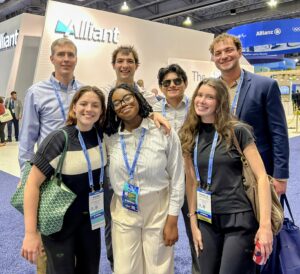
One of many benefits to pursuing a certificate in Risk Management and Insurance at St. Thomas is that there are a tremendous number of opportunities to meet people in the industry. In September, I was invited to attend the Gamma Iota Sigma annual conference in Hartford, Connecticut. I was able to take part in this experience because of the Spencer grant program. This program is designed to present and engage with students about the Risk Management profession and the Insurance Industry. At this conference, I was able to meet students from around the nation who had similar interests to me, attend career fairs, and sit in on valuable presentations about current topics in the field. I am grateful for the generosity of the Spencer grant and Professor Axtell for supporting my ability to attend this conference.

Throughout my time in the Risk Management and Insurance Certificate program, I have gained valuable knowledge and expertise about the industry. I am thankful that I explored these courses outside of my major. I am excited to transition my skills to a professional career after I graduate this December.

Networking

GIS Career Fair: November 6, 2025. Tables Available!

Is your company looking for interns for Summer 2026 or earlier? Do you have some full-time entry-level roles you are looking to get quality candidates for? The University of St. Thomas is hosting the 11th annual RM&I Career Fair on Nov. 6th, 2025 from 11 am to 1:30pm in the Anderson Student Center on the St. Paul campus. This event, organized by the university’s chapter of GIS, offers employers a chance to connect with UST students, recruit for internships and jobs, and raise your company’s profile on the campus of the University of St. Thomas.

To register your company, please go here.

There is a recommended $250 donation to attend this event. All donations are used by the GIS chapter to send undergraduate members to the GIS National Convention. Donations can be made here.


Academics

Graduate Program Update

Our undergraduate program isn’t the only place where innovation and preparation is happening. Our graduate courses and certificates are preparing leaders in Risk Management through coursework and research. Here’s what’s happening in the graduate program!

The University of St. Thomas’ Risk Management & Insurance (RM&I) initiative contains several component parts. Under the general heading of Graduate Programming are two principal features:

1) The Graduate Certificate in Strategic Risk & and Responsibility

2) The Research Project. Included below is a list of the research conducted in the past five years by our graduate faculty.


The Graduate Certificate in Strategic Risk and Responsibility

Our graduate program is reorganizing for this academic year to create additional remote learning features. Here’s what we anticipate offering in the 2026-27 academic year, and beyond!

Graduate students of all interests are welcome to participate in MGMT 753. However, it should be noted that MGMT 753 also satisfies a key course requirement for the Opus College of Business’s (OCB’s) Certificate in Strategic Risk and Responsibility (SR&R).

Through delivery of a graduate certificate in Strategic Risk and Responsibility, OCB seeks to provide students knowledge and frameworks to improve the quality of managerial decisions in their organizations by exploring risk evaluation and decision theory, compliance programs and processes, and corporate responsibility and reputation. Graduate certificate students will explore the interconnectivity between these areas and gain fundamental skills in managing strategic risk and leadership, corporate governance, compliance, and business ethics—with particular attention paid to corporate social responsibility, sustainability, and resilience.

Certificate Structure

The certificate in Strategic Risk and Responsibility includes four 3-credit courses (12 total credits). The certificate draws on existing courses delivered by faculty from the Opus College of Business and the St. Thomas School of Law.

The curriculum structure is as follows (required or highly recommended courses are in bold; all others are optional):

· Risk Management – 3 credits

o MGMT 751 Risk Management – 3 credits

· Compliance – 3 credits

o BETH 650/LAWS 730 Compliance Programming – 3 credits

· Corporate Social Responsibility and Sustainability – 3 credits

o MGMT 753 Risk Leadership in a Global Context – 3 credits

o MGMT 714 Strategic Sustainability – 3 credits

o ENTR 708 Social Entrepreneurship – 3 credits

· Professional Effectiveness – 3 credits

o MGMT 623 Project Management – 3 credits

o BCOM 661 Reputation Management and Stakeholder Engagement – 3 credits

o BCOM 635 Persuasion – 3 credits

o MGMT 702 Leading Organizational Change – 3 credits

Students interested in learning more about the Certificate are encouraged to contact Professor Peter Young for further information (pcyoung@stthomas.edu; 605.645.7505).

The Research Project


Young, P.C. (2025). “Corporate and Public Responses to Uncertainty: Understanding the Challenge of Collaboration”, Chapter 20, Editors: TJ Andersen, Petersen, B, Ashbee, E. Business and Policy Challenges of Global Uncertainty: European Perspectives. World Scientific Publishing Europe Ltd.

Andersen, T. J., Young, P. C. (2024). Enhancing public sector enterprise risk management through interactive information processing. Frontiers in Research Metrics and Analytics, https://doi.org/10.3389/frma.2023.1239447

Young, P. C., Hoang, T. (2024). The role of risk leadership in defining ERM readiness to adopt. The IBM Center for the Business of Government.

Ryan, R., Egan, T., Young, P. C., Burke, R. (2024). The role of leadership in embedding risk management: lessons from an Irish public sector organisation. International Journal Public Sector Performance Management, 1(1). 10.1504/IJPSPM.2024.10056247

Andersen, T. J., Young, P. C. (2023). Reshaping Public Sector (Enterprise) Risk Management. International Journal of Public Administration. DOI: 10.1080/01900692.2023.2197170

(2022) Young, P.C. Public/Private Risk Financing Innovation: The Case of Risk Pools. ADIA Europe Research Series on Insurance Law and Regulation. Chapter 10. Springer Publishing. AIA In print, expected publication date June 30, 2022. Electronic ISSN: 2662-1789 Print ISSN: 2662-1770

Young, P.C. (2022). Public Sector Leadership in Assessing and Addressing Risk, Vol: 4. Emerald Studies in Finance, Insurance, and Risk Management. Editors P.C. Young, Simon Grima, Rebecca Dalli Gonzi. Bingley, UK: Emerald Publishing Ltd.

Andersen, Torben J., Peter C. Young (2021). Strategic Risk Leadership: Context and Cases. Abingdon: Routledge.

Andersen, T., Young, P. C. (2020). Strategic risk leadership: Engaging a world of risk, uncertainty, and the unknown. London: Routledge.