The 2025-2026 academic year proved to be a banner one for on-campus activities promoting the insurance industry! Bringing industry-focused events and practitioners into the classrooms and clubs of the university is one of the Center’s top tools for increasing student awareness concerning the opportunities and careers this dynamic industry offers.
Leading the charge is St. Thomas’s chapter of Gamma Iota Sigma (GIS), a student-run club focusing on promoting the RM&I industry at the undergraduate level. In addition to a myriad of speakers and club-specific opportunities, GIS focused on co-hosting RM&I events with other student groups on campus in an effort to reach a wider student audience. Some of these co-sponsored events included:
- An AI panel consisting of RM&I tech specialists co-hosted with the CS Club
- A seminar on Interest and Liquidity Risk given by guests from US Bank cohosted by both the Econ Club and the Finance Club
- A Careers Panel from Travelers spoke at a joint meeting of GIS and the HR Club
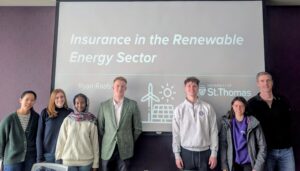
- Alum Ryan Raab provided a fascinating look at brokering for renewable energy companies at an event shared with the Sustainability Club
- Alum Rachel Dodd delivered a Cyber Security 101 demonstration to members of GIS and the CS Club
- The Economics Club welcomed a panel of former Economics majors who found homes in the industry
- The Women in Business Club featured several women in RM&I on a panel co-sponsored by GIS
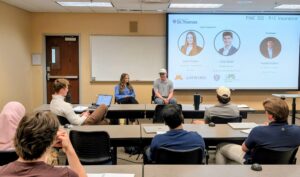
The classroom was another venue where St. Thomas strove to connect students with the industry. The classes that make up the undergraduate certificate in RM&I were active in bringing expert from the industry to discuss current trends and topics with UST students. Over 30 such classroom visits took place this year – visits that students consistently call out as one of the best parts of their RM&I academic experience!
Social activities where students connected with RM&I professionals were also on tap! Most formally, students enjoyed taking part in the MN Insurance Hall of Fame where they got to see and hear the stories of some of the state’s industry leaders! In addition, students connected with risk managers at an on-campus social hosted by RIMS-MN which also featured St. Thomas’s risk manager Karen Harthorn. And, the CPCU and Western National hosted an evening of bowling and RM&I Careers 101 at St. Thomas’s bowling alley!
The school year kicked off in fine style with St. Thomas hosting a Travelers Institute Symposium which focused on Risk, Regulation, Resilience and Responsibility. Students were able to attend the talks and luncheon and socialize with the agents and brokers attending.
Finally, and perhaps most central to the Center for Risk Management and Insurance’s mission on campus, was the incredibly successful RM&I Career Fair organized by our GIS club. This October event connected over 30 companies with 100+ students searching for internships and full-time roles.
All in all, the past year featured a myriad of events and opportunities for St. Thomas students to learn more about the industry and engage with professionals. We cannot thank those of you enough who shared the gifts of your time and knowledge with our students!