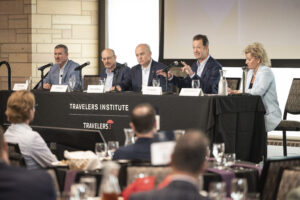
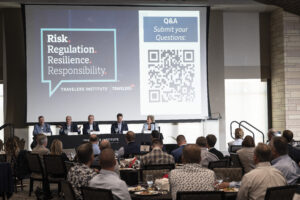
In September, the Travelers Institute, the public policy division of property and casualty insurer Travelers, launched its Risk. Regulation. Resilience. Responsibility. initiative at the University of St. Thomas. The program, hosted by the university’s Center for Risk Management & Insurance and its Gamma Iota Sigma student chapter, brought together students, industry partners, local agents and Travelers leaders to explore how climate change, economic inflation and other trends impact the availability and affordability of insurance in certain markets.
Rob Vischer, President of the University of St. Thomas, and Rick Smith, Regional President at Travelers, opened the program with remarks on the collaborative spirit at the heart of the event. The day continued with a Cyber: Prepare, Prevent, Mitigate, Restore panel hosted by Joan Woodward, President of the Travelers Institute. Carolyn Purwin Ryan, Partner at Mullen Coughlin LLC, provided a cyber threat landscape update, and Lauren Winchester, Head of Cyber Risk Services at Travelers, shared strategies to enhance cyber resilience. Rick Keegan, Executive Vice President and Chief Underwriting Officer at Travelers, opened the Risk. Regulation. Resilience. Responsibility. symposium with a keynote address. Afterward, Keegan joined Michael Klein, Executive Vice President and President of Personal Insurance of Travelers, Eric Nelson, Senior Vice President of Enterprise Catastrophe Risk Management of Travelers, and Glenn Westrick, Senior Vice President of Government Relations of Travelers, on a panel, also hosted by Woodward, that explored how environmental changes, regulatory shifts and economic pressures are reshaping the insurance landscape.
The discussion highlighted key factors shaping the industry’s future, including:
· The importance of disaster preparedness for families, businesses and local governments.
· How insurance markets work today and the role of risk-based pricing.
· The impact of climate change and catastrophic natural disasters.
· The latest building science and the evolution of building codes.
· The current state of community infrastructure.
· The need for legal reform to address litigation abuse.
“We were thrilled to launch our insurance availability and affordability initiative at the University of St. Thomas, uniting thought leaders from various sectors to tackle this critical issue,” said Woodward. “By harnessing community insights and equipping agents, brokers and customers with the tools and information they need to make sound decisions, we can empower people to better navigate today’s risks and build stronger, more resilient communities for the future.”
Travelers Institute events are free and open to the public, including its Wednesdays with Woodward webinar series and the “Travelers Institute: Risk & Resilience” podcast. To learn more, visit www.travelersinstitute.org.

No Comments