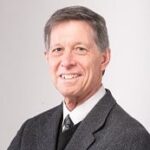
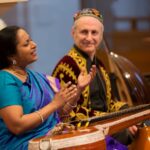
J.D. Steele and Ahmed Ismail Yusuf (photo by Beck Lee)
It began with an explosion of rhythm, poetry, and soul. The Schoenecker Center Performance Hall erupted into life as Meet You at the Crossroads opened with welcoming remarks from University of St. Thomas President Rob Vischer, who invited the audience to expand their understanding of “neighbor” through the parable of the Good Samaritan and then brought Somali blues into dynamic conversation with Black gospel-style music. With voices soaring and drums pulsing, the evening opened not with silence, but with celebration. At the heart of it stood two master storytellers: Somali author and poet Ahmed Ismail Yusuf and music legend J.D. Steele. Muslim and Christian, Somali and African American, elder and youth, their presence embodied the very spirit of the festival: a harmony forged not through sameness, but through the beauty of shared humanity. A highpoint of the concert featured a young boy from the MacPhail Community Youth Choir delivering a stirring solo of Michael Jackson’s “Man in the Mirror,” drawing the audience to its feet in a moment that was as tender as it was electric. Curated by David Jordan Harris with the Jay Phillips Center and co-produced by Beck Lee and the Cultural Fluency Initiative – with support from the College of Arts and Sciences, Department of Music, Film, and Creative Enterprise, Scene Setters, the Encountering Islam Initiative of the Theology Department, and the Chapel Arts Series – the sold-out performance launched the 2025 Culture of Encounter Ideas Festival with a profound sense of awe, welcome, and shared tears. With a waitlist that had to be closed and a crowd that rose more than once in standing ovation, the evening set the tone for what was to come: bold, embodied, and unapologetically plural.
A Festival That Lived Its Name
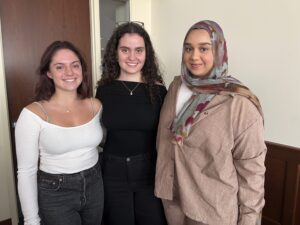
The festival’s vision was shaped from the outset by the strategic wisdom and leadership of three student Interfaith Fellows: Alina Kiedinger, Naomi Peters, and Diana Tewelde. Their voices were instrumental in guiding the planning committee, ensuring that student priorities and insights were woven throughout the week’s design. The 2025 Culture of Encounter Ideas Festival was never just a schedule of events. It was a public experiment in relational education; that is, an invitation to stretch beyond the comfortable edges of sameness and enter the sometimes challenging, always necessary terrain of difference.
Inspired by the late Pope Francis’s call to build a “culture of encounter” – a way of being rooted in openness and bridge-building across lines of identity and conviction – the festival asked participants to show up with curiosity, humility, and courage. “Diversity,” as Eboo Patel reminds us, “is not just about the differences we like.” This festival was about all of it: race and religion, gender and worldview, politics and practice. Participants were encouraged not to agree, but to listen. Not to solve, but to relate. The aim was not consensus, but connection. The festival sought to build a healthy community of disagreement, a space where people stay in relationship even across enduring differences, because that tension is where innovation and human flourishing can grow.
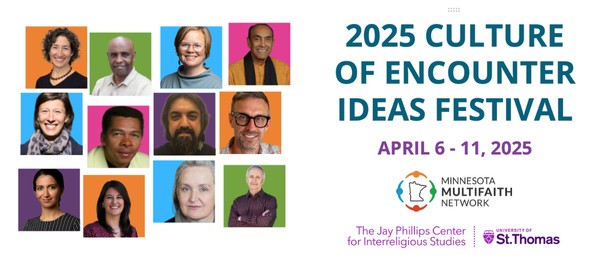
Co-created by the student Interfaith Fellows program of the Jay Phillips Center for Interreligious Studies and the Minnesota Multifaith Network, with partial support from the Arthur Vining Davis Foundations, the festival spanned five days in April and gathered more than 900 participants across 18 events. Dozens of campus units and community organizations co-sponsored the week, including the Theology Department, Center for the Common Good, Scene Setters, Claritas Initiative, Melrose & The Toro Company Center for Principled Leadership, Hamline University’s Wesley Center for Spirituality, Service, and Social Justice, Saint John’s University’s Jay Phillips Center for Interfaith Learning, St. Olaf College’s Lutheran Center for Faith, Values, and Community, Augsburg University’s Interfaith Institute, Interfaith Photovoice, Cultural Fluency Initiative, Niagara Foundation, and others.
This wasn’t just a series of events, it was a pedagogical experiment, a public humanities initiative, and an intercultural ecosystem in motion.
The Sound of Encounter
The opening night concert was only the beginning. Throughout the week, the festival invited participants to encounter diverse cultural, spiritual, religious and secular ways of life and and meaning not through debate or doctrine, but through listening, conversation, music, movement, and silence.

Megan Hopkins
In Experiencing a Calm Body, Megan Hopkins, a doctoral candidate in Comparative Theology at Boston College, guided thirty participants through a multi-sensory exploration of sacred sound. Drawing from the Sufi practice of dhikr, the Buddhist mantra Om Mani Padme Hum, and Gregorian chant, Hopkins introduced humming and chanting as both spiritual and physiological practice. Participants experienced firsthand how vocal resonance can activate the vagus nerve and bring the body into a state of calm. The session was equal parts interfaith engagement and wellness practice; students reported leaving more grounded, open, and attuned to both their breath and each other.
Path to Impact: The Mindful Labyrinth Walk, hosted in a quiet room of the Anderson Student Center, offered a different kind of encounter. Designed as an open-house format, the labyrinth invited participants to enter into a space of intentional movement. With ambient music and soft lighting, participants walked the ancient meditative path in silence. Some stayed for minutes, others for much longer. The labyrinth became a metaphor for life itself, full of turns, occasional distractions, and moments of reorientation. Many reflected that the walk offered not just personal insight, but a shared sense of presence with others; wordless, but deeply connective.
In Theology as Embodied Practice, Dr. Laurel Marshall Potter transformed the dance studio into a space for spiritual inquiry through movement. With shoes off and lights dimmed, students engaged in a series of structured body exercises – mirroring, responding, gesturing – to explore how theological insight might be carried in posture, rhythm, and form. Students drew connections to traditions they had studied in class, such as yoga in Hinduism or the embodied rituals of Islamic prayer. Instead of speaking about belief, participants expressed spiritual memory and inquiry through physical motion. For many, it was the first time they had considered theology not as text or concept, but as something lived and felt in the body.
These sessions weren’t theoretical. They were grounded, visceral, and often wordless. Students left not just informed, but transformed, and reminded that encounter is not always something to be articulated but something to be lived. Sometimes, it sings. Sometimes, it walks. Sometimes, it hums. As Mircea Eliade recounts in his journals, an American philosopher once asked a Shinto priest to explain the theology of Shinto. The priest simply replied, “We have no theology; we dance.” The point was not to dismiss reflection, but to suggest that spiritual meaning is often disclosed not only through doctrine, but through embodied practice. These sessions echoed that wisdom. They reminded us that while theology seeks understanding, it is spirituality – lived through sound, movement, stillness, and breath – that can also attune individuals and communities to the sacred. Dr. Tamara Gray, Founder and Executive Director of Rabata, who contributed to both artistic and academic moments during the week, remarked: “The Encounter project was an amazing experience. I loved how it spanned music, art, and academics. I personally benefited from the academic lectures and very much enjoyed the more artistic presentations. I loved how it took very seriously the idea of encounter and engagement.”
Hamline University Explores Reparative Scriptural Reasoning
As a core partner in the Culture of Encounter Ideas Festival, Hamline University hosted its Spring Mahle Lecture sequence on “Reparative Scriptural Reasoning,” from April 6 to 9, 2025, the capstone of a two-year exploration titled Interreligious Peace-building Through Study. Three linked events opened distinct doors into the practice.
On Monday, thirteen of the 2025 Mahle Keynote Participants attended a luncheon with the Higher-Ed Convening Group of the Minnesota Multifaith Network, hosted by Jay Phillips Center for Interreligious Studies Center with funding from Hamline University’s Wesley Center Department’s Stephen and Kathi Austin Mahle Endowed Fund for Progressive Christian Thought. Faculty, student-life staff, and chaplains swapped hard-won wisdom on navigating multifaith campuses. Conversation starting questions regarding multireligious/interfaith engagement included naming: one thing that’s going well on your campus; one challenge your campus; and one takeaway you’re hoping to get from the week of events. The thirteen Mahle Keynote Participants brought into this, normally Minnesotan, group experiences from around our nation and the world including from places like: California, Massachusetts, Virgina, Cambridge, Lahore, Santiago, and more.

“Leading an SR Group” Training, Hamline University (photo by CT Ryan Photography)
That evening on April 7 the Wesley Center held an invite-only workshop, “Leading an SR Group.” Participants with prior Scriptural Reasoning (SR) experience – among them Mahle Guest Participants, Multi-Faith Alliance (MFA )Scholars, chaplains, faculty, and and Hamline staff – practiced SR’s three core moves: slow reading, honest questioning, and disagreeing without demolition. By dessert, six new facilitators were ready to co-lead tables at the public event the next day.

Dr. Rocío Cortés Rodríguez (photo by CT Ryan Photography)
The Mahle Public Workshop & Keynote on April 8 at Hamline opened with mezze and mingling, then dropped 100 guests into seventeen round-table SR circles on the theme of repair. After a fishbowl demonstration of Scriptural Reasoning, newly trained facilitators, paired with SR excerpt guided the study of the scripture texts. Conversation spilled into a South-Asian buffet – halal chicken tikka, vegan dal, mango-passionfruit finale – while The Potluck Project’s Viveka Hall-Holt invited diners to imagine potlucks as civic glue. At 8 p.m. the room settled for keynote speaker Dr. Rocío Cortés Rodríguez, whose address – “Scriptural Reasoning and Indigenous Wisdom” – showed the practice of Scriptural Reasoning is not limited to written texts, and how indigenous wisdom can be accessed through different mediums such as Mapuche textiles and carved drums. Her candid account of breakthroughs and bruises underscored a central lesson: real repair requires risk. An interactive Q&A, moderated by Dr. Kevin Hughes, sent participants home with fresh questions and – ideally – a wider table. The evening closed with exciting news: Hamline University, the new editorial home of the Journal of Scriptural Reasoning, is uploading all past issues to its new Digital Commons site. Student Lead Iris/Sam Eichinger has completed most of the work, with Volume 20 now available online and Volume 21 set to launch in Fall 2025.
Dialogue in the Key of Honesty
Abraham’s Bridge, a powerful documentary screening co-hosted by the Minnesota Multifaith Network and the Jay Phillips Center, drew nearly 90 students, faculty, and community members into a cinematic exploration of hope, fragility, and the limits of interfaith cooperation. The film, directed and produced by Ellie Pierce of Harvard University’s Pluralism Project, chronicles the work of the Tri-Faith Initiative in Omaha, where a mosque, church, synagogue, and interfaith center share not only a campus but a vision of collaborative community life. What began as a portrait of promise evolved into a meditation on tension and resilience, as the film captured how geopolitical trauma, especially the October 7 Hamas-Israel war, reshaped the interfaith dynamics of even the most committed partners.

Panel discussion following screening of film “Abraham’s Bridge” (pictured left to right: David Jordan Harris, Ellie Pierce, Dr. Tamara Gray, Dr. Anantanand Rambachan, and Rabbi Adam Stock Spilker)
Following the screening, Pierce joined a distinguished panel of local interfaith leaders: Dr. Tamara Gray, Rabbi Adam Stock Spilker, and Dr. Anantanand Rambachan. Moderated by David Jordan Harris, the conversation delved into the complexities of shared space and fractured trust. Panelists reflected on the emotional toll of interfaith work during global crises, the importance of staying in relationship when it’s hardest, and the need to embrace encounter not just as comfort, but as commitment. One audience member’s question, why the Abrahamic traditions haven’t yet lived into their shared ideals, prompted a poignant reply from Pierce: ““Like the garden, this work is ongoing. Transformation doesn’t happen in the abstract. It happens in the garden.”
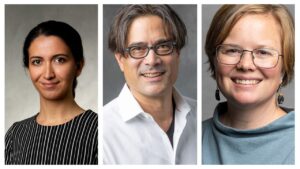
Shaherzad Ahmadi, Ph.D., Christopher Michaelson, Ph.D., and Laurel Marshall Potter, Ph.D.
Moral Realism and Relativism in Higher Education, hosted virtually by the Melrose & The Toro Company Center for Principled Leadership, offered a different but equally vital angle on the ethics of difference. The panel featured Dr. Christopher Wong Michaelson (business ethics), Dr. Laurel Marshall Potter (theology), and Dr. Shaherzad Ahmadi (history), each of whom brought disciplinary insight to bear on one of academia’s thorniest questions: how do we teach students to navigate moral disagreement in pluralistic classrooms? Rather than offering tidy answers, the panelists modeled pluralism in action by naming tensions, honoring contradictions, and offering tools for curiosity-based engagement. Students especially appreciated the practical advice: ask questions before offering judgments; clarify your own values while respecting others’.

Dr. Marianne Moyaert delivering the festival keynote address, “The Challenge of Interreligious Dialogue: How We Perceive and Misperceive the Religious ‘Other.'”
The Challenge of Interreligious Dialogue, the week’s culminating keynote by Dr. Marianne Moyaert of KU Leuven (Catholic University of Leuven, Belgium), offered a sweeping yet searing critique of the frameworks that shape interfaith encounters in the West. Drawing on her experience directing the Emoena program in the Netherlands, Moyaert illuminated the subtle ways in which even inclusive dialogue spaces often privilege Christian or secular norms, pushing others, especially Muslims, to translate, explain, or accommodate in ways not asked of dominant groups. Her concept of “religionization,” in which traditions like Judaism and Islam are historically constructed as rigid or political in contrast to Christianity’s presumed normativity, landed with particular weight. For many attendees, her talk served as a wake-up call: true interfaith dialogue requires historical reckoning, not just personal openness. Dr. Moyaert’s challenge to the audience was clear: Hope must be paired with honesty, and empathy must be sharpened by self-examination.
Dr. Moyaert’s challenge to the audience was clear: Hope must be paired with honesty, and empathy must be sharpened by self-examination.
Encounter as Public Story
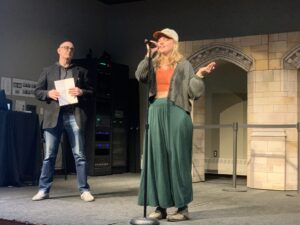 Religious Diversity and Me: StorySLAM transformed Scooter’s Café into a stage for student voices. Guided by student leaders and supported by faculty and staff, the event featured six unscripted five-minute stories, some vulnerable, others humorous, all deeply human. Stories ranged from discovering Wiccan heritage in a friend, to a grief-laced reflection on a friend’s final Instagram post tagged “Heaven.” With around 30 attendees, the evening created a space where belief, doubt, and cultural difference could be named without fear. The informal, peer-led format helped participants feel safe enough to share and to listen. Even those who remained silent reported being moved by the raw honesty in the room.

Kristi Wenzel Egan, Ph.D. and Amy Muse, Ph.D.
Sharing Stories of Encounter, co-facilitated by Professors Amy Muse and Kristi Wenzel Egan, brought the Narrative 4 story exchange model into practice. For those who attended, the impact was profound. Each shared a personal story, then retold their partner’s story in the first person, a practice that requires deep empathy and active listening. Students reflected on how this mirrored storytelling made them see their own lives in new ways and allowed them to momentarily inhabit another’s worldview. The session demonstrated that transformative dialogue doesn’t require a crowd – just care, trust, and attention.
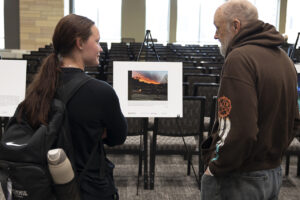
Interfaith Photovoice Public Exhibit
The Art of Interfaith Understanding, the culminating exhibition of the Interfaith Photovoice workshop, displayed the week’s reflective photographic work from participants ranging in age from 19 to 80. Founded and directed by Dr. Roman Williams, and co-facilitated by Dr. Jennifer Kilps, Interfaith Photovoice is a dialogue method that uses photography and personal storytelling to explore how religious, spiritual, and secular identities are expressed in everyday life. The workshop was co-sponsored by the Minnesota Multifaith Network. In this workshop, contributors used their smartphone cameras to capture glimpses of the sacred in the ordinary: prayer beads on a table, a Dairy Queen cone shared with a grandchild, a jellyfish suspended in water. These images and their accompanying reflections invited gallery visitors into a visual dialogue about meaning, memory, and resilience. The exhibit encouraged not just observation but transformation: for several attendees, it served as a gentle but powerful nudge toward empathy. Over 100 people attended the exhibit, lingering in silence, speaking softly with strangers, and discovering that spirituality often lives in the small, unspoken moments of daily life.
One of the most poignant expressions of encounter came not on the main St. Thomas campus, but across the river at Augsburg University. As part of Augsburg’s “Living Stories” chapel series, Dr. Anantanand Rambachan, Professor Emeritus at St. Olaf College and board member of the Minnesota Multifaith Network, shared personal reflections and stories from his Hindu tradition. Hosted in Hoversten Chapel and co-sponsored by the Augsburg University’s Interfaith Institute, Religion and Philosophy Department, and Campus Ministry, the session invited attendees into a personal and local interreligious storytelling rooted in lived commitment.
Dr. Martha Stortz, who attended Dr. Rambachan’s session, later remarked, “The Culture of Encounter Festival was truly multi-cultural, multireligious, multi-generational, even multi-locational. At a time when diversity is disparaged, the festival brought people together across difference with offerings that engaged body, mind, and spirit.” Dr. Rambachan’s gentle and evocative storytelling, rooted in his experiences growing up in Trinidad and his lifelong engagement with religious diversity, stood out as one such offering. His talk reminded attendees that dialogue is not only an academic endeavor, but a narrative practice, an act of spiritual hospitality, and a form of moral memory.
Reflecting on the week’s spirit of vulnerability and connection, Serhat Gezer, with the Niagara Foundation-Minnesota, shared, “Each session I attended left a deep impression on me, especially the ones that brought people of different faiths together through honest, heartfelt dialogue. I felt inspired, hopeful, and grateful to be part of a community that values connection and understanding.”
From Classroom to Civic Life

Ali Chamseddine, Dr. Anastasia Young, Nawal Hirsi, and Dr. Geeta Balkissoon
Religious Diversity and Interfaith Engagement in Healthcare Professions brought together nearly 80 attendees to explore how religion intersects with healthcare delivery and patient dignity. The panel featured five professionals with deep, diverse experience in medicine, chaplaincy, nursing, spiritual care, and community health. Panelists included Rabbi Amy Ariel, Dr. Geeta Balkissoon, chaplain and interfaith dialogue leader Ali Chamseddine, community health organizer Nawal Hirsi, and nurse practitioner and educator Dr. Anastasia Young. Moderated by Dr. Susan E. Myers, the conversation emphasized the importance of “whole-person care,” an approach that honors the many areas of a person’s sense of self, including a patient’s religious and spiritual identities, alongside medical needs. Students heard stories about honoring Sabbath restrictions in clinical environments, supporting pilgrimage dreams amid diagnoses, and advocating for culturally appropriate dietary accommodations. Panelists encouraged future health professionals and others in attendance to practice respectful inquiry, noting that asking sincere questions and truly listening can build trust and improve outcomes. The session was co-sponsored by the Theology Department and an Interfaith America microgrant and reflected the festival’s broader commitment to interfaith literacy and civic readiness in professional settings.

Dr. Deanna Thompson (St. Olaf College) and Dr. Matthew Maruggi (Augsburg University)
The Symposium on (Inter)religious Literacy and Interfaith Leadership in Higher Education shifted the lens from clinical to institutional life. Over lunch, 40 faculty, staff, and administrators from colleges and universities across Minnesota gathered for a pre-symposium networking session to exchange ideas, build relationships, and share current interfaith initiatives. The afternoon session welcomed nearly 70 additional attendees and was held in the Iversen Center for Faith. Moderated by Dr. Hans Gustafson, the panel featured four respected voices in the field: Dr. Barbara McGraw (St. Mary’s College of California), Dr. Deanna Thompson (St. Olaf College), Dr. Matthew Maruggi (Augsburg University), and Dr. Marianne Moyaert (KU Leuven). Together, they explored the evolving landscape of religious diversity in higher education by discussing not only how to support students from all religious and secular backgrounds, but how to equip them to lead in a world of complex belief systems.

Dr. Marianne Moyaert (KU Leuven) and Dr. Barbara McGraw (St. Mary’s College of California)
Panelists emphasized that religious literacy requires both a substantive understanding of religious beliefs and practices, and the cultivation of curiosity, humility, and the skills needed to navigate worldview differences in civic and professional contexts. One of the most compelling moments came when panelists challenged the assumption that interfaith work is solely for the religious; instead, they argued, it’s for anyone preparing to lead in a pluralistic society. Student participants, some of whom were invited to reflect during the session, echoed this sentiment, expressing a desire for more sustained engagement across worldview lines in their coursework, co-curricular life, and career preparation.

Dr. Mark McInroy, Rabbi Debra Rappaport, Dr. Fuad Naeem, and Dr. Anantanand Rambachan
Interfaith Reflections on Beauty, Goodness, and Truth, hosted by the Claritas Initiative, offered yet another dimension of civic and spiritual formation. Held in McNeely Hall, the panel gathered over 85 attendees to explore how the transcendentals – beauty, goodness, and truth – are understood across Christianity, Hinduism, Islam, and Judaism. Featuring Dr. Mark McInroy, Dr. Anantanand Rambachan, Dr. Fuad Naeem, and Rabbi Debra Rappaport, the conversation blended theological insight with personal reflection. Panelists shared how these values are manifest in humility, compassion, mercy, and artistic expression. Students were especially struck by the interpretive humility required when engaging across traditions, and by the Jewish reflection that divine mercy may itself be a form of beauty. The event offered not just an academic conversation but a model of interfaith listening at its most reverent, reminding participants that these values are not just studied, but are lived, and they shape how we move through the world. “We were all reminded, in each session, of the diversity in our communities and the opportunities for learning from and being enriched by opening ourselves to difference,” said Dr. Anantanand Rambachan. “The University of St. Thomas and the Jay Phillips Center offered a hospitable and inviting space for these critical discussions.”
Taken together, the healthcare panel, the higher education symposium, and the Claritas conversation on beauty, goodness, and truth offered a rich composite of what civic formation rooted in interfaith literacy can look like: practical, institutional, and transcendent. Whether tending to the needs of patients, shaping inclusive campuses, or contemplating shared ethical frameworks across traditions, each event modeled a different path into the same essential question: How can we prepare the next generation to encounter religious and worldview difference not with fear or avoidance, but with humility, attentiveness, and moral imagination?
Food, Fellowship, and Futures
Peace Meals Simulation, directed by Sarah Chamseddine and hosted by Campus Ministry inside the Jay Phillips Center for Interreligious Studies, brought 36 students and staff around shared tables for an immersive dialogue experience rooted in hospitality, story-sharing, and reflective prompts. Adapted from the semester-long Peace Meals program, this one-time simulation encouraged participants to explore identity through personal questions, such as the meanings of their names, experiences with tradition, and moments of transformation across belief systems. Over a taco lunch, what began as casual conversation quickly deepened. Students shared stories of fasting in solidarity with friends, of reclaiming family rituals, and of navigating religious difference with humility and curiosity. Some had never spoken aloud about their spiritual or secular identities in a group setting; others offered hard-earned wisdom from years of quiet reflection. Despite an unexpected overflow of last-minute registrations, the energy in the room was unmistakably generous; extra chairs were pulled in, couches filled, even a few steps on the stairway claimed, as participants chose community over comfort. For many, the event was not just a conversation, but a turning point in how they understood themselves and others.
Family Homelessness: Journeys in Minnesota, held in the Iversen Center for Faith, offered a different kind of encounter, one rooted in empathy for those navigating housing instability. Hosted by Catholic Charities in collaboration with the Center for the Common Good and the Tommies Together Volunteer Center, the simulation guided participants through real-life scenarios based on Wilder Foundation research. Led by Mike Rios Keating and facilitated by a guest who brought his own lived experience with homelessness, the event illustrated the precarious and often dehumanizing decisions families must make when facing poverty. Participants, mostly students, rolled dice to determine outcomes: whether they could afford food or healthcare, whether a raise might disqualify them from assistance, whether dignity could survive the chaos of scarcity. As the hour unfolded, the room fell into an intense, thoughtful quiet. Students later reflected on how the experience dismantled stereotypes and exposed systemic injustices in sharp relief. One takeaway echoed across multiple reflections: empathy must be rooted in awareness, and awareness must lead to action.

Ori Z. Soltes, Ph.D.
Exploring Hizmet Values, a presentation co-sponsored by the Niagara Foundation-Minnesota and offered by Dr. Ori Z. Soltes (Georgetown University), introduced participants to the Hizmet movement: a global Islamic initiative rooted in the teachings of Turkish scholar Fethullah Gülen. Held in the Iversen Hearth Room of the Anderson Student Center, the session attracted students, faculty, and community members curious about the intersection of faith, education, and civic service. Dr. Soltes offered a sweeping overview of Hizmet’s core values – interfaith dialogue, public service, and educational excellence – and explored its theological grounding in humility, hospitality, and action over proselytization. Participants were especially struck by Hizmet’s global footprint: schools that blend academic rigor with ethical formation, youth-led service projects that prioritize local compassion, and an approach to Islam that is deeply committed to dialogue and democracy. Students asked probing questions about Hizmet’s engagement beyond school settings and its potential as a civic model for pluralistic societies. For many, the session expanded their understanding of Islam, not just as a belief system, but as a lived commitment to building peace in the world.
Cultivating an Antiracist Formation, facilitated by trainer and organizer Anna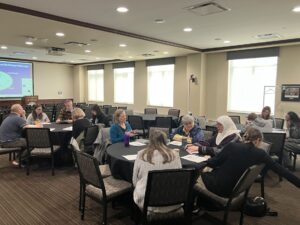 Stamborski, offered a spiritually grounded and introspectively challenging session. The workshop invited a diverse group of students, staff, clergy, and nonprofit leaders into an interactive exploration of how antiracist transformation begins not with performance, but with daily practices rooted in personal values. Drawing on Ignatian and Benedictine spiritual traditions, Stamborski guided participants in developing their own “Rule of Life,” a framework for grounding justice work in habits like creating practices of reflection, learning, and accountability throughout their days, weeks, and months. Rather than centering guilt, the session emphasized embodied alignment: moving from stated commitments to lived integrity. The session resonated with the festival’s themes of interreligious engagement, encounter, dialogue, and leadership. One participant captured the essence of the session this way: “This helped me see that reacting out of stress doesn’t build justice. Habits do.”
Students at the Center
Envisioning Interfaith Engagement at St. Thomas, a student-only workshop held on the final evening of the festival, created a space for dreaming, organizing, and leading. Facilitated by student Interfaith Fellow Alina Kiedinger, the session gathered undergraduates for dinner, games, and visioning exercises that moved quickly from reflection to momentum. Icebreakers helped cultivate ease and inclusion, setting the tone for authentic conversation. As students shared their experiences with worldview diversity on campus, both the moments of belonging and those of absence, they uncovered a shared desire: more consistent, visible, and student-led interfaith engagement. By the end of the evening, they had formed a working group of over 20 students committed to launching a new interfaith initiative. Brainstormed ideas included monthly dialogue nights, collaborations with cultural and justice-focused clubs, visibility campaigns for secular and nonreligious students, and partnerships with community organizations. Participants didn’t just leave with inspiration, they left with a list of action steps and the beginnings of an interfaith student network. The session modeled the principle that culture change happens most powerfully when students lead, and when their leadership is supported.
“Culture change happens most powerfully when students lead, and when their leadership is supported.”
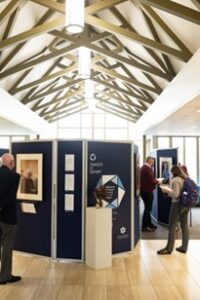
From Quito to Campus, hosted earlier that week, offered a reflective counterpoint to organizing energy. The event transformed a lunchroom into an open gallery, inviting attendees to engage with the stories, photos, and artifacts from a J-Term immersion trip to Quito, Ecuador, organized through the University of St. Thomas VISION program. Students who had traveled with the program shared images of rural landscapes, community gardens, family meals, and shared labor, all framed by the Andean concept of minga: collective work for the common good. Rather than presenting their trip as service or aid, the students emphasized accompaniment, which is the practice of walking alongside rather than leading or solving. Many recounted moments of transformation: building relationships with community members while plowing fields, grappling with the ethics of global travel and power dynamics, and discovering deep joy and gratitude in settings shaped by material scarcity but rich in relational abundance. Guest speaker Olivia Young, the Community Director at the Center for Working Families in Quito, joined the event and spoke of the mutual respect and longevity that define the partnership. Visitors wandered among the storytelling booths, pausing to ask questions, share memories, or sit in quiet reflection. Several students expressed interest in future VISION trips, while others remarked on how the event reshaped their understanding of solidarity, humility, and intercultural encounter.
Hosted by the Interfaith Fellows of the Lutheran Center for Faith, Values, and Community at St. Olaf College, Death Over Dinner invited students into a rare and honest conversation about mortality over a shared meal. Drawing from the national Death Over Dinner initiative and grounded in pre-assigned readings and a TED Talk by Joan Halifax, the event created a space where students reflected on how death is shaped by cultural taboos, personal beliefs, and spiritual traditions. Interfaith Fellow Zach Martin ’25 reported, “The dinner helped me to reflect on my own beliefs about death and helped me learn more about the people there I was already close with.” Fellow Dick Nchang ’25 added, “What struck me most was how naturally the laughter and levity coexisted with moments of deep reflection. We spoke about the kinds of legacies we hope to leave and even our fears around the dying process itself. We would move from sharing plans for our ashes and the ashes of loved ones to laughter over a well-timed joke. The emotional range made the space feel human and whole.” This dinner continued the Fellows’ work of cultivating “third spaces” on campus that are neither strictly secular nor religious, but fully human.
Together, these events reflected one of the clearest insights of the entire festival: that the next chapter of interfaith and intercultural engagement at St. Thomas will not be faculty-led or administratively imposed, it will be co-created by students themselves, in classrooms, at kitchen tables, and across the many places where curiosity becomes connection.
What Comes Next?
The Culture of Encounter Ideas Festival modeled a kind of education that is both rigorous and relational. It was not always comfortable, nor should it have been. It asked the university community to sit with hard questions, to listen before solving, and to lead with curiosity. It also left a challenge: Will we build the infrastructure to carry this culture forward beyond the festival? The festival was not an event but an invitation. As one attendee, Eamaan Rabbat, Education Director of Rabata, reflected, “The Culture of Encounter Ideas Festival offered an enriching experience. The wide range of events was thought-provoking, engaging, and offered meaningful takeaways. I gained valuable insights that will inform and enhance my work in higher education, interfaith dialogue, and impactful communication.”
Organizing Team and Advisory Committee
The Culture of Encounter Ideas Festival was made possible by the collaborative work of an interdisciplinary advisory committee whose members brought diverse experience and deep commitment to interfaith engagement:
- Ali Chamseddine, Interfaith Fellows Faculty Coordinator, Jay Phillips Center; Board Certified Chaplain, Regions Hospital
- Danielle Clausnitzer, Ph.D., Adjunct Professor of Religion, Augsburg University; Assistant Director, Wisdom Ways
- Mary Elmstrand, Adjunct Faculty, Department of Theology, University of St. Thomas
- Hans Gustafson, Ph.D., Director and Senior Adjunct Professor, Jay Phillips Center for Interreligious Studies
- Alina Kiedinger, student Interfaith Fellow Leader
- Jennifer Kilps, Ph.D., Network Executive, Minnesota Multifaith Network
- Naomi Peters, student Interfaith Fellow Leader
- Laurel Marshall Potter, Ph.D., Assistant Professor, Department of Theology, University of St. Thomas
- Diana Tewelde, student Interfaith Fellow Leader
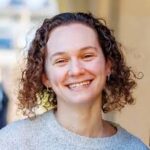
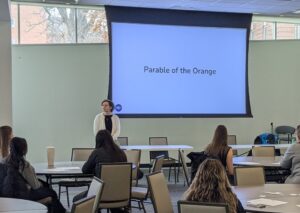 In February, The Viewpoints Project’s founder and executive director, Shira Hoffer, spent two days at St. Thomas meeting with students, faculty, staff and administrators. Her visit offered a firsthand look at the fellowship’s approach and the organization behind it.
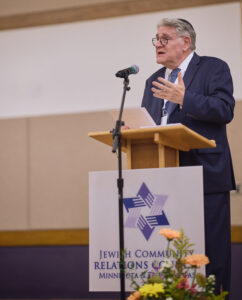
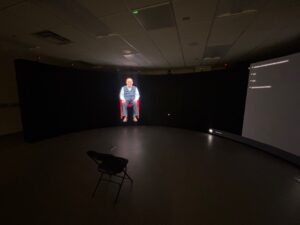
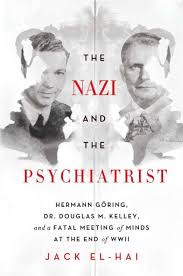
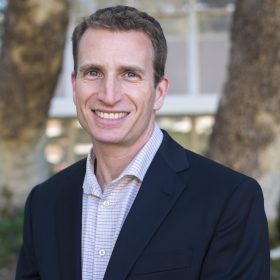 Holocaust Testimony in the Age of AI: History, Memory, and Ethics Thursday, April 16, 2026 | noon–1:15 p.m. CDT 3M Auditorium (Owens Science Hall, Room 150), University of St. Thomas, Free and open to the public: What happens to Holocaust memory when the last survivors are gone? As the generation of firsthand witnesses passes, new technologies – including AI-powered interactive testimony – are transforming how we preserve, access, and engage with survivor stories. Todd Presner, Ph.D., Chair and Professor of European Languages and Transcultural Studies at UCLA, will trace the history of preserving survivor testimony from earlier technologies to today’s AI-driven platforms, exploring both the possibilities and ethical challenges of Holocaust memory in the digital age. Dr. Presner holds the Michael and Irene Ross Chair in the Humanities and is the author of Ethics of the Algorithm: Digital Humanities and Holocaust Memory (Princeton University Press, 2024).
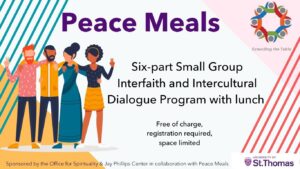 meal around the table is commonplace in our society, but who we invite—or do not invite—holds deep meaning. When people do not know each other, broad assumptions and judgments are often made on minimal truth and little understanding, leaving individuals and communities disconnected and suspicious of one another. Peace Meals offers a path forward by gathering people from different faith traditions, religious identities, and worldviews at a common table for food, friendship, and hospitality. Participants commit to meet six times to share a meal and honest discussion, with the goal of building awareness and understanding of each other’s beliefs, questions, concerns, and hopes. In these sessions, students experience the richness of constructive conversations across lines of difference and receive training to facilitate them. Learning to participate in and lead conversations like these is a core competency for effective leadership in professional, civic, and community settings. Open to all UST students of any religious identity or no religious identity.
  We’re building a campus culture where bridge builders are the heroes. Bridging the Gap (BTG) is a nationally recognized curriculum that equips students with practical skills to listen well, share their stories, engage tension constructively, and find common ground across deep divides without compromising their values. Sessions explore why bridgebuilding matters, the art of listening, sharing your story, and engaging tension constructively. All sessions are facilitated by Prof. Mary Elmstrand, food is provided, and students who complete all sessions and the final project earn a $200 stipend. Priority deadline: December 10. Applications accepted on a rolling basis until the program is full. Organized by Prof. Mary Elmstrand and the Jay Phillips Center with support from Interfaith America.
 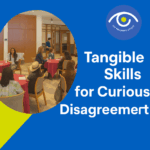 Join The Viewpoints Project for an interactive workshop focused on building the skills to disagree curiously! Led by Executive Director Shira Hoffer, this workshop will introduce you to the science behind why it’s so hard to have conversations across difference, and give you a toolkit to be able to do so, no matter the topic. Sponsored by the Jay Phillips Center in collaboration with Bridge St. Thomas, with a generous grant from Interfaith America.
  The
The 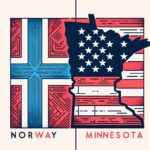 This course explores religious diversity and dialogue through immersive, practice-based learning in Norway. Following a couple of days in Minnesota, the course spends significant time in Norway working with DialogPilotene (The Dialogue Pilots) through dialogue sessions, interactive workshops, and encounters with Norwegian scholars, leaders, and peers, complemented by site visits and guest lectures. Students examine antisemitism, Islamophobia, secularism, pluralism, freedom of expression, and Norway’s commitment to det livssynsåpne samfunn (a worldview-open society) rooted in constructive disagreement. Through these experiences, students develop practical dialogue skills and a nuanced understanding of how religiously diverse secular societies navigate deep difference. Contact


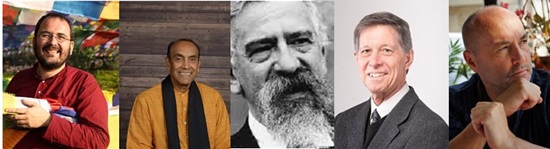

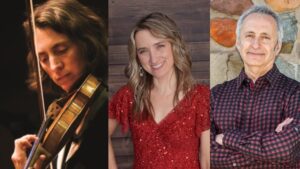
 the Jay Phillips Center’s Interfaith Fellows Program, generously funded in part by the Arthur Vining Davis Foundations grant in Religious Literacy and Interfaith Leadership, has made remarkable strides in nurturing the next generation of leaders. This innovative initiative has brought together a diverse cohort of students—Bell Castilleja, Antoine Chehade, Laila Franklin, Alina Kiedinger, Naomi Peters, and Diana Tewelde—each contributing unique perspectives and commitment to fostering religious literacy and interfaith dialogue. The program’s mission is to “educate and prepare (inter)religiously literate and responsible scholar-practitioner leaders, critically informed by how lived religious practices and beliefs shape America, who act wisely, work skillfully, and engage religious diversity to advance the common good in civic, academic, professional, nonprofit, public, and community sectors.”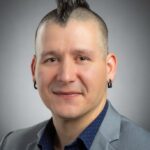
 The Jay Phillips Center (JPC) continues to cultivate and expand its external partnerships to enhance its reach. In collaboration with the
  president of the
  acknowledges the invaluable contributions of their Director, Dr. John Merkle. The JPC at St. Thomas will honor Dr. Merkle’s legacy on September 26, 2024, with a
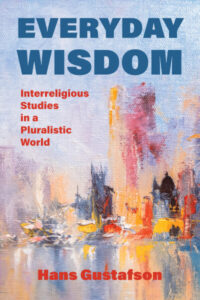
 “Religion and Higher Education: Challenges and Opportunities” at an event honoring Dr. Jeanne Kilde, Director of the Religious Studies Program, Institute for Advanced Study (IAS), University of Minnesota-Twin Cities. Gustafson also participated in key events such as the annual Minnesota Multifaith Network conference, the Interfaith America convening on “Religion and the Health Professions,” and was an invited guest on Dr. John Marten’s podcast