In Context - The official blog of the Department of Art History at UST - Page 11
Research, Students

Amanda Lesnikowski: Entering the Museum World as a New Graduate

Amanda Lesnikowski will be undertaking an internship at the Whitney Museum in New York after her graduation (see previous blog on her senior paper).  As she mentions in her blog entry, Amanda also received a research grant from the Luann Dummer Center for Woman last year.

When I declared my major in art history three years ago, I made my decision based on how I felt and not on my plans for the future. I had come to the conclusion that if I was going to spend four years studying one thing, I wanted to enjoy the courses and look forward to even the 8:00AM meeting times. Majoring in Art History is one of the best decisions I have made thus far in my life. It has made me a happier person, and it has helped me mix work and play.  As a future Curatorial intern at the Whitney Museum of American Art in New York, I am confident in saying that you can have an enjoyable major and still have a successful future.

One of the high points of my undergraduate work was how I spent the summer 2012, when I traveled to Alabama to meet and interview the quilters of Gee’s Bend. My research, The Freedom Quilting Bee in the 1960s and Today: The Quilters of Gee’s Bend as Artists, Merchants, and Activists, taught me a great deal about myself and about the world of research. It was one of the main reasons Claire Henry, curator at the Whitney, wanted to meet me.  I am very thankful that Dr. Heather Shirey guided me through the process of applying for a grant from the Luann Dummer Center for Women for the project, and later helped me to produce something I am proud to share with others.

Being able to add on-site research experience to my resumé has been indispensable and often came up in interviews when I began applying for internships the first semester of my senior year. Many institutions did not post internship possibilities until October, while larger institutions had deadlines as early as the first few weeks in January. I applied to the Museum of Modern Art, the Guggenheim, the Metropolitan Museum of Art, the Whitney, the Frick Collection, and the Minneapolis Institute of Arts. I flew out to New York on two separate occasions for interviews. Because of my future with the Whitney, I will just describe my experience there.

After ranking the Whitney’s departments in order of my preference on the application, I was asked to interview with both the Registration and Catalogue/Documentation departments. This was exciting, but when I got there I was surprised with a third interview in the Curatorial department. I loved all three areas and felt very comfortable with the interviewers. When I first met Claire Henry, she told me that it was my research experience that impressed her. She is working on a catalogue raisonné of Andy Warhol’s original films. The first volume has already been published, but the Whitney is working with MoMA to compile a second publication. I will spend my time traveling with Claire uptown to MoMA and the rest of the time at the Whitney’s offices on Park Avenue South during my internships.

I cannot believe this wonderful opportunity I have been given. I know that my internship with the Whitney is only the beginning. I hope that at the end of my time there, I will find a more permanent place within the museum world.


Conference Presentations, Presentations, Research, Students

Amanda Lesnikowski: Rembrandt’s Two Lucretias

Amanda Lesnikowski is a senior art history major who will graduate in May 2013.  Her senior paper and presentation, on Rembrandt’s paintings of Lucretia, was presented at a research conference at Baker University in Kansas and a symposium at the Minneapolis Institute of Arts.  Her senior presentation will be on May 17.

When the senior paper began popping up in conversations about a year ago, everyone kept telling me not to “reinvent the wheel.”  At the end of my junior year, I knew that I wanted to elaborate on a paper I had already written, but I was not sure what that paper would be.  During the fall 2012 semester I was enrolled in Robert Ferguson’s Baroque and Rococo course. We were required to choose a work from the Minneapolis Institute of Arts and use it as the basis for all of our research.  Portraits having a special place in my heart, I claimed Rembrandt’s 1666 Lucretia. The semester went quickly, and my final paper only left me with more questions and bigger ideas than answers.

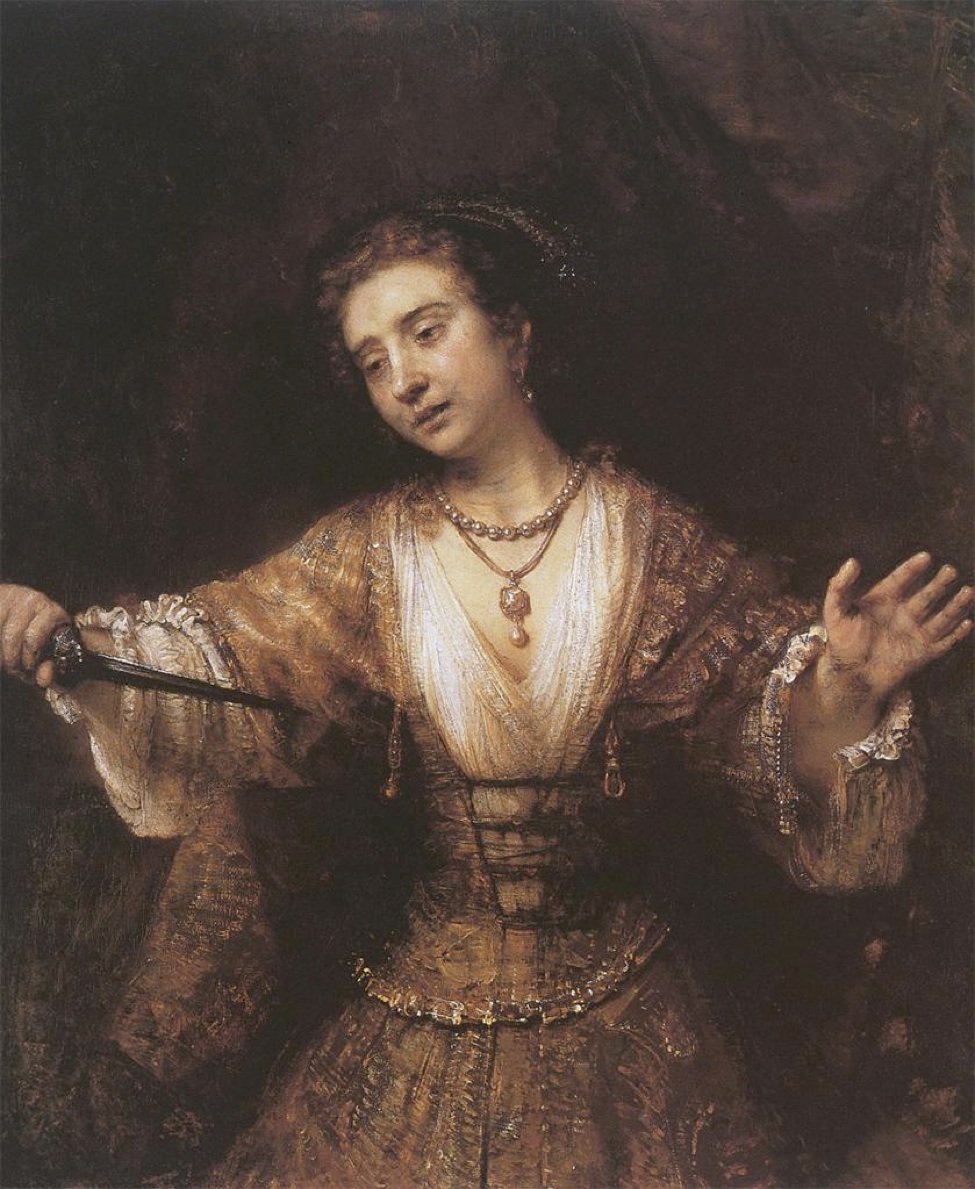
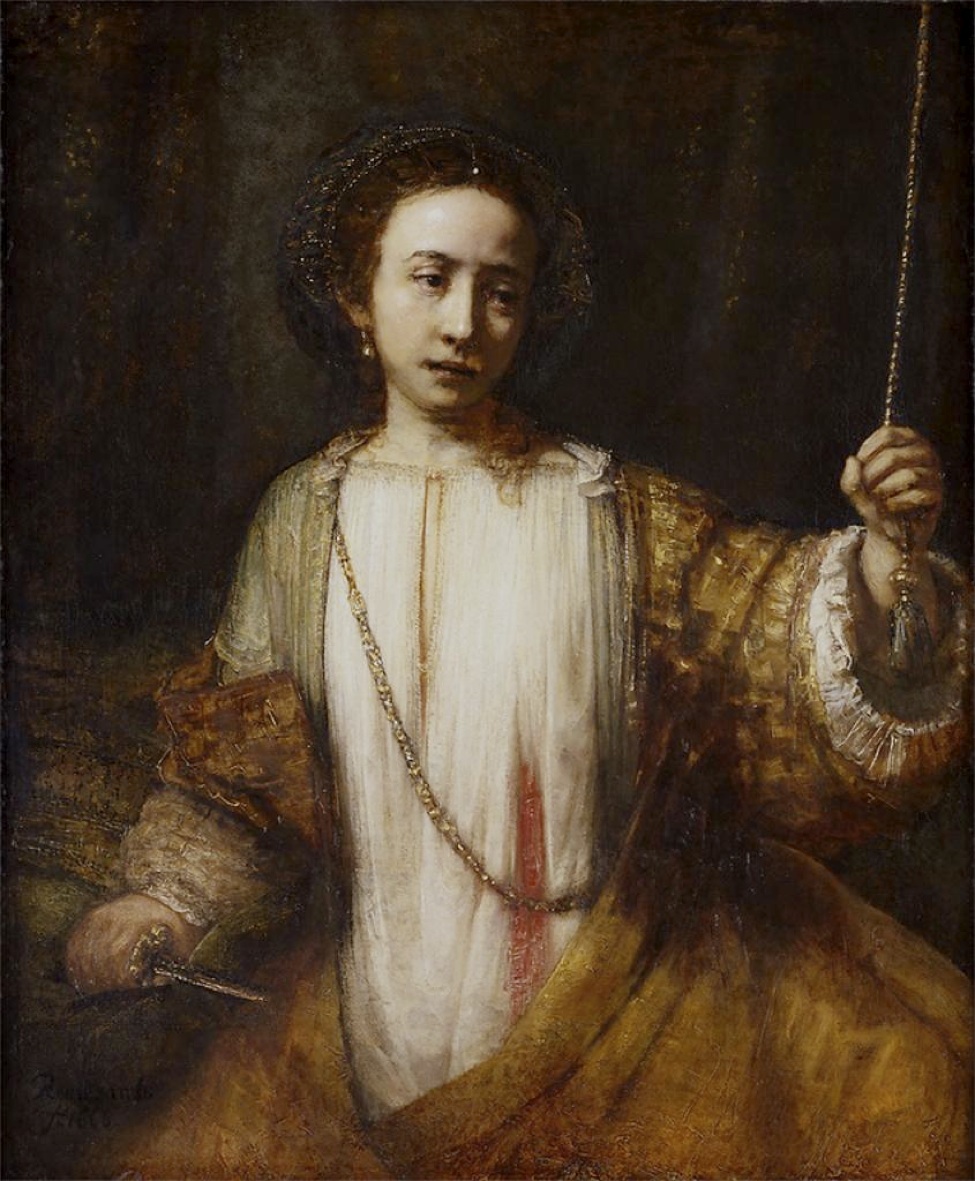
It was at this point that both Robert and I knew this paper had more potential than just a final classroom essay.  After asking him to be my advisor, we began brainstorming what new questions we wanted to answer. This process left us with two areas of study: theatricality and family in Rembrandt’s two Lucretias (see images below). Rembrandt is known by scholars as having included great amounts of theater into his paintings, whether it be live gestures, the implication of speech, or even his application of lighting. When it came to family, Rembrandt had a very colored history. He saw his family as one of the most important parts of his life, and it was often seen in his art.

DC

Rembrandt, Lucretia, 1664. National Gallery of Art, Washington, D.C.


Rembrandt, Lucretia, 1666.  Minneapolis Institute of Arts.

Rembrandt, Lucretia, 1666. Minneapolis Institute of Arts.


Through further research, we discovered another important part of Rembrandt’s art: the tronie. A tronie, a Dutch word for face, is used as a term to describe a combination of portraiture and history painting. Here is an excerpt of my paper detailing Rembrandt’s invention:

Rembrandt “combined theory and practice” and invented the “tronie,” a combination of portraiture and history painting.(1)   Martha Hollander spoke highly of the seventeenth-century, Dutch history painting. She explains the genre’s power and the ability to move an audience: “History painting was an opportunity to tell a story on a grand scale, combining anecdotal and archaeological details with displays of eroticism, violence, and powerful emotion. Successful compositions required strong stage-managing skills.”(2)  As seen in these two portraits of Lucretia, the background is bare, almost completely faded to black. Hollander attributes this to Rembrandt’s style: “Rembrandt’s method, demonstrated in his history paintings [. . .], is to imply, rather than describe, a space.”(3)   This pushes the actor, or subject, to the front of the stage. Rembrandt clearly saw his studio as a stage, where the model’s purpose was to perform.(4)

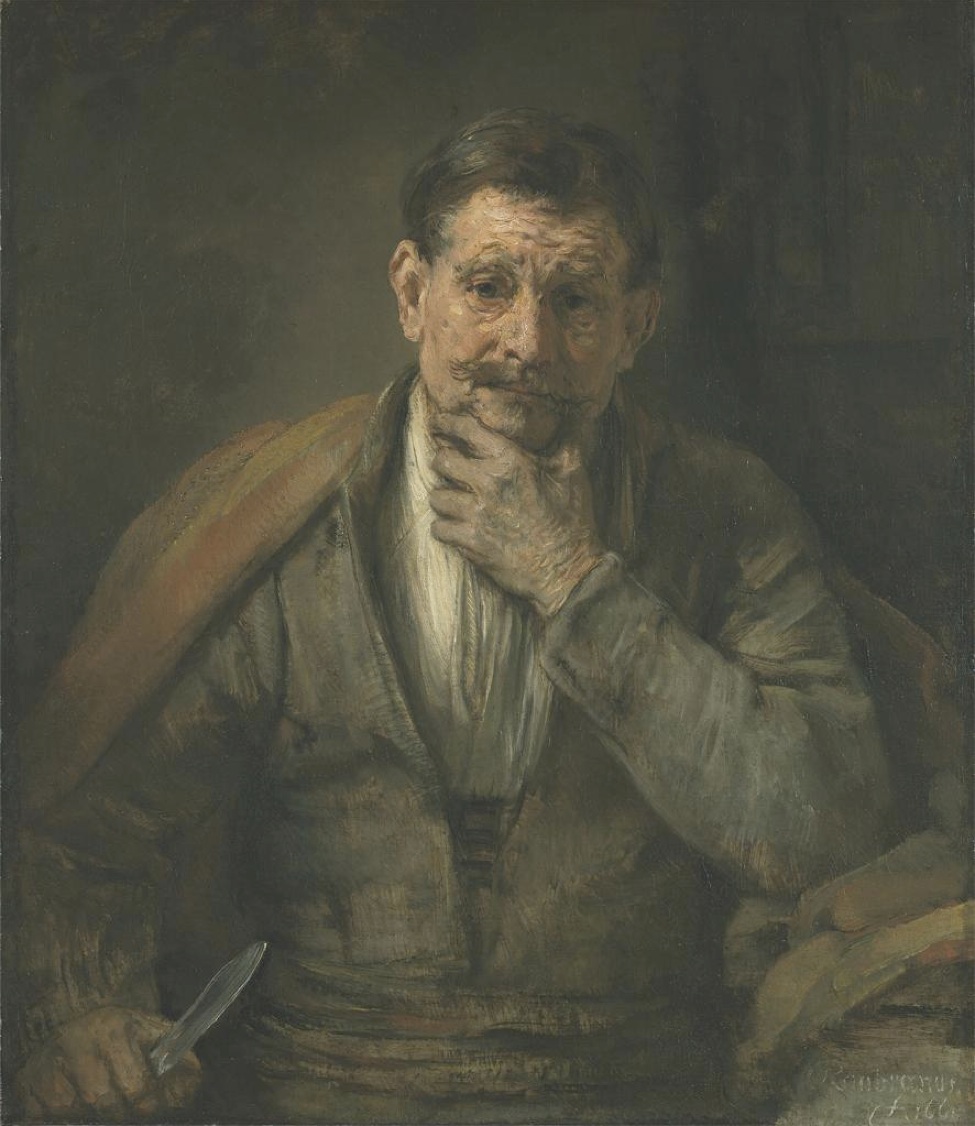
Rembrandt’s depiction of St. Bartholomew is a wonderful example of the tronie (see below). The painting, from 1661 and now at the J. Paul Getty Museum, is apparently a character study, but is converted into a history painting by adding a single prop: the knife. Rembrandt uses the prop to bring the audience full circle. The knife allows the audience to complete a mental image, one of a man everyone knows. Without the knife, this would just be a portrait, albeit of a particular person. The man in the painting gazes out towards his audience with a look of contemplation. Holding his head in his left hand, his emotions are hard to classify. His look of self-reflection is a feeling anyone could relate to. Like the Lucretias, Rembrandt’s lighting emphasizes the subject’s face. It is here that the viewer is drawn first, and only then, down his right arm and along the draped fabric where they observe that he is holding a knife. Now they identify that this man is St. Bartholomew, the martyr who was skinned alive.

Getty

Rembrandt, St. Bartholomew, 1661. J. Paul Getty Museum.

Writing this paper has taught me how to be a better art historian, a stronger writer, and a more eloquent speaker.  I have had the opportunity to present my paper three times: at the ACTC and Minneapolis Institute of Arts (MIA) symposium, at the Baker University Art History Conference, and at the St. Thomas undergraduate symposium. I was honored to be asked to speak at the ACTC/MIA and represent St. Thomas. I am so grateful that the department chose me. I heard of the Baker University conference through a department e-mail. I sent in a five hundred word abstract and title, then a few weeks later heard I was chosen to speak. I traveled to Kansas at the end of April to present along with other undergraduate researchers.

The undergraduate symposium at St. Thomas is also a celebration as well as a presentation. It is a wonderful opportunity to show your peers and professors what you have been working on the past year, and to hear your friends speak and to get their opinion on your own work.

Research always brings more questions than it does answers, but, hopefully, your own paper is able to answer someone else’s question. Attending these symposiums has been inspiring, humbling, and exciting, but they have prepared me for my next steps as an art historian.

NOTES

(1) Simon Schama, Rembrandt’s Eyes (New York, 1999), 660-663.

(2) Martha Hollander, An Entrance for the Eyes: Space and Meaning in Seventeenth-Century Dutch Art (Berkley, 2002), 16.

(3) Hollander, 67.

(4) Svetlana Alpers, Rembrandt’s Enterprise (Chicago, 1988), 58.


Conference Presentations, Graduate Student, Presentations, Research

Olga Ivanova: The Pictorial Photography of Alfred Stieglitz: Validating Photography through Painting.

Olga Ivanova presented her paper on Alfred Stieglitz at a conference in Gzhel, Russia in November 2012.  The paper was delivered in Russian and based on research in a graduate seminar taught by Craig Eliason.

My first presentation of a research paper at an academic conference was in Russia, and I found this experience both rewarding and challenging.  I came across the listing for the Conference in Gzhel, Russia in early October 2012 and I was quite surprised to see that they were still accepting submissions.  The Conference was to take place on November 22-23.   The organizing committee accepted my paper and proved to be very resourceful about getting me into the program and answering all my questions in a timely manner.  My main concern was about the presentation style and their technical capabilities.  I was assured that most presenters use PowerPoint and stick to a script, which was a relief to me for presenting a paper in Russian.

Slide from Presentation

Slide from Presentation


I presented research that I had started in Craig Eliason’s graduate seminar, American Painters of the Gilded Age.  Though the conference mentioned it was “international,” they requested that I present in Russian.  I was eager to take on the challenge of translating my paper.  While I speak Russian fluently, I don’t have a strong technical vocabulary in art history, and I had to consult dictionaries and various art publications in Russian in order to make appropriate translations of terms.  Another limitation was that I could not practice my presentation and get feedback on it since no one in the program spoke Russian (I would strongly encourage everyone to present to faculty and colleagues before a conference).

Gzhel is located about 60 kilometers outside of Moscow and I took an early morning train to get there on time. I was given very detailed instructions and had no problem finding the university.  Gzhel University is famous for it unique style of ceramics that is painted solid white with distinctive blue designs, all made by hand.  Together with other guests, I was given a tour of the University’s art gallery and the studio where the ceramics are produced.  After a welcoming speech, the conference broke into sections.  There were fifteen presenters in my section, fourteen on Russian art. I was scheduled to be tenth, but the Dean unexpectedly gave me the honor of presenting first.  I was the only international student who had travelled from far away, and it was their way of showing their appreciation for my interest.  Believe it or not, but I was really thankful for this gesture, after my initial shock.  Since I did not expect to be presenting right away, I was somewhat relaxed.  Though I am genuinely terrified of public speaking, I felt calm and confident during the presentation and I was asked a number of questions, mostly about the logistics of conducting the research in the USA.  I think it was a combination of various factors that made my presentation successful: I put a lot of effort and time into the research and translation, which added to my confidence during the presentation, and I was frankly excited to share it with other art historians and to hear their opinions.    I was thrilled to see that my presentation was received so well, and more thrilled that I was awarded a second place prize in my section.

One difficulty was that during my presentation, I couldn’t control my PowerPoint from a remote at the presenter’s stand and had to ask the tech guy to switch the slides for me as I was presenting.  I found that distracting, especially because I tend use transitional slides in the middle of sentence.  Other presenters, however, were used to present in this manner of calling for the next slide rather than using a remote control.

The scope of topics at the conference was broad, but they were mostly concentrated on the art of the 20th century, so my photography research fit nicely.  I found that the Russian presentation style was more casual and many presenters didn’t follow their script.  This did make some presentations rather longer than scheduled, unfortunately.  Overall I found that Russian art historians conduct brilliant research, and I was happy to make some contacts.

Photo courtesy Gzhel University

Photo courtesy Gzhel University


After the presentations, I socialized with other presenters and the organizing committee during the reception hour.  I met many fascinating people who were interested to learn about UST and its art history program.  One day, I hope to see some of them at our own annual Graduate Art History Symposium.

In addition to participating in this conference, I conducted research at the Russian State Documentary Film and Photo Archive at Krasnogorsk (outside of Moscow) and at the State Archive of Documentary Films, Photographs, and Sound Recordings (St. Petersburg). I collected some important resources that will serve as a foundation for my Qualifying Paper this spring.  I look forward presenting my research at the UST Graduate symposium in May.

Since my Powerpoint presentation was in Russian, I doubt this information will be practical.   Nevertheless I am attaching a PDF below of my presentation for your review.  I am happy to discuss it further if anyone is interested!

Ivanova Presentation Slides

Books, Faculty, Publications, Research, Uncategorized

Mark Stansbury-O’Donnell: The Point of View for Art and Architecture

Mark Stansbury-O’Donnell is completing a book on the history of Greek art that will be published by Wiley-Blackwell in summer 2014.  This entry recounts one of the projects for the book during his trip to Athens in Feb. 2013.

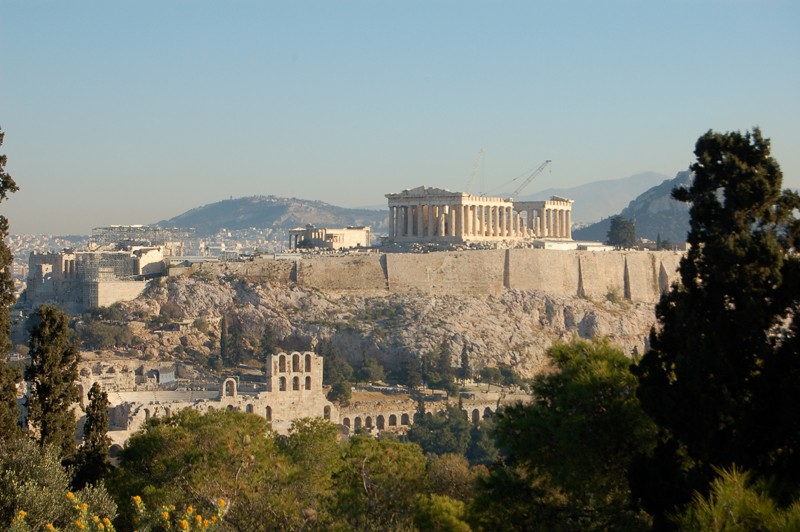
When art historians get pictures to illustrate their research and work, we often rely on photographs that provide the best view of an object or building.  For vases in museums, this usually means a straight profile shot showing the shape of the object and its decoration with as much focal depth as possible.  Buildings are a bit harder since they have multiple sides and being taller than the average person, harder to see in their entirety unless you have an elevated view.  For photographing the Parthenon in Athens, for example, many pictures are made from the Hill of Philopappos to south and west of the Acropolis.  From here, one has a clear view of the elevation of the west and south sides of the Parthenon.  One can also see the Erechtheion in its entirety, including the Caryatid porch, and, when not covered with scaffolding for restoration, the Propylaia and the Temple of Athena Nike.  From this vantage point, the entire Periklean program of Classical Athens is clear to see.

Photo: M. Stansbury-O'Donnell

Photo: M. Stansbury-O’Donnell


The problem is that this vantage point is one that very few people, today or in the past, visited.  It is a high spot visible from the rest of the city, which is why the Roman Gaius Julius Antiochus Philopappos built an elaborate monument there that can be seen throughout Athens.  It was a place to be seen, but not to look from.

In writing my book, I have tried to emphasize the experience of the ancient viewer, and this means reconsidering what the ancient viewer could actually see.  Shots like the first picture do not reflect a typical Athenian point of view.  There is a place just to the north, however, that was a common vantage point for ancient Athenians: the Pynx.  Today, this is a site that is little visited, mostly because it is just a large open bowl on a hill due west of the Acropolis.  It is important, however, as the place where the ekklesia, the body of 6000 citizens who voted met as the Assembly of democratic fifth-century Athens.  Here they heard speeches and made political decisions, voting on war, peace, public projects, and laws, among other things.

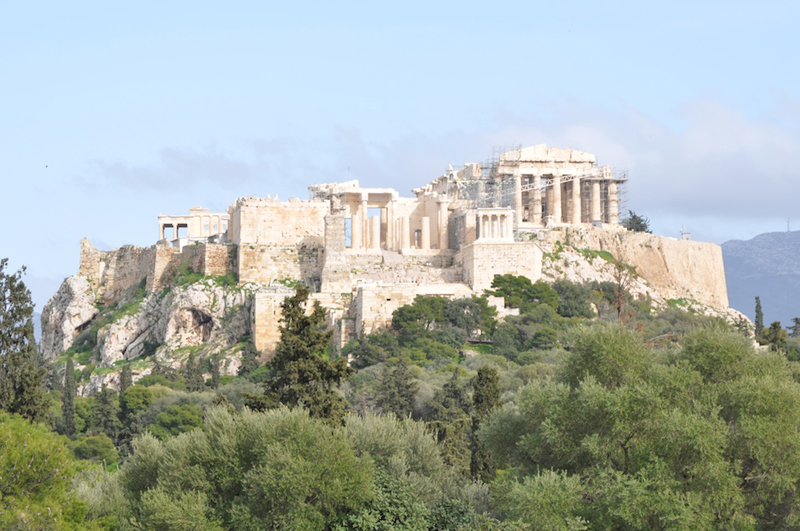
From the Pynx, one has a very different view of the Acropolis and Parthenon.  Looking east from the Pynx, one sees full on the gateway of the Propylaia and the Temple of Athena Nike (victory), clearly an important factor in decisions on war.  The Parthenon spreads out to the right and to the left the north porch of the Erechtheion, where the most important cults like the sacred olive tree of Athena were housed.  From this view on the Pynx, one cannot see the buildings individually as an art historian would look at them for an analysis, but one would see them as Athenians were used to seeing them, while they were carrying out one of their most important roles as citizens.  Undoubtedly, this was one goal for the Periklean building program, to make, as Perikles said, the citizens of Athens look upon their city and become lovers of that city.

Photo: M. Stansbury-O'Donnell

Photo: M. Stansbury-O’Donnell


I realized after I had written about this in several different chapters that I myself did not have a good photograph of the Acropolis from the Pynx.  My photos were either too blurry or hazy or cloudy to use for publication, and that was true of some other photos I had that were made from the point of view of the Athenian rather than the art historian.  In February, I had to spend several days in different parts of the city, working around the weather, to get the six or seven good photos that I needed for the book.  Of course, the Parthenon now has a giant crane on rails in front of it as they work on restoring the building, but that is good for another point in the book, the preservation of the past.


Conference Presentations, Graduate Student, Research

Lauren Greer: Charles Darwin, Fairies & Cambridge University

Graduate student Lauren Greer presented a paper entitled “Glamour: A Dissection of John Anster Fitzgerald’s Fairland” at Cambridge University’s Graduate Conference in December 2012.  This entry describes the research process that led to the presentation and her experience at Cambridge.

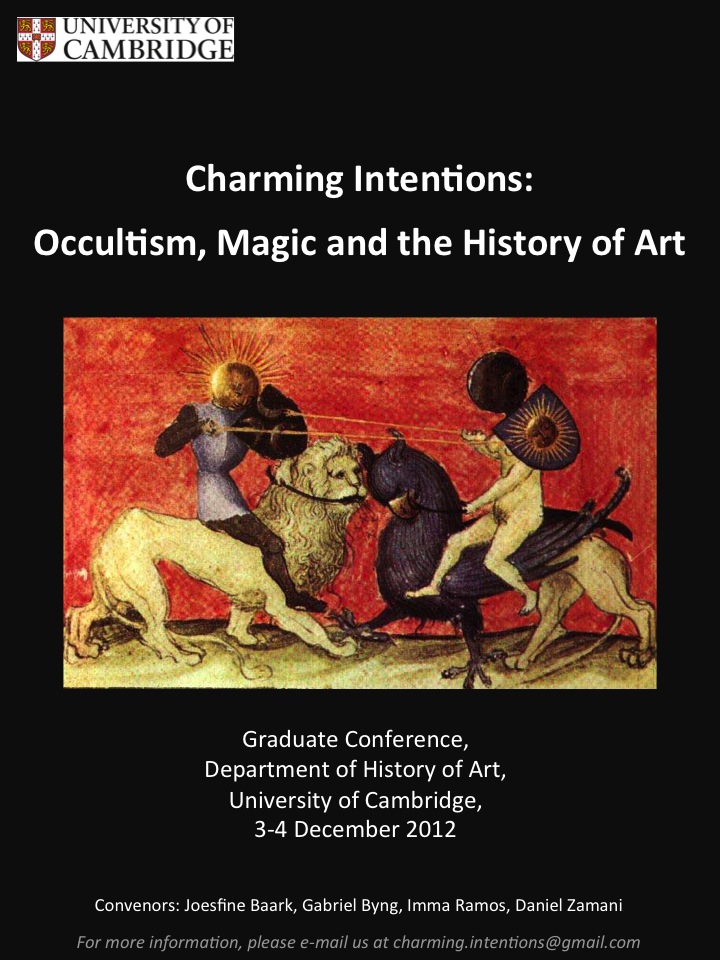
As last summer slowly trickled to an end with the fall semester rapidly approaching I began to once again get into the academic frame of mind. In doing, so I came across the perfect call for papers, it seemed too good to be true, a conference specifically on magic and the occult in art history! As I read further it only got better, Charming Intentions: Occultism, Magic and the History of Art was the theme for the 2012/13 Graduate Conference at Cambridge University. At this point I knew I had to face my fears of presenting at a conference and apply. I figured even if my paper did not get accepted it was still good practice since I had to write a CV and an abstract. As October 15th, the day the conference would be notifying the selected presenters, rolled around I realized how much I wanted my paper to be accepted. So, you can imagine my excitement (and panic) when I received a congratulatory email from the conference organizers informing me that my paper had indeed been chosen. In the subsequent weeks, as the details of the conference were finalized I learned there would be twenty presenters spanning two intense days. I would be presenting on the second day in the first session, giving me time to settle in and get a feel for the conference.

Graduate Conference Poster


John Anster Fitzgerald, The Chase of the White Mouse, early 1860s.  Formerly Nicolette Wernick Collection.

John Anster Fitzgerald, The Chase of the White Mouse, early 1860s. Formerly Nicolette Wernick Collection.

Before I got on a plane for the eight-hour flight I had a lot of work to get done. First, I needed to submit a bio and abstract for the conference brochure. Here is the abstract I submitted:

Glamour: A Dissection of John Anster Fitzgerald’s Fairland

Fairy paintings captured the imagination of artists for approximately thirty years during the mid-19th century. Specifically the painter, John Anster Fitzgerald found his calling in the depiction of the miniature, jewel-toned fairy realm. During this time fairy painters, such as Fitzgerald, began to move away from Shakespearian references to create a fairyland entirely of their own imagination. The rise of fairy subject matter in popular Victorian culture can be attributed to the emergence of common fairy knowledge. The classification and discovery of origins was not limited to the biological sciences, but seeped into the social sciences. As scientists were collecting specimens, folklorists were attempting to discover the origins of fairies. This led to an increasing awareness of fairytales and fairies in Victorian culture. Coinciding with this growing fascination was the spread of Darwinism. Charles Darwin published On the Origin of Species by Means of Natural Selection in 1859. On the Origin of Species, along with subsequent publications, presented to Victorian society a radical new way to comprehend man’s role in the world. Man was now part of the violent and cruel world of natural selection and the human consciousness was no longer exempt, but subject to the forces of nature.

This paper will seek to understand how, as the theory of evolution stripped away the mystical aura surrounding the natural world, the fantastical world of fairyland began to reflect the growing social uncertainty. My research explores the visualization of Darwinism in order to better grasp the relationship between the theory of evolution and the magical world of fairyland. Specifically, my paper investigates the role of the fairy through a dissection of John Anster ‘Fairy’ Fitzgerald’s complex fairyland in his painting The Chase of the White Mice (c. 1864). Woven into Fitzgerald’s magical realm are references to scientific imagery. Through an analysis of the imagery in The Chase of the White Mice a better understanding of the effects of Darwinism on the Victorian psyche can be reached.

Now, I had to nail down my presentation. Luckily, I was working with Dr. Shelly Nordtorp-Madson on the same topic for an independent study on the visual culture of Darwinism in the 19th century during the fall semester of 2012.  Thus, I felt I had a solid body of research by the time I left for Cambridge.  During the weeks leading up to the December deadline, members of the art history faculty and staff were incredibly supportive and helpful, listening to my presentation, critiquing and perfecting my PowerPoint, and making sure the images were of the best quality. By the time I got on the plane for London, I was confident in both my knowledge on the subject and the quality of my presentation.

Once I arrived in Cambridge, with my parents who were kind enough to accompany me in my confident but anxious state, it was magical. The conference took place in the upstairs one of the small row houses that make up Cambridge. The room was intimate, about half the size of our classroom with a projection screen and podium at the front. Before the conference got underway I wondered: Would other people be reading a script? What would their PowerPoint look like? Would I be able to answer the questions people would ask? Yes, every person read his/her presentation from a script. The other presenters’ PowerPoints were well done, but it was well worth the extra time I put in to make sure I was not on one slide for too long and that my images were of the highest quality. The five minutes of questions was a huge concern for me, but everyone was supportive, gave me positive feedback and ideas for additional research. After I presented, the coffee breaks and lunch were a great time for meeting people and answering additional questions. I met people from all over the world, England, Germany, Hungary, Scotland, France… with a range of interests from alchemy, Islamic imagery, Roman magical gems, to surrealist magicians… it was amazing. I did it, I faced my fears and the overall experience and the opportunity to share a topic I am fascinated with were well worth the stress and hard work.

View of Cambridge, Photo: Lauren Greer

View of Cambridge, Photo: Lauren Greer

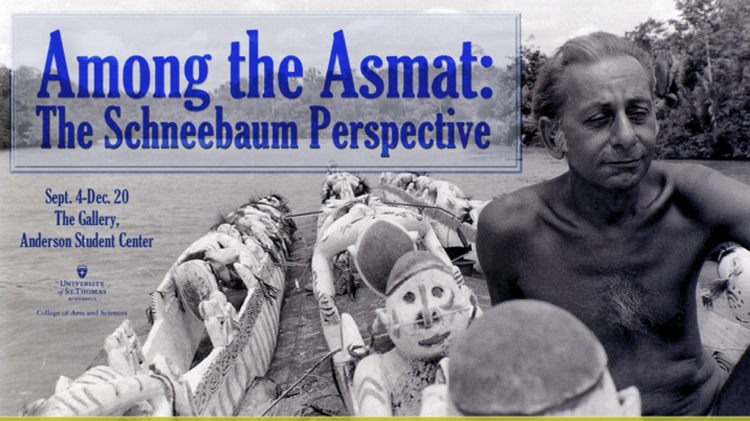
Asmat, Conference Presentations, Exhibitions, Graduate Student

Rachel Simmons: Curating Wowipitsj: Creating your own Opportunities

Rachel Simmons is the Curator for the exhibition “Wowipitsj: Man, Myth, Legend,” on view in the Gallery of the Anderson Student Center from Feb. 4 to Aug. 4, 2013.  Ms. Simmons is the second graduate student to develop an exhibition for the American Museum of Asmat Art at the University of St. Thomas.

Wowipitsj

The experience I gained through developing this exhibition has been invaluable. Having been an assistant to Julie Risser, Director of the AMAA@UST, for two years and a student in two of her classes prepared me for the challenges it takes to curate an exhibition.  Some of the challenges included picking objects and writing their labels, developing material for the brochure, deciding on just the right piece for the marketing materials and then the correct angle to photograph the piece so that it will catch peoples’ attention.  All of this might sound minor or tedious, but it demonstrates how much thought literally goes into every aspect of an exhibition.  While I knew going into this project that I would face those challenges, there are really two things I learned that I think others in the program will also find helpful.

1) Co-writing is hard, so it helps to have someone you know well.  Luckily I have worked side by side with Julie for so long that as we were developing the text for the brochure we could literally finish each other’s sentences.  When one of us was stuck and just could not find the right words and we were left to resort to odd hand gestures to get our point across, the other would take over the keyboard and finish.  Others around us as we were writing frequently heard, “Yes! That’s it, that’s exactly what I wanted it to say!”

2) Opportunity doesn’t always knock and sometimes you have to chase it down and tackle it.  For example, this exhibition is a part of an internship I did over the fall semester.  While it is not uncommon for students in our program to take internships, this was the first time there was an internship within the department.  Even though the path was somewhat unconventional, I knew this was something I really wanted to do since I did not think I would get this kind of curatorial experience at a larger museum.  Thankfully, Julie was on board and the department was able to award me a Patricia Jaffray Scholarship to help pay for the internship credits.

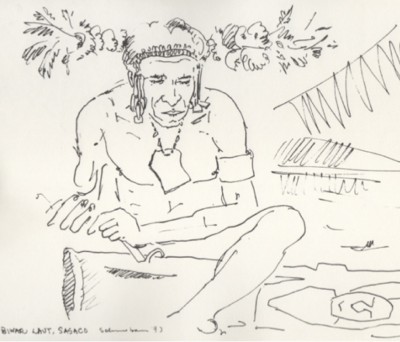
Dr. Risser had wanted to have an exhibition about myth.  Fortunately, I had already completed a paper about myth in one of her classes the year before.  I combined that paper with one I presented at the Midwest Art History Society Conference annual meeting last year about contemporary Asmat carving.  This exhibition came out of both of those papers.  “Wowipitsj: Man, Myth, Legend” not only explores myth and carvings, but also how carvers are preserving the oral traditions in their art forms.  Doing this exhibition allowed me to really explore this topic both in words and in objects.

My final word of advice for my peers is DO NOT be afraid to ask for something you want, because there are a lot of really great people here that can help you accomplish it, even if the task sounds daunting and even if it has never been done before.


Exhibitions, Graduate Student, Research

Angela Daniels: Toulouse-Lautrec in the Fiterman Collection

What follow are excerpts from a seminar paper written by graduate student Angela Daniels. Her research uncovered the historical context of the circus scenes created by late-nineteenth-century French artist Henri de Toulouse-Lautrec, including the print of “Footit and Chocolat” which is part of the Dolly Fiterman collection at the University of St. Thomas.

 Henri de Toulouse-Lautreac, Le Cirque.  Gift of Dolly Fiterman.  Photo: Christy Dent.

Henri de Toulouse-Lautreac, Le Cirque. Gift of Dolly Fiterman. Photo: Christy Dent.


Henri de Toulouse-Lautrec and the Circus: A Complex Relationship to Nineteenth-century France by Angela Daniels

In the brief intervening years between his life and death, Henri de Toulouse-Lautrec chose to live as an artist and amassed an impressive body of work.(1)  To accomplish this he became a consummate recorder of people from an early age. His approach as an artist to his subject matter might be compared today to that of participant-observation normally undertaken by anthropologists, whereby one both observes and records the complex relationships and interactions of a group, but also acts as a member of the group to better understand them.

Montmartre and its melting-pot of social classes was his area of study. Though Toulouse-Lautrec would come to be known most for his depictions of the women and the cabarets in this locale, it was actually the circus and its performers that he was exposed to as a young artist. It would be the imagery of the circus that he recalled from memory and returned to in his art at the end of his life as his health began to fail and the question of his sanity was at stake.(2)

For this project, it is Toulouse-Lautrec’s imagery that is compelling as an area for research. I argue that this work, particularly the artist’s treatment of the figures in the composition, is influenced by the cultural and political atmosphere of Montmartre, particularly the social class conflicts and interactions Toulouse-Lautrec witnessed as a patron and resident of Montmartre.

Even before Toulouse-Lautrec moved to Paris, events were unfolding that would create a conducive climate for the type and style of art he would come to create throughout his artistic career. The first factor was the establishment of the Third Republic government of France shortly after his birth in 1870 to 1871; second, the influence of Impressionism as the major art movement in his formative years; third, the relaxation of censorship as it applied to visual and literary pursuits originally instituted to restrict political satire; and fourth, his involvement with avant-garde circles, notably the Young Independents group and later, Thadée Natanson and the artistic and literary circle surrounding the publication, La Revue Blanche.

The institution of the Third Republic as France’s system of government was marked with an uneasy acceptance by French citizens from its beginning. Established between 1870 and 1871, it served as a replacement for the failed Second Empire under the rule of Napoleon the Third. The political leaders of the new Third Republic were forced to concede to and make peace with Germany, made especially necessary with the anticipation of a civil war rumbling among citizens of the lowest classes impacted most by the effects of the siege and angered by France’s concessions to Germany.
The bourgeoisie, or middle class, of France became particularly visible during this period of France’s history. This economic and social class emerged from the fruits of the economic success of the European industrial revolution and the competitive ideologies of a capitalist society. Armed with their newfound wealth, the bourgeoisie made possible the expansion of Montmartre into an entertainment district responsible for catering to the nouveau riche with leisure time to spare.(3)

Though Toulouse-Lautrec could actually claim aristocratic lineage and upbringing, he chose to self-identify with the artists and the rest of the lower-class echelons of French society that called Montmartre home.(4) They envisaged the bourgeoisie as the embodiment of the ineffectual government of the Third Republic.(5) During the Third Republic, it was the entertainment venues of Montmartre that became the stage on which the drama of class divisions was played.

Before the entertainment venues of Montmartre, modern Paris and her designer had already shaped the city landscape into an ideal setting for the display of bourgeois wealth and status. Under the guidance of Baron Georges von Hausmann, the Gothic design of Paris was radically transformed into a modern, post-Enlightenment city. More broad, well-lit avenues created clear sightlines down the busiest streets of the city framed and unimpeded by the new, uniform facades lining the boulevards. The intention of the transformation was to reduce crime, as well as to accommodate the population influx from the industrial revolution, and to participate in a modern aesthetic for urban design.(6)  Almost immediately, the bourgeois adopted the boulevards as a format for display of the wealth and status it afforded, a kind of visual spectacle of the new modernity.

“We need publicity, daylight, the street, the cabaret, the café, the restaurant…We like to pose, to make a spectacle of ourselves, to have a public, a gallery, witnesses to our life.”(7)  But spectacle could also mean something more sinister. In the context of the entertainment venues frequented by the bourgeoisie, the performances and the performers also became a spectacle. The bourgeois patrons of these establishments paid to view the low-class performers, objectifying them as a visual spectacle and perpetuating class hierarchies.(8)

The artists of the Impressionist movement, such as Edgar Degas, were the first of this period to capture the phenomenon of visual spectacle. They painted the boulevards, the theaters, the cafés, and the circuses with the top-hatted patrons in the audience and lurking backstage with the performers framed on stage. Many scenes of performances manifest as cropped views, framing the performers as the focal point of work—the view one might have if seen through binoculars.

The circus did not have a native tradition in France, but inherited and adapted the practice from the Italian commedia dell’arte and the English touring circus.(9) The English variety was particularly important to this discussion for its contribution of the Auguste clown character and is the historical precedent for the type Toulouse-Lautrec depicted in the work from the Fiterman collection.(10)

Footit and Chocolat were the most successful interracial clown duo performing in Paris at this time. The man that assumed the character of Chocolat was an Afro-Cuban immigrant from Havana. The Englishman from Manchester who played Footit styled his character as the clever antidote to Chocolat’s foolishness, thus completing the dynamic act of opposition, both in difference of skin color and personality. The exploitation of their many differences added to the comedy, which was only further heightened by the effect of their costumes.

Romantic and Realist artists and literary figures adopted and identified with the clown as a symbol of popular culture, evocative of the precarious state of the human condition.(11)  One group of artists, known as the Young Independents shared an empathetic ideology and subscribed to a lifestyle that aligned harmoniously with the contemporary attitudes toward the clown and class distinction. The content in their work reflected these principles and suggested a fascination with the sexual exploitation and class voyeurism that went hand in hand with the entertainment venues of Montmartre.(12)

In 1881 France relaxed censorship laws that had been put in place to limit the social and political critique of the republic and middle class in response to the rapidly modernizing landscape.(13)  The act of lifting the bans also coincided with educational reform in France that created a more literate public and provided a greatly expanded readership for the magazines and newspapers. Caricature of social types became popular after these censorship bans were lifted in photography, illustration, and journalism.(14)

Caricature became a central element in Toulouse-Lautrec’s works beginning in the 1890s at the same time he was personally and professionally supported by Thadée Natanson of La Revue Blanche. As one half of the founding team of the literary periodical, Natanson cultivated a circle of friends that critiqued the conventionalism embodied by the conservative bourgeoisie.(15)

As artist Toulouse-Lautrec’s oeuvre shows, his work was highly dependent and reflective of the environment in which he lived and worked. Toulouse-Lautrec and his contemporaries in the latter half of the nineteenth century depicted the social inequalities between the bourgeoisie and the lower classes in their immediate environments. Spurred on by the failings of the Third Republic toward the lower classes, artists’ imagery moved to Montmartre and the interiors of the entertainment venues where the bourgeois flocked to visually consume the spectacle of the performers on stage.

Toulouse-Lautrec depicted this dynamic in Footit et Chocolat. The space of the spectacle is contained by the boundary of the circus ring and overall cropping of the scene to frame the action of the clown duo as the object of the viewer’s focus. The viewers in the scene behind the ring wear top hats, carry canes, and festoon their suits with military awards barely discernible. These are the bourgeois patrons of the circus with their physiognomies mutated by caricature, so that only their quality of dress represents them.

NOTES
1 Gerhard Gruitrooy, Henri de Toulouse-Lautrec (New York: Smithmark Publishers, 1996), 113.
2 Wolfgang Wittrock, Toulouse Lautrec: The Complete Prints, vol. 1 of Toulouse Lautrec: The Complete Prints, trans. and ed. Catherine E. Keuhn (New York: Harper & Row Publishers, Inc., 1985), 113.
3 Wittrock, 106.
4 Ibid, 14.
5 Thomson, 4.
6 Mary Weaver Chapin, “Toulouse-Lautrec & the Culture of Celebrity,” in Toulouse-Lautrec & Montmartre (Washington, D.C.: National Gallery of Art, in association with Princeton University Press, 2005), 47.
7 Chaptin, 47.
8 James Smalls, “’Race’ As Spectacle in Late-Nineteenth-Century French Art and Popular Culture,” French Historical Studies 26, no. 2 (Spring 2003): 357-358.
9 A. H. Saxon, “The Circus as Theatre: Astley’s and Its Actors in the Age of Romanticism,” Educational Theatre Journal 27, no. 3, Popular Theatre (Oct., 1975): 300.
10 Smalls, 365.
11 Helen O. Borowitz, “Painted Smiles: Sad Clowns in French Art and Literature,” The Bulletin of the Cleveland Museum of Art 71, no. 1 (Jan., 1984):23.
12 Gruitrooy, 14.
13 Thomson, 17.
14 Thomson, 11.
15 E. Paul Gaultier, “La Revue Blanche,” Books Abroad 25, no. 4 (Autumn, 1951): 336.

Bibliography

Borowitz, Helen O. “Painted Smiles: Sad Clowns in French Art and Literature.” The Bulletine of the Cleveland Museum of Art 71, no. 1 (Jan., 1984):23-35.
Brown, Marilyn R. “’Miss La La’s’ Teeth: Reflections on Degas and ‘Race’.” The Art Bulletin 89, no. 4 (Dec., 2007): 738-765.
Cate, Phillips Dennis, Mary Weaver Chapin, and Richard Thomson. Toulouse-Lautrec and Montmartre. Washington: National Gallery of Art, in association with Princeton University Press, 2005. Published in conjunction with the exhibition “Toulouse-Lautrec and Montmartre” shown at the National Gallery of Art in Washington, DC, and the Art Institute of Chicago.
Gauthier, E. Paul. “La Revue Blanche.” Books Abroad 25, no. 4 (Autumn, 1951): 336-339.
Gruitrooy, Gerhard. Henri de Toulouse-Lautrec. New York: Todtri Productions Limited, 1996.
Haxell, Nichole A. “’Ces Dames du Cirque’: A Taxonomy of Male Desire in Nineteenth-Century French Literature and Art.” MLN 115, no. 4 French Issue (Sep., 2000): 783-800.
Saxon, A. H. “The Circus as Theatre: Astley’s and Its Actors in the Age of Romanticism.” Educational Journal 27, no. 3 Popular Theatre (Oct., 1975): 299-312.
Smalls, James. “‘Race’ As Spectacle in Late-Nineteenth-Century French Art and Popular Culture.” French Historical Studies 26, no. 2 (Spring 2003): 351-382.
 

Uncategorized

Welcome to the Art History department blog.

We are pleased to initiate a blog for the Art History department that will highlight student and faculty research.  Our departmental newsletter has featured a few projects in each issue, but this is only a small portion of the activity going on in the department.  For this blog, we are asking individuals to write a 500-1000 word reflection on current projects and include pictures of the places or works that they are studying.  Look for a new entry at least once a month, starting with February 2013.

Mark Stansbury-O’Donnell, Professor and Chair of Art History

The Winton Guesthouse, designed by architect Frank Gehry