February – 2025 – In Context
Monthly Archives

February 2025

Graduate Qualifying Paper, Graduate Student, Research Travel, Uncategorized

Emily Ross in Edinburgh

This January, MA student Emily Ross travelled to Edinburgh in Scotland to study the murals by Phoebe Anna Traquair in what is now the Mansfield Traquair Center – a former Catholic Apostolic Church. While in Edinburgh the building had an open day to the public, and on all other days, Emily was in the National Gallery and National Museum of Scotland to see Traquair’s embroidery, enamel work, and paleontological illustrations, and at the National Library of Scotland to read Traquair’s letters and page through her smaller scale work illustrating Elizabeth Barrett Browning’s Sonnets from the Portuguese.
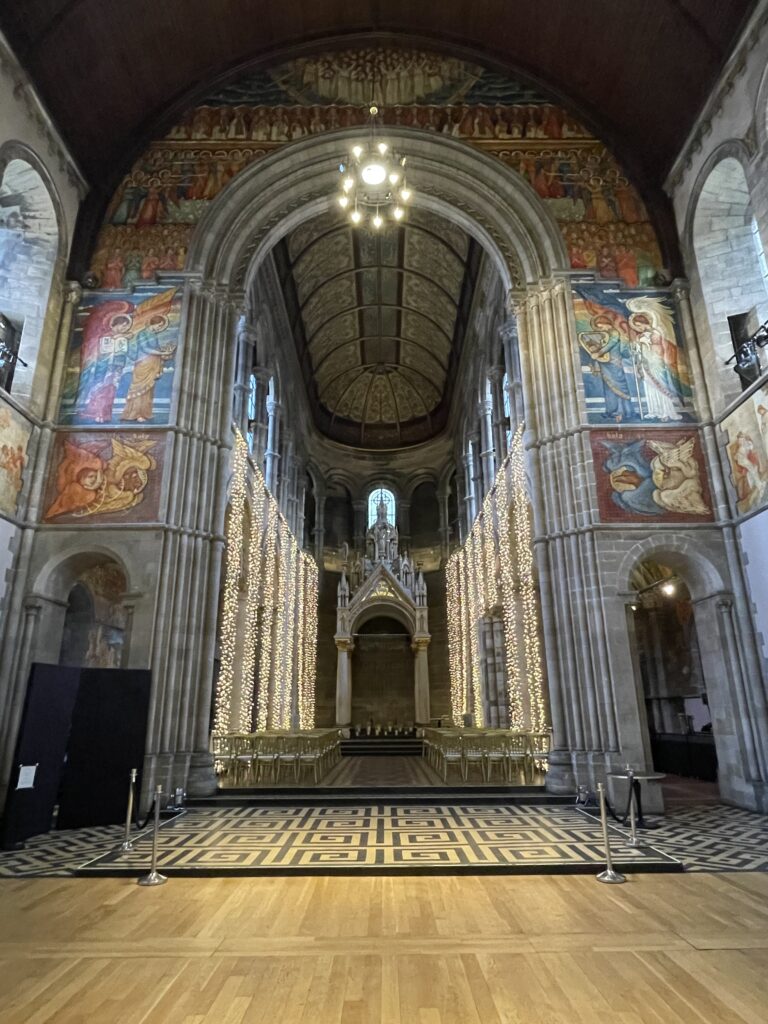
The chancel arch at the Mansfield Traquair Centre, decorated by Phoebe Anna Traquair. This was the first section of the church that Traquair painted, meant to depict worship in Heaven, and in line with the particular beliefs and structure of the Catholic Apostolic Church that commissioned her.
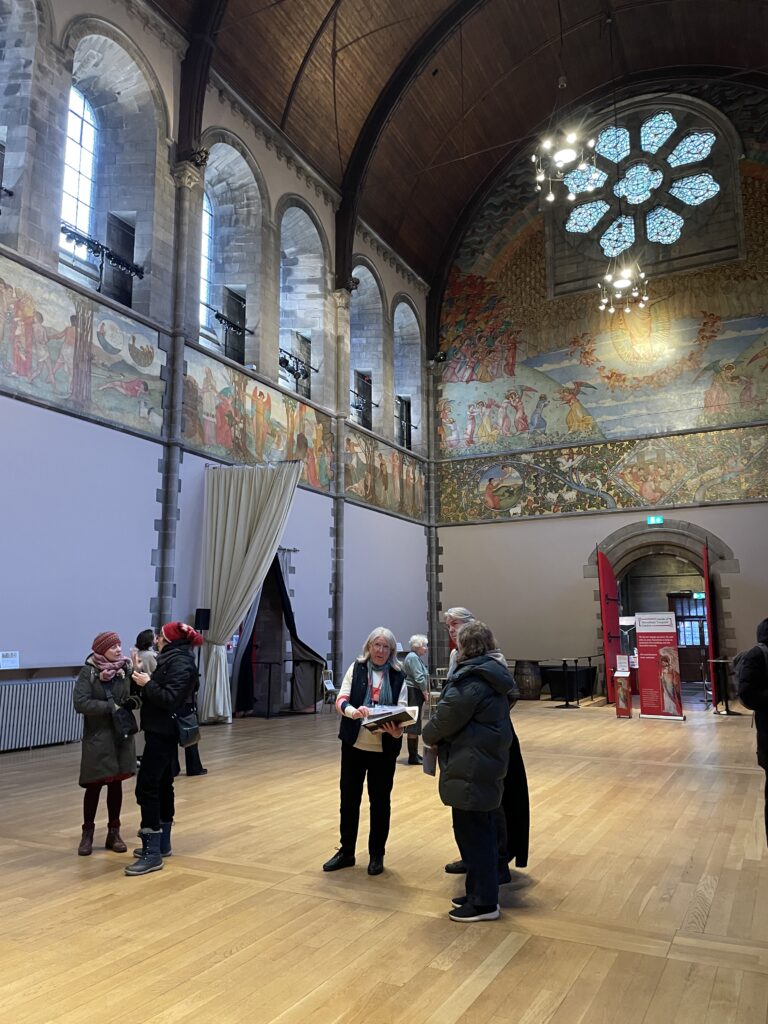
View of South and West walls at Mansfield Traquair Centre. Open only once a month, the open days for the Mansfield Traquair Centre are one of the few ways to get inside, short of booking the entire building for an event. Remarkably, the West Wall is not the usual Last Judgment found on church walls across eras, but a Second Coming, the uplifting millennial doctrine that that Catholic Apostolic Church was founded on.

The murals are in grand scale, and contain much visual synthesis and quotation from other pieces and artists Traquair knew, mentioned in her letters or painted in portrait in her other works. They also include landscapes from where she and her family went on vacation together, making them personal murals. Emily will be writing about these murals for her Qualifying Paper this semester.
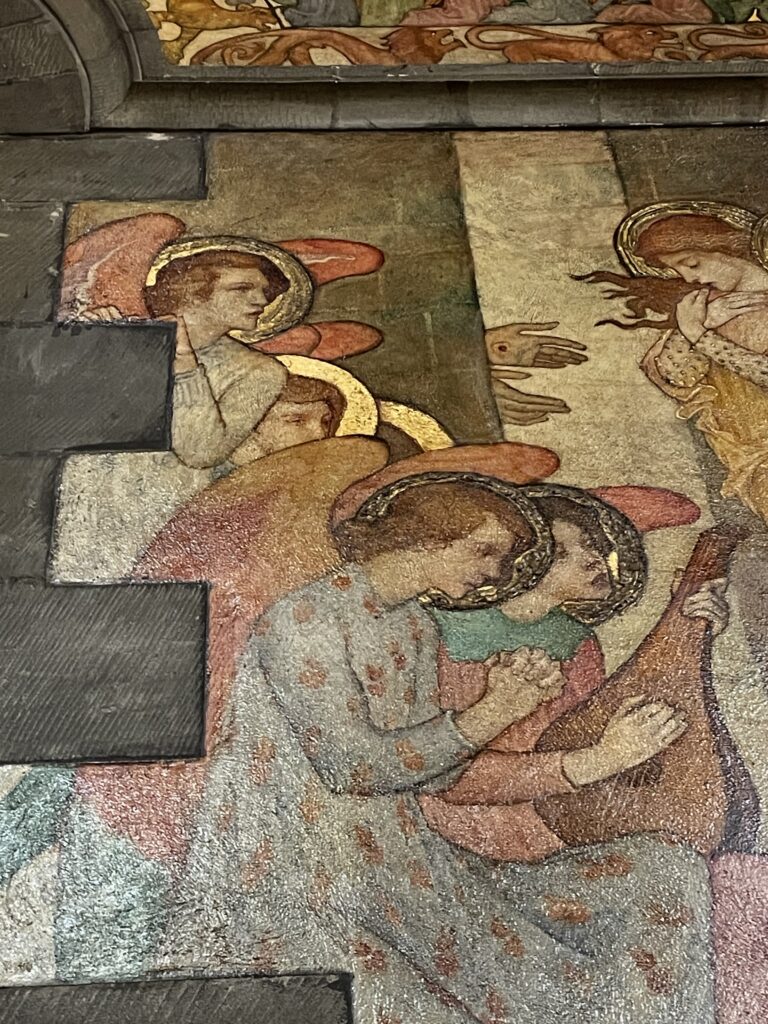
Detail of angels and hands of Christ in Parable of the Ten Virgins cycle, North Aisle of Mansfield Traquair Centre. Traquair worked in large scale and in minute illustration and marginalia, and was willing to take the playful interaction of picture to its frame that medieval marginalia did, letting an angel lean on a part of the building’s masonry.
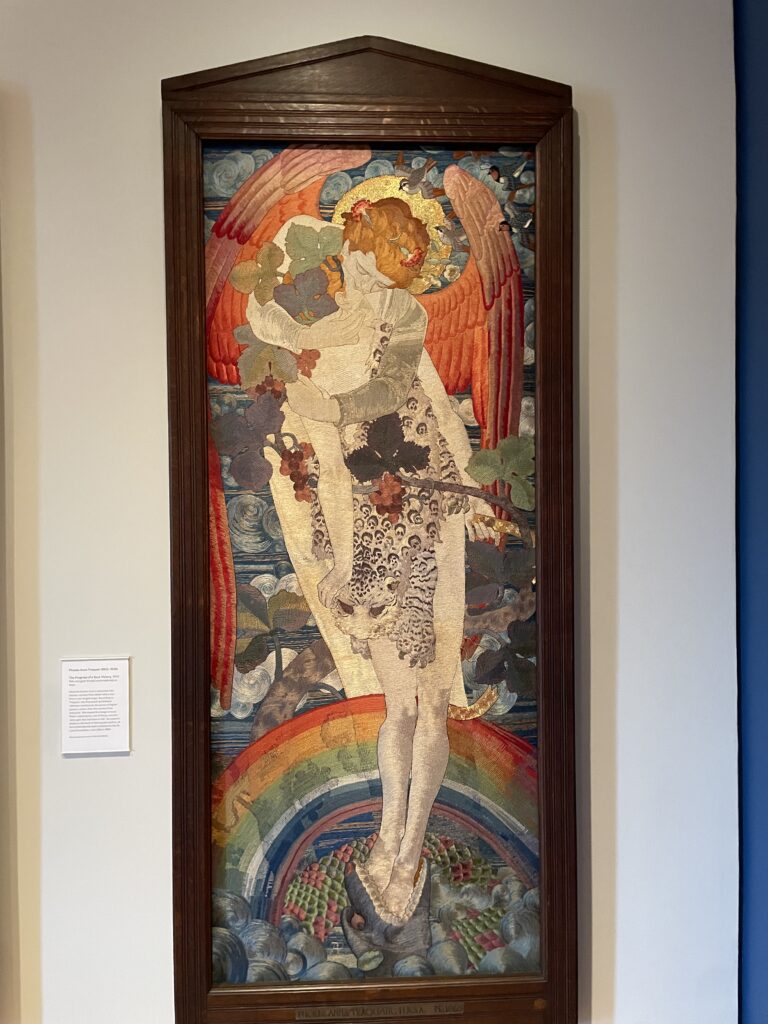
The Victory, embroidery panel by Phoebe Anna Traquair. This part of a series of four, called The Progress of a Soul, which Traquair was embroidering in the same time frame as she was making the murals in the church that is now the Mansfield Traquair Centre.

She also got to meet with Dr. Elizabeth Cumming, the first real scholar of Traquair’s work, who spearheaded the National Gallery of Scotland exhibition in 1993 that brought Traquair back to the attention of the Scottish art world.
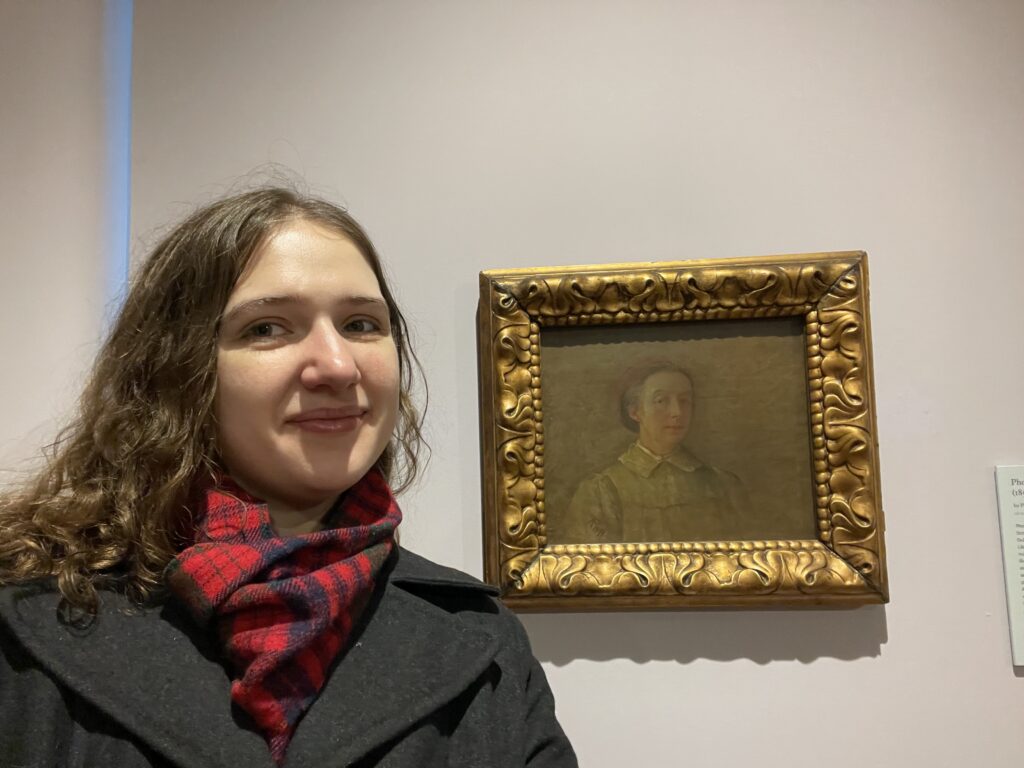
Emily Ross, with the self portrait of Phoebe Anna Traquair in the National Portrait Gallery of Scotland.

When she wasn’t doing scholarly visits, Emily was enjoying haggis with neeps and tatties.

Graduate Qualifying Paper, Graduate Student, Research Travel

Erin Bourget in Northern Ireland

This was my second trip to Belfast, Northern Ireland to see the International Wall murals, so I knew the neighborhood I wanted to go to and what I wanted to document while there.  Due to some issues with my flights, a short trip was even shorter, and I ended up having only one full day in Belfast which provided a great opportunity to get the photos I wanted.  Belfast recently opened their brand new Grand Central Train Station, so my train from Dublin arrived at the new station.  I went to Mass at St. Peter’s Catholic Cathedral in the West Belfast neighborhood, which was not only a beautiful place, but also historically important to the Catholic community in Belfast, and the famed Divis Flats were built next to the church.  I spoke with some of the local residents about the International Wall mural project, and got names of contacts to interview for my project.  I was surprised and excited to find out just how small the West Belfast neighborhood is, despite being geographically a significant part of the city, it is a community that is well connected.

St. Peter’s Catholic Cathedral, Belfast. An integral part of the West Belfast neighborhood, the Cathedral was built in the early 1860s in a Gothic style. The Divis Flats complex was built next to the Cathedral in 1966 and was a stronghold for Irish Republicans during the Troubles. St. Peter’s is located just two blocks from the majority of political murals in the West Belfast area.

After Mass, I walked just two blocks to the Falls Road where I photographed the International Wall murals.  They were in nearly pristine condition, which was surprising since the weather in Belfast would lead me to expect some chipping and erosion of the paint, however they were in the same condition as when I saw them in June.  The wall is part of the “Peace Walls” in Belfast, that separate the Catholic and Protestant communities, and is  currently painted with a series of Palestinian solidarity murals.  I chatted with neighbors and tourists near the murals, the neighbors were particularly excited to hear about my research.  One man told me about Brendan Hughes (pictured in one of the murals), who grew up in the West Belfast neighborhood, and he pointed out his house—Hughes is famous for being a member of the Provisional IRA and while in prison leading the “dirty protest.”  On the Falls Road, I stopped at the Garden of Remembrance, looking for more Palestinian solidarity messaging.  I did find some on the walls leading up to the Garden.  My last major stop along the Falls Road was the famed Bobby Sands mural on the side of the Sinn Fein offices building, which is also in near perfect condition and is a common stop on the “Black Taxi Tour” route, which provides tourists with a guided and curated look at famous sites from the Troubles.

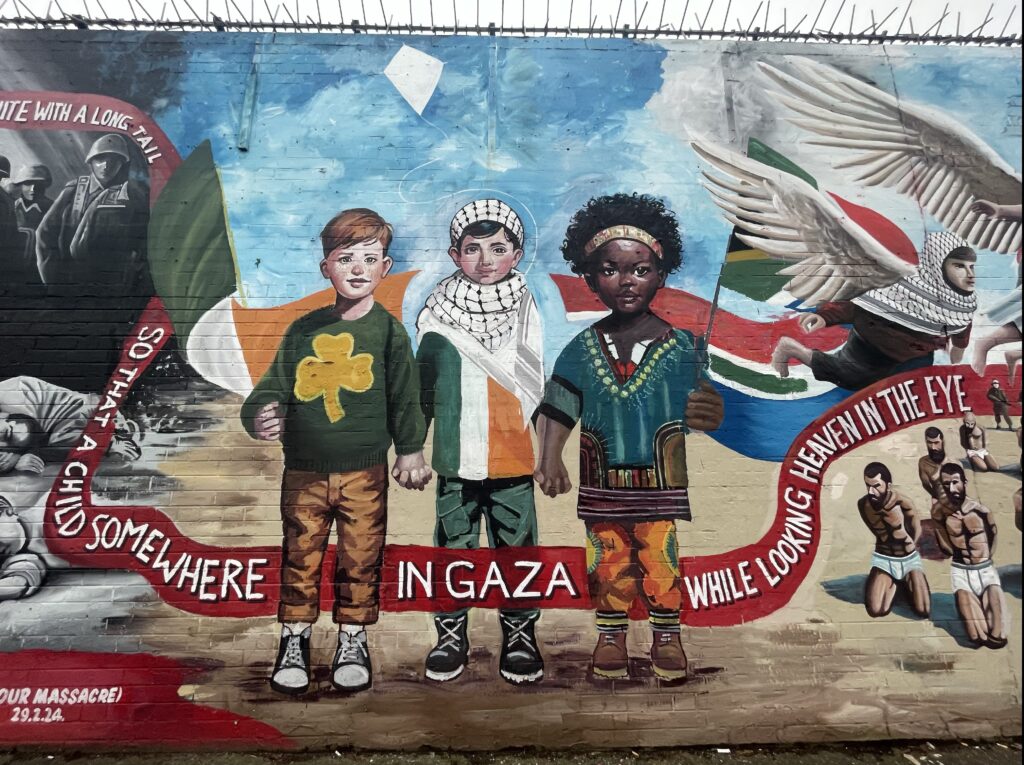
International Wall, Divis Street, Belfast. These children are the centerpiece of the International Wall mural series in West Belfast, organized by the “Painting for Palestine” community group in early 2024. They represent the children of Ireland, Palestine, and South Africa.

International Wall, Divis Street, Belfast. Painted from a digital graphic designed by Palestinian artist Said Hassan, this mural features Khaled Nabhan holding his granddaughter, Reem, age 3, who was killed in an Israeli airstrike in Nov 2023. Khaled was killed just over a year later.

International Wall, Divis Street, Belfast. This mural, a recreation of Palestinian artist Heba Zagout’s original work, shows the city of Bethlehem with fireworks.

I was successful in documenting the Palestinian solidarity murals, and I appreciated seeing them at a different time of the year, since I previously saw them at the beginning of the tourist season.  I also explored more of the neighborhood and talked with local residents at the church and around the murals.  The people of West Belfast are incredibly friendly, they love to tell tourists about their city, and they are happy to share their stories with those who have a genuine desire to learn more about their community.  I am truly blessed and thankful for the opportunity to travel to Belfast to see the murals, to meet the people, and to see the context for these pieces of art.  This is certainly an experience I will never forget!


Graduate Qualifying Paper, Graduate Student, Research, Research Travel

Michaela Piene in Florence and Rome

In September of 2024, graduate student Michaela Piene of the Art History and Museum studies program at the University of St. Thomas received a departmental travel grant to complete her research in Italy in support of her qualifying paper. Michaela’s research focuses on quattrocento devotional art, specifically the usage of visual languages and sensory qualities within the work of Fra Angelico. 

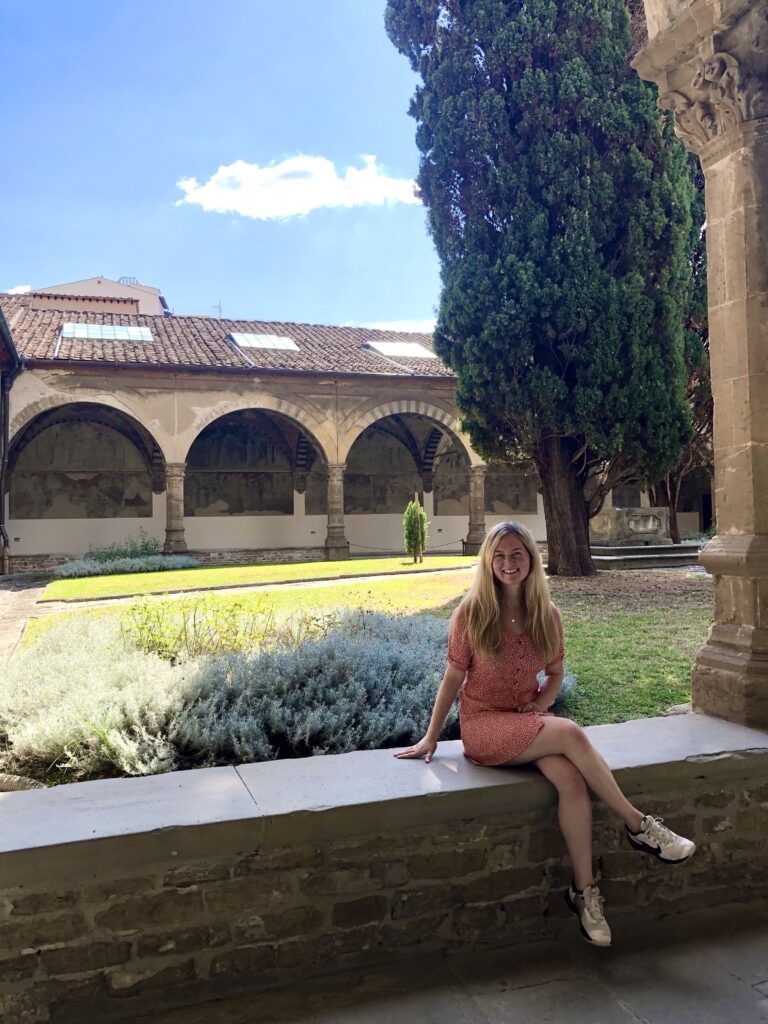
Michaela Peine in Cloister of Santa Maria Novella, Florence

The in-person experience of Renaissance art was key to her research, allowing her to study the material and formal qualities that activate these works of art up close and in a more personal way. She divided her time primarily between Florence and Rome, researching Fra Angelico’s work and hunting for contemporary examples of similar activation in art. A key element of her trip was a visit to the Niccoline Chapel, located within the Vatican Palace. The chapel, entirely frescoed by Fra Angelico, is typically closed to guests, however, Michaela was able to connect with Dr. Fabrizio Biferali, the curator of Renaissance art in the Vatican Museum. Dr. Biferali brought Michaela on a tour of the Niccoline Chapel and provided her with conservation reports, allowing her to study in-depth the architectural and material context of Fra Angelico’s work. The work Michaela did in Italy is key to the research for her qualifying paper, which is advised by Dr. Lois Eliason, and will be presented in December of 2024. 

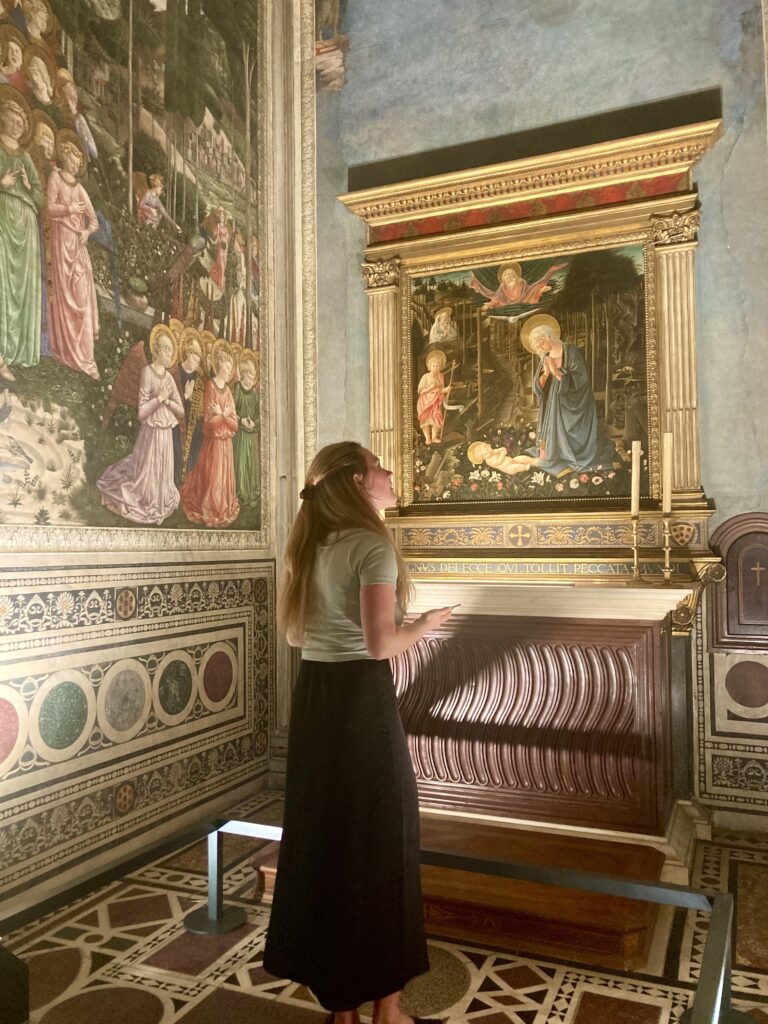
Michaela in Chapel of the Magi, Palazzo Medici Riccardi, Florence.

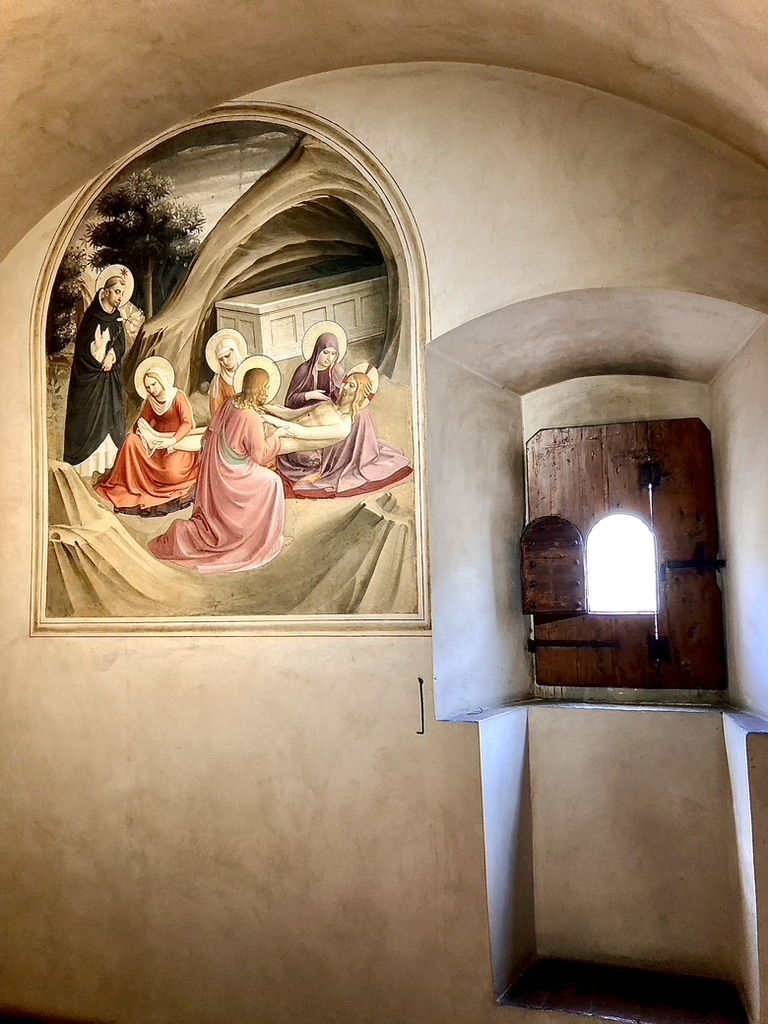
Fra Angelico painting in cloister of San Marco, Florence.

Graduate Qualifying Paper, Graduate Student, Research, Research Travel

Elsa Ballata in England

In September 2024, Art History graduate student Elsa Ballata traveled to England with her mother, who proclaimed herself Elsa’s research assistant, to research fan vaulting for her qualifying paper. Over the course of a week, Elsa visited six different sites around the country where she toured buildings and spoke with guides about the history of each location. She spent two days in the Oxford area visiting the staircase at Christ Church College in Oxford and taking a day trip to Gloucester to see the Cathedral and the famous cloisters. After finishing up her time in Oxford, Elsa took a train to London where she visited Westminster Abbey, the British Museum, and a number of other tourist attractions in the city. From London, she took days trips to Cambridge, Salisbury (and Stonehenge), and Canterbury. 

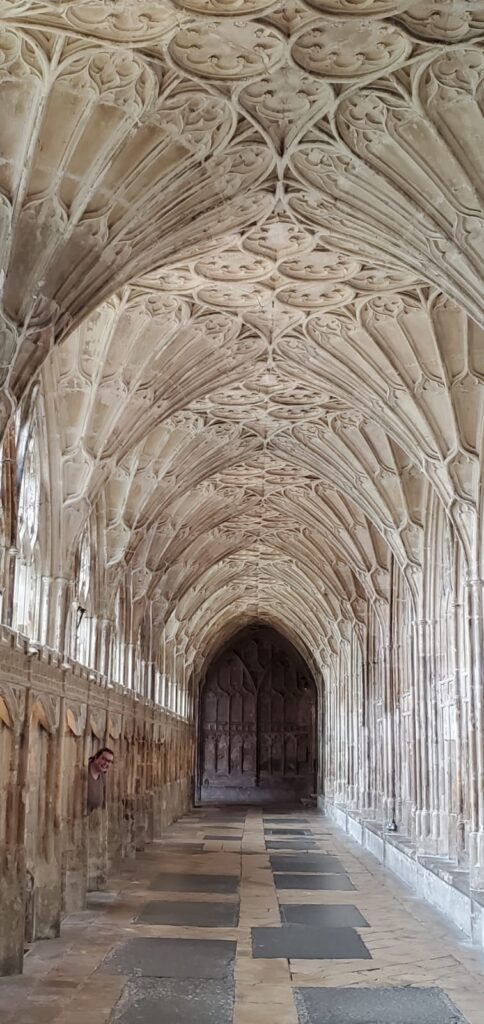
Photo of Elsa peeking out of a cloister stall at Gloucester Cathedral, her favorite fan vaults from the trip, built in the 14th century.

She spent time at each site she visited speaking with the staff about the vaults and history of the buildings, finding the staff to be as excited as her to be studying there. A couple of particularly memorable conversations she had were in Westminster Abbey, where she spoke to a priest before any other members of the public were allowed in the chapel, and with an amazing guide in Canterbury, who spent the week before her arrival researching fan vaults himself so she could ask more questions. It was an amazing experience for Elsa, allowing her to be in the spaces she was studying in person and take notes about details that photos online rarely manage to capture.  

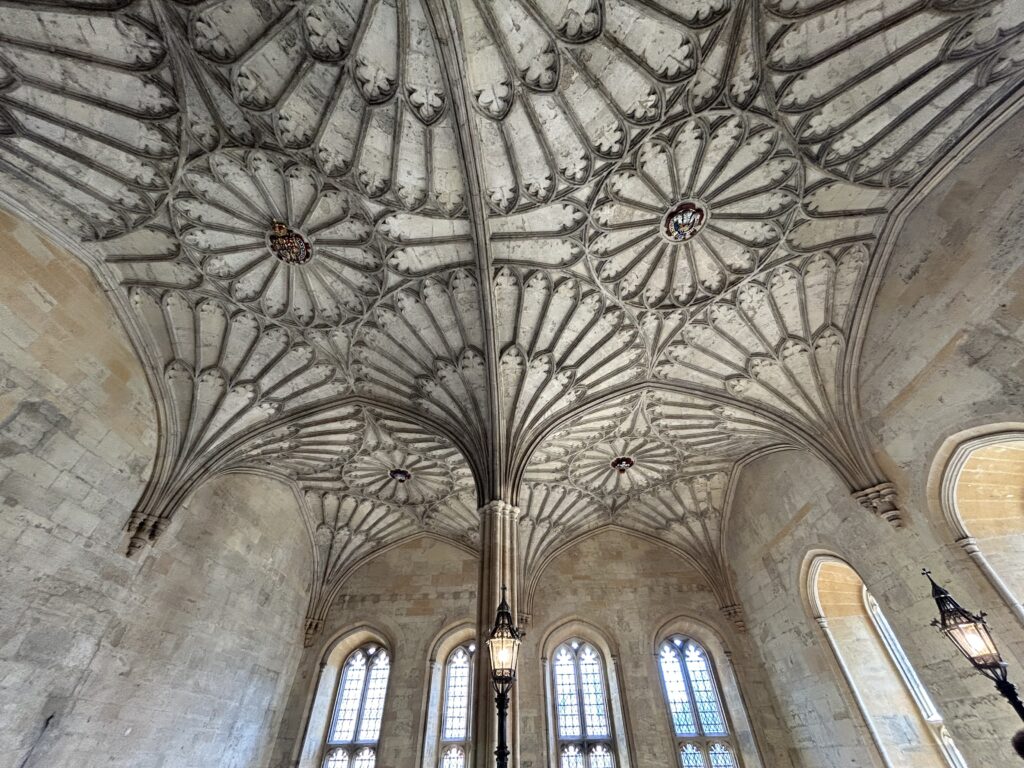
Great Hall Staircase vaults, Christ Church College, Oxford, 17th century.

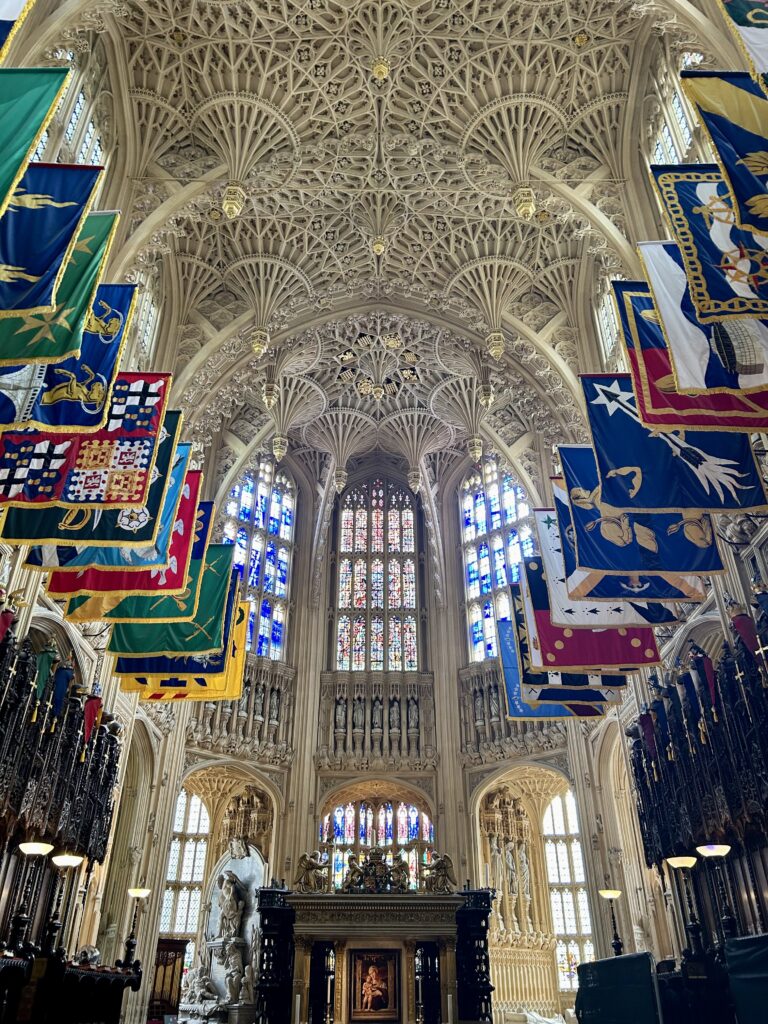
High vaults of Henry VII’s Lady Chapel, Westminster Abbey, London, early 16th century.

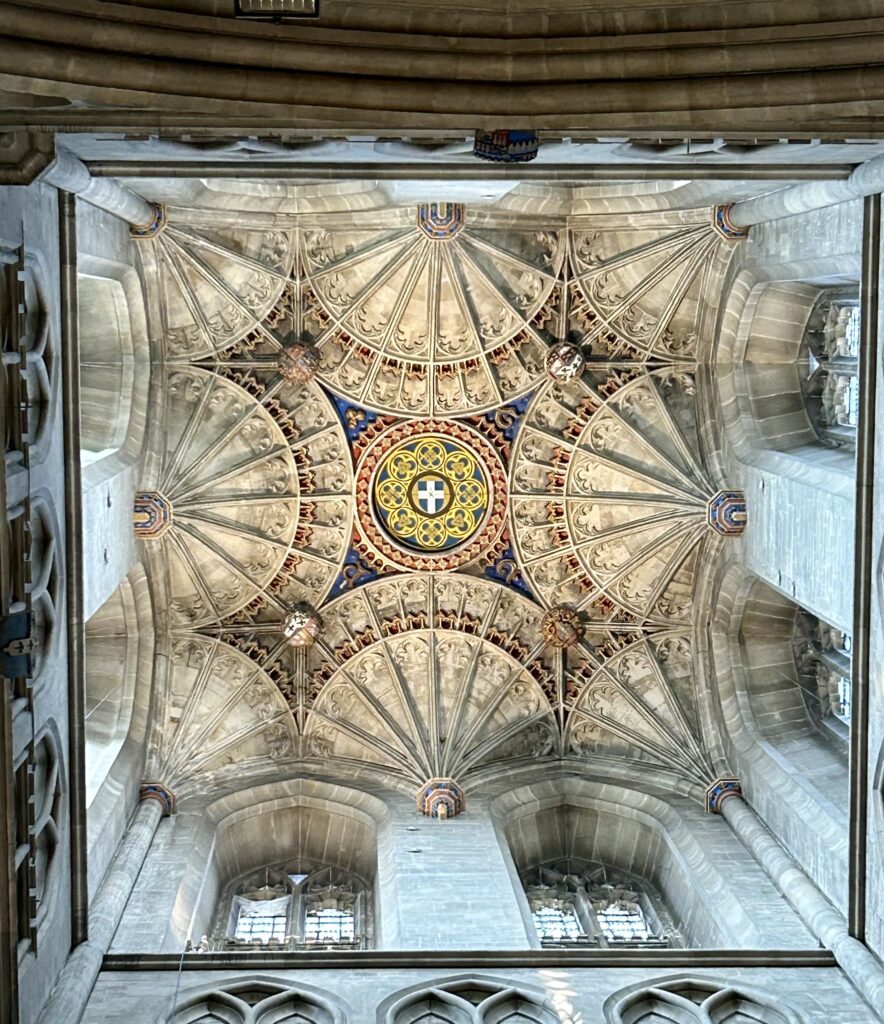
Bell Harry Tower vaults, Canterbury Cathedral, late 15th/early 16th century.