August – 2024 – In Context
Monthly Archives

August 2024

Graduate Qualifying Paper, Research, Research Travel

Nicole Petersen in Siena

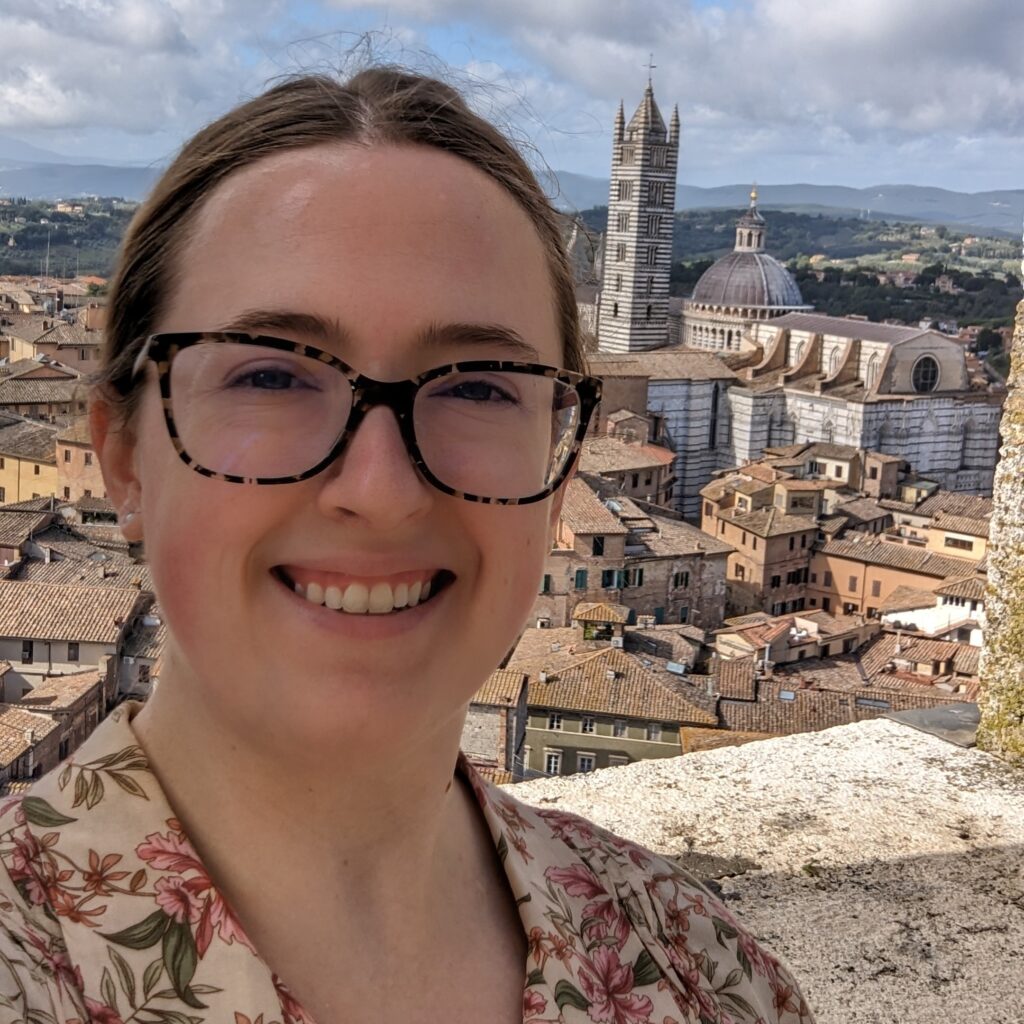
In September 2023 Art History graduate student Nicole Petersen (@nicole.etal_ travelled to Florence and Siena via a travel grant awarded by the department. They visited Italy to work on their Qualifying Paper project, which focuses on the hexagonal bowl in Pietro Lorenzetti’s “Birth of the Virgin” altarpiece (1335-1342) and how women experienced the work in its original placement in Siena Cathedral.


Detail of Pietro Lorenzetti’s Birth of the Virgin altarpiece in Siena

The first photo shows a selfie of them from the top of the Torre del Mangia with Siena Cathedral in the background. The second photo shows one of the many detail photos of “The Birth of the Virgin” they captured to utilize in their paper.

Nicole Peteresen on Torre del Mangia, looking toward Siena Cathedral

Conference Presentations, Graduate Student, Presentations

2024 Travel Highlights: Emily Ross in Chicago

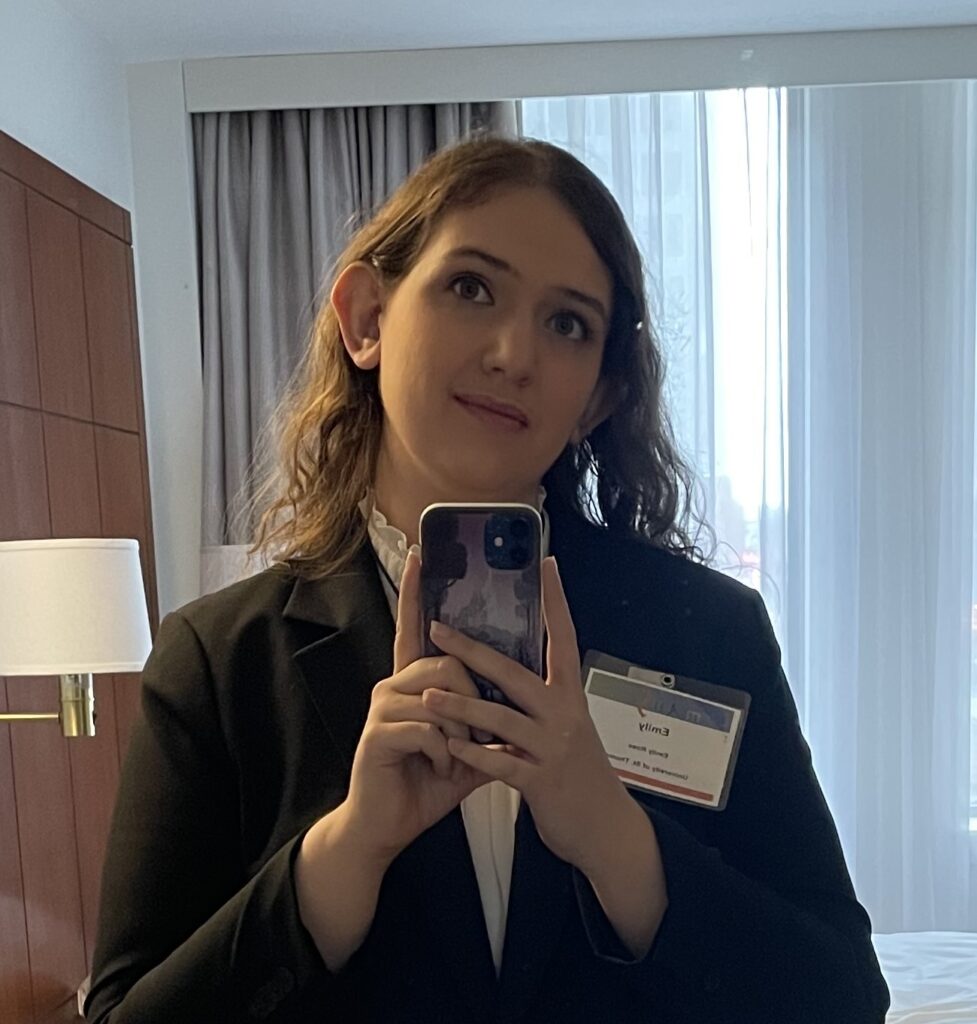
Emily Ross (she/her) is a graduate student in the Art History department. She works at the Minneapolis Institute of Art, and her focus of studies is on the reinterpretation of medieval art in later revival eras. 

In April of 2024, she presented her paper, “Adorning Mary: The Brooch in Latter Quattrocento Florence,” to the Midwest Art History Society (MAHS) annual conference in Chicago. The paper focused on the presence of brooches in Madonna and Child paintings in Florence, and their relative boom in the 1460s and 1470s, corresponding to the height of productivity for goldsmith-painters and sumptuary law prescribing and limiting the wearing of brooches for women at the time. Other papers in the panel discussed violence and sensuality in Florentine mannerist sculpture and the continuous motif of Mary revealing Christ from under a blanket in Paduan art. 

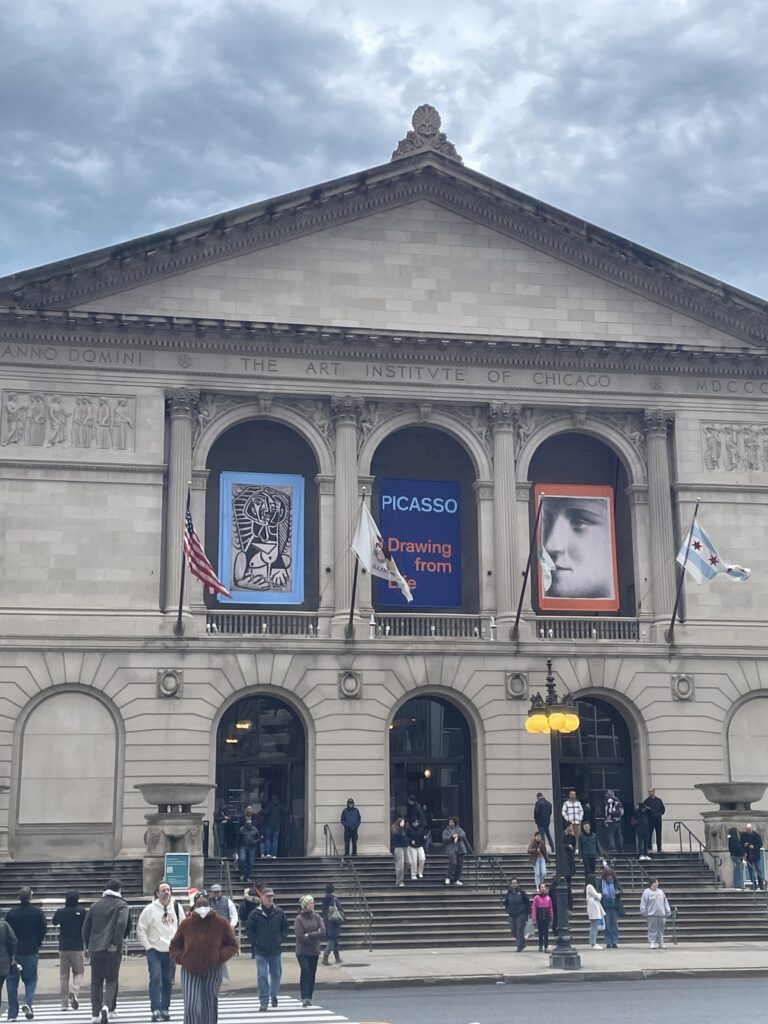
The conference was held at the Art Institute of Chicago, and at the various buildings that the School of the Art Institute owns, with keynote addresses surrounding the opening of the exhibition “Picasso: Drawing from Life.” There were also tours of the prints and drawings study room and of the Smart Museum’s Modern Meiji exhibition.

Emily’s talk was very well received, garnering compliments from those who had not even been in attendance but heard it was a highlight from those who did attend. 

Graduate Qualifying Paper, Research, Research Travel

2024 Research Travel: Madeleine DeGrace in London, Kew, and Beaulieu House, Southhampton

In January of 2024, Madeleine DeGrace had the opportunity to complete research for her Qualifying Paper at Beaulieu Palace House near Southampton, the British National Archives in Kew, and the Imperial War Museum in London.

How far along are you in the program?

  • 2 years, this is my 4th semester! I am planning on graduating in December 🙂

What is your area of interest?

  • English country house architecture and their uses in WWII as espionage training schools

Do you work? On campus/off?

  • I have an internship at Minnestoa History Center in their Interpretive Programming division, and I am one of the gallery guards in the American Museum of Asmat Art at St.Thomas

Where were you traveling?

  • I went to England for one week, specifically to Southampton and London to visit Beaulieu Palace House, the Imperial War Museum and the National Archives to see first-hand the sites and artifacts connected to my Qualifying Paper with Professor Victoria Young.

Image of Beaulieu Palace House from January 5th, 2024

Why did you have to go there?

  • It was primarily to view Beaulieu House in person and gather as much information as I possibly could that wouldn’t be available in the US. For architectural research (as with all research) it’s important to see and be in the space you are interpreting, otherwise you don’t really feel a connection to the space. The British National Archives are pretty locked down in terms of online access, so a lot of the primary source documents I needed had to be accessed in person.

What institution/person did you work with at the location?

  • I scheduled a visit with Beaulieu palace house staff to have them give me a private tour walking through the house, and that was quite valuable, but at the IWM and the National Archives, that was primarily led by me. I was able to reserve a ton of documents to view at the national archives and they had them ready for me to look through.

SOE field radio at the IWM’s exhibit on secret operations and spies

What was the content of your research?

  • I was looking at the house and its history, most importantly, looking at how it was used as a training school for the SOE in WWII. Most of the documents I was pulling at the National Archives and the research I was doing at the Beaulieu House focused on the SOE training schools at these sites and how a grand old country house could be used as a training school.

How were your days structured?

  • Most days were a quick breakfast, museum/site visit trip for the whole day, hunker down for dinner and relax. It was pretty lowkey and chill because it was pretty cold and got dark really early, and both my dad and I ran out of steam after a long day of museums (museum fatigue is really real!)

What was your favorite part of the findings/research results?

  • This research is a continuation of my undergraduate senior thesis, in which I studied female agents of the SOE, so for me to get to walk on the same grounds as these women whom I looked up to is really important to me. I found that research so important since many of these women were looked down upon in the immediate post war, so for me to see them in exhibit galleries on walls or to see objects that were connected to them directly was my favorite part of the research. Also, at the National Archives, I pulled out the personnel files of all of the women I studied and to see their handwriting and look through their documents was also so special to me and important.
Madeleine pouring over SOE documents at the national archives

Madeleine pouring over SOE documents at the national archives

Anything else notable about the trip/the work you did?

  • My dad and I drove on the wrong side of the road down country lanes in the New Forest and it was very stressful! But it was very fun! My mom is also a flight attendant for United so we flew standby there and back and we were able to fly business class both ways, which slays.
  • I got to hear Big Ben and St Paul’s Cathedral’s chimes, which was very cool!
Graduate Qualifying Paper, Graduate Student, Research Travel, Uncategorized

Renaissance Florence: Ghirlandaio’s quattrocento goldsmith promotional frescoes

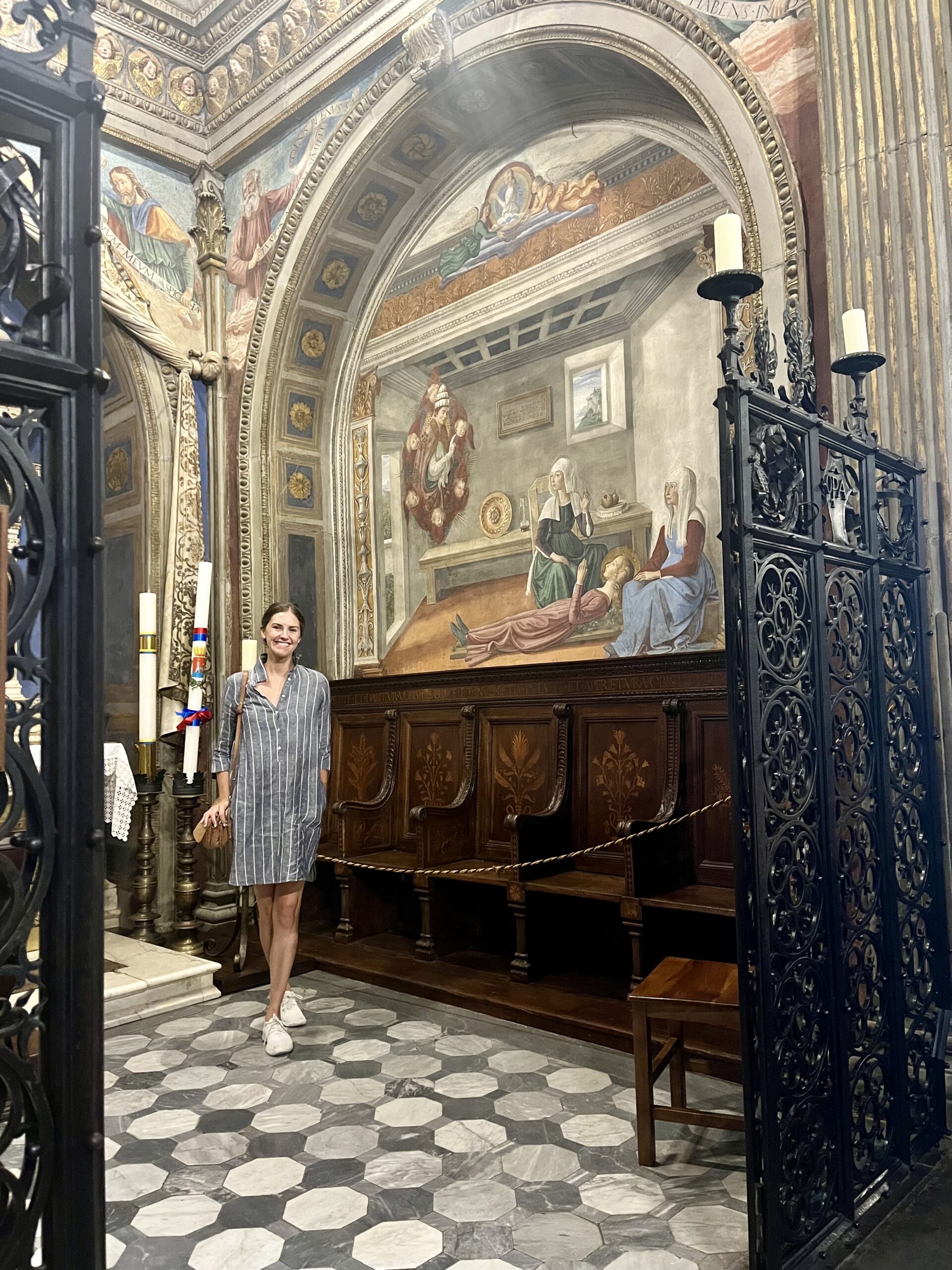
In a seminar on early Renaissance Florentine art with Dr. Lois Eliason, Ingrid became interested in the frescoes of Domenico Ghirandaio (1448-94), one of the most celebrated artists of the late 15th century in Florence. Her research on his Birth of the Virgin (1485-90) fresco in the Tornabuoni Chapel at Santa Maria Novella became the foundation for her Qualifying Paper topic, and draws on a variety of methodologies – including stylistic, feminist, materialistic, and theories about sensory experience in art – to better understand the artist’s work and contributions.

Ingrid at the Tornabuoni Chapel of Santa Maria Novella, Florence

Ingrid had two hypotheses that were crucial to investigate in-person: Firstly, how did Ghirlandaio intentionally introduce sound into his frescoes, creating a multi-sensory experience? Secondly, how did Ghirlandaio’s involvement in his family’s goldsmith business influence his art in comparison with his contemporaries?

Through a travel grant awarded by the Art History department, Ingrid was able to explore these questions onsite in Florence, providing her with an a wealth of contextual information that simply would not have been possible through digital or library research alone. Some particularly valuable scholarly experiences including attending a mass a Santa Maria Novella to experience the acoustics Ghirlandaio would have been working with, and the discovery of a golden plate at the Bargello Museum that was nearly identical to one depicted in Ghirlandaio’s Santa Fina fresco (1477-78). These will be important contributions to her qualifying paper.