The Murphy Institute program, “Protests and a Christian Response to Government Abuses,” was featured in a March 6 The Catholic Spirit article.
To read the full article, please visit The Catholic Spirit website.
The Murphy Institute program, “Protests and a Christian Response to Government Abuses,” was featured in a March 6 The Catholic Spirit article.
To read the full article, please visit The Catholic Spirit website.
by Jared Zimmerman
Over the 2025 Fall Break, I had the wonderful opportunity to visit Rome while on my honeymoon. Other than the amazing food and enriching experiences with Italian culture, I was struck by the sheer number of churches throughout the city. Specifically, the number of churches constructed on sites once associated with Christian persecution and martyrdom. What had once been the scene of countless Christian martyrdoms, had now been transformed into a site of hope and thanksgiving. These sacred spaces stand as physical reminders that systems of violence and oppression are not immutable, but capable of redemption and renewal. Likewise, the American legal system, once a system used to justify horrors such as slavery and religious discrimination, can be transformed into a system that truly recognizes that everyone is created equal. Law, like history, reflects the values of those who interpret and apply it. Just as the early Christians transformed the Roman system of persecution and oppression, so too must we as law students and lawyers continue to guard and prevent the legal system from being used to further oppression and discrimination.
While there is a plethora of examples from ancient Rome, one of the most visible and well-known is the Colosseum. What had once been the grounds for innumerable Christian martyrs, executed for their faith to the cheers of a pagan society, was transformed into the Church of Santa Maria della Pietà al Colosseo in approximately the sixth or seventh century. Notably, on Good Friday the Pope leads the stations of the cross in and around the Colosseum, reclaiming a former site of violence as one of reflection and worship. This ritual serves as a powerful reminder that even the most brutal instruments of injustice can be reoriented toward truth, memory, and moral accountability.
Just as the early Christians transformed the Colosseum into a church, so too did Frederick Douglass shift the narrative that the Constitution was pro-slavery, into a fundamentally anti-slavery and pro-freedom document. Douglass went further and argued that when properly understood, the Constitution required equality under the law. Douglass’s influential interpretation demonstrates that legal texts are not static, but depend upon the moral courage of those willing to challenge unjust readings of the law.
As the heirs of the early Christians and abolitionists, us law students and lawyers now have a duty to help transform the law and safeguard it from being corrupted into a tool of persecution and oppression. This does not require any of us to do the extraordinary, but only the ordinary, such as using our discretion for the betterment of the common good. Likewise, whenever we see an unjust law or even a just law which is being misused to harm another, we have a duty to speak out and to work toward justice through the legal system. This duty may take many forms, including advocating for reform through litigation or legislation, providing zealous and ethical representation to marginalized clients, and refusing to remain silent in the face of injustice. In doing so, we honor both the victims of past injustices and the promise of a legal system rooted in dignity, equality, and the rule of law.
Jared Zimmerman is a Murphy Scholar and 3L at the University of St. Thomas School of Law in the JD/CSMA program.
“Student Perspective” is a recurring blog series which highlights the various activities of the Murphy Scholar graduate students during their fellowship.
by Georgina Sugrue
This summer, I worked as a research assistant for Dean Greg Sisk, co-director of the Murphy Institute, analyzing data for his ongoing empirical study on religious liberty issues in the courts. The study began in 1998 with a null hypothesis which states that partisan appointment has no effect on free exercise claims. So far, the null hypothesis has prevailed, but the study continues as research is divided into ten-year increments. At this time, Sisk’s work is particularly interested in whether judges displayed more bias during years with high COVID-19 case counts. Our summer project specifically focused on how district court judges handled constitutional claims from individuals with diverse religious backgrounds in 2020.
The research process required coding for the different factors raised in the case, along with specific facts. I began by noting the court, date of decision, the judge’s name, and the overall outcome of the case (whether the religious claimant won on any claims). My focus was specifically on 2020, so I made sure to note if COVID-19 and the resulting restrictions played a role in the claim. I then noted whether the person who believed their religious rights were infringed upon was in court as a plaintiff or as a defendant. Next, I identified the claimant’s religion, which often required additional research beyond the opinion to determine the specific denomination of the individual or organization. I reviewed cases from a variety of traditions, including Catholic, American Baptist, Lutheran, Unitarian, Jewish, Native American, Rastafarian, and others.
A more detailed analysis was necessary to identify the type of religious claim involved and whether the individual prevailed or lost on it. These issues included the Free Exercise Clause, the Religious Freedom and Restoration Act, the Free Speech Clause, the Equal Access Act, the Equal Protection Clause, and/or the Establishment Clause. Next, I would categorize the type of situation the specific case falls under and the claimant’s religion. I reviewed claims regarding health or safety regulations of private activities, public elementary education, religious solicitation, prisoner claims, employment discrimination against a government employer, and exemptions from anti-discrimination rules.
As my list of cases spanned across 2020, it was important to note whether each case came before or after the SCOTUS decision in Roman Catholic Diocese of Brooklyn, New York v. Cuomo on November 22, 2020. In short, the Supreme Court reviewed cases in which the government in New York limited attendance at religious services by a church and a synagogue due to COVID-19 concerns, while businesses in the area deemed essential were permitted to have unlimited numbers of people in their buildings. The Court determined that the strict restrictions imposed by the governor of New York were too severe and ordered them to be revoked as they were not generally applicable to citizens, the loss of First Amendment freedoms was likely to cause irreparable harm, and there was minimal public interest in the restrictions. This decision was vital to the lower courts in resolving the large number of cases brought by religious organizations challenging COVID-19 gathering restrictions.
The next step in this process is for Dean Sisk to review the data and determine whether the null hypothesis has been rejected. If there is a significant conclusion, more writing about the research might follow. Previously, Dean Sisk and Professor Michael Heise have written Muslims and Religious Liberty in the Era of 9/11: Empirical Evidence from the Federal Courts, 98 Iowa L. Rev. 231 (2012), as well as Approaching Equilibrium In Free Exercise Of Religion Cases? Empirical Evidence From The Federal Courts, 64 Ariz. L. Rev. 989 (2022).
The experience as a research assistant was an excellent opportunity to refine my analytical skills and learn more about the treatment of religious liberty by the courts. I am eager to see the outcomes of our summer research and review future findings.
Georgina Sugrue is a Murphy Scholar and 2L at the University of St. Thomas School of Law.
“Student Perspective” is a recurring blog series which highlights the various activities of the Murphy Scholar graduate students during their fellowship.
Murphy Institute co-director Msgr. Martin Schlag delivered the Fall 2025 Archbishop Ireland Lecture hosted by the Saint Paul Seminary. In his lecture, titled “From Leo XIII to Leo XIV: Catholic Social Thought in an Era of Anti-Humanism,” Msgr. Schlag offered a fresh perspective on Pope Pius XI’s vision of society’s essential institutions, building on Pope Leo XIII’s legacy and proposing a fourth pillar: the world of work and economic exchange. Drawing especially from Rerum Novarum, the landmark Church document on labor and social justice recently highlighted by the election and name choice of Pope Leo XIV, Msgr. Schlag set the scene historically, showing how Catholic social teaching evolved from earlier legal and political debates to universal principles that continue to guide the Church today.
Msgr. Schlag was also featured in a recent episode of “Practicing Catholic,” a podcast produced by Relevant Radio and the Archdiocese of St. Paul and Minneapolis, to discuss his inspiration for the lecture. A recording of the episode and summary of the interview may be found on The Catholic Spirit website.
The Murphy Institute was featured in the September 13 article, “At Catholic law schools, the pursuit of truth and justice is elevated by faith” published by Our Sunday Visitor.
To read the full article, please visit the Our Sunday Visitor website.
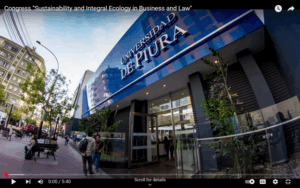
The conference “Sustainability and Integral Ecology in Business and Law: Ten Years after Laudato si'” took place on July 1-2 in Lima, Peru. Organized by the Murphy Institute and University of Piura, this event hosted over 80 academics and practitioners from 11 countries to discuss the theological foundations, ethical implications, and practical applications of Pope Francis’ 2015 encyclical.
As a result of the 2024 Murphy Institute co-sponsored symposium “Universal and Quality Health Care: Public or Private?,” the University of St. Thomas Journal of Law & Public Policy Volume 18, Issue 1: Health Care is now available.
Please visit the Journal of Law & Public Policy website for further publication details.
by Jared Zimmerman
Over the past academic year, I have had the pleasure of working as a Research Assistant with the Joint Religious Legislative Coalition (JRLC) in my role as a Murphy Scholar with the Terrance J. Murphy Institute for Catholic Thought, Law, and Business (Murphy Institute). The JRLC is an interfaith public policy advocacy group which represents the shared public policy goals of Roman Catholics, Protestants, Jews, and Muslims. One of its central aims is to repeal or modify laws that penalize individuals for marrying—laws that, intentionally or not, discourage people from entering into this lifelong commitment. The JRLC chose this because the right to marry is not only a fundamental right recognized by the Supreme Court of the United States, but also because of the positive outcomes from entering into legally recognized marriages, such as certain tax benefits and increases in happiness.
A significant hurdle to people marrying was identified by the JRLC, during the 2023-2024 Minnesota Legislative Session. Specifically, the JRLC addressed and changed legislation that took food assistance away from people who married. Continuing this work, the JRLC asked its Murphy Scholar research assistants to identify other unjust laws that similarly targeted those who married or wished to marry.
After researching various Minnesota statutes and agency policies, I found a provision within the Minnesota GI Bill. Under current law, if the surviving spouse of a deceased military member remarries, they lose the government-assisted tuition benefits earned by their deceased spouse. In other words, choosing to remarry means forfeiting educational benefits tied to a loved one’s service and sacrifice. I proposed amending the current law, which is now incorporated into Minnesota Senate File (SF) 1959 and Minnesota House File (HF) 2444. My proposed change, which is going for a vote during the 2025-2026 MN Legislative session, allows surviving spouses to remarry without losing their access to tuition assistance.
This issue wasn’t chosen at random. It addressed a clear injustice, and it held political viability—a key factor in any advocacy effort. This topic was chosen because it: (1) addressed a discriminatory action against individuals wishing to become married and (2) it is difficult for legislators to justify being elected if they vote against the spouses of deceased service members who are simply seeking an education. But beyond political calculations, this experience reminded me that real change requires more than good policy—it requires humility, understanding, and a willingness to meet people where they are.
Policy change is often slow and incremental. Yet in this work, I found myself guided by the wisdom of Scripture—especially St. Paul’s words in 1 Corinthians 9:19–22, where he calls us to “become all things to all people” and meet others where they are. For example, amending the Minnesota GI Bill meets people where they are by recognizing and responding with charity and fairness to the challenges faced by surviving spouses of deceased service members. This does not mean to stop zealously advocating for what is true and moral, but being realistic with what it is you are attempting to accomplish. What public policy you advocate for and how you do it looks different depending where you are. For example, how you advocate in Minnesota may look different compared to advocating in Alabama or California.
We want things to take place immediately, and this is a worthy desire, however, as St. Paul writes, we need to meet people where they are. This means listening to people’s concerns, attempting to dissuade and persuade them to why it is you are advocating for a righteous piece of public policy and they should too. When that fails, and it inevitably will at some point, is when we have to compromise and show radical love. Only God knows why things happen the way they do, and while it can be absolutely frustrating, any step forward is a step towards righteous change.
Never stop fighting to uphold the dignity of others—but do not forget the timeless wisdom of St. Paul: meeting people where they are. Meeting people where they are and becoming “all things to all people” has been the greatest privilege of my time with the JRLC.
Jared Zimmerman is a Murphy Scholar and 2L at the University of St. Thomas School of Law in the JD/CSMA program.
“Student Perspective” is a recurring blog series which highlights the various activities of the Murphy Scholar graduate students during their fellowship.
by Caleb Callanan
As my time as a student at the University of Saint Thomas School of Law draws to a close, I have found myself reflecting on the entire experience. One of the most impactful aspects of my time in law school has been spending these last three years as a Murphy Scholar with the Terrence J. Murphy Institute for Catholic Thought, Law, and Business. Through this work with the Murphy Institute, I have been blessed with the opportunity to assist with many wonderful events. One of my favorite event series hosted by the Murphy Institute is our “Hot Topics: Cool Talk” series. I was very excited that our most recent “Hot Topics: Cool Talk” program covered an issue that is near and dear to my heart and has been an area of study for me during my time at the University of Saint Thomas School of Law: Religious Accommodations.
To discuss this important topic through a passionate yet civil conversation, the Murphy Institute brought in two leading legal scholars with differing views on the benefits and constitutionality of religious exemptions. Through this conversation, Rick Garnett (Notre Dame Law School) and Nelson Tebbe (Cornell Law School) shared their knowledge on this topic by discussing a number of cases related to religious liberty and exemptions in front of the United States Supreme Court this term, including Oklahoma Statewide Charter School Board v. Drummond, and Mahmoud v. Taylor.
Professor Garnett began by explaining that these sorts of disputes are inevitable, stating that as long as “we have a government that does things, and we have citizens with differing viewpoints, we will have conflict”. Despite the unavoidable nature of conflict, these two professors demonstrated that even when discussing the most contentious of issues, civility is not only possible but allows for the highest level of discussion. While they fundamentally agreed about the importance of religious liberty as an ideal, the substance of their discussion hinged upon their disagreement over the need for and constitutionality of religious exemptions when government funding was involved. Professors Garnett and Tebbe began by sharing their views on Oklahoma Statewide Charter School Board v. Drummond, a recent Supreme Court case considering if a charter school ran by the Catholic Church can receive funding from the state. The professors discussed how this case has significant implications for the “separation of church and state” within the Establishment Clause of the First Amendment. Professor Garnett observed that merely operating a charter school doesn’t make the Church a part of the government, as “Lockheed doesn’t become part of the government by building a jet for the government”. Professor Tebbe presented an interesting counterargument, suggesting that this case is unique, as the proposed school had not yet been established, so if it were to receive state funding at this stage, “Oklahoma would be funding its creation”.
The conversation then shifted from the State Action Doctrine to parental rights and their relationship with religious exemptions. Professor Garnett introduced Mahmoud v. Taylor, a case recently heard by the Supreme Court, about the right of parents to receive notice and to opt their children out of lessons that are contrary to their sincerely held religious beliefs. He then explained that this case demonstrates the ongoing legal debate about both the first amendment and religious liberty broadly. This is because, as Professor Garnett explained, Maryland does not have universal school choice, and as a result, policies denying parents the right to be notified and to exempt their children from such instruction would be coercive.
At the conclusion of this “Cool Talk”, there was a collective sense of intrigue and desire for further talks like this from the audience. This is a sentiment that I share. It was wonderful to hear these professors collegially discuss such a contentious topic, and I know from conversations with my peers that the robust legal framework and understanding of religious liberty and exemptions these scholars provided was the impetus for much research and discussion among the law students at Saint Thomas. The commitment to rigorous academic discourse and level of cordiality between these two professors is exemplary of the standard of the “Hot Topics: Cool Talk” series, and I am very grateful to Murphy Institute for this and all of the programming I have been blessed to be part of throughout my time as a Murphy Scholar. As I look to my future as an attorney, I hope to follow the example of the wonderful scholars featured in this Murphy Institute initiative, and I look forward to attending many more “Hot Topics: Cool Talk” programs in the future.
A recording of this program is available in our video archive.
Caleb Callanan is a Murphy Scholar and 3L at the University of St. Thomas School of Law.
by Jack Frundt
In March, the Murphy Scholars hosted a clothing drive on the Law School campus. We were able to collect about 10 bags of clothing items. We delivered the donations to Closet of Hope, a ministry located at the Bloomington Covenant Church. Closet of Hope started in 2012 when a high school student and his mom would make meals for people in downtown Minneapolis. They noticed the biggest need that people faced was CLOTHING. Today, the Closet of Hope is open to anyone in the public one Saturday each month. They currently have three rooms full of clothing for women, men, and children. Four of the Murphy Scholars Fellows spent a Saturday morning in March helping the mother who founded Closet of Hope sort clothes, fold socks, and chat about the amazing people who they’ve supported with their ministry.
This is the first service that the Murphy Scholars has done as part of our “Works of Mercy” series. We hope to continue our relationship with Closet of Hope, and to continue finding more ways to spread the love of Christ.
To learn more about the Closet of Hope ministry, visit their website.
Jack Frundt is a Murphy Scholar and 1L at the University of St. Thomas School of Law in the JD/CSMA program.
“Student Perspective” is a recurring blog series which highlights the various activities of the Murphy Scholar graduate students during their fellowship.