Many Voices
A newsletter/blog from the Luann Dummer Center for Women
Table of Contents
Note from the Director
Pop Culture
Feminist Spooky Book Recommendations
The Evolution of Girl Power: From Madonna to Chappel Roan
Personal Reflections
A Story of Self-Empowerment Through Public Speaking
Women in History
Belle da Costa Greene
Queen Yodit of Ethiopia
Upcoming Fall Events
Ongoing at the LDCW
Special Events
Note from the Director
By Liz Wilkinson
We’ve made it through midterms and are careening toward a brief but beautiful Thanksgiving break. After that, in the blink of an eye, we’ll be wrapping things up and heading into finals. Every semester seems to go so slowly…until it doesn’t!
Here at the Center, we’ve been enjoying the weekly ebb and flow of students, faculty, and staff at events. One of the standouts was our time with María José Iturralde, better known as Chochi, and Daniel Bryan from Fundación Pachaysana. Chochi and Daniel led us through two workshops, one for faculty and staff and one with students, that helped us to “re-story” our way of navigating the world. The simple exercises we did nudged us into recognizing and altering rote practices that keep us disconnected from each other. In one short hour, we created threads of relationship with our fellow work-shoppers and rethought our understanding of self. I think we all felt a little magic.
In her evening talk, Chochi spoke to over 100 audience members on “Collective Re-Worlding through Feminine and Indigenous Power: A Path to Thriving Biodiverse Ecosystems.” It was one of those talks that condensed time; an hour felt like a handful of minutes. Audience questions were so thoughtful, and folks lingered in the OEC lobby talking with Chochi, Daniel, and each other. Picture me with a toothpicked cheese cube in my hand and a grin on my face, gazing at the groups of deeply engaged folx; this is what the LDCW is about and for. Connections. Relationships. Feminist re-worlding.
A nod to what’s coming… During J-term, we’ll again be hosting a Ms. Magazine’s Writers in Residency workshop. Keep an eye out for a call for applications: any faculty and staff interested in refashioning feminist or womanist academic research into public facing articles are welcome to apply.
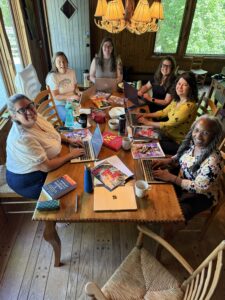
Ms. Magazine Writers in Residency for Feminist Scholars at the Women’s Environmental Institute (Stacy Keltner)
This past summer’s workshop resulted in two of us getting published in Ms. Here are the links:
‘Los Angeles Is for Everyone,’ ‘Pay Us What You Owe Us’: The Long History of Women Athletes Leading the Resistance – Ms. Magazine by Liz Wilkinson
Sleep Is a Feminist Issue: Why Women’s Rest Is Political – Ms. Magazine by Roxanne Prichard
Finally, we are already deep into our planning for March Women’s History Month! Last year we leaned into “The Power of Storytelling” with our fierce feminist speakers from The Moth. This year, we will take storytelling a step further… We are so excited for what’s brewing! Look for a big announcement coming soon, and be ready to connect with us, to create relationships with each other, and to join in some feminist re-worlding together.
Feminism is for everybody! (thank you, bell hooks!)
Pop Culture
Feminist Spooky Book Recommendations
By E.N.
These are my recommendations for a spooky feminist fall read, genre by genre. Every book on this list is written by a woman and addresses feminist issues in provocative and haunting measure.
Tender is the Flesh, by Agustina Bazterrica
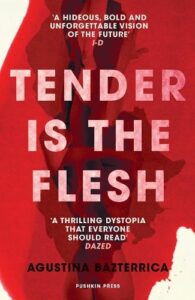
Tender is the Flesh by Agustina Bazterrica
Genre: Horror
Themes: Bodily autonomy, dehumanization, free will, the cattle industry, propaganda, poverty
Intern Rating: 5/5 Stars
Summary: “Working at the local processing plant, Marcos is in the business of slaughtering humans—though no one calls them that anymore.
His wife has left him, his father is sinking into dementia, and Marcos tries not to think too hard about how he makes a living. After all, it happened so quickly. First, it was reported that an infectious virus has made all animal meat poisonous to humans. Then governments initiated the “Transition.” Now, eating human meat—“special meat”—is legal. Marcos tries to stick to numbers, consignments, and processing.
Then one day he’s given a gift: a live specimen of the finest quality. Though he’s aware that any form of personal contact is forbidden on pain of death, little by little he starts to treat her like a human being. And soon, he becomes tortured by what has been lost—and what might still be saved.”
Review: This book is a chilling account of what happens not when we choose evil, but when we fail to choose good. I recommend this book to fans of The Handmaid’s Tale and those with very strong stomachs. This book holds an uncomfortable mirror to contemporary society and the passivity we adopt to enjoy the comforts of everyday life.
How to be Eaten, by Maria Adelmann
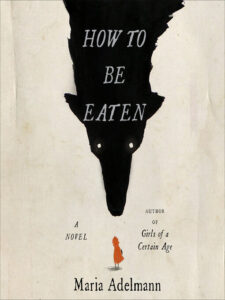
How to be Eaten by Maria Adelmann
Genre: Psychological fiction, fairytale retelling
Themes: Contemporary feminism, media ethics, cancel culture
Intern Rating: 5/5 Stars
Summary: “In present-day New York City, five women meet in a basement support group to process their traumas. Bernice grapples with the fallout of dating a psychopathic, blue-bearded billionaire. Ruby, once devoured by a wolf, now wears him as a coat. Gretel questions her memory of being held captive in a house made of candy. Ashlee, the winner of a Bachelor-esque dating show, wonders if she really got her promised fairy tale ending. And Raina’s love story will shock them all.
Though the women start out wary of one another, judging each other’s stories, gradually they begin to realize that they may have more in common than they supposed . . . What really brought them here? What secrets will they reveal? And is it too late for them to rescue each other?
Dark, edgy, and wickedly funny, this debut for readers of Carmen Maria Machado, Kristen Arnett, and Kelly Link takes our coziest, most beloved childhood stories, exposes them as anti-feminist nightmares, and transforms them into a new kind of myth for grown-up women.”
Review: Each girl in this book is a case study in how the media and society treats women, from the reality TV star to a victim of grooming. By linking beloved fairytales to modern archetypes, Adelmann unites a story both nostalgic and reflective of contemporary society. I recommend this book to Disney adults, fans of The Office, and anyone who followed the #MeToo Movement.
Notes on an Execution, by Danya Kukafka
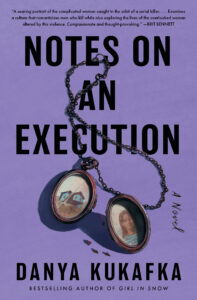
Notes on an Execution by Danya Kufafka
Genre: Psychological thriller, crime
Themes: Women as victims of true crime
Intern Rating: 4/5 Stars
Summary: “Ansel Packer is scheduled to die in twelve hours. He knows what he’s done, and now awaits execution, the same chilling fate he forced on those girls, years ago. But Ansel doesn’t want to die; he wants to be celebrated, understood. He hoped it wouldn’t end like this, not for him.
Through a kaleidoscope of women—a mother, a sister, a homicide detective—we learn the story of Ansel’s life. We meet his mother, Lavender, a seventeen-year-old girl pushed to desperation; Hazel, twin sister to Ansel’s wife, inseparable since birth, forced to watch helplessly as her sister’s relationship threatens to devour them all; and finally, Saffy, the homicide detective hot on his trail, who has devoted herself to bringing bad men to justice but struggles to see her own life clearly. As the clock ticks down, these three women sift through the choices that culminate in tragedy, exploring the rippling fissures that such destruction inevitably leaves in its wake.
Blending breathtaking suspense with astonishing empathy, Notes on an Execution presents a chilling portrait of womanhood as it simultaneously unravels the familiar narrative of the American serial killer, interrogating our system of justice and our cultural obsession with crime stories, asking readers to consider the false promise of looking for meaning in the psyches of violent men.”
Review: This book is a sharply critical analysis of how even the murders of women often centers male perpetrators. At no point does this book adopt the sentiment that men who murder are misunderstood. Rather, it delves into the psychology of a murder through the eyes of the women it touches. I recommend this book to those who love true crime, but especially to those who feel uncomfortable with the true crime industry.
Manhunt, by Gretchen Felker-Martin
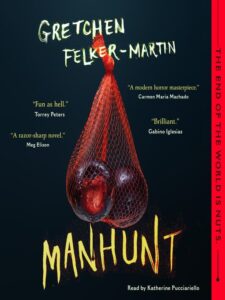
Manhunt by Gretchen Felker-Martin
Genre: Dystopian, horror
Themes: Trans rights and identity, intersectionality, the body, zombies
Intern Rating: 5/5
Summary: “Beth and Fran spend their days traveling the ravaged New England coast, hunting feral men and harvesting their organs in a gruesome effort to ensure they’ll never face the same fate.
Robbie lives by his gun and one hard-learned motto: other people aren’t safe.
After a brutal accident entwines the three of them, this found family of survivors must navigate murderous TERFs, a sociopathic billionaire bunker brat, and awkward relationship dynamics―all while outrunning packs of feral men, and their own demons.”
Review: Manhunt is both witty and heartbreaking. It is a clever twist on the classic zombie apocalypse book, featuring a virus that only affects men and two trans main characters. It addresses not just the violence perpetuated against women by men, but the violence we perpetuate against one another. I recommend this book to those who understand that everyone in Mean Girls was a mean girl, and anyone who doubts that trans and queer women are really women.
Frankenstein, by Mary Shelley
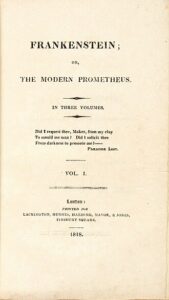
Title page of Frankenstein Vol. I, first edition, 1818
Genre: Classic
Themes: Human nature, companionship, social responsibility, the pursuit of truth
Intern Rating: 3/5 Stars
Review: Brush up on the classic just in time for Guillermo del Toro’s cinematic release of Frankenstein! Whether this is your first impression or a reread of the book that launched the horror genre, viewing Frankenstein’s monster through a feminist lens will give you new insights to how women are viewed by society.
The Evolution of Girl Power: From Madonna to Chappell Roan
By E.V.
Pop music has always been more than catchy hooks and glittery outfits, it’s been a mirror reflecting women’s voices, desires, and defiance. Across the decades, pop artists have redefined what it means to be a woman in control, in love, and in the spotlight. From Madonna’s unapologetic self-expression in the ‘80s to Chappell Roan’s campy rebellion today, “girl pop” has become a language of empowerment that evolves with each generation’s idea of feminism.
Madonna: The Blueprint of Feminist Rebellion (1980s–1990s)
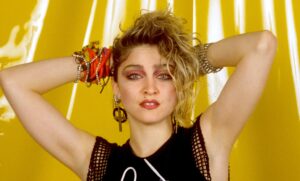
Fryderyk Gabowicz /picture alliance via Getty Images
When Madonna burst onto the scene in the early ‘80s, the music industry wasn’t ready for her kind of woman. She wasn’t just performing; she was provoking. Songs like “Express Yourself” and “Like a Prayer” didn’t just push pop boundaries; they pushed cultural ones. Madonna used her sexuality not as something to be exploited, but as something she owned.
She blurred the line between sacred and profane, masculine, and feminine. In a time when women were told to choose one role, Madonna chose all of them and made it art. Her message was clear: empowerment means defining yourself, even when the world tells you not to.
The Spice Girls: Mainstreaming Girl Power (1990s–2000s)
If Madonna gave women permission to be bold, The Spice Girls gave a generation the slogan to do it: “Girl Power.”
Emerging in the late ‘90s, the British group turned feminism into a global pop phenomenon. Their message wasn’t wrapped in academic theory. It was wrapped in platform shoes and catchy choruses. Songs like “Wannabe” and “Spice Up Your Life” celebrated female friendship, independence, and self-worth in a way that was both playful and profound.

Tim Roney/Getty Images
While critics sometimes dismissed “girl power” as commercialized feminism, The Spice Girls made empowerment accessible. For many young fans, they were the first introduction to the idea that girls could be loud, diverse, and supportive, not in competition, but in community.
Olivia Rodrigo: Vulnerability as Power (2020s)
Fast-forward to today, and we find a new kind of feminist voice in Olivia Rodrigo. Her debut album SOUR isn’t about overt rebellion, but about emotional honesty. Olivia writes about heartbreak, anger, jealousy, and self-doubt, all while rejecting the idea that girls should be “cool” or “put together.”

Christopher Polk
In songs like “good 4 u” and “get him back!”, she channels rage and revenge, not to please anyone, but to process her emotions publicly and authentically. Her feminism is rooted in vulnerability as strength. Olivia’s openness about mental health, relationships, and self-discovery reflects Gen Z’s broader feminist movement, one that values emotional intelligence just as much as independence.
Chappell Roan: Camp, Queerness, and Radical Self-Expression (Now)
Enter Chappell Roan, the neon queen of pop’s newest wave. With theatrical performances, over-the-top visuals, and unapologetically queer lyrics, Chappell has redefined what “girl pop” can be.

Steve Jennings / Getty
Her songs like “HOT TO GO!” and “Femininomenon” embrace femininity as performance art, a celebration of being loud, dramatic, and too much. In a culture that often tells women to tone it down, Chappell’s art says the opposite: dial it all the way up.
She represents a feminism that’s intersectional and inclusive, embracing queerness, body autonomy, and creative freedom. Where Madonna fought for the right to own her body, and The Spice Girls championed sisterhood, Chappell fights for the right to exist as your truest, weirdest self.
From Madonna to Chappell: What Girl Pop Says About Feminism Today
Each generation’s “girl pop” reflects the feminist battles of its time:
- Madonna fought to own her image and sexuality.
- The Spice Girls fought to make empowerment fun and mainstream.
- Olivia Rodrigo fights to make vulnerability valid and visible.
- Chappell Roan fights to make authenticity and queerness central to pop culture.
Together, they show that feminism in pop isn’t static, it’s alive, ever-changing, and shaped by the voices who dare to sing loudest.
Girl Pop Isn’t Just About Catchy Songs
From “Express Yourself” to “HOT TO GO!”, these artists prove that feminism can wear lipstick, cry over heartbreak, dance in glitter boots, and still demand equality. And that’s the beauty of it: girl power keeps evolving, just like the women who sing it.
Personal Reflections
A Story of Self-Empowerment Through Public Speaking
By R.H.
When I was in my early teens, I was as awkward as anyone else, if not even more so. I walked around my high school every day, trying to avoid the eyes of everyone, and staying as quiet as possible. On the whole, I wanted to avoid being noticed by anyone. What could I, someone who struggled with confidence in her body, who was of average intelligence, and who brought nothing particularly interesting to the table, have to offer anyone?
Near the end of my freshman year, I reluctantly joined my school’s forensics team, after pleas from a teacher who was struggling to recruit enough members to fill a roster. I ended up competing several times that year, and even more frequently throughout my sophomore year. In doing this, I began to become more confident. My category of choice was extemporaneous speaking—in every round, I was given a new prompt, usually related to politics, and gave a seven-or-so minute impromptu speech on the prompt. With my participation in extemp (as the cool kids called it), I began to realize a few things about myself. I began to recognize that I was smart. I knew a good amount about politics and could quickly formulate an answer to my given prompt as well as deliver this answer verbally. Before and throughout my recognition of these, my self-esteem began to expand. I realized that I was talented, could work under pressure, and that I did bring valuable opinions to the table.
Public speaking is usually something that is feared or at least generally disliked by most members of the population. However, I have found it empowering in my journey from high school to college, and throughout my time at St. Thomas. Having the ability to express one’s opinions, in general situations as well as in a competitive setting, is freeing and can build confidence in anyone who participates in the activity. Everyone, especially women in this day and age, deserves to have a seat at the table in political discussions, and deserves to feel as though their opinion is valuable. There is nothing more feminist than the assured inclusion of voices and opinions from all backgrounds, experiences, and identities. Sometimes, someone just needs a little push to participate in confidence-building activities such as forensics, as I did.
If you are interested in building self-confidence through public speaking skills, feel free to reach out to University of St. Thomas Speech and Debate Club through the information provided on their TommieLink page.
Women in History
Belle da Costa Greene and Queen Yodit of Ethiopia
Belle da Costa Greene
By J.K.
Belle da Costa Greene, born Belle Marion Greener, is famously known as J.P. Morgan’s personal librarian. The Pierpont Morgan Library started construction in 1902, and Belle da Costa Greene was hired in 1905. Belle grew up in a prominent Black family; however, after her father left, Belle’s mother moved them to New York, where they began to pass as white.
During this time, there were fewer career opportunities for women, especially for Black women. Due to these social restrictions, Belle was unique in her position. She worked for the Morgan family in their library until her retirement. After J.P. Morgan’s death, Belle convinced his son, and heir, to open the previously private library public.
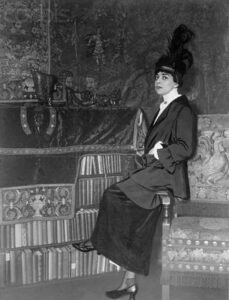
Belle da Costa Greene (Bettmann / Getty)
Not much information is known about Belle da Costa Greene. It was not until 1999, when an article was written about her in The New Yorker, that it was discovered that she was not white. The information discovered about her has been pieced together from her correspondence, newspaper coverage, and other professional paperwork. All personal paperwork was destroyed by Belle before her death.
The novel, The Personal Librarian, is a historical fiction novel about Belle da Costa Greene and her time working in the Pierpont Morgan Library. Although many of the interactions are exaggerated in the book, the storyline is based on what is known of Belle’s life.
References
“Belle Da Costa Greene, the Morgan’s First Librarian and Director.” Belle Da Costa Greene, the Morgan’s First Librarian and Director | The Morgan Library & Museum, www.themorgan.org/belle-greene.
Benedict, Marie, and Victoria Christopher Murray. The Personal Librarian. Berkley, 2022.
Colclough, Joanna. “Belle de Costa Greene: Library Director, Advocate, and Rare Books Expert.: Headlines & Heroes.” The Library of Congress, 8 Feb. 2022, blogs.loc.gov/headlinesandheroes/2022/02/belle-de-costa-greene/.
Queen Yodit of Ethiopia
By L.G.
Queen Yodit, also known as Gudit or Judith, was a warrior queen who ruled Ethiopia in the 10th century CE and is remembered as one of the most influential figures in the nation’s early history.
Emerging during the Aksumite Empire, Yodit led a rebellion that overthrew the Aksumite dynasty, ending Christian rule and ushering in a new political era. Chronicles describe her as a brilliant military strategist and ruthless conqueror who burned churches, destroyed monuments, and seized the throne, ruling for approximately forty years. Because of her actions, many Christian sources depict her as a destroyer driven by vengeance.
According to some versions, Yodit was raised in the Aksumite court, possibly as a noblewoman or captive, but was humiliated, exiled, or wronged by the king. In contrast, non-Christian traditions view her as a liberator who challenged a corrupt monarchy. Her name, “Gudit,” derived from the Amharic and Ge’ez words for “fire” or “destruction,” symbolizes her power and the dramatic transformation she brought to Ethiopia.
Upcoming Fall Events
Ongoing at the LDCW
CAPS Platonic Book Circle with Dr. GiGi Giordano
November 13 and December 4, 5:00 to 6:30 p.m.
Care and Connection Series
November 20 and December 11, 5:00 to 7:00 p.m.
Community Coffee Hour
Tuesdays, 12:00 to 1:00 p.m.
Feminist Community Karaoke
November 30, 6:00 to 8:00 p.m.
Feminist Community Meetings
Thursdays, 12:00 to 1:00 p.m.
Feminist Community Movie Night
November 9 and December 14, 6:00 to 8:00 p.m.
Fiber Arts Hour
November 17 and December 15, 12:00 to 1:00 p.m.
Power Hours: Protected Writing Hours for Faculty and Staff
Tuesdays, 8:00 to 10:00 a.m. and 1:00 to 3:00 p.m.
WGSS Feminist Forums: Feminists at Work in the World
December 5, 3:15 to 4:30 p.m.
Special Events
LACS Movie Night
November 6, 6:00 to 7:30 p.m.
OPUS College of Business: Queer in Business Panel
November 12, 12:00 to 1:00 p.m. (MCH 100)
Sustainability Sips
November 18, 12:00 to 1:00 p.m.
SDIS Purple Couch Event with Giiwedin
November 21, 3:00 to 4:00 p.m. (Location TBD)

No Comments