Many Voices
A newsletter/blog from the Luann Dummer Center for Women
Table of Contents
Note from Dr. Liz Wilkinson, Director
2026 Women’s History Month Speaker Series: Intern Takeaways
2025 Fellowship Grant Recipient Reflections
Changing The Game: How Female Athletes Are Closing the Wage Gap
Investigating Lifestyle and Environmental Factors that Impact Preeclampsia, A High-Risk
Pregnancy Condition
Dress to Impress: A Study on Perceptions of Professional Appearance
Intern Project Highlights
Threads, Bodies, and Breaking Normality: My Dive into Karen Searle’s “Wire Woman”
Looking Ahead to the Minnesota Aurora FC 2026 Season
History of Take Back the Night
Upcoming Spring Events at the LDCW
Note from Dr. Liz Wilkinson, Director
It’s hard to believe we are already in the middle of April, and the end of the semester and graduation are just over a month away! Five of our LDCW interns will be launching into the work world and, for one, law school! Where does the time go…
But, of course, we’ve all had a tumultuous J-Term and Spring semester, supporting students and supporting each other as we were (and still are) forced to navigate the I.C.E. invasion in the Twin Cities. In January, a number of activist scholars met to learn from Ms. magazine writer/editor Stacy Keltner about how to use our research to write advocacy journalism for public audiences. As January rolled into February, interns helped with our Spring Kickoff, hosted Care & Connection meetings and Fem Com gatherings, and provided support for WGSS Feminist Forums. We continue providing clothing and shoes via our Gender Affirming Tommies’ Closet, and we created a free food drop-off and pick-up site, first just to get students through January and now simply available for anyone.
Our biggest night, of course, was our Women’s History Month event on March 5, Ms. Magazine to Teen Vogue: Essential Feminist Journalism. We hosted Elaine Welteroth (former Editor-in-Chief of Teen Vogue) and Dr. Janell Hobson (writer and editor for Ms. magazine) in a conversation moderated by Nina Moini (MPR host of Minnesota Now). The audience included students from ThreeSixty Journalism, the Selim Center for life-long learners, and our own UST faculty, staff, students, alumni, and community. If you made it out to the event – thank you for coming! As you know, the three women on the stage gave us so much about their own journeys and about our collective agency. The core of the conversation conveyed the necessity of feminist advocacy journalism and provided us with confidence in our own abilities and hope for a more just future. After the discussion, audience members used the long book signing lines (Welteroth’s More than Enough and Hobson’s When God Lost Her Tongue) to continue the conversation long past our predicted 8:30 p.m. end time. Both Ms. and our local Women’s Press covered the event. While the night itself was impactful and important, what I find even better is the continuing engagement and activism. Check out Welteroth’s advocacy for BirthFund and Hobson’s fantastic resource Founding Feminists.
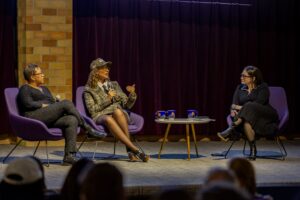
Janell Hobson, Elaine Welteroth and Nina Moini. Photo by S.B.
Who would you like for our Women’s History Month event in March 2027? Let us know via email (wilk9056@stthomas.edu)! I’ll have (at least) one more year at the helm, so please get in touch if you want to connect about what we at the LDCW can do to support and promote the rights of women, queer, and feminist individuals and communities.
2026 Women’s History Month Speaker Series: Intern Takeaways
S.B.
These days, a lot of us deal with feelings of pressure, suffocation, and helplessness; trying to get our word out, our voices heard, and making a difference in the world we live in. And the world demands that. Our younger generation, our future generation, our minorities, and the political state we live in demands that. Life demands that. Humans need stories to live; fictional ones bring us excitement and joy, and real ones keep us informed of the world around us. The world that still needs a lot of work. We have done a lot, but there is plenty more to be done.
Many wonder if journalism is dead or not, if in a digital and somewhat robotic world, it is still worth it to study in fields of communications, journalism, or creative writing. Many students grapple with that question these days. To that, I dare to say yes. Listening to Elaine Welteroth and Dr. Janell Hobson, I’ve realized journalism is our tool to change narratives. To give voice to the unheard. Where people of the same mind come together and movements are made. In a world where human touch with reality is rapidly decreasing and fears of Artificial Intelligence rise, we need real truth seekers and bold speakers.
It is essential, now more than ever, to distinguish right from wrong. To bring out what is real and what matters and give it light in a cloud of fake news that circles around these days. It is essential, now more than ever, to advocate, to have critical and open-minded conversations and share schools of thought, and to guard ourselves against the recent pushbacks against women’s rights and other basic human rights that we see happening these days. So, use your tools, pick up that pen, start typing, the world is waiting to hear what you have to say. You just have to say it. Say it and you will find people who will say it with you. We just have to get out there and find each other in our words.
L.R.
Listening to these three powerful individuals speak openly about their struggles, and the strength they found on the other side, had a much deeper impact on me than I expected. Hearing them describe moments of uncertainty, fear, and doubt, yet still choosing to push forward, shifted the way I think about my own future. Lately, I’ve felt a lot of anxiety about what lies ahead, especially under this current administration, and I’ve caught myself imagining the worst-case scenarios. But their stories reminded me that difficult periods aren’t permanent, and that resilience is something we build by moving through challenges, not by avoiding them.
What stood out to me the most was the way each of them framed adversity as a turning point rather than an ending. That perspective helped me realize that I don’t need to have everything figured out right now. I just need to keep going. By the time the event ended, I felt lighter, more grounded, and genuinely hopeful.
2025 Fellowship Grant Recipient Reflections
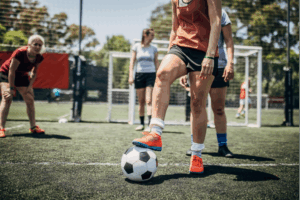
Changing The Game: How Female Athletes Are Closing the Wage Gap
Emma Brobakke
The summer of 2025, I was able to complete independent research on the gender wage gap, thanks to the Luann Dummer Center for Women research grant.
Studying economics with a concentration in public policy, I have been lucky to read the research of contemporary economists who have identified the structural aspects of the gap. One cannot understand bias or injustice if one does not understand the true causes. Labor force participation, education level, experience, access to contraceptives and civil liberty are all factors with proven explanatory power. Still, a big part of the gap is left unexplained even when controlling for reasons contributing to wage differentials in traditional economic theory. The most probable explanation left is bias. Bias is hard to quantify. In addition, it is easily dismissed at the individual level. I believe it to be structural, normative and institutional. I tried measuring it using women’s sports.
Using econometrics, I was able to isolate the effect of female sports participation, holding other variables known to affect the gap constant (including labor force participation, education level and access to contraceptives). Data was limited, and I spent two months building panel-data surveying a set of uniform variables across 17 countries over a span of 24 years (6 Olympic cycles). I used the percentage of women in Olympic delegations as an instrumental variable for overall sports participation. The rationale being that a pipeline would require increased activity on the local level to sustain increased activity on the national level. I used regression to build an inverse random effects model.
I find that female athletic participation has a clear and significant effect on decreasing the gender wage gap. Across all levels of participation across all countries and time periods, an increase of 1% was projected to results in significant reductions of the gender wage gap.
Sports require effort, passion, determination and competitive spirit. These qualities are celebrated beyond the court, field or pitch, as traits of strength, leadership and success. Girls and women portraying these qualities served as a visual contrast to discriminatory gender norms. Women have been restricted from entering this space, despite being eager and willing. Female athletes have historically contributed to the fight for universal suffrage, for labor rights, and gay rights, as well as overall gender equality. The findings presented in this paper illustrate that female sports participation breaks down existing norms of gender affecting marginal productivity.
Without the generous funding from the LDCW, I would never have been able to pursue the project. The months of data-collection – thinking, teaching myself software, failing and trying again – was an incredible learning experience. The lessons will make me a better economist in the future and helped me grow as a feminist.
Investigating Lifestyle and Environmental Factors that Impact Preeclampsia, A High-Risk Pregnancy Condition
Drs. Kathleen Miller and Funmi Knutson
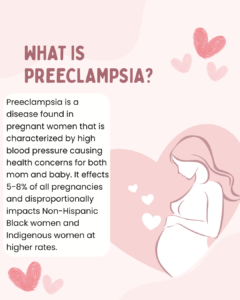
We began this project with the goal of developing an interdisciplinary research approach that integrates epidemiology and integrative physiology to better understand environmental and lifestyle contributors to preeclampsia. Preeclampsia is a pregnancy complication characterized by new-onset hypertension and is associated with significant risks for both maternal and infant health. It also disproportionately affects minority populations in the United States, making it an important area for equity-focused research.
Our initial plan was to use federally available datasets on perinatal and women’s health, such as the CDC’s Pregnancy Risk Assessment Monitoring System (PRAMS) and other national cohort data, to examine these relationships quantitatively. We also proposed conducting a literature review and developing a causal diagram to guide future analyses. However, over the course of the project, access to several key data sources became uncertain or unavailable due to broader changes in data accessibility with federal priority changes, which required us to shift our approach.
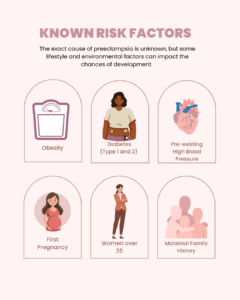
In response, we focused on strengthening the conceptual foundation of the project. We conducted a targeted literature review to identify key environmental and lifestyle risk factors associated with preeclampsia. In parallel, we worked with undergraduate students interested in women’s health, mentoring them in epidemiologic study design, scientific research methods, causal diagrams, and physiological mechanisms underlying preeclampsia.
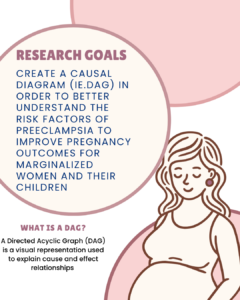
Although our original data analysis plan was not feasible within the project timeline due to changes in the accessibility of the datasets, the LDCW fellowship allowed us to build a strong interdisciplinary framework and enabled us to work collaboratively with undergraduate students. Based on this work, we hope to identify alternative data sources, including exploring opportunities to access data at more local or regional levels.
Dress to Impress: A Study on Perceptions of Professional Appearance
Rose Hissom
My research project, entitled Dress to Impress: A Study on Perceptions of Professional Appearance, has been nothing if not eye-opening. I am currently making steady progress on my interview-based research project. Over the past few months, I have been seeking meetings with individuals across UST’s campus and gathering their thoughts on professional dress and appearance standards across a variety of industries. This research will eventually culminate in a podcast composed of portions of these interviews as well as a written research report summarizing my findings, both of which will be publicly available at the Luann Dummer Center for Women.
Through this project and with the support of the LDCW, I have been able to collect a large amount of quality data on individuals’ opinions of what constitutes professional dress and why. These data will serve the goal of my final product well—they will be able to inform the public and assist current students in making clothing decisions that will be advantageous to their career goals. This project has also enabled me to make connections and establish friendships with people across UST’s campus who I probably would not have interacted with outside of my research. I am very thankful for the funding and support the LDCW has provided me for this research and am excited to present my findings in May!
Intern Project Highlights
Threads, Bodies, and Breaking Normality: My Dive into Karen Searle’s Wire Woman
E.V.
I used to think that knitting was an “old person” activity while I watched PBS Kids on the television. Karen Searle would very respectfully prove me wrong now that I am in college and 21 years old.
Karen Searle is a Minnesota-based fiber artist who uses traditionally domestic techniques such as knitting, stitching, and weaving to make bold art that talks back. Her pieces don’t just sit quietly on a shelf like a can of seasoning in the kitchen, but rather chooses to bulge, twist, and intertwine uncomfortably… but in a good way, I promise! I wanted to share my take of Karen Searle’s Wire Woman, a piece currently showcased at the Luann Dummer Center for Women at the University of St. Thomas.
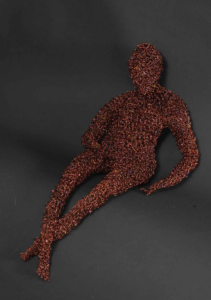
Wire Woman by Karen Searle, LDCW Art Collection
What I find most interesting about this work of art is its intricacy and how Searle was able to weave copper threads and beads to create a shell of a woman. Searle describes the body as a “container,” something that holds memory, experience, and identity. That resonated with me heavily as a young woman who has struggled with societal norms and beauty standards. It’s amazing how Searle can weave together these materials to create a body, not from canvas and paint, but from fibers, which I find to be amazing!
One of the attributes that stands out to me when I look at Wire Woman and Searle’s other art is how she’s able to portray softness as power. Fibers such as yarn, thread, and textiles, and the techniques of knitting and weaving are traditionally associated with domesticity. But in Searle’s hands, they become an even greater force of power. I also love how Searle represents bodies in her art, how they can be stretched and disproportional. To me, it addresses and contradicts societal beauty standards of the “perfect” woman image.
To me, Searle’s work says:
- The body is something not to fix but to understand.
- Traditionally domestic skills and techniques aren’t small, but foundational.
- There is strength in imperfection, softness, and vulnerability.
While I can recognize the softness in her work, there is also a tension that I can feel when I look at it. The materials may feel familiar and comforting, however the forms can be unsettling, making you pause. It definitely made me pause when I first saw Wire Woman. Searle’s work forces you as the viewer to reconsider things that you’ve been told or taught about bodies and the value of tradition.
Karen Searle’s art doesn’t just challenge artistic traditions, it also challenges social traditions. She repurposes materials to tell a story that is complex, twisting, and endearing.
I’ll never look at knitting the same way again, and truth be told, knitting is AWESOME and not a “old person” activity.
Looking Ahead to the Minnesota Aurora FC 2026 Season
E.N.
The Minnesota Aurora are gearing up for their 2026 season. They will be looking to defend their Heartland Division title for the fifth year in a row after winning the Central Conference and reaching the National Semifinal last year. Three new clubs will be joining the USL W League, Rally Madison, Edgewater Castle, and Rockford Raptors.
Aurora is also collaborating with the Minneapolis Institute of Art (Mia) and local artist Lindsay Nohl in 2026. The project brings art, sport, and community together to unveil the 2026 jersey, “Flora.” Flora embodies themes of community ownership, inclusivity, and creativity. Designed by Cassidy Sepnieski, the jersey uses layers of native plants and stars inspired by Minnesota’s night sky and the club’s original Constellation kit.
In addition to the collaboration with Mia, earlier this year Aurora released the Community Collection. Fifteen percent of the collection’s sales, as well as $5 from every Aurora season ticket will be donated to the Immigrant Law Center of Minnesota (ILCM). ILCM provides free immigration legal representation to immigrants and refugees across Minnesota and North Dakota.
Season and single game tickets are on sale now at mnaurora.com, starting at $17 with free admission for children ages 3 and under. They will kick off preseason May 9 against the Kansas City Current II at the University of Kansas Health System Training Center. The regular season and home opener will be played May 21 at TCO stadium against Rochester FC.
History of Take Back the Night
J.K.
Take Back the Night is a movement that originated in the 1970s to stand up against sexual assault culture after recurring instances of violence in Philadelphia, San Francisco, and Los Angeles. In 1976, following individual movements in various cities, a group of women from over forty countries met in Belgium to discuss and advocate for women’s safety. During the 1980’s, marches and rallies became common for colleges and universities in North America. Some other events included walks, vigils, speak-outs, and even concerts. These events have included artists, musicians, poets, and activists coming together for their shared mission. Take Back the Night Events continued to expand through the following decades, and in 2001, the Take Back the Night Foundation was established.
The mission of TBTN is to end all forms of sexual violence. This includes sexual assault, sexual abuse, trafficking, stalking, gender harassment, and relationship violence. They also work to support survivors and create safe communities.
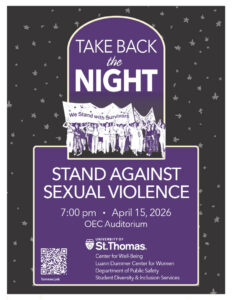
This year, the Center for Well-Being will be partnering with the Luann Dummer Center for Women to host Take Back the Night on Wednesday, April 15th, at 7 pm in the O’Shaughnessy Education Center Auditorium. There will be speakers, community organizations and resources, a march around the campus, and a speak-out to share experiences.
https://tommielink.stthomas.edu/event/12333641
https://takebackthenight.org/history
Upcoming Spring Events at the LDCW
Family and Expectations, hosted by the Center for Well-Being
April 20, 5:00 to 6:00 p.m.
April 21, 12:00 to 1:00 p.m.
Menstrual Product Student Advisory Committee Meeting
April 21, 6:00 to 7:00 p.m.
April 22, 3:00 to 4:00 p.m.
Got Worms? Vermicomposting Workshop
April 23, 12:00 to 1:00 p.m.
Film Screening of Can’t Stop Change: Queer Climate Stories from the Florida Frontlines
April 23, 6:00 to 7:00 p.m.
Gathering Space / Community Meal, hosted by the Center for Well-Being
April 27, May 4, and May 11, 5:00 to 6:00 p.m.
Fem Com TBD
April 30 and May 7, 12:00 to 1:00 p.m.
Women in the Workplace Panel with Jillian Hiscock and Ashley Adamma Meeks
May 6, 12:00 to 1:00 p.m. (TMH 252, Minneapolis campus)
WGSS Feminist Forum featuring Graduating WGSS Majors: JoLee Karnz and Rose Hissom
May 8, 3:15 to 4:30 p.m.
Period Product Grab Bags!
May 11, 12:00 to 1:00 p.m.