Riccardo Benotti, Desk Chief & Journalist, Italian Bishops’ Conference interviewed Fr. Daniel Griffith on January 27, 2026 regarding Griffith’s statement about the fatal shooting of Alex Pretti and recent events in the Twin Cities of Minneapolis and Saint Paul.
In your statement, you spoke of the “grief and trauma” affecting the entire Twin Cities community. How do you pastorally interpret the death of Alex Pretti in this climate of fear and dismay?
As a pastor, I have heard from a number of parishioners after Mass and via email and text messages that they are really struggling – they were struggling after the death of Renee Good and now even more after Alex Pretti’s death – it is overwhelming for folks in the Twin Cities. People feel helpless – they don’t know what they can do. We have provided opportunities for prayer, special Masses, frequent communications, and opportunities for dialogue. The challenge in the Twin Cities is that we have experienced so much grief in the last several months – the killing of the Hortman’s, the Catholic school shooting at Annunciation and now these two killings – all violent deaths. Catholics and others are feeling disoriented and experiencing collective trauma as a result of so much violence.
You noted that many immigrants are staying home, away from work, school, and church. What is your most urgent concern regarding their safety and their sense of belonging?
My urgent concern for our immigrant brothers and sisters is for their wellbeing and health. They have been here in our community for years contributing to the common good – the vast majority have been law abiding and constructive members of our community. Now they are isolated and in fear. I heard one credible story of a man who was at church and got in the trunk of the family car so he would not be spotted by ICE. It seems that many of the tactics that are being used are intentionally used to stoke fear and intimidation. Of course, this is contrary to Catholic social teaching which centers the dignity of every human being – this is an important criterion for judging the morality of law and policy. A country has a right to regulate its boarder but the key is whether this regulation is just. These folks – our brothers and sisters feel hunted. But in the darkness, there has been light. So many folks and many Catholics have mobilized to provide meals and other important necessities – this is the ministry of accompaniment in action and a true manifestation of solidarity.
The Basilica remained open for prayer and has dedicated a Mass to Pretti and to the city. What role can a faith community play today in fostering healing, trust, and mutual listening?
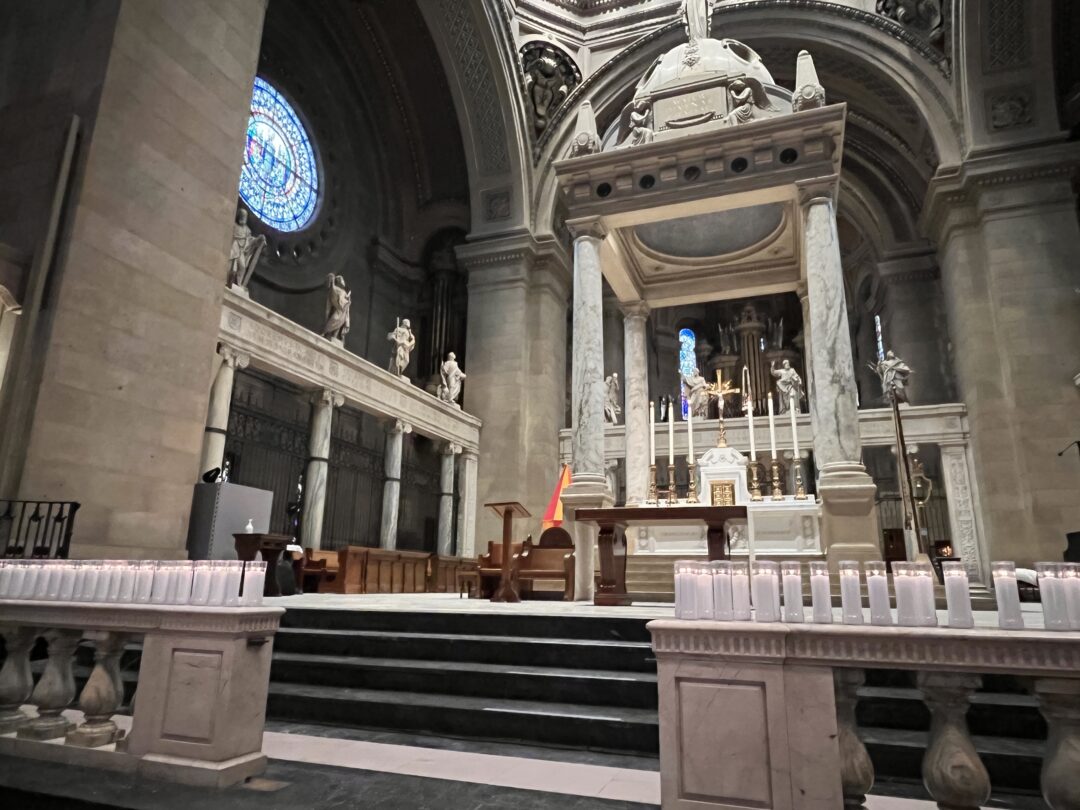
The evening Mass the day after Alex’s life was violently taken was well attended. We heard from so many people who were grateful, including non-Catholics who are rarely in a Catholic Church. They were invited to take home a candle as a symbol of their prayer for Alex, his family, and our community. We also hosted a special Mass for Peace and Justice after Renee Good was killed. This was also well attended. In my homily, I tried to name the harm which is multivalent. I do work in the area of restorative justice – its values and principles are more effectively employed in Europe than the U.S.. In restorative justice it is important to name the harm and then in time to seek to repair the harm in a way that restores right relationship. We are a ways from that happening in the Twin Cities but the first step is encouraging folks to name what they are feeling. After the shooting at Annunciation Catholic School, The Basilica of Saint Mary hosted a forum where a psychologist and I talked about the nature of trauma. After the teaching, we had healing circles where people could talk about what they were feeling. I have found as someone who is a practitioner of restorative justice and a teacher of Catholic social teaching that the two are synergistic – they have similar values, goals, and methodologies. So in summary, it is important to open the doors of our churches widely during these times to provide opportunities for prayer, fellowship, and dialogue.
In light of the contrasting accounts between videos, witnesses, and federal authorities, what responsibility do you believe the Church has in calling for truth, justice, and transparency?
I think the Catholic leaders can call for a just, rigorous, and transparent process and investigation. The Church teaches that due process is a natural right. These rushes to judgments are based in ideology and political posturing and are thus contrary to justice and the common good. Rather than the Church asserting its own teaching in this context, it can point to American rights of free speech, also in the case of Alex Pretti the right to carry a gun – I understand that much of Europe thinks that right may not be consistent with the common good – but this was his right under American law. Also, Church leaders can call for a just and due process and an impartial investigation and attendant accountability. Interestingly, Cardinal Tobin of Newark, NJ made headlines this week by calling on Catholics to contact their elected representatives to say no to funding ICE in the wake of what he described as lawless behavior.
You spoke of a future of “lasting justice and peace.” What concrete paths of dialogue and reconciliation do you envision the Basilica promoting in the coming days?
I think we need to come together as a community to talk about what lasting justice and peace look like and what steps are needed to get there or at least to begin the furtherance of these goals. There is much that Minnesota needs to do. Notwithstanding our reputation of “Minnesota Nice,” our state has some of the most acute racial disparities in the country – across multiple categories. This is called the “Minnesota Paradox” and was prominently noted when Geroge Floyd was killed in 2020. I have been proud that many Minnesotans have stood up for our immigrant brothers and sisters and have protested what I and they believe are unjust and inhumane immigration policies and tactics. But there is much work to be done. One thing that I can do as a pastor is to communicate to parishioners what Catholic social teaching envisions as lasting justice and peace – what are those social conditions that further the common good and what dimensions of our Minnesotan and American culture need to transformed, including through the light of the Gospel, so we can experience personal and collective flourishing. This is our task and will take all of us and God’s abiding grace to get there.